
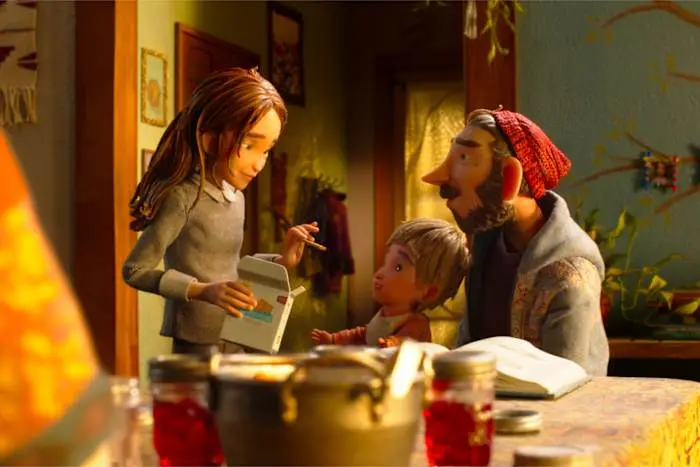

In an era dominated by instantaneous digital generation, hyper-optimized algorithms, and the looming horizon of artificial intelligence in cinema, Portland-based stop-motion studio Laika is swimming bravely against the cultural current. When the studio released the teaser trailer for its upcoming epic, Wildwood, it did not just generate standard industry metrics; it went viral, racking up over 90 million views on YouTube almost overnight.
For Travis Knight, Laika’s chief executive officer and the film’s director, the response was both humbling and entirely unexpected. Hardened industry veterans, typically immune to the standard promotional machinery of Hollywood, sent him emotional text messages praising the sheer scale, emotional resonance, and painstaking artistry of the footage. One viral user comment perfectly captured the public sentiment: "AI is the future. Laika: Hold my meticulously handcrafted stop-motion beer."
Set to premiere in theaters on October 23, Wildwood represents the culmination of a 16-year journey. Based on the 2011 fantasy novel by Colin Meloy (frontman of The Decemberists) and illustrated by Carson Ellis, the film is a deeply personal, dark fantasy set in the studio’s literal backyard of Portland, Oregon. At 139 minutes, Wildwood is uncommonly long for an animated feature, standing as a monumental testament to physical craftsmanship.
Behind the corporate backing of the Knight family wealth—provided by Nike co-founder Phil Knight—lies an artistic philosophy that views painstaking stop-motion animation not merely as an archaic method of filmmaking, but as a deliberate, poetic act of rebellion in a digitized world.
Detailed Chronology: A 16-Year Genesis
The story of Wildwood stretches back well over a decade, charting a careful trajectory of technological development, artistic maturation, and personal perseverance.
2003–2011: Origins and Acquisition
Laika was forged in 2003 when billionaire philanthropist and Nike co-founder Phil Knight acquired Vinton Studios, transitioning the commercial-and-animation house into a dedicated feature-film studio named after the pioneering Soviet space dog, Laika. Travis Knight, who began his career as a humble animator at the studio, quickly climbed the ranks. Long before Wildwood was even published as a novel, Knight acquired the intellectual property rights, recognizing an intrinsic synergy between Colin Meloy’s gothic Pacific Northwest folklore and Laika’s distinct cinematic sensibilities.
2011–2019: Building the Toolkit
Recognizing the massive scope of Meloy’s novel—which features sprawling magical forests, complex political factions of animals, and high-stakes supernatural conflict—Knight made the strategic decision to delay production. The studio needed to evolve. Over the next several years, Laika produced a string of critically acclaimed, artistically daring features: Henry Selick’s Coraline (2009), ParaNorman (2012), The Boxtrolls (2014), Kubo and the Two Strings (2016), and Missing Link (2019).
Each film served as a stepping stone. The studio developed hybrid techniques, marrying classical puppet fabrication with rapid prototyping via 3D printing, silicon molding, and advanced computer-generated visual effects. "I felt like we had to develop the tools, the tricks, and the technologies to actually do justice to this story," Knight reflects. "We built on all of our learnings from our earlier movies and stood on those shoulders. I felt like: OK, I think we’re ready to do it. And we were not."
2020–2026: Production and the Road to Release
Production on Wildwood pushed the boundaries of what stop-motion animation could achieve. Over a grueling, meticulous production schedule, the team constructed 136 distinct sets and brought 231 practical puppets to life.
Following distribution shifts—including Focus Features ending its multi-picture pact with Laika after Kubo and the Two Strings—the studio partnered with Fathom Entertainment for Wildwood. This distribution model follows the unprecedented box-office success of Laika’s 2024 theatrical re-release of Coraline, which raked in an astounding $52.4 million worldwide, proving that contemporary audiences retain a fierce, unquenchable appetite for tactile, soulful cinema.
Supporting Context & Metrics: The Anatomy of an Epic
To understand the sheer magnitude of Wildwood, one must examine the metrics of its production. Stop-motion animation is famously described by Knight as moving at the speed of "continental drift." It is an art form defined by physical constraints, human endurance, and astronomical time investments.
Production Scale and Statistics
- Runtime: 139 minutes—an extraordinary length for an animated feature, allowing for deep narrative complexity and world-building.
- Sets: 136 fully realized miniature environments, capturing the damp, mossy, gothic beauty of the Pacific Northwest.
- Puppets: 231 practical puppets created by hand, featuring intricate joint systems, custom-tailored costumes, and facial expression replacement mechanics.
- The General: One standout character—a majestic golden eagle known as The General—required approximately 3,000 hours of specialized design, sculpting, and fabrication work by Laika’s artisan team.
The Business of Rebellion
While British studio Aardman Animations continues to champion pastoral whimsy with properties like Wallace & Gromit and Shaun the Sheep, Laika operates in a starkly different psychological and tonal space. The studio embraces a darker, more surreal palette.
However, running a high-end stop-motion studio is notoriously precarious. Without the foundational financial backing of the Knight family, keeping hundreds of artists employed on a single project for over a decade would be economically impossible in modern Hollywood. Despite this corporate safety net, the artistic risk remains immense. Wildwood carries a PG-13 rating—a rarity for major animated releases—underscoring Knight’s refusal to water down the material into a "candy-colored confection."
Official Statements & Insights: Inside the Mind of Travis Knight
In an exclusive interview, Travis Knight opened up about the philosophy guiding Laika, the personal tragedies that shaped Wildwood, and the cultural necessity of making art by hand.
On the viral reaction to the teaser trailer and the emotional impact of physical craft, Knight noted:
"People that I worked with—hardened industry folks with wizened black husks of hearts—were sending me text messages: ‘Jesus Christ, your trailer just made me cry.’ The making of the art leaves fingerprints on the art. And I think people feel that."
Contrasting stop-motion with the rise of automated digital tools and artificial intelligence, Knight emphasized the spiritual weight of patience:
"These are great acts of care and devotion. In this modern era where everything is so rapid pace, where entire worlds can be generated with a click of a mouse, the idea of taking your time, and with great devotion and care coaxing life out of something, is very special. I like to call it a quiet act of rebellion."
Addressing the thematic darkness of the film—which deals heavily with grief following the loss of his older brother, Matthew, and subsequent family tragedies—Knight explained the necessity of emotional authenticity:
"When you devote this much of your life to something, you don’t want it to be some candy-colored confection, a bit of pop culture fun. You want it to be meaningful… You want the stories you tell to be about something. That often involves climbing into the darkened, cobwebbed corners of yourself and pulling those things out. I did lose my brother. He was too young. A handful of years ago, my wife lost her brother and her nephew. These things are seismic in families. So the movie does wander… through the corridors of grief."
Finally, reflecting on the absurdity and beauty of the medium, Knight offered a vivid description of the animator’s daily reality:
"You build thousands of tiny things. You put them under lights. You move them microscopic distances. You take a picture. And then you repeat that process over and over and over again until you finish the movie or society collapses."
Future Outlook: The Resurgence of Tactile Cinema
As Wildwood prepares for its October 23 theatrical release, its trajectory will likely serve as a bellwether for the animation industry at large. The resounding success of the Coraline re-release demonstrated that audiences are experiencing collective fatigue from slick, frictionless, computer-generated outputs that increasingly rely on algorithmic optimization.
Laika’s gamble is that humanity values human effort. By anchoring Wildwood in tangible materials—silicon, wool, resin, wire, and paint—the studio is betting that viewers can inherently sense the human touch embedded in every frame.
Looking beyond Wildwood, Laika is continuing to expand its slate, proving that its unique brand of dark, sophisticated fantasy has a permanent place in contemporary culture. Whether the industry follows Laika’s lead or continues to chase the siren song of fully automated digital content, one thing is certain: Travis Knight and his army of artisans have proven that slow, deliberate, handcrafted art is not dead. It is simply waiting in the woods, breathing new life into the silver screen one microscopic frame at a time.

0 Comments