

Executive Overview
Through just two weeks of the college football season, the Florida State Seminoles find themselves staring down an alarming reality. Sitting at 1-1 overall and 0-1 in Atlantic Coast Conference play, FSU’s much-needed bye week has arrived at the absolute eleventh hour. The narrative surrounding Tallahassee has shifted dramatically from optimistic championship aspirations to a frantic damage-control mission.
After opening the campaign with a listless, uninspired victory over New Mexico State in Week 0, the Seminoles followed it up with a deeply concerning performance on Labor Day against SMU. Despite winning the turnover battle by a staggering 4-0 margin, FSU was systematically outplayed, looking every bit the part of a struggling program rather than an ACC contender. Head coach Mike Norvell’s seat is beginning to feel the heat as mounting red flags flash across every single unit on the roster.
Unfortunately for a team desperate to catch its breath, the schedule offers no respite. Emerging from the bye week, the Seminoles will pack their bags for Tuscaloosa to face a vengeful, 12th-ranked Alabama Crimson Tide squad eager to erase the memory of last year’s stunning upset in Tallahassee. With a daunting strength of schedule looming and advanced metrics painting a grim picture, the crisis in Tallahassee runs deep. To understand how a program that captured the ACC crown just three seasons ago reached this precipice, one must examine the cascading failures across the offense, defense, and the broader institutional landscape.
Detailed Chronology: How the Seminoles Unraveled
To fully grasp the current turbulence in Tallahassee, one must trace the step-by-step unraveling of the team’s opening fortnight. The warning signs were unmistakable long before the clock ran out on their Labor Day collapse.
Week 0: The Lethargic Prelude
The curtain-raiser against New Mexico State was supposed to be a polished exhibition, an opportunity for a revamped roster to showcase its offseason labor under the Florida sun. Instead, what unfolded inside Doak Campbell Stadium was a sluggish, disjointed affair. While the Seminoles secured the victory, the execution lacked the sharpness and identity characteristic of an elite program. Missed assignments, a stagnant offensive rhythm, and uninspired body language plagued the team from the opening kickoff. Rather than establishing dominance, FSU sleepwalked through portions of the contest, masking systemic issues that astute observers recognized would be severely punished by higher-caliber competition.
Week 1 & Labor Day: The SMU Reality Check
If Week 0 was a warning, the Labor Day matchup against SMU was a five-alarm fire. The Mustangs exposed every vulnerability in the Seminoles’ armor. Most bafflingly, Florida State managed to squander an extraordinary defensive gift: a 4-0 turnover margin. In typical football logic, forcing four turnovers translates to a comfortable victory. Yet, FSU’s offense was so toothless and its defense so consistently gashed that the turnover margin proved entirely irrelevant.
When the final whistle blew, the scoreboard confirmed what everyone in the stadium had witnessed: the Seminoles were thoroughly outclassed. The aftermath brought forth sobering reflections, highlighted by head coach Mike Norvell’s candid assessment with local media.
“Just another close game,” Norvell told reporters on Monday following the defeat. “A lot of one plays, and you think back through it, some of the explosive plays that we had, that we gave up defensively, some missed opportunities there offensively.”
Those "missed opportunities" have become the defining theme of the early Norvell era in 2025—a cascading series of self-inflicted wounds that a depleted roster and a regressing coaching staff have proven incapable of overcoming.
Supporting Context & Metrics: The Anatomy of a Collapse
While subjective observations tell a story of decline, the hard data confirms it. Three specific metrics from the opening two weeks encapsulate the systemic failures plaguing the Florida State program.
1. The Disappearance of Duce Robinson (Stat: 5)
Through the first two games of the season, star wide receiver Duce Robinson has hauled in just 5 receptions. To put that pedestrian production into proper perspective, running back Sam Singleton Jr. has reeled in six catches out of the backfield over the same span.
The Seminoles have utterly failed to integrate their most explosive offensive weapon into the game plan. This failure culminated in one of the most critical sequences against SMU, when Robinson dropped a crucial, contested catch in the end zone—a play that could have altered the game’s trajectory. Robinson’s microscopic stat sheet serves as a glaring microcosm of a passing offense that is practically non-existent.
According to advanced analytics portal gameonpaper.com, FSU generated a meager 0.14 Expected Points Added (EPA) per dropback against SMU, while the Mustangs carved them up to the tune of 0.65 EPA per dropback. Furthermore, the Seminoles averaged just 4.73 yards per dropback, landing them in the 23rd percentile nationally.
This anemic output is not solely on the pass-catchers. It is an indictment of an entire offensive ecosystem: a coaching staff failing to scheme players open, a glaringly below-average offensive line, and deeply disappointing quarterback play.
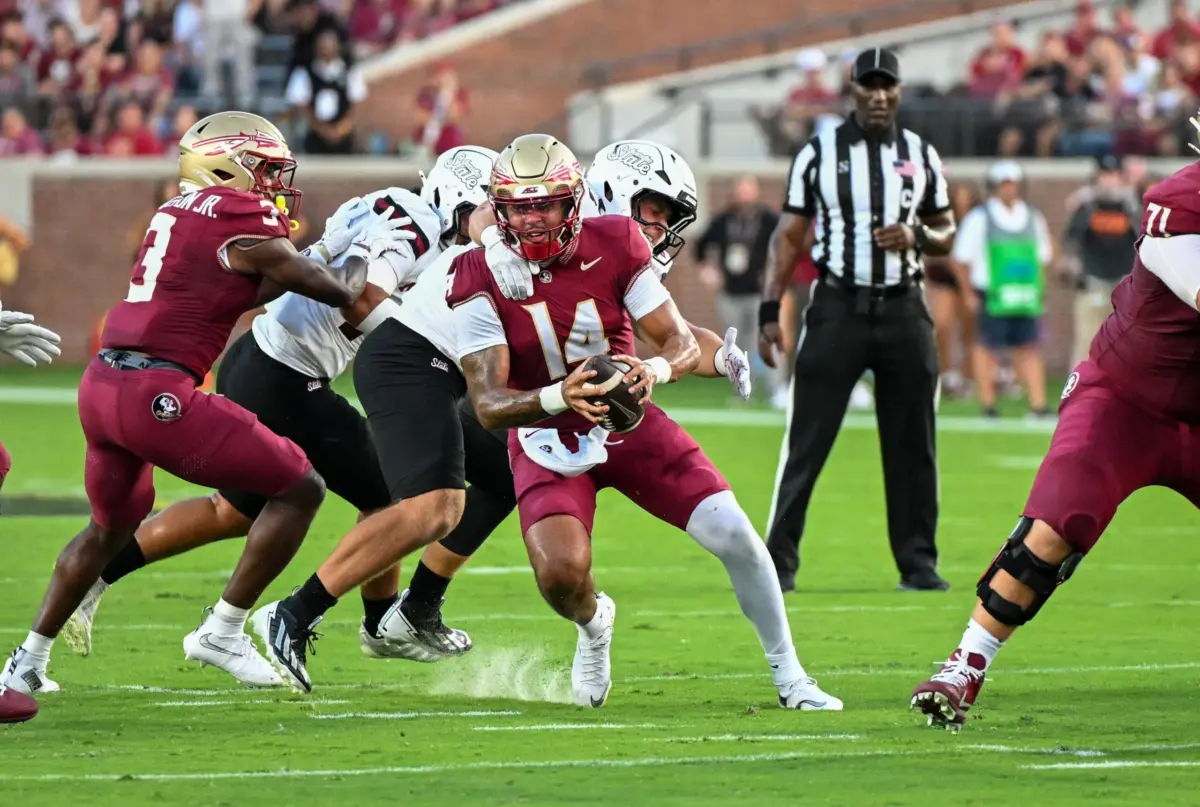
All offseason, players and coaches lauded Ashton Daniels for his maturity and total command of the offensive scheme. Yet, the reality on the field has been starkly different. Daniels’ completion percentage sits at an uninspiring 58%, while averaging a modest 6.5 yards per attempt. His struggles eroded the coaching staff’s confidence by the time the SMU game reached its climax, resulting in a conservative approach of just 23 passing attempts across 67 total offensive snaps. Without a signal-caller capable of stretching the field vertically and generating high-percentage completions, getting the ball into Robinson’s hands has proven mathematically and tactically impossible.
2. The Powerless Pass Rush (Stat: 2)
On the defensive side of the ball, the statistics are equally damning. The Seminoles’ defensive line has generated a paltry 2 sacks through two games. In fact, zero might have been an equally accurate reflection of their efficacy against SMU, where the entire FSU defense failed to record a single sack.
This unit was projected to be the sturdy anchor of the defense. Instead, it has morphed into one of the most glaring disappointments on a roster full of them. Consider the regression of the unit’s headliners: defensive standouts Mandrell Desir and Daniel Lyons have been invisible. Lyons opened the campaign without registering a single statistic against New Mexico State, while Desir was completely shut out of the stat sheet against SMU, failing to record a single tackle.
Entering year two under defensive coordinator Tony White, both players were expected to take a monumental developmental leap by moving fluidly across the front. That expected evolution has failed to materialize.
The depth behind them has fared no better. Deante McCray has managed just three total tackles and a single tackle for loss through two contests. Meanwhile, reserve defensive tackles Kevin Wynn and Jordan Sanders were thrust into heavy action, combining to play 32 of 67 snaps against SMU while both earning Pro Football Focus (PFF) grades below 60. While Rylan Kennedy and Jalen Anderson have scraped together one sack apiece to keep the unit from total statistical ignominy, neither projects as a game-wrecking, elite pass rusher.
3. The Fall from Grace in the Odds Market (Stat: +25,000)
Perhaps no metric illustrates Florida State’s precipitous fall quite like the betting markets. As of Saturday afternoon, FanDuel listed FSU’s odds to win the ACC at +25000. A $100 wager on the Seminoles capturing the conference crown would net a staggering $25,000 payout if it miraculously hit.
To contextualize these long-shot odds, consider that +25000 is precisely where oddsmakers pegged perennial laughingstocks like the Cleveland Browns and New York Jets to win the NFL Super Bowl prior to the professional season.
That a traditional powerhouse sits at these astronomical odds just two weeks into the season—with only a single conference game in the books—is astonishing. Only two programs in the entire ACC, Boston College and Stanford, possess longer odds to claim the conference championship. This stark reality underlines how far the Seminoles have fallen since cutting down the nets as ACC champions just three short seasons ago.
Compounding the problem is an unforgiving remaining strength of schedule. The road ahead features a surging Miami program, alongside top-25 ranked tests against Virginia and Louisville. In total, the Seminoles’ first four conference games and first five Power Four matchups come against opponents currently entrenched in the national rankings. With daunting late-season road trips to Pittsburgh and traditional showdowns against Clemson still looming, the prevailing sentiment in Tallahassee is simple: things may get significantly worse before they show signs of improvement.
Official Statements & Internal Perspectives
The dissonance between public optimism and on-field execution was palpable during post-game press conferences. Coaches are desperately searching for answers while attempting to project stability to a restless fan base.
Offensive coordinator Tim Harris Jr. addressed the media following the SMU debacle, emphasizing the urgency of maximizing the team’s perimeter talent.
“We have very good players on the wings, and we have to do a good job of moving them and putting them in positions,” Harris said. “We had an opportunity… that we couldn’t seize, but these are the balls that need to be won.”
The acknowledgment of underutilized talent is a step, but execution remains the missing link. The primary directive for FSU’s offensive coaching staff during the current bye week must be engineering scheme adjustments to unlock Duce Robinson, using his immense skill set as a catalyst to jumpstart the wider passing attack.
Defensively, coordinator Tony White offered a surprisingly generous review of his unit’s output against SMU, claiming his defense “balled out” for 60 snaps. However, analytical evaluations and box scores flatly reject that assertion, highlighting a glaring disconnect between the coaching staff’s internal grading and the brutal realities of live competition. Bridging that perceptual gap will be vital if the Seminoles hope to patch their leaking defensive dam.
Future Outlook: Navigating the Storm
As Florida State retreats to the practice fields during its bye week, the coaching staff faces a formidable diagnostic challenge. The roster boasts talent, but that talent is currently being out-schemed, out-coached, and out-executed on a weekly basis.
The immediate horizon offers no comfort. Stepping onto the field in Tuscaloosa to face a top-12 Alabama team looking for blood is the ultimate baptism by fire for a reeling squad. If the offensive line cannot protect Ashton Daniels, if the defensive front continues to generate ghost-town pass rushes, and if playmakers like Duce Robinson remain walled off from the game plan, the trip to Bryant-Denny Stadium could turn into a sobering afternoon.
Mike Norvell and his staff are navigating the most perilous stretch of their tenure in Tallahassee. The bye week provides a temporary shield from public humiliation, but it is merely a brief intermission before the storm resumes. How the Seminoles respond over the next fortnight will dictate not just the trajectory of the 2025 season, but the fundamental direction of the Florida State football program for years to come.

0 Comments