

Executive Overview
TALLAHASSEE, Fla. — It was never a state secret that the Florida State Seminoles entered the 2024 college football campaign carrying the heavy burden of a deeply flawed roster. Months of speculative chatter regarding personnel acquisitions, the questionable allocation of Name, Image, and Likeness (NIL) capital, and a lack of depth across both trenches had painted a precarious picture of a proud program trying to bridge the gap between historical expectations and modern roster realities. Yet, even within a roster beset by systemic imbalances, bright spots existed—principally residing within the offensive skill positions.
When the scheduling gods handed the Seminoles a high-stakes, early-season clash against the mighty Alabama Crimson Tide, the blueprint for a monumental upset was painstakingly narrow. Critics and analysts alike agreed that for Florida State to shock the college football world, the team’s elite playmakers would need to author career-defining performances.
To the sheer credit of the players themselves, that is precisely what happened.
From the opening kickoff, FSU’s skill-position dynamos delivered an offensive masterclass that caught the Crimson Tide flat-footed. Wide receiver Duce Robinson exploded for a breakout game, running back Ousmane Kromah continued his bruising early-season tear, and explosive threats like Micahi Danzy and Sam Singleton Jr. showcased the kind of game-breaking speed that terrifies defensive coordinators. Sparked by these dynamic performances, the Seminoles surged out of the gate, constructing a stunning 21-6 lead early in the second quarter that sent shockwaves through the stadium and breathed a transient, intoxicating hope into a fanbase desperate for a signature win.
Yet, football remains the ultimate team sport—a delicate ecosystem where structural integrity is mandatory for survival.
Ultimately, the glittering individual efforts of a few transcendent skill players could not mask the cavernous structural deficiencies that plagued the rest of the roster. Once Alabama settled into the contest, the overwhelming chasm in depth, defensive discipline, and quarterback play reasserted itself. FSU’s defense, despite a spirited opening sequence, hemorrhaged points on nine consecutive possessions. Concurrently, quarterback Ashton Daniels turned in a maddeningly paradoxical performance—racking up impressive empty-calorie yardage while torpedoing the offense with crippling turnovers.
When the dust settled, the final scoreboard reflected a stark, sobering reality: stellar individual heroics are no match for systemic roster flaws. Slumping to a dismal 1-2 record, Florida State now finds itself staring down the barrel of an unforgiving schedule. With a looming gauntlet of consecutive games against ranked opponents following an upcoming tune-up against FCS opponent Central Arkansas, the Seminoles are running out of time to fix what is broken before the season spirals entirely out of control.
Detailed Chronology of the Clash: From Early Promise to Relentless Collapse
The evening began with an electric pulse, the sort of sensory overload reserved for elite-tier college football showdowns under the lights. For the first twenty minutes of game clock, Florida State executed its offensive game plan with surgical precision, exploiting pre-snap motion, creative play-calling, and undeniable athletic mismatches to catch the formidable Alabama defense completely off-balance.
The First-Quarter Blitz
Florida State head coach and offensive play-callers recognized early that their path to victory lay in getting the ball into space quickly, neutralizing Alabama’s fearsome pass rush, and letting their blue-chip skill players make plays. The strategy bore immediate fruit.
On the defensive side of the ball, the Seminoles opened the game with an intensity that had been conspicuously absent through their first two outings. After managing a paltry total of one three-and-out across their previous eight quarters of football, FSU rattled off consecutive three-and-outs against the Crimson Tide’s vaunted offense. The sudden, ferocious energy injected into Doak Campbell Stadium was palpable.
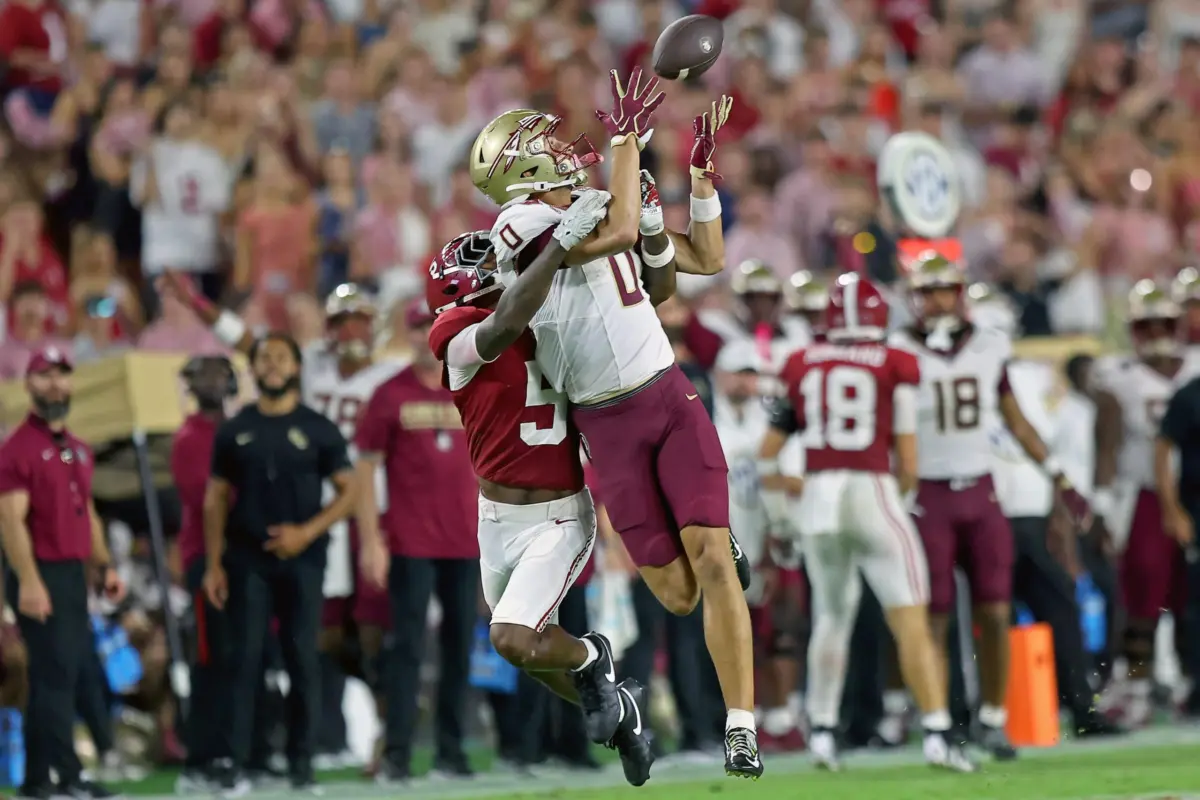
Capitalizing on the defensive momentum, the offense went to work. Duce Robinson, who had endured a relatively quiet start to his campaign, immediately established himself as a matchup nightmare. Lined up across from Alabama’s secondary, Robinson became quarterback Ashton Daniels’ preferred safety blanket. He was targeted eight times in the first half alone, hauling in receptions that consistently moved the chains and exploited soft spots in the Crimson Tide’s zone coverages.
Meanwhile, true freshman sensation Ousmane Kromah established a punishing physical presence between the tackles. Kromah didn’t just pick up yards; he delivered blows, wearing down Alabama’s front seven and forcing the linebackers to creep closer to the line of scrimmage.
The cascading effect of Robinson and Kromah’s success opened up vast swaths of the field for complementary playmakers. Micahi Danzy began carving up the seam with his blinding speed, while Sam Singleton Jr. chipped in with crucial chunk plays that kept the chains moving. When Singleton scampered for a 68-yard receiving sequence, it capped a sequence of plays that left the Alabama sideline visibly rattled.
By the early stages of the second quarter, the scoreboard flashed a number that few outside the Seminoles’ locker room dared to dream of: Florida State 21, Alabama 6.
The Turning Point and Crimson Tide Counter-Punch
Every heavyweight contender eventually lands a counter-punch, and the Alabama response, when it arrived, was swift, methodical, and utterly relentless.
The defensive awakening that carried FSU through the first quarter proved to be a fleeting mirage. Once Alabama offensive coordinator Nick Sheridan adjusted his blocking schemes and exploited FSU’s linebackers in space, the dam broke. After those initial two three-and-outs, the Crimson Tide embarked on an offensive masterclass of their own.
Remarkably, Alabama scored on every single possession for the remainder of the contest—nine consecutive drives ending in points before the Tide mercifully slid into victory formation to run out the clock. FSU’s defense, exposed by a lack of rotational depth and fundamentally sound tackling, was worn down into submission by a relentless ground game and explosive play-action passing.
Offensively, the Seminoles’ momentum ground to a sudden halt. As Alabama began mixing up its coverages and bringing simulated pressures, quarterback Ashton Daniels began to unravel. The rhythm that had yielded 21 quick points evaporated under the weight of mounting pressure, missed reads, and self-inflicted wounds.
The 15-point lead vanished before halftime, and as the teams trudged into the locker rooms, the psychological momentum had completely flipped. The second half was not a contest, but an exhibition of structural superiority versus architectural decay.
Supporting Context & Metrics: Quantifying the Disconnect
To fully understand how a game featuring historic individual performances from FSU’s skill players resulted in a definitive defeat, one must dive deep into the analytics and underlying roster mechanics.
The Skill Position Brilliance
Statistically, Florida State’s skill-position groups did everything asked of them—and then some. A granular breakdown of their contributions highlights just how much heavy lifting they performed:
- Duce Robinson: Finished the contest with 6 receptions on 8 targets for 135 yards and 1 touchdown. To put this in perspective, Robinson nearly doubled his entire output from the first two games of the season combined (75 yards). His ability to stretch the field vertically (averaging 22.5 yards per catch) provided the explosive element FSU desperately needed.
- Ousmane Kromah: Lugged the rock for 80 hard-earned rushing yards and found the end zone once. His season totals now sit at an impressive 311 yards and three scores through three games, cementing his status as the bell-cow back of the future—and the present.
- Micahi Danzy & Sam Singleton Jr.: Danzy contributed 89 explosive receiving yards, consistently winning on vertical routes. Singleton added 68 yards through the air before a devastating lower-leg injury forced him out of the game, requiring crutches in the locker room—a massive blow to an already thin running back room.
The Quarterback Paradox: Ashton Daniels’ Night
The most polarizing figure of the evening was undoubtedly quarterback Ashton Daniels. On paper, Daniels’ box score looks respectable, even impressive at first glance. He amassed 377 passing yards, representing the highest single-game passing mark for a Florida State quarterback since the 2023 matchup against Wake Forest.
However, metrics can be profoundly deceiving without contextual depth.
+-------------------------------------------------------------+
|               ASHTON DANIELS: THE STATISTICAL PARADOX       |
+-------------------------------------------------------------+
| Passing Yards        | 377 yards (Highest since FSU/Wake '23)|
| Turnovers            | 3 Interceptions                      |
| Throw Difficulty     | Low (High YAC / Schemed Open)        |
| Time to Throw        | Excessively Slow (Holding the ball)  |
+-------------------------------------------------------------+
A rigorous film review reveals that a vast majority of Daniels’ 377 yards were "manufactured" through scheme, yards-after-catch (YAC) by elite athletes like Robinson and Danzy, and blown coverages by a rotating Alabama secondary. Very few of his throws could be classified as particularly difficult or requiring elite window-throws.
Worse still, Daniels was plagued by catastrophic decision-making. He threw three interceptions, each of which halted a promising FSU drive and served as a demoralizing turnover. While the offensive line certainly had its moments of porous pass protection—surrendering crucial pressures against exotic blitzes—Daniels frequently compounded the issue by holding onto the football far longer than advisable. His internal clock was chronically slow, inviting pass-rushers into the backfield and failing to process the field at the speed required against a defensive coordinator of Kirby Smart or Kalen DeBoer caliber.
He largely played like a quarterback unequipped for the incandescent lights of a marquee primetime stage against an elite defensive unit.
Roster Construction Flaws: The Root Cause
The broader narrative of this game traces directly back to roster management decisions made over the previous cycle. Questions surrounding how athletic department funds and NIL allocations were distributed—specifically regarding positional prioritization—have come home to roost.
While heavy investments were poured into certain areas, glaring vulnerabilities were allowed to fester along both line-of-scrimmage units and within the defensive back seven. When a program skimps on foundational depth in the trenches, it creates a house of cards. Against lower-tier opponents, supreme athlete talent at wide receiver and running back can paper over these cracks. Against a monolith like Alabama, those structural faults are ruthlessly exposed until the entire edifice collapses.
Official Statements and Post-Game Reactions
In the somber media room beneath Doak Campbell Stadium following the final whistle, the mood among the Florida State coaching staff and player representatives was a heavy mix of frustration, accountability, and stark realism.
Head Coach Mike Norvell cut a resolute, if deeply disappointed, figure at the podium, refusing to sugarcoat the realities of his football team while acknowledging the valiant efforts of his offensive playmakers.
"We had guys step up tonight on the perimeter and in the backfield that played their hearts out," Norvell stated during his post-game press conference. "Duce [Robinson] made some incredible plays, Ousmane [Kromah] ran with incredible heart, and we showed what we are capable of when we execute early on. But football is played across sixty minutes, and it requires eleven men doing their job in unison. We didn’t coach well enough, we didn’t execute consistently enough, and against a program of Alabama’s standard, any lapse in focus or execution will be severely punished."
Norvell addressed the glaring defensive collapse following the team’s promising start, noting that structural fatigue and a lack of execution proved fatal.
"You cannot give up nine straight scoring drives against anyone, let alone an opponent like that," Norvell admitted. "Our guys fought, but we lacked the consistency and the depth required to sustain that level of play over four quarters. We have to look in the mirror—every single one of us—and figure out how we fix the foundational issues that are holding this team back."
Offensive skill players, meanwhile, expressed pride in their individual outputs tempered by the bitter taste of a wasted opportunity. Speaking to reporters with his leg heavily wrapped and leaning on crutches, running back Sam Singleton Jr. reflected on the offensive rhythm that briefly stunned the college football world.
"We knew what people were saying about us coming into this game," Singleton said quietly. "We knew we had the playmakers to hurt them if we got the ball in space. We proved we could do it in the first quarter. But it hurts because you want it so bad for your brothers, for the defense, for the fans. We left everything out there, but at the end of the day, team wins and team losses are all that matter."
Defensive leaders echoed the sentiment of collective accountability, acknowledging that the unit failed to build upon its early success. The consensus within the locker room was clear: while individual brilliance is commendable, the Seminoles’ collective identity remains a work in progress—one requiring drastic, urgent surgery.
Future Outlook: Navigating a Perilous Path Forward
As the embers of this crushing defeat cool, the Florida State Seminoles find themselves standing at a perilous crossroads. Sitting at a precarious 1-2 record through the first month of the season, the margin for error has evaporated entirely.
Unfortunately for a team searching for an identity and desperate for breathing room, the schedule makers have offered zero respite.
On the immediate horizon is a much-needed home matchup against FCS opponent Central Arkansas. While this game presents an ostensibly safe canvas to work out structural kinks, rebuild confidence, and rest banged-up contributors like Sam Singleton Jr., it serves as little more than a temporary bandage on a gaping wound.
What lies beyond the Central Arkansas game should send shudders down the spine of the FSU faithful.
+-------------------------------------------------------------+
|             THE COMING GAUNTLET: FSU'S SCHEDULE             |
+-------------------------------------------------------------+
| Week 4: vs. Central Arkansas (FCS)                          |
| Week 5: [Ranked Opponent #1]                                |
| Week 6: [Ranked Opponent #2]                                |
| Week 7: [Ranked Opponent #3]                                |
+-------------------------------------------------------------+
The Seminoles are staring down the barrel of three consecutive games against teams that were ranked inside this week’s top polls.
This impending gauntlet will test the absolute limits of Florida State’s roster depth, psychological resilience, and coaching mettle. If the offensive line cannot clean up its protection schemes, if Ashton Daniels fails to curb his tendency to hold the ball and throw critical interceptions, and if the defense cannot find a way to stop bleeding yards and points over four quarters, this season risks unraveling into a lost campaign.
Yet, within crisis also lies opportunity.
The breakout performances of Duce Robinson, Ousmane Kromah, and Micahi Danzy prove that Florida State possesses elite, championship-caliber talent at the skill positions. If the coaching staff can use the upcoming weeks to reallocate responsibilities, simplify reads for the quarterback, and patch together a functional defensive rotation, the Seminoles might yet salvage something meaningful from this turbulent year.
One thing is certain: the time for moral victories, explosive first quarters, and excuses regarding roster construction has officially expired in Tallahassee. The Seminoles must adapt, evolve, and execute—or risk being left behind in the ruthless landscape of modern college football.

0 Comments