

Executive Overview
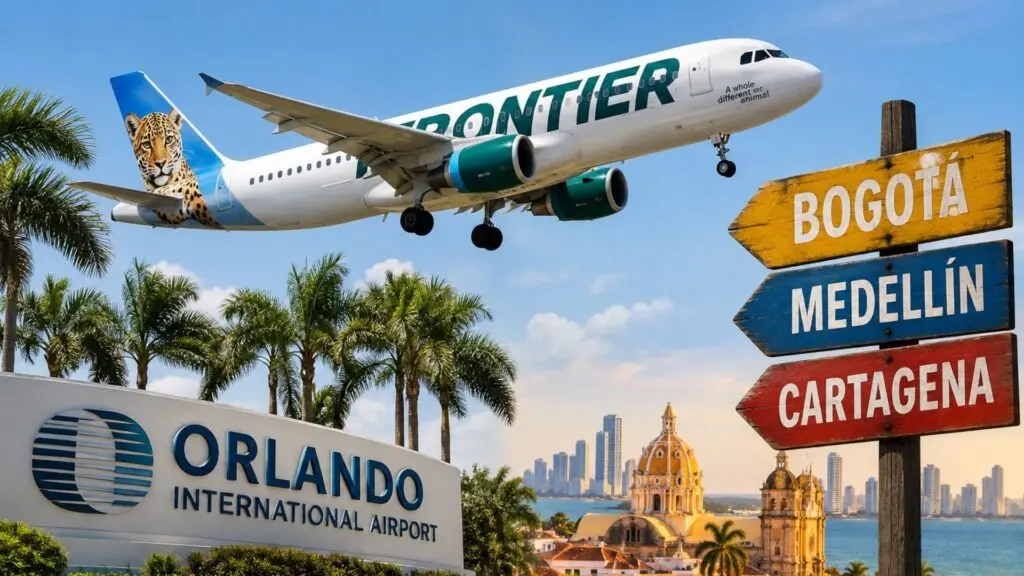
In a historic turning point for its 32-year corporate history, ultra-low-cost carrier Frontier Airlines is preparing to breach a major geographical frontier by expanding its route network into South America. Anchored by a strategic positioning at Orlando International Airport (MCO)—one of the airline’s primary operational strongholds—this cross-continental push represents a fundamental shift in the carrier’s growth trajectory. While company executives have kept official city disclosures under wraps ahead of a dedicated press unveiling at MCO, industry filings, regulatory paper trails, and aviation data point definitively toward Colombia as the initial gateway for Frontier’s entry into the South American market.
This ambitious initiative does more than merely add new dots to an expanding route map; it marks a calculated escalation in the ongoing turf wars characterizing the ultra-low-cost carrier (ULCC) sector. Frontier is aggressively moving to capitalize on structural market vacuums left by the sudden collapse of rival carrier Spirit Airlines in May. As Spirit dismantled its operations, it left behind valuable gate space, slot allocations, and a massive base of unserved or underserved travelers—particularly in Florida. By stepping into this void, Frontier is not only consolidating its domestic footprint in key destinations such as Las Vegas, Dallas-Fort Worth, Fort Lauderdale, and Detroit, but it is also leaping international borders to capture lucrative leisure and visiting-friends-and-relatives (VFR) traffic streams.
Financially, the timing could not be more advantageous for the Denver-headquartered carrier. Propelled by its aggressive post-merger and post-collapse market capture strategy, Frontier recently posted an unprecedented milestone: a record-shattering $1.3 billion in total quarterly revenue, marking a staggering 38% year-over-year surge. As the airline prepares to officially pull back the curtain on its South American operations, the move promises to reshape the competitive dynamics of Florida-to-Colombia air corridors, injecting fresh low-cost capacity into routes traditionally dominated by legacy and foreign network carriers.
Detailed Chronology: Regulatory Filings and the Path to South America
The journey toward Frontier’s historic South American debut has been anything but accidental. Months before any public relations campaign or celebratory ribbon-cutting ceremony, the foundational groundwork was laid through complex international bureaucratic channels. Unlocking foreign airspace requires navigating a labyrinth of bilateral aviation agreements, safety clearances, and direct regulatory applications submitted to foreign civil aviation authorities.
The Colombian Blueprint Unveiled
While Frontier’s executive leadership team initially maintained a tight-lipped stance regarding the precise destinations of its inaugural South American routes, aviation intelligence reports lifted the veil on the airline’s blueprint. According to a detailed report by Aviation Week, Frontier Airlines officially submitted comprehensive route applications to Colombia’s Civil Aviation Authority (Aerocivil).
The filings reveal a targeted strategy focused on three of Colombia’s most economically vibrant and culturally significant urban hubs:
- Bogotá (BOG): The nation’s sprawling capital and primary aviation nexus, sitting high in the Andes.
- Medellín (MDE): The famed "City of Eternal Spring," which has rapidly evolved into a powerhouse for digital nomads, international tourists, and business travelers.
- Cartagena (CTG): The historic Caribbean coastal jewel renowned for its colonial-era walled city, thriving luxury hospitality sector, and sun-soaked island escapes.
Navigating the International Approval Labyrinth
Securing green lights from foreign regulators is notoriously time-consuming, requiring meticulous compliance with foreign operational specifications, security audits, and bilateral air service agreements between the United States and the target nation. Historically, establishing international connections out of major hubs like Orlando International Airport demands immense institutional patience.
To put the magnitude of these regulatory hurdles into perspective, airport authority records show that securing international routes can span multiple years. For instance, MCO airport officials spent more than five consecutive years lobbying, negotiating, and working behind the scenes to successfully secure coveted nonstop service between Orlando and Japan. While Colombia’s open skies agreements and proximity to the U.S. mainland generally streamline the administrative timeline compared to transpacific endeavors, navigating foreign civil aviation bureaucracy remains a high-stakes test of logistical coordination.
By routing these applications through its primary Florida base, Frontier is positioning MCO not just as a domestic stepping stone, but as a formidable international launchpad capable of rivaling larger legacy hub operations across the Southeast United States.
Supporting Context & Metrics: Filling the Void Left by Spirit Airlines
To fully understand the economic rationale behind Frontier’s South American expansion, one must examine the profound structural shifts that reshaped the ultra-low-cost carrier landscape in the first half of 2026. The definitive turning point arrived in May, when Spirit Airlines—long a dominant force in the budget travel sector and a powerhouse at Orlando International Airport—suddenly ceased operations.

The Aftermath of Spirit’s Collapse
Throughout 2025, Spirit had solidified its standing as MCO’s third-busiest airline, commanding an impressive 10.8% share of the airport’s total passenger market. Its sudden exit created an immediate crisis for budget-conscious travelers, but it also presented an unprecedented windfall for surviving competitors nimble enough to absorb the displaced capacity.
Frontier recognized this market vulnerability instantaneously. During the company’s first-quarter 2026 earnings call, Frontier Chief Executive Officer Jimmy Dempsey laid bare the airline’s strategic intentions. Dempsey announced that Frontier was actively mobilizing to backfill service in Orlando and other former Spirit strongholds, explicitly targeting high-volume leisure markets including:
- Las Vegas (LAS)
- Dallas-Fort Worth (DFW)
- Fort Lauderdale (FLL)
- Detroit (DTW)
The expansion into Colombia is the international extension of this very strategy. Notably, the proposed route connecting Orlando to Cartagena directly restores nonstop ultra-low-cost carrier competition to a market previously served by Spirit. By stepping into this space, Frontier ensures that the departure of Spirit does not automatically translate into monopolistic pricing or diminished flight choices for travelers seeking affordable Caribbean getaways.
Market Dynamics in Colombia
Frontier will not be operating in a vacuum. The Orlando-to-Colombia corridor is already an established, high-demand travel artery.
- Bogotá: Currently served via nonstop flights out of Orlando by both Avianca and LATAM Airlines.
- Medellín: Connected directly to Orlando through Avianca’s existing network.
- Cartagena: Long prized by U.S. tourists for its romantic colonial architecture and pristine Caribbean beaches, Cartagena has experienced a massive boom in luxury tourism investment over recent years, making it prime real estate for a low-cost carrier looking to stimulate new demand among price-sensitive vacationers.
By introducing lower fare baselines to these routes, Frontier expects to stimulate traffic—effectively inducing new demand from travelers who might have previously found South American vacations financially out of reach due to legacy carrier pricing structures.
Official Statements and Financial Indicators
The aggressive pivot toward international expansion and domestic market capture is paying extraordinary dividends for Frontier’s bottom line, validating the leadership team’s high-stakes gamble on post-merger and post-collapse consolidation.
Record-Breaking Financial Performance
The direct correlation between Frontier’s route expansion strategy and its corporate financial health was laid bare in the company’s subsequent quarterly financial disclosures. Following the rollout of its expanded domestic and international scheduling initiatives, Frontier reported an all-time corporate record of $1.3 billion in total revenue. This figure represents a staggering 38% year-over-year increase compared to the same period in the previous fiscal year.
Wall Street analysts have closely monitored the airline’s ability to maintain low unit costs while expanding its geographic footprint. By tapping into higher-yield international leisure routes in South America, Frontier is diversifying its revenue streams beyond domestic U.S. markets, which are frequently susceptible to domestic fuel price volatility and seasonal domestic demand slumps.
Executive Vision and Stakeholder Optimism
While formal details regarding flight frequencies, introductory fare promotions, and exact launch dates are slated to be unveiled at an upcoming media event hosted at Orlando International Airport, executive commentary underscores a deep institutional commitment to the region.
Speaking to investors and industry analysts, CEO Jimmy Dempsey emphasized that the airline’s operational maturity—now spanning over three decades—has prepared it to successfully manage the operational complexities of international expansion.

"Our presence in Orlando is stronger than ever, and the deliberate steps we are taking to meet the travel demands of consumers in Florida and beyond reflect our commitment to affordable, accessible travel," corporate communications have continually echoed as the airline prepares for its inaugural South American flights.
Local tourism authorities in Central Florida have similarly welcomed the news. Greater Orlando has long benefited from robust international inbound tourism, which serves as a vital economic engine supporting hospitality, retail, car rental, and entertainment sectors. Introducing direct, low-cost air links to South American economic hubs is anticipated to grease the wheels of commerce, fostering tighter business ties and encouraging longer visitor stays from travelers originating south of the equator.
Future Outlook: What This Means for Travelers and the Aviation Industry
As Frontier Airlines prepares to officially ink its debut in South America, the broader aviation landscape is bracing for a wave of competitive adjustments. The strategic deployment of assets out of Orlando International Airport signals a maturing ultra-low-cost carrier model—one that is no longer content to merely skim domestic cream off the top of traditional legacy carrier networks, but is actively willing to cross international boundaries to secure long-term market share.
Implications for the Consumer
For the everyday traveler, Frontier’s move is a definitive win for consumer choice and wallet-friendly travel options. Historically, flying from Central Florida to South America often required purchasing high-priced tickets on legacy network carriers or enduring inconvenient, multi-leg itineraries.
By introducing unbundled, point-to-point nonstop options to destinations like Bogotá, Medellín, and Cartagena, Frontier is democratizing access to South American tourism. Travelers can look forward to:
- Lower Baseline Fares: Standard ULCC pricing pressure forces competing airlines to adjust their fare structures downward.
- Nonstop Convenience: Eliminating layovers in Miami, Atlanta, or Houston significantly cuts down travel times for Orlando-based vacationers and business commuters.
- Expanded Connectivity: Easier access to Colombia opens up seamless leisure corridors for families visiting relatives or exploring the diverse ecological and cultural landscapes of the Andes and the Caribbean coast.
Long-Term Industry Ramifications
Looking ahead, industry watchers will be closely evaluating whether Frontier’s Colombian gamble serves as a stepping stone for even broader international ambitions. If the Orlando-to-Colombia routes achieve the projected passenger load factors and yield margins, Frontier could easily replicate the playbook across other Latin American and Caribbean markets, utilizing MCO and other key Southeast hubs as ongoing springboards.
Furthermore, the expansion serves as a case study in corporate resilience. In an industry defined by high fixed costs, fierce fuel price fluctuations, and the occasional catastrophic collapse of major competitors, Frontier’s ability to pivot rapidly, gobble up abandoned market share, and successfully petition foreign civil aviation authorities underscores a high degree of operational agility.
As the countdown ticks toward Frontier’s official media reveal at Orlando International Airport, Central Florida stands at the threshold of a new era in international connectivity—one where low-cost travel officially spans two continents, bridging North and South America with affordable, accessible flight paths.

0 Comments