
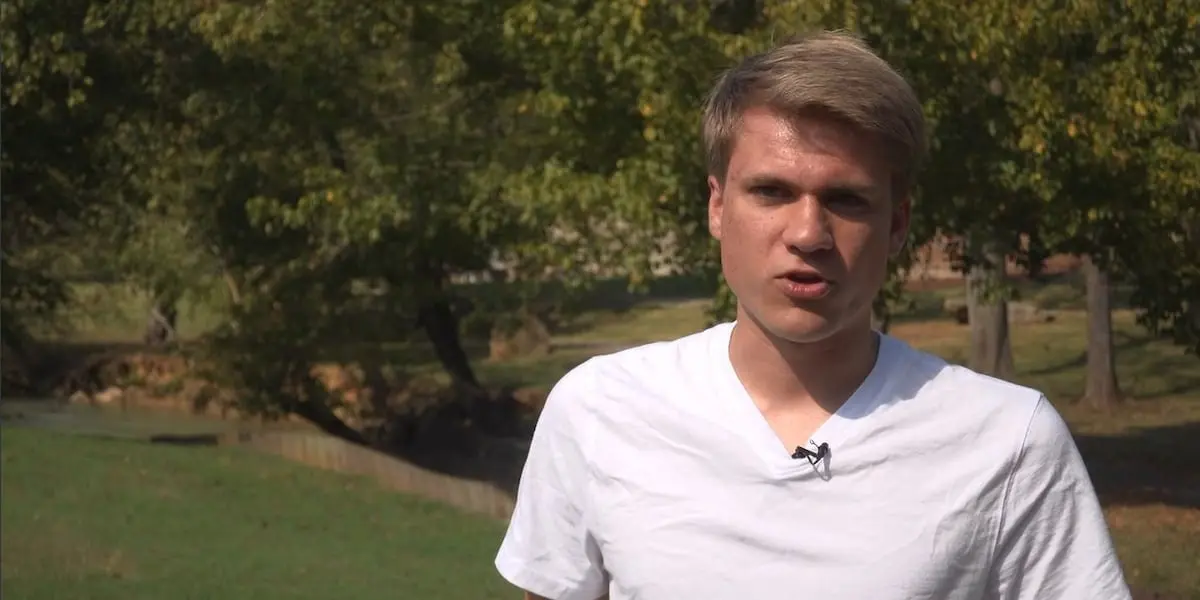

JEFFERSON CITY, Tenn. — In an extraordinary display of situational awareness, profound courage, and split-second decision-making, a Carson-Newman University student has been heralded as a local hero after rescuing a 3-year-old boy from swift, dangerous creek waters. Junior Noah Mathews intervened just in time on a Monday afternoon, pulling the toddler to safety as he clung desperately to a submerged tree branch.
Local authorities have confirmed that the young boy, who has autism, had wandered away from his nearby residence. Thanks to Mathews’ swift and decisive actions, a potentially catastrophic tragedy was averted. The incident has since ignited widespread admiration across East Tennessee, highlighting the extraordinary character found within the state’s collegiate communities and underscoring the critical importance of community vigilance.
Executive Overview
The dramatic rescue unfolded at approximately 3:30 p.m. on a Monday afternoon near the campus of Carson-Newman University in Jefferson City, Tennessee. Noah Mathews, a junior pursuing his undergraduate studies at the institution, was taking a routine walk near a local creek bordering the campus grounds when an unusual sight disrupted his afternoon.
Spotting a submerged, crescent-shaped tree within the rushing waters of the swollen creek, Mathews investigated further and discovered a terrifying scene: a small child, later identified as a 3-year-old boy, was trapped in the fast-moving current, clinging desperately to a tree branch. Understanding that every second counted, Mathews did not hesitate. He descended into the freezing, turbulent water, successfully secured the toddler, and hauled him up the embankment to safety.
Following the rescue, Mathews demonstrated remarkable composure and care, contacting campus security and comforting the frightened child with cartoons on a mobile device while awaiting the arrival of the Jefferson City Police Department. Subsequent investigations by local law enforcement revealed that the boy had slipped away from his home unobserved, wandering into a hazardous natural environment.
Police officials and community leaders have universally praised Mathews, noting that his selflessness and immediate intervention directly prevented a fatal outcome. This comprehensive report explores the chronology of the event, the broader context of water safety and wandering behaviors among children with autism, official statements from responding agencies, and the enduring impact of this remarkable rescue on the Jefferson City community.
Detailed Chronology: From a Routine Walk to a Desperate Rescue
To fully understand the gravity of the incident, it is essential to trace the sequence of events as they unfolded on that fateful Monday afternoon. The timeline demonstrates how narrow the margin was between safety and tragedy.
3:15 p.m. — The Separation at Home
Approximately fifteen minutes prior to the discovery, the 3-year-old boy—whose identity has been withheld due to his age and privacy considerations—managed to exit his family home unnoticed. Children diagnosed with autism frequently exhibit wandering behaviors, often referred to in psychological and safety literature as "elopement." Drawn by sensory stimuli, open spaces, or running water, the toddler traveled a significant distance from his residence toward the natural creek bed situated near the Carson-Newman University campus.
3:30 p.m. — A Catch in the Corner of the Eye
Noah Mathews was walking along the familiar pathway near the creek adjacent to campus grounds. The weather and recent precipitation had caused the creek’s water levels to rise, resulting in a swift, powerful current. As Mathews walked, something unusual caught his peripheral vision.
"So, that tree right there that’s in the water kind of submerged, kind of like a crescent almost," Mathews recalled, describing the specific geographical feature that drew his attention. Driven by curiosity and a sense of unease, he altered his path and approached the steep embankment of the creek.
3:33 p.m. — Assessing the Danger
Upon reaching the water’s edge, Mathews was met with a chilling sight. The 3-year-old boy was waist-deep in the rushing, icy water, his small hands locked in a desperate grip around a submerged tree branch. The force of the current was thrashing against the child’s small frame, threatening to rip his hands away at any moment.
"My immediate thought was just to get him out of that area, so he didn’t fall in and get swept downstream or drown possibly," Mathews explained. The cognitive processing time between observation and action was virtually zero; Mathews recognized that waiting for professional emergency services was not an option given the imminent risk of drowning.
3:35 p.m. — The Physical Extraction
Without regard for his own physical safety or the potential hazards of the swift current, Mathews descended the muddy, unstable bank of the creek. Bracing himself against the slippery rocks and the powerful pull of the water, he positioned his body to maximize leverage and reach.
"I kind of lower myself and prop myself up, so I can pull him up and pull him out of that area safely," Mathews detailed. With steady hands and targeted strength, he reached down, wrapped his arms securely around the toddler, and hoisted him out of the rushing current, carrying him up the embankment onto solid, dry ground.
3:40 p.m. — Securing Help and Providing Comfort
Once the immediate physical danger had passed, Mathews turned his attention to the emotional state of the traumatized toddler, as well as securing official assistance. He immediately contacted campus security to report the incident and request emergency medical and police response.
Recognizing that the child was deeply distressed, cold, and frightened, Mathews sat down with him on a nearby park bench. Displaying an intuitive and compassionate understanding of child psychology, Mathews pulled out his phone and played cartoons for the boy, helping to calm his nervous system and distract him from the harrowing experience while they waited for authorities to arrive.
4:00 p.m. — Law Enforcement Arrival and Reunion
Officers from the Jefferson City Police Department arrived at the scene shortly thereafter. Emergency personnel evaluated the 3-year-old boy, determining that aside from being thoroughly shaken and cold, he had sustained no major physical injuries. Concurrently, law enforcement officers launched an inquiry to locate the child’s family, quickly tracing his identity and safely reuniting him with his relieved mother.
Supporting Context & Metrics: Autism Elopement and Swift-Water Dangers
To contextualize the significance of Noah Mathews’ actions, it is vital to examine the intersecting safety crises of pediatric elopement among children with autism and the inherent lethality of swift-water environments.
The Hidden Crisis of Pediatric Elopement
According to data compiled by public health organizations and autism advocacy groups, wandering, or elopement, is a common and highly dangerous behavior associated with Autism Spectrum Disorder (ASD). Studies indicate that nearly half of all children with autism attempt to wander or bolt from safe environments.
- Frequency: Approximately 48% of children with autism wander from home, school, or supervised settings at least once after the age of four, with many starting earlier.
- Lethal Attraction: Water is one of the primary destinations that attract children who wander. Drowning is consistently documented as a leading cause of mortality-related wandering among individuals with autism, accounting for a disproportionate number of accidental deaths in this demographic.
- Time Sensitivity: When a child with autism elopes, time is the single most critical factor. Because these children often lack a sense of danger and may not respond when their name is called, search-and-rescue operations require immediate, specialized community awareness.
In this instance, the proximity of the residential areas to natural waterways in Jefferson City created a high-risk scenario. If not for the chance routing of Mathews’ afternoon walk, the outcome could have mirrored tragic statistics nationwide.
The Lethality of Swift Water
Hydrologists and emergency rescue personnel frequently warn the public about the deceptive power of moving water. Even a relatively shallow creek, when swollen by rain or runoff, can generate forces capable of overwhelming an adult, let alone a 3-year-old child.
- Hydrostatic Pressure: Moving water exerts immense pressure against submerged objects. Just six inches of moving water can knock a person off their feet, while two feet of rushing water can sweep away most vehicles.
- Undercurrents and Obstions: Submerged branches, root systems, and debris—such as the crescent-shaped tree described by Mathews—can create hidden undercurrents, entrapment zones, and strainers that trap bodies underwater.
Mathews’ decision to enter this environment required calculated courage. By successfully bracing himself before attempting the rescue, he avoided becoming a secondary victim—a common hazard in swift-water rescue scenarios where well-intentioned rescuers are also swept away.
Official Statements and Community Reaction
The heroic rescue has drawn widespread commendation from university officials, local law enforcement, and residents throughout Jefferson County.
Law Enforcement Assessment
Representatives from the Jefferson City Police Department issued formal statements praising the Carson-Newman University student for his extraordinary intervention. Investigators confirmed that the child had wandered away from home and emphasized that Mathews’ decisive, selfless actions unquestionably prevented a fatal outcome.
"The citizen’s quick thinking and willingness to put himself in harm’s way saved this young boy’s life," a spokesperson for the Jefferson City Police Department noted during a local media briefing. "Incidents involving wandering children near water hazards can turn tragic in a matter of seconds. We are profoundly grateful for Mr. Mathews’ alertness and heroism."
Reflections from the Hero
Despite the high praise, Mathews remains remarkably humble about his role in the life-saving event. Rather than seeking personal glory, he views the incident through a lens of profound gratitude, personal faith, and community responsibility.
"I did something to better someone’s life, I guess," Mathews reflected during an interview with regional news affiliates. When asked what message he might want to leave with the young boy as he grows older, Mathews offered a deeply reflective and compassionate thought:
"I would want him to know that God is looking out for him, and I hope that he can walk through life knowing that."
Carson-Newman University Community Pride
Leadership and students at Carson-Newman University have rallied around Mathews, celebrating his actions as a testament to the values instilled within the institution. The private Christian university, known for its emphasis on service, character development, and community engagement, has seen Mathews’ story resonate deeply across campus bulletin boards, social media channels, and local gatherings.
University faculty members noted that Mathews exemplifies the very best of student citizenship, proving that leadership and heroism often manifest outside the traditional boundaries of the classroom.
Future Outlook: Water Safety, Awareness, and Ongoing Support
While the immediate crisis ended in a joyful reunion between mother and child, the incident has sparked broader conversations within Jefferson City and surrounding communities regarding public safety, infrastructure awareness, and support systems for families navigating developmental disabilities.
Enhanced Community Vigilance
Local safety advocates are utilizing this event as an educational opportunity to remind residents about the prevalence of elopement among children with developmental disorders. Recommendations for families and communities include:
- Securing Perimeter Access: Installing specialized locks, alarms, and fencing around residential doors and windows to deter wandering behavior.
- Community Education: Training local neighborhoods to recognize the signs of pediatric wandering and encouraging residents to immediately question or assist unattended young children near hazardous areas like roads, woods, and waterways.
- First Responder Partnerships: Promoting registries and awareness programs between local police departments and families with autistic children to facilitate faster, more targeted search-and-rescue operations.
Recognition for Noah Mathews
As normal routines return to Carson-Newman University, discussions are reportedly underway among civic and academic leaders to formally recognize Noah Mathews for his valor. While medals and certificates of appreciation are standard protocol for acts of civic heroism, those closest to the situation note that the most enduring reward is the knowledge that a young life was preserved.
The story of the Carson-Newman junior and the 3-year-old boy serves as an inspiring reminder of human connection, split-second bravery, and the profound impact that a single individual can have when they choose to pay attention to the world around them.

0 Comments