
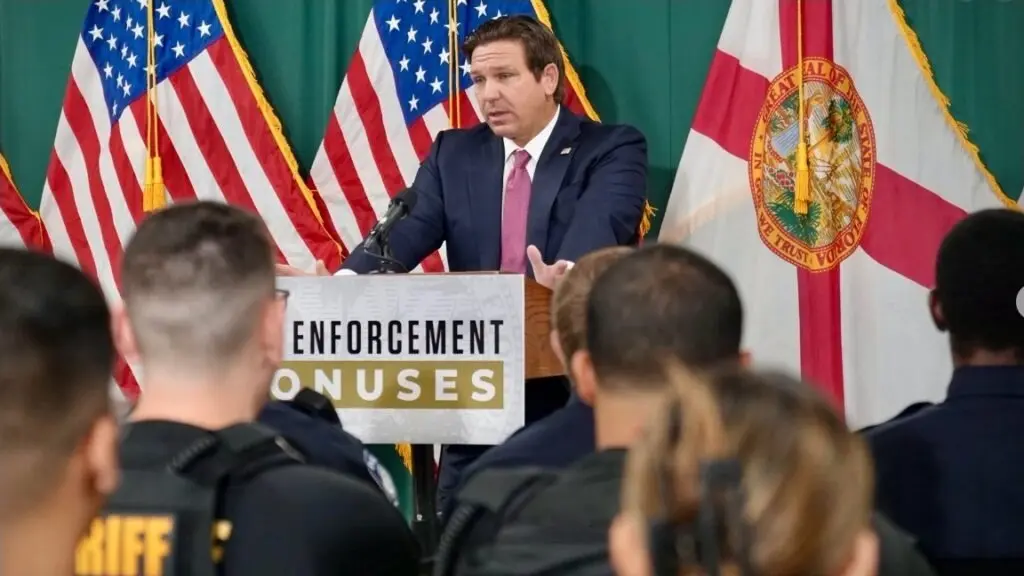

TALLAHASSEE, Fla. — In a continued push to bolster local and state public safety ranks, Governor Ron DeSantis announced on Monday that the state of Florida has successfully distributed more than $10 million in recruitment bonuses to 1,506 newly hired law enforcement officers. This latest financial disbursement includes 38 newly minted recruits stationed in Pasco County alone, highlighting the widespread regional reach of an initiative designed to attract fresh talent to the Sunshine State’s criminal justice agencies.
The payments are channeled through the highly publicized Florida Law Enforcement Recruitment Bonus Program. Established initially in 2022 as a legislative priority to combat nationwide hiring shortages within the public safety sector, the program has grown into a cornerstone of Florida’s aggressive strategy to position itself as the most pro-law enforcement state in the nation. According to official data released by the Governor’s Office, nearly 12,500 officers have received financial incentives through the initiative since its inception, with cumulative payouts eclipsing the $83 million mark.
Executive Overview: A Multi-Million-Dollar Investment in Public Safety
The contemporary landscape of American policing is fraught with complex challenges, ranging from recruitment deficits and early retirements to shifting public perceptions of the badge. While numerous jurisdictions across the United States struggle to fill vacancies, Florida has adopted an assertive, capital-intensive approach to buck this trend.
The $10 million allocation announced this week represents more than just a routine administrative milestone; it underscores the state’s ongoing commitment to maintaining high operational readiness across its municipal departments, county sheriff’s offices, and state highway patrols. By offering a tangible financial incentive—a one-time, after-tax bonus of $5,000 per qualifying officer—Florida has engineered a direct pipeline to attract both inexperienced cadets and experienced out-of-state transferees looking for professional stability and supportive municipal leadership.
Administratively overseen by FloridaCommerce, the recruitment initiative serves as a primary engine for agencies seeking to replenish their ranks. By targeting individuals who have either recently entered the field or relocated from less supportive jurisdictions, the program has fundamentally altered the competitive landscape of law enforcement recruitment nationwide.
Detailed Chronology: The Evolution of Florida’s Recruitment Initiative
To fully appreciate the scope of Monday’s announcement, it is vital to examine the chronological trajectory of the Florida Law Enforcement Recruitment Bonus Program from its legislative genesis to its current operational maturity.
2022: The Legislative Catalyst
The program was officially born out of a special legislative push in 2022, conceived as a direct countermeasure to the "defund the police" rhetoric and civil unrest that swept major American cities in preceding years. Recognizing that municipal and county departments were bleeding experienced personnel and struggling to attract replacement candidates, state leadership crafted a targeted legislative package.
The core of this legislation was simple yet potent: a $5,000 after-tax bonus designed to sweeten the deal for new hires. To ensure the integrity of the fund and prevent double-dipping, strict eligibility criteria were put in place. To qualify, an officer generally had to:

- Begin full-time employment with a recognized Florida criminal justice agency on or after July 1, 2022.
- Possess no prior history of working as a law enforcement officer within the state of Florida, thereby incentivizing net-new talent acquisition rather than lateral shuffling between local departments.
2023–2025: Scaling Up and Hitting Milestones
In the years following its launch, the program gained significant momentum. As word spread through targeted recruitment campaigns—which actively targeted disgruntled or under-appreciated officers in states with restrictive policing environments—thousands of applicants applied.
Throughout 2024 and 2025, regional departments reported steady inflows of applications. State administrators streamlined the verification process through FloridaCommerce, ensuring that funds were disbursed rapidly once probationary periods and employment verifications were cleared. By early 2026, the program officially surpassed the major milestone of 10,000 distributed bonuses, signaling that the state’s financial incentive was working as intended.
July 2026: The $10 Million Milestone and Pasco County’s Influx
The latest funding wave brings the total program output to nearly 12,500 individual bonuses and over $83 million disbursed. Notably, the influx of 38 new recruits in Pasco County reflects the localized impact of these state-level funds. Pasco County Sheriff’s Office and local municipal departments have long emphasized community policing models that require steady manpower; these added resources ensure that response times remain low and neighborhood patrols remain robust.
Supporting Context & Metrics: Analyzing the Fiscal Framework
The recruitment bonus program does not exist in a vacuum. It is part of a holistic, multi-layered fiscal approach embedded within Florida’s broader state budget strategies. A close examination of recent state budgets reveals a comprehensive financial architecture dedicated not just to hiring officers, but to retaining them over the course of long, hazardous careers.
The Fiscal Year 2026-27 Budget Breakdown
In the state’s current budget cycle, lawmakers allocated significant funding to maintain public safety momentum:
- $20 million dedicated explicitly to sustaining the Law Enforcement Recruitment Bonus Program.
- $19.8 million earmarked for targeted pay increases for sworn state law enforcement officers.
- $2.5 million allocated for salary enhancements for state firefighters, recognizing the broader emergency services family.
These figures build upon substantial baseline investments from previous fiscal years. Most notably, the preceding state budget fundamentally reset the compensation baseline for state law enforcement by raising the minimum base salary to $60,000 per year. For decades, low starting pay made it difficult for state agencies to compete with private-sector security or higher-paying municipal gigs; the $60,000 floor effectively eliminated that competitive disadvantage.
Beyond Base Pay: Wellness, Training, and Scholarships
Recognizing that financial compensation alone cannot solve systemic retention challenges, Florida officials have expanded auxiliary support systems for law enforcement personnel. Key components of this expanded safety net include:
- Officer Wellness Programs: Comprehensive mental health resources, peer support networks, and critical incident debriefings designed to combat the psychological toll of modern policing.
- Education and Training Initiatives: Advanced tactical and de-escalation training programs funded by the state to keep officers safe and legally adept.
- Academy Scholarship Assistance: Financial aid for civilian recruits entering law enforcement academies, removing the financial barrier to entry for working-class candidates who might otherwise struggle to afford academy tuition.
Official Statements and Perspectives
During Monday’s press conference detailing the latest round of payments, Governor Ron DeSantis emphasized the philosophical and practical underpinnings of the state’s public safety agenda.

"In the four years since we launched this initiative, we have awarded nearly 12,500 bonuses totaling more than $83 million to our law enforcement officers," Governor DeSantis stated. "While other states have vilified and abandoned the men and women in uniform, Florida has consistently chosen to stand proudly with our law enforcement community. We back our blue with action, not just words, ensuring that those who put their lives on the line are compensated, respected, and supported."
Law enforcement associations and local sheriffs have echoed these sentiments, pointing out that the recruitment bonuses have fundamentally altered their operational capacities. In regions like Pasco County, local administrators have noted that out-of-state transfers—often escaping high-tax, low-morale jurisdictions in the Northeast and West Coast—bring invaluable years of experience to local forces, elevating the overall quality of tactical execution and community engagement.
Critics of the program, while acknowledging its popularity among recipients, have occasionally raised questions regarding long-term fiscal sustainability and whether one-time bonuses create lasting institutional loyalty once the initial funds are spent. However, state economists and legislative leaders counter that the integration of higher baseline salaries ($60,000 minimums), recurring pay increases, and comprehensive wellness initiatives create a sticky retention environment that far outlasts the initial $5,000 payout.
Future Outlook: Sustaining the Momentum in Florida Law Enforcement
As Florida continues to experience rapid population growth and demographic shifts, the demand for competent, professional law enforcement services will only intensify. The state’s proactive strategy offers a compelling case study in governance—demonstrating how targeted fiscal intervention can reverse national hiring trends and turn a state into a magnet for public safety professionals.
Looking ahead, state lawmakers have signaled a willingness to maintain funding for both the recruitment bonus program and ongoing salary adjustments in future budget cycles. With $20 million locked into the current fiscal year’s allocation, the program is well-funded to absorb thousands of additional applicants in the coming months.
Ultimately, Florida’s aggressive model has set a new benchmark for state-level support of criminal justice agencies. By combining immediate financial gratification ($5,000 bonuses) with structural career enhancements ($60,000 minimum bases, robust wellness programs, and academy scholarships), the Sunshine State has ensured that its law enforcement agencies remain fully staffed, highly trained, and deeply supported for years to come.

0 Comments