
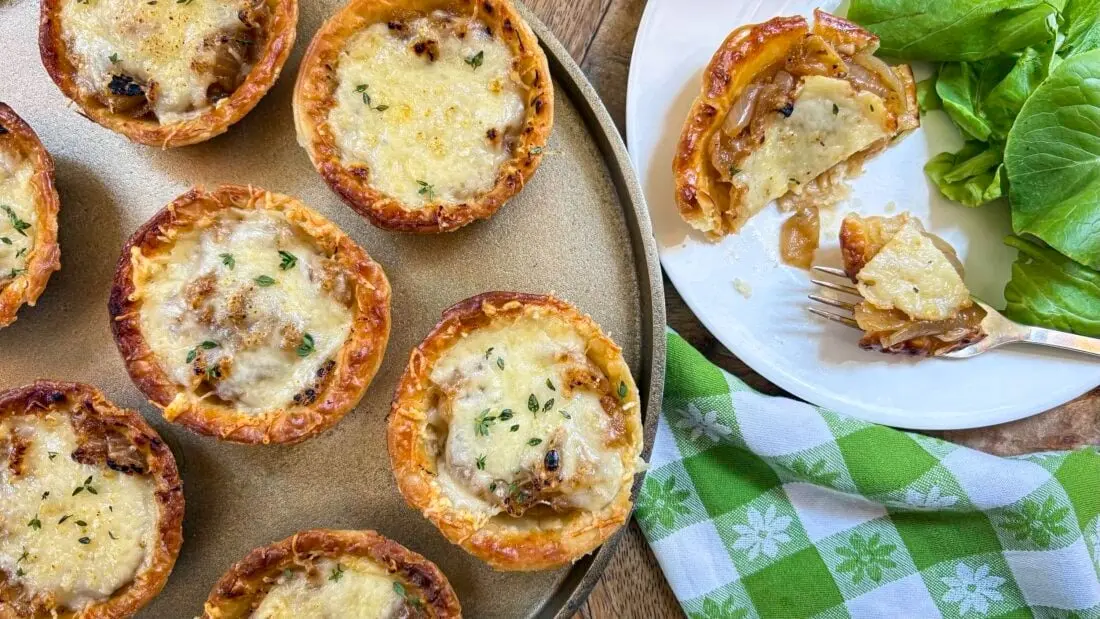

Executive Overview
In the ever-evolving landscape of contemporary American gastronomy, few movements are as enduring as the reimagining of heritage comfort foods. The traditional French onion soup—a historic bistro staple defined by slow-cooked alliums, rich beef stock, and a crown of melted Gruyère over toasted bread—has long served as a masterclass in culinary patience and the chemistry of caramelization. On September 17, 2026, culinary writer Katherine Cobbs introduced a striking evolution of this classic flavor profile in a feature for Garden & Gun: the Bourbon-Caramelized French Onion Tart.
By translating the deep, savory umami of traditional onion soup into an individual, handheld pastry format, this recipe bridges the gap between rustic European technique and Southern-inflected American distilling. At the heart of this innovation is a deliberate departure from the standard culinary canon. While traditional French preparations rely on dry white wine, vermouth, or sherry to deglace the pan and introduce acidity, this recipe integrates a generous splash of bourbon.
When married with sweet roasting alliums—such as Vidalia or Maui onions—and a robust beef broth, the bourbon does more than merely flavor the dish. The spirit undergoes a chemical transformation during the braising and baking processes. The high heat of the oven tames the alcohol’s sharp bite, leaving behind a complex tapestry of oak, vanilla, and caramel notes that amplify the natural earthiness of the onions and the savory depth of the beef stock.
Bound together by a rich custard of beaten eggs and heavy cream, and finished with a blanket of bubbling, golden Gruyère cheese, these individual tarts represent a sophisticated yet accessible shift in modern baking. Designed for weekend brunches, elegant luncheons, or make-ahead freezing, the Bourbon-Caramelized French Onion Tart stands as a testament to how traditional flavor profiles can be successfully upended through thoughtful ingredient substitutions and precise structural engineering.
Detailed Chronology and Culinary Methodology
The creation and execution of the Bourbon-Caramelized French Onion Tart require a meticulous, step-by-step approach that honors both pastry arts and slow-cooking traditions. Understanding the timeline and mechanics of this recipe reveals why each phase is critical to achieving the ideal balance of texture, sweetness, and umami.
Phase 1: Allium Selection and Spiced Butter Roasting
The foundation of any great onion dish lies in the quality and preparation of the alliums. For this recipe, the selection of sweet onions—specifically regional varieties like Georgia Vidalias or Hawaiian Maui onions—is paramount. These varieties possess a high water content and lower sulfur levels compared to standard yellow storage onions, making them exceptionally well-suited for high-sugar caramelization without acquiring an unpleasantly bitter edge.
The process begins by slicing the sweet onions and subjecting them to a preliminary roasting phase in a spiced butter mixture. Unlike standard stovetop sweating, oven-roasting allows the heat to evenly penetrate the dense layers of the onions while the spiced butter coats every surface. As the onions roast, the natural sugars begin to mobilize and concentrate, initiating the foundational stages of the Maillard reaction. This step builds a complex flavor profile that standard pan-frying often fails to achieve uniformly.
Phase 2: The Bourbon Braise and Umami Infusion
Once the onions have achieved their initial roasted tenderness, they are transferred to a braising environment. Here, a rich, unctuous beef broth is introduced to the pan. However, the defining moment of the recipe occurs with the addition of a splash of bourbon.
In classic French gastronomy, dry vermouth or fortified wines like sherry are the standard agents used to deglaze fond from the pan and add a bright, acidic counterpoint to the rich fats. Cobbs’s adaptation swaps these out for America’s native spirit. As the bourbon hits the hot pan and mingles with the beef stock and sweet onions, the alcohol begins to cook off.
Chemically, bourbon contains congeners—compounds produced during fermentation and aging—that include vanillins, tannins, and lactones derived from charred oak barrels. When simmered alongside the savory beef broth and the sweet, caramelized alliums, these compounds bond with the fats and sugars. The result is a deeply savory, aromatic braising liquid that penetrates the onion fibers, elevating the umami profile far beyond what traditional wine can accomplish. The onions are braised in this mixture until they reach a silky, meltingly tender consistency.
Phase 3: Structural Binding and Pastry Engineering
Translating a soup into a tart requires careful management of moisture and structural integrity. A traditional French onion soup is notoriously liquid-heavy; if simply dumped into a pastry crust, it would yield a soggy, unappealing failure.
To solve this, the concentrated, braised onion mixture is drained of excess liquid and combined with a binding agent consisting of beaten eggs and heavy cream. This classic custard base serves a dual purpose:
- Moisture Control: The proteins in the egg and the fats in the cream absorb and stabilize the remaining braising juices within the onion matrix.
- Texture Enhancement: During baking, the custard sets into a tender, quiche-like consistency that holds its shape when sliced or served as an individual portion, while maintaining a velvety mouthfeel.
The filling is spooned into prepared tart shells—crafted from a buttery, flaky pastry dough that provides a crisp, structural contrast to the soft interior.
Phase 4: The Gruyère Crust and Finishing Touches
No French onion-inspired dish would be complete without cheese. For this recipe, shredded Gruyère is the undisputed choice. Known for its distinct nutty, slightly sweet, and intensely savory flavor profile, Gruyère melts smoothly under high heat without becoming overwhelmingly oily.
Generously mounded over the top of the egg-and-onion filling, the Gruyère undergoes a rapid transformation in the oven. As the tarts bake, the cheese bubbles, browns, and forms a crisp, golden-brown crust. This crown provides a delightful textural crunch that contrasts sharply with the molten, silky interior beneath.
Phase 5: Serving, Storage, and Regeneration
Once removed from the oven, the tarts are designed for versatility. They can be served immediately while the cheese is still actively bubbling, or allowed to cool to room temperature, where the custard firms up slightly, making them easier to handle for casual buffet spreads or outdoor garden gatherings.
Furthermore, the recipe accounts for modern home-cooking efficiency: the finished tarts freeze exceptionally well. For meal-prep enthusiasts or hosts seeking a stress-free dinner party element, the tarts can be frozen after baking. When needed, they require only a straightforward stint in a 350°F oven for twenty to thirty minutes, restoring the pastry to a flaky crispness and the cheese to its original melted glory.
Supporting Context and Metrics
To fully appreciate the culinary weight of the Bourbon-Caramelized French Onion Tart, it is helpful to examine the historical and nutritional metrics surrounding its core components, as well as the broader cultural context of cooking with spirits.
The Science of Spirit-Infused Cooking
The culinary use of alcohol is rooted in organic chemistry. While popular culinary myth once claimed that alcohol completely burns off during cooking, modern food science—most notably studies conducted by the United States Department of Agriculture (USDA)—has demonstrated that residual alcohol levels vary wildly depending on cooking methods, surface area, and cooking time.
| Cooking Method / Time | Percentage of Alcohol Retained |
|---|---|
| Flambéed | 75% |
| Added to boiling liquid, removed immediately | 85% |
| Baked/Simmered for 15 minutes | 40% |
| Baked/Simmered for 1 hour | 25% |
| Baked/Simmered for 2.5 hours | 5% |
In the case of the Bourbon-Caramelized French Onion Tart, the bourbon undergoes a multi-stage thermal process: first during the stovetop braising phase and subsequently during the twenty-to-thirty-minute oven baking cycle. This extended exposure to heat ensures that the harsh, volatile ethanol compounds dissipate, leaving behind the heavy, non-volatile flavor congeners.
These congeners interact directly with the lipid structures in the butter, cream, and Gruyère. Fats act as flavor carriers; because many of the aromatic compounds in bourbon are fat-soluble, the inclusion of heavy cream and cheese locks in the whiskey’s complex flavor notes, distributing them evenly across the palate rather than letting them flash off into the air.
Nutritional and Yield Metrics
Yielding a precise batch of 8 individual tarts, the recipe is dimensioned to serve a small dinner party, a family weekend brunch, or a curated holiday gathering.
- Preparation Time: Approximately 45 minutes (active cooking and pastry prep)
- Baking Time: 25–35 minutes
- Storage Life (Freezer): Up to 3 months when properly wrapped in airtight containers
- Regeneration Parameters: 350°F (175°C) for 20 to 30 minutes from a frozen state
Nutritionally, the dish relies heavily on lipid-rich ingredients—butter, heavy cream, and Gruyère—balanced by the high dietary fiber and antioxidant compounds (such as quercetin) found in alliums. Onions are well-documented sources of organosulfur compounds, which have been linked to cardiovascular health and anti-inflammatory benefits. While transforming them into a decadent pastry tart shifts the dish firmly into the realm of indulgent comfort food, the incorporation of authentic, high-quality components ensures that the nutritional profile is driven by whole, unprocessed ingredients rather than industrial additives or artificial flavor enhancers.
Official Statements and Culinary Perspectives
The introduction of the Bourbon-Caramelized French Onion Tart highlights a growing trend among contemporary food journalists and Southern culinary figures: the seamless fusion of classic European techniques with indigenous American pantry staples.
Katherine Cobbs, reflecting on the sensory experience of developing the recipe, noted the profound shift that occurs when replacing traditional European wine with bourbon:
"Bourbon does more than just flavor the dish; it acts as an amplifier. By leaning into the natural wood sugars and charred notes of the spirit, we are able to pull out an earthy depth from the sweet onions and the beef stock that you simply cannot achieve with dry vermouth or sherry. The oven heat tames the bite, making it a sublime swap that completely redefines what a French onion dish can be."
Culinary historians and pastry chefs have similarly pointed out the brilliance of adapting soup-based flavor profiles into solid pastry formats. Chef-restaurateurs across the American South and Midwest have increasingly focused on "deconstructed comfort," taking dishes traditionally eaten with a spoon and translating them into handheld or plated forms suited for modern dining habits.
The individual tart format offers distinct advantages in professional and home settings alike:
- Portion Control: Eliminates the messy distribution of a communal casserole or soup crock.
- Aesthetic Appeal: Allows for a striking visual presentation, featuring a golden-brown, blistered cheese crust atop a neatly fluted pastry shell.
- Operational Efficiency: Streamlines hosting duties, as the tarts can be prepared ahead of time, frozen, and baked on demand with minimal kitchen friction.
Future Outlook
As consumer preferences continue to oscillate between nostalgic comfort foods and adventurous flavor experimentation, recipes like the Bourbon-Caramelized French Onion Tart point the way forward for modern domestic cooking.
The success of this recipe lies in its adherence to a simple culinary rule: respect the integrity of the base ingredients while remaining fearless in structural and flavor innovation. By swapping sherry for bourbon, Cobbs has not only modernized a classic soup profile but also opened the door for further experimentation across the culinary spectrum.
Looking ahead, we can expect to see a broader adoption of regional American spirits in classic European baking and braising applications. The marriage of charred oak-aged whiskeys with slow-cooked alliums, rich dairy, and flaky pastry demonstrates that heritage recipes are not museum pieces to be preserved behind glass, but living, breathing templates ready for creative reinvention.
Whether served alongside a crisp, acidic green salad for a light spring lunch, featured as a standout item at a festive weekend brunch, or pulled straight from the freezer for an effortless weeknight supper, the Bourbon-Caramelized French Onion Tart secures its place as a modern classic for the discerning home cook.

0 Comments