
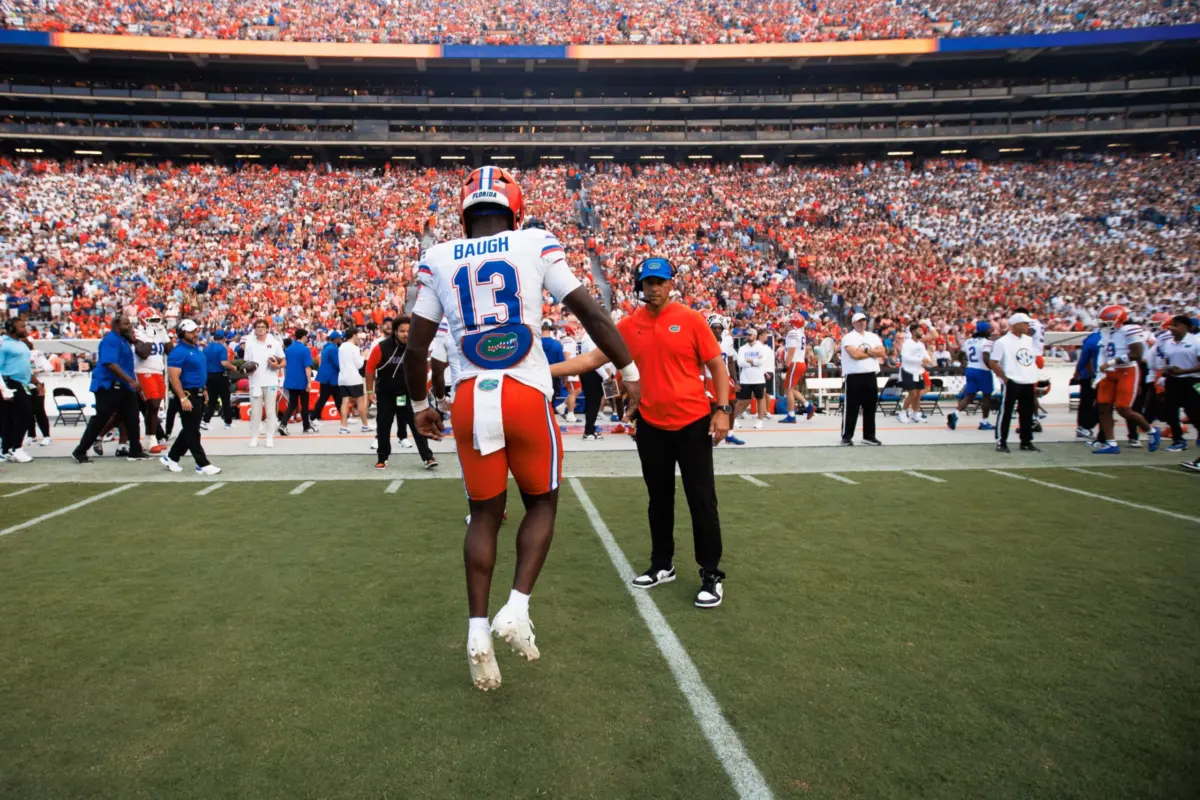

AUBURN, Ala. — College football rivalries in the Southeastern Conference are rarely short on theater, but the latest chapter of the historic Florida-Auburn clash delivered a script that neither head coach could have entirely anticipated. In a high-stakes, high-scoring SEC opener on Saturday night, the Florida Gators marched into Jordan-Hare Stadium and weathered a furious late-game surge to outlast the Auburn Tigers 44-39.
The contest served as an early-season measuring stick for two prestigious programs undergoing massive cultural and structural overhauls. Both Florida’s Jon Sumrall and Auburn’s Alex Golesh are navigating the treacherous waters of Year 1 at their respective institutions, tasked with restoring championship standards to campuses accustomed to gridiron excellence. For Sumrall, this Saturday night under the Alabama lights yielded a signature, program-defining road victory, improving the Gators to 3-0 for the first time since 2019.
The engine driving Florida’s offensive explosion was junior running back Jadan Baugh, whose bruising, relentless style of play dismantled Auburn’s defensive front. Baugh churned out 162 yards and three touchdowns on 26 carries, completely taking over the contest in the second half. Supported by an efficient passing game orchestrated by Aaron Philo and a series of brilliant play-calls, the Gators put on a masterclass in offensive balance, racking up 245 yards on the ground and 252 through the air for a total of 497 yards of total offense.
Yet, for all of Florida’s dominance through the middle and late stages of the game, the final scoreline indicates a contest that hung in the balance until the game’s dying moments. Auburn (2-1), plagued by early-game catastrophes and offensive stagnation, woke from a slumber in the second quarter and fought tooth and nail behind the dual-threat heroics of quarterback Byrum Brown. Brown orchestrated a frantic, late-game aerial assault—culminating in a desperate 35-yard Hail Mary touchdown to Chaz Nimrod with just 24 seconds remaining—that forced the Gators to sweat out every final tick of the game clock.
Ultimately, however, Auburn’s catastrophic start and defensive breakdowns proved insurmountable. As the dust settled on a pulsating 83-point SEC opener, Florida walked off the sacred turf of Jordan-Hare Stadium with a statement win, while the Tigers were left to pick up the pieces of an erratic performance that exposed deep-seated vulnerabilities on both sides of the ball.
Detailed Chronology: How the Battle at Jordan-Hare Unfolded
The atmosphere inside Jordan-Hare Stadium was electric as the referee’s whistle blew to kick off the Southeastern Conference schedule for both Florida and Auburn. The initial exchanges, however, were characterized by a staggering disparity in offensive preparedness and execution.
The First Quarter: Auburn’s Offensive Void and Florida’s Early Momentum
While Florida hit the ground running with a deliberate, physical game plan designed to establish the line of scrimmage, Auburn’s opening sequence of possessions can only be described as a complete disaster. Tigers head coach Alex Golesh watched in dismay as his offense retreated into a shell from the opening whistle.
Auburn’s first three drives of the evening were textbook definitions of futility: three-and-out, three-and-out, and another three-and-out. The Tigers’ offensive line struggled to generate any push against a surprisingly aggressive Florida front seven, and by the end of the opening quarter, Auburn had actually accumulated minus-3 yards of total offense. The home crowd sat in stunned silence as the Gators capitalized on the short fields gifted by the stagnant Auburn offense, putting early points on the board to establish control.
The Second Quarter: The Awakening of the Tigers and the Momentum Shift
Just as prognosticators were beginning to write off the Tigers as thoroughly outclassed, Auburn’s offense finally discovered a pulse. Trailing comfortably, the Tigers broke out of their lethargy by embarking on a stunning 16-play, 150-yard sequence that completely flipped the momentum of the half.
Quarterback Byrum Brown began finding rhythm in the quick-passing game, utilizing his legs to escape collapsing pockets and converting crucial third downs. The Tigers engineered two rapid scoring drives, showcasing the explosive potential that Golesh has continually preached since taking over the program. By the time the dust settled on the first half, Auburn had miraculously clawed its way back, knotting the score at 17-17 just moments before the halftime whistle.
The sudden surge electrified the Jordan-Hare faithful, turning what had the makings of a blowout into a heavyweight prize fight heading into the locker rooms.
The Third Quarter: Baugh Takes Over and the "Double Pass" Dagger
If the first half belonged to Auburn’s dramatic recovery, the third quarter belonged entirely to Jadan Baugh and the Florida ground game. Recognizing that the Tigers were vulnerable on the interior, Sumrall and his offensive staff leaned heavily on their bell-cow back.
Baugh imposed his will in the trenches, churning out 106 of his 162 yards and scoring two of his three touchdowns in the second half alone. Every time Auburn’s defense appeared to have him bottled up, Baugh bounced off arm tackles, kept his legs churning, and picked up vital yards that drained the clock and demoralized the Tigers’ front seven.
Compounding Auburn’s defensive misery was a moment of trickeration that effectively broke the back of the Tigers’ secondary. Midway through the half, seventh-year receiver Kahleil Jackson took a lateral on a trick play, cocked his arm, and launched a deep, spiral-perfect 48-yard pass downfield to a wide-open Amir Jackson. The explosive play caught Auburn’s defense completely flat-footed, setting up another Florida score and expanding the lead to a comfortable margin.
As the fourth quarter dawned, Auburn found itself trapped in familiar territory: forced to abandon its running game, rely strictly on the arm of Byrum Brown, and fight desperately against a mounting deficit and an unrelenting Florida clock-management scheme.
The Fourth Quarter: A Desperate Late-Game Barrage
As the game bled into its final frame, Florida’s defense—despite concerns voiced by Sumrall prior to kickoff—tightened the screws. The Gators generated four critical sacks in the second half, continually disrupting Byrum Brown’s timing and forcing Auburn into long-yardage situations. Compounding their strategic woes, the Tigers self-destructed with undisciplined play, accumulating six penalties down the stretch that stalled potential scoring drives.
Yet, Byrum Brown refused to go quietly into the night. With Florida holding a seemingly insurmountable lead late in the game, Brown engineered a frantic, pass-heavy comeback attempt. He completed 20 of 35 passes on the night for 271 yards, accounting for four total touchdowns (three through the air and one on the ground) alongside 65 rushing yards.
The climax of Auburn’s desperate rally occurred with just 24 seconds remaining on the game clock. Facing a frantic scenario, Brown uncorked a prayer—a soaring 35-yard Hail Mary heave toward the end zone. Wide receiver Chaz Nimrod fought through a maze of Florida defensive backs to haul in the miraculous reception, electrifying the remaining fans and narrowing the gap to 44-39.
Unfortunately for the home side, the miraculous grab came too late. Florida recovered the ensuing onside kick attempt, allowing the offense to safely kneel out the remaining seconds and seal a hard-fought, pulse-pounding road victory.
Supporting Context & Metrics: Analyzing the Numbers Behind the Battle
To truly understand how Florida managed to escape Auburn with a victory, one must dive deep into the statistical underpinnings of the contest. The box score reveals a game of stark contrasts, where dominant stretches by both offenses were countered by glaring structural deficiencies.
Florida’s Offensive Dominance and Balance
The Gators’ offensive performance was nothing short of surgical, particularly when considering the hostile road environment. Florida finished the night with 497 total yards, perfectly split between the run and the pass:
- Total Rushing Yards: 245 yards
- Total Passing Yards: 252 yards
- Yards Per Play: Highly efficient across all four quarters.
At the heart of this offensive machine was Jadan Baugh. His stat line—26 carries for 162 yards and three touchdowns—translates to a robust 6.2 yards-per-carry average. Baugh’s ability to consistently pick up positive yardage kept the chains moving and allowed Florida to control the time of possession.
Through the air, quarterback Aaron Philo managed the game with maturity and poise, completing efficient passes to stretch the Auburn defense horizontally. Philo finished with 202 yards and a touchdown, spreading the wealth among a talented receiving corps. Vernell Brown III led the wideouts with five receptions for 86 yards, while Dallas Wilson contributed four catches for 74 yards, including a highlight-reel touchdown catch.
Furthermore, running back Duke Clark added valuable depth to the backfield, churning out 50 yards and a touchdown of his own, punctuated by a bruising run where he bounced off multiple Auburn defenders en route to paydirt.
Auburn’s Statistical Paradox: Flashes of Brilliance and Fatal Flaws
For the Tigers, the final statistics paint a picture of a team playing catch-up for sixty minutes. Auburn finished the game with 373 yards of total offense, but the distribution of those yards highlights a deeply flawed performance.
- Total Rushing Yards: 102 yards (heavily dependent on Byrum Brown’s scramble yardage)
- Total Passing Yards: 271 yards
- First-Half Turmoil vs. Second-Half Output: Minus-3 yards in the first quarter alone, followed by a sudden burst that leveled the score at halftime.
Alex Golesh’s offense was utterly one-dimensional for large stretches of the game. With the running game completely shut down by Florida’s defensive front (yielding a meager 102 total yards on the ground), the Tigers were forced to rely disproportionately on the right arm of Byrum Brown. While Brown delivered an admirable individual performance—accounting for 336 total yards (271 passing, 65 rushing) and four total touchdowns—the lack of a balanced attack exposed the offense to constant pressure.
Florida’s pass rush took full advantage of this predictability, relentlessly hunting down Brown in the second half and registering four crucial sacks. Coupled with six costly penalties, Auburn’s self-inflicted wounds continually undermined their ability to sustain drives when it mattered most.
Official Statements: Post-Game Reactions from the Head Coaches
The emotional temperature in the post-game press conferences could not have been more different, reflecting the divergent realities of a victorious road team and a stunned home squad.
Jon Sumrall: Gratified by the Offense, Vigilant on Defense
For Florida head coach Jon Sumrall, securing a signature victory in Gainesville’s first high-profile SEC road test of his tenure was a massive validation of the program’s trajectory. However, the pragmatic coach made it clear that while his offense exceeded expectations, his defensive unit still has plenty of room for improvement.
"I knew what we were going to do on offense tonight. … I had no doubt," Sumrall stated firmly during his post-game media session. "I was probably more concerned about our defense, to be honest with you."
Sumrall’s candid assessment underscores the high standards he is trying to instill in the Swamp. While the Gators’ offense executed brilliantly—scoring 44 points and punishing Auburn on the ground—giving up 39 points and allowing a late-game Hail Mary touchdown are metrics that a defensive-minded coach like Sumrall will undoubtedly address in the film room this week. Nevertheless, starting the season 3-0 for the first time in seven years provides an invaluable reservoir of confidence as the schedule drastically intensifies.
Alex Golesh: Frustrated by Slow Starts and Inopportune Explosives
On the other sideline, Auburn head coach Alex Golesh cut a frustrated figure as he dissected his team’s second consecutive sluggish start to a game. Golesh did not mince words when evaluating the abysmal opening sequences that put his team behind the eight-ball.
"The first three drives were abysmal: three-and-out, three-and-out, three-and-out," Golesh lamented. "About as abysmal as you can get, and then just leave the defense out there for as long as we do."
When asked about the turning point of the game, Golesh pointed directly to the explosive plays surrendered by his secondary during the middle stanzas of the contest, specifically highlighting the back-breaking trick play that completely altered the field position battle.
"Story of the game is that middle part of it," Golesh explained. "The defensive explosives, obviously the double pass was a dagger, the explosives given up. Don’t know how many that was, but it felt like it’s inopportune times, and then you’re fighting back and going back."
The message from the Auburn locker room is clear: until the Tigers can eliminate slow starts, avoid self-destructive penalties, and find consistency across all four quarters, competing at the elite tier of the Southeastern Conference will remain an uphill battle.
Future Outlook: The Road Ahead in the SEC
As the confetti settles and the film sessions begin, both Florida and Auburn must quickly pivot their focus toward the daunting challenges waiting for them on the immediate horizon. In the merciless landscape of the Southeastern Conference, there is never any time to dwell on the past—win or lose.
Florida Gators: Preparing for a Monster Test Against Ole Miss
For Jon Sumrall and the Florida Gators, the reward for a gritty, hard-fought road victory in Auburn is a brutal return to Gainesville to face elite national competition.
Next Saturday, the Gators will welcome the No. 8 Ole Miss Rebels into the Swamp for a massive, high-stakes showdown. If Florida’s defense was exposed down the stretch by Byrum Brown’s aerial attack, they will face an even more formidable test against the high-powered offensive schemes of the Rebels. However, if Jadan Baugh and the offensive line can replicate their punishing ground performance, and if Aaron Philo can maintain his efficiency, the Gators will have a legitimate opportunity to shock the college football world and prove that their 3-0 start is merely the prelude to a special season in Gainesville.
Auburn Tigers: Regrouping to Host Vanderbilt
For Alex Golesh and the Auburn Tigers, the immediate mission is one of internal repair and stabilization.
The Tigers will return to the friendly confines of Jordan-Hare Stadium next Saturday to host the Vanderbilt Commodores. While on paper this matchup appears more forgiving than a battle against an SEC heavyweight, Golesh’s post-game comments make it abundantly clear that Auburn cannot afford to overlook any opponent. Fixing the offensive line protection issues, eliminating the drive-killing penalties, and—most importantly—finding a way to avoid the disastrous, stagnant three-and-outs that have plagued them for two straight weeks will be the primary points of emphasis during practice.
As the 2026 college football season gathers momentum, Saturday night’s thriller in Auburn serves as a microcosm of the SEC as a whole: razor-thin margins of error, relentless offensive explosions, and an unforgiving schedule that tests the mettle of every coach, player, and program daring to chase greatness.

0 Comments