

Executive Overview
For more than a quarter of a century, Daniel Wallace and Laura Kellison Wallace viewed their Chapel Hill, North Carolina, property through the predictable lens of suburban wildlife co-existence. Raccoons periodically rummaged through their attic spaces, and the occasional opossum traversed the garden borders. However, the ecosystem of their domestic perimeter shifted fundamentally in January 2026, when a solitary gray fox (Urocyon cinereoargenteus) materialized at the edge of their yard, cutting a silhouette that initially resembled an oversized Persian cat.
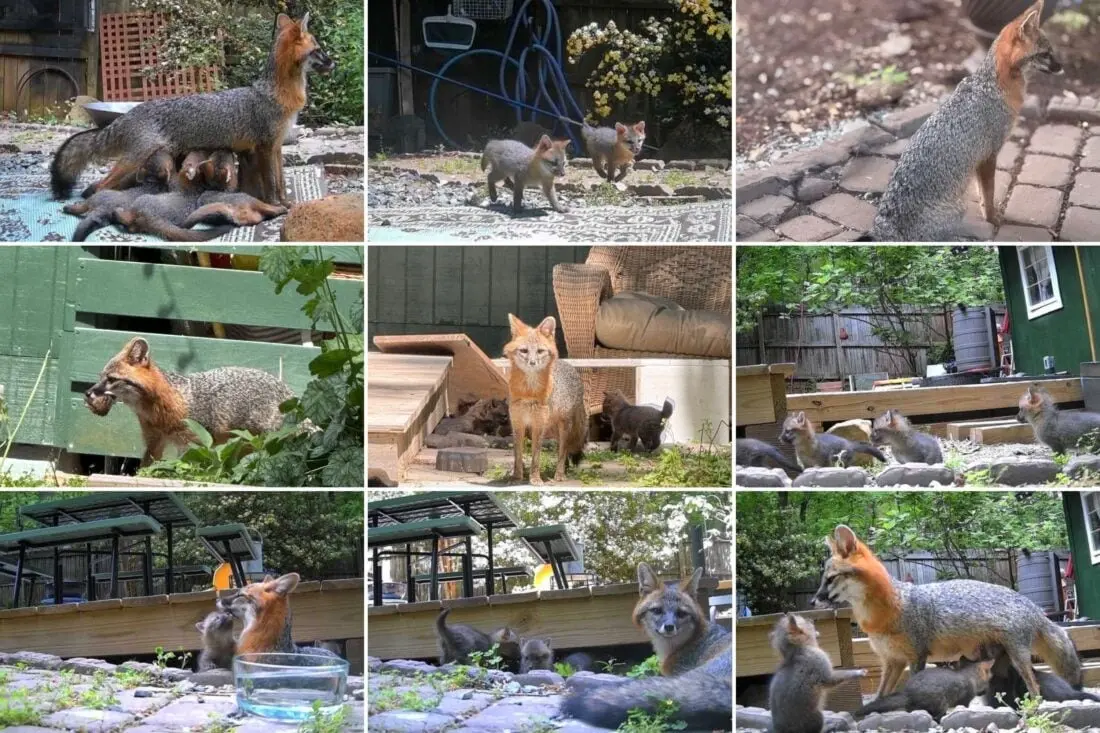
What began as a fleeting glimpse evolved into an immersive, multi-month cohabitation with a breeding pair and their litter of six kits, which established an underground nursery directly beneath the Wallaces’ wooden deck. This unexpected residency upended the homeowners’ daily routines, transforming a suburban backyard into an avian and mammalian amphitheater.
Documented extensively through motion-activated trail cameras and direct observation, this urban-wildlife interface offers a rare, granular look at gray fox parenting dynamics, the developmental stages of wild canids, and the psychological impact of sudden proximity to unblemished nature. In an era marked by habitat fragmentation and the encroachment of coyote populations (Canis latrans) across the American Southeast, the Wallaces’ experience underscores both the adaptability of native carnivores and the profound emotional resonance of unexpected ecological encounters in our own backyards.
Detailed Chronology: From First Sighting to Sudden Departure
Phase I: The Discovery (January – April 2026)
The initial encounter in January proved ephemeral. The animal vanished within seconds, leaving the homeowners with a momentary sense of wonder. Three months later, in mid-April, subtle disturbances in the landscape alerted the household to potential activity. Gravel bordering the base of the back deck had been displaced, a sign initially misattributed to the property’s familiar population of raccoons.
Seeking to identify the nocturnal disturber, the Wallaces deployed wireless motion-activated trail cameras programmed to capture and transmit imagery every three seconds. On April 24, the technology yielded an astonishing revelation. The subsequent morning footage unveiled six tiny, round-headed kits peering tentatively through the deck boards, overseen by an intensely vigilant vixen.
The discovery triggered an immediate psychological shift among the homeowners, characterized by what they describe as "fox-euphoria." Recognizing the structural suitability of their fenced-in, quiet yard—which offered protection against encroaching coyote packs—the adult foxes had selected the property as a secure natal den site.
[Timeline of Residency]
January 2026      — Initial sighting of a solitary gray fox at garden edge.
Mid-April 2026    — Ground disturbance noted near deck gravel borders; trail cams installed.
April 24, 2026    — First confirmation of six newborn kits beneath the deck.
May 2026          — Peak activity period; intensive nursing, foraging, and socialization.
Early June 2026   — Dispersal phase begins; yard left vacant as the family relocates.
Phase II: The Domestic Hiatus (May 2026)
With eight wild canids taking up residence, human domestic priorities were instantly subjugated. Planned spring renovation projects—including deck sealing, power-washing, and the construction of a pergola—were indefinitely shelved. Outdoor social gatherings were canceled in deference to the resident wildlife.
The family room window transformed into a permanent viewing gallery. While gray foxes are traditionally characterized as crepuscular predators (most active during twilight hours), this specific family exhibited diurnal patterns, engaging in play and exploration throughout the daylight hours. Despite the temptation to intervene, the homeowners exercised strict behavioral discipline, withholding supplemental food to prevent habituation, save for occasional offerings of water and distant blueberries during severe heatwaves.
Phase III: The Architecture of Independence (Late May – Early June)
Observational data gathered via direct sightlines and trail camera logs revealed a sophisticated parenting strategy executed by the adult pair. The male dog fox functioned as the primary hunter, supplying sustenance to the nursing vixen while actively patrolling the perimeter against rival scavengers, including a notable nocturnal confrontation with a trespassing raccoon.
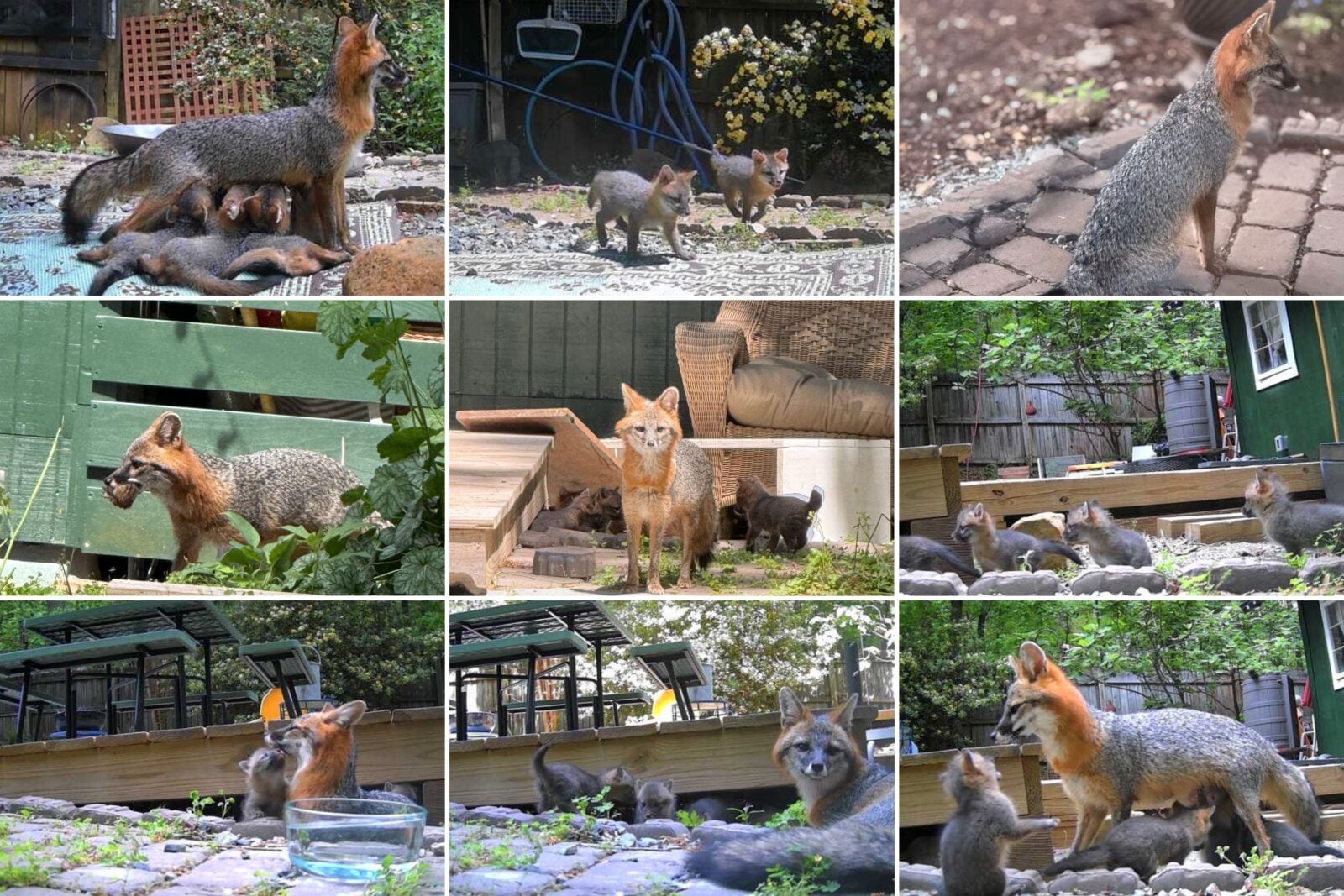
As the weeks progressed, the behavioral dynamics shifted toward forced independence. The vixen began employing calculated withdrawal techniques—moving short distances away from the kits and turning her back to break eye contact, effectively communicating a maternal mandate for self-reliance. By late May, the kits transitioned from uncoordinated stumbling to agile pouncing, exploring fence gaps, and testing arboreal skills along the low wooden deck frame.
Phase IV: The Dispersal (June 2026)
By the first week of June, the cadence of activity slowed markedly. The den entrance, previously churned and active, grew undisturbed. Morning trail camera logs registered empty frames. In alignment with natural developmental timelines, the family had abandoned the natal den site to transition into a broader territorial range before ultimate dispersal at approximately seven months of age.
Supporting Context & Metrics: The Biology of the Gray Fox
To contextualize the Chapel Hill residency, it is necessary to examine the distinct behavioral and ecological traits of Urocyon cinereoargenteus:
- Climbing Adaptations: Unlike most other canids, the gray fox possesses semi-retractile claws that allow it to scale vertical trees and navigate complex structures like deck framing. This adaptation grants it superior refuge options against ground predators.
- Habitat Selection: Gray foxes favor heterogeneous landscapes comprising a mix of deciduous forests, brushlands, and edge habitats. Suburban environments that retain structural cover (such as elevated decks and crawlspaces) increasingly serve as surrogate denning sites when natural hollow logs or rock crevices are scarce.
- Parental Investment: Both parents invest heavily in rearing. While the female manages lactation and direct care within the den, the male assumes primary provisioning duties during the altricial (helpless) stage of the kits.
- Litter Size: Average litters range from one to seven kits, making a successful rearing of six offspring a high-water mark for reproductive output in a suburban matrix.
Expert Perspectives and Professional Insights
The phenomenon of apex and meso-predators utilizing human-dominated landscapes is a subject of growing inquiry among wildlife biologists and conservationists. Dr. Daniel Wallace, professor and director of the creative writing program at the University of North Carolina at Chapel Hill, alongside Laura Kellison Wallace, an MSW transition and loss counselor, offer a unique synthesis of empirical observation and psychological reflection regarding the event.
"We went from raccoon-worry to fox-euphoria," the authors noted in their field reflections. "A family of foxes was living here! It was astonishing and insanely moving, and we felt, weirdly, a kind of honor, pride: They had picked us."
Wildlife management professionals frequently emphasize the importance of maintaining distance during such encounters. The Wallaces’ adherence to a non-interference protocol—resisting the urge to provision the animals with processed food or intensive hand-feeding—ensured that the six kits retained their natural foraging instincts, a critical factor in their subsequent successful dispersal into the greater North Carolina piedmont.
Psychologically, encounters of this magnitude serve to recalibrate human relationships with the immediate environment. Laura Kellison Wallace’s background in transition counseling mirrors the emotional arc experienced by households that host migratory or transient wildlife: an acute period of hyper-focus and joy, followed by the inevitable melancholy of detachment when the subjects return to the wild.
Future Outlook: Coexistence in the Anthropocene
As suburban development continues to expand into historical wildlife corridors across the American Southeast, encounters between humans and adaptable meso-predators like the gray fox will likely increase. The Chapel Hill case study provides a working model for passive urban wildlife management:
- Tolerance and Adaptation: Recognizing that structural intrusion by wildlife does not inherently necessitate lethal removal or animal control intervention.
- Technological Monitoring: Utilizing non-invasive tools—such as infrared trail cameras—to observe animal behavior without inducing human-induced stress or habituation.
- Preparedness for Dispersal: Acknowledging the temporary nature of natal dens; preparing emotionally for the inevitable departure of wildlife guests as juveniles reach independence.
Ultimately, the brief residency of the gray fox family beneath a Chapel Hill deck serves as a poignant reminder of the hidden ecological networks operating parallel to human domesticity. As E.B. White famously advised, remaining vigilant for the presence of wonder transforms ordinary suburban property into a dynamic theater of natural history.

0 Comments