

Executive Overview
The race for the United States Senate seat representing Georgia has taken an increasingly contentious and volatile turn. U.S. Representative Mike Collins, the Republican challenger seeking to unseat Democratic incumbent Senator Jon Ossoff, has found himself at the center of a rapidly escalating political firestorm. The controversy ignited following a sharp, direct challenge from Senator Ossoff during a high-profile campaign stop in Atlanta, where the incumbent demanded the immediate public release of all correspondence between Representative Collins, his congressional staff, and various extremist figures.
The unfolding political clash highlights the increasingly polarized nature of modern American elections, where allegations of associations with fringe groups and extremists can rapidly dominate the news cycle. While Senator Ossoff has framed his demand around issues of government accountability, public integrity, and the misuse of official resources, Representative Collins has aggressively pushed back, vehemently denying the accusations, condemning all forms of hate speech and antisemitism, and pivoting to counter-accuse his opponent of maintaining troubling political associations of his own.
As both campaigns gear up for the general election cycle—with rallies crisscrossing the state from metropolitan hubs like Atlanta to South Georgia communities such as Thomasville and upcoming stops in Houston County—the narrative has shifted from traditional policy debates over the economy, healthcare, and infrastructure to fundamental questions regarding political ethics, transparency, and association. This investigative overview examines the timeline of the confrontation, the core allegations raised by both camps, the broader context of political polarization in Georgia, and what this high-stakes feud means for the trajectory of one of the most closely watched Senate races in the country.
Detailed Chronology of Events
The latest flashpoint in the Georgia Senate race did not emerge in a vacuum, but it reached a dramatic boiling point over the course of a single, high-intensity 24-hour campaign cycle that stretched from the state capital to the rolling hills of South Georgia.
Tuesday Morning: The Atlanta Demands
The political escalation began on Tuesday in Atlanta, where Senator Jon Ossoff took the stage during a heavily attended campaign event. Steering away from standard stump-speech talking points, Ossoff launched a blistering critique of his Republican challenger, specifically targeting the operations of Collins’ congressional office.
Standing before supporters and members of the press, Ossoff issued an ultimatum that immediately made waves across state and national political circles. He demanded that Representative Collins release all logs, emails, text messages, and other forms of communication exchanged between his congressional office, his political associates, and individuals whom Ossoff characterized as "notorious white nationalists with ties to Collins or his office."
"His office is intervening using official resources on behalf of a prominent Holocaust denier," Ossoff declared to the crowd, raising the stakes of the confrontation significantly. "And his senior staff is briefing some of the nation’s most notorious white supremacists on those efforts. Congressman Mike Collins needs to come out today, and he needs to release these records and these communications in full."
The specificity of Ossoff’s allegations—pointing toward the alleged use of official congressional resources and staff involvement—transformed the rhetorical attack from a standard campaign disagreement into a potential matter of congressional ethics and institutional integrity.
Tuesday Afternoon: The Thomasville Rally and Collins’ Counter-Punch
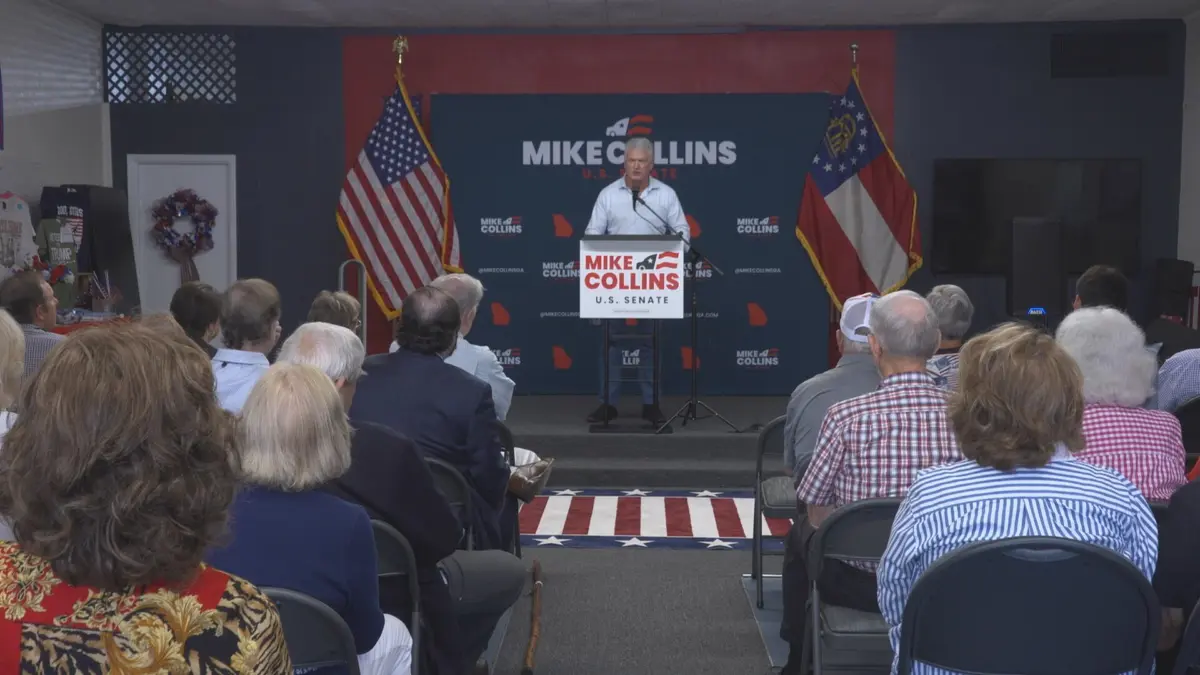
Later that same day, Representative Collins maintained his scheduled campaign itinerary, traveling south to Thomasville, Georgia, for an evening rally. Despite the growing controversy brewing in media circles following Ossoff’s morning remarks, the venue in Thomasville was nearly packed with local community members and Republican faithful eager to hear the challenger’s vision for the state.
Collins addressed the audience, detailing his platform and policy proposals focused on Georgia’s economic growth, agricultural interests, and conservative governance. However, the shadow of the morning’s accusations hung heavily over the event.
Following the conclusion of the rally, Collins addressed reporters and supporters directly, pushing back forcefully against the narrative pushed by the incumbent senator. Rather than merely denying the claims, Collins went on the offensive, turning the allegations back toward Ossoff and questioning the incumbent’s own record on condemning extremism.
"I have always condemned hate speech, antisemitism, always condemned them," Collins stated firmly when pressed by local media following the rally. "I don’t care where the source is. But Jon Ossoff, he hasn’t even done that; where is he at?"
By framing Ossoff’s immediate silence or perceived failure to address broader ideological questions as a deficiency, Collins sought to neutralize the damaging nature of the white nationalism allegations by shifting the burden of proof back onto the incumbent.
Supporting Context & Metrics
To understand the gravity of this clash, one must examine the broader political topography of Georgia. Long considered a reliably red Southern stronghold, Georgia has undergone a profound political metamorphosis over the past decade, transforming into one of the premier battleground states in American politics.
The Georgia Battleground Dynamic
Following historic statewide victories for Democrats in recent election cycles—including Jon Ossoff’s razor-thin runoff victory in 2020 and subsequent federal wins—every statewide office in Georgia is now viewed through a microscope by national political strategists, donors, and media outlets. In a state where statewide elections are routinely decided by razor-thin margins of one to two percentage points, narrative warfare becomes a critical instrument for mobilization and persuasion.
- Voter Demographics: Georgia’s electorate is deeply divided along geographic, racial, and ideological lines. The rapidly growing, diverse Atlanta metropolitan area serves as a stronghold for Democratic candidates like Ossoff, while rural and suburban South Georgia—typified by communities like Thomasville and Houston County—remain vital power centers for conservative Republicans like Collins.
- The Power of Extremism Allegations: In modern American politics, accusations tying candidates to fringe extremist movements are among the most potent weapons deployed in campaigns. They are designed not only to sway undecided, moderate voters in the center but also to energize party bases by raising the perceived stakes of the election.
- Institutional Scrutiny: By dragging allegations of misuse of official congressional resources into the public square, Ossoff’s campaign has attempted to elevate the dispute from partisan mudslinging to a structural critique of how Collins manages his taxpayer-funded congressional office.
The Logistics of the Campaign Trail
As both candidates navigate the physical and political geography of Georgia, their itineraries reflect their strategic priorities:
- Urban Centers vs. Rural Strongholds: Ossoff’s choice of Atlanta to drop his transparency ultimatum underscores his reliance on urban and suburban turnout to drive his narrative. Conversely, Collins’ choice of Thomasville and upcoming stops in Houston County highlights the traditional Republican strategy of shoring up enthusiastic support in deep-red rural enclaves.
- The Media Ecosystem: The rapid dissemination of these charges and counter-charges demonstrates the power of regional media networks, such as WCTV and other local outlets, in capturing the localized ripples of a statewide battle that quickly garners national attention.
Official Statements and Rhetorical Analysis
A close examination of the rhetoric deployed by both campaigns reveals distinct political strategies aimed at shaping public perception regarding morality, accountability, and political courage.
Senator Jon Ossoff’s Stance: The Accountability Frame
Senator Ossoff’s camp has chosen to frame their offensive around the pillars of transparency and ethical governance. By explicitly mentioning "official resources" and "senior staff," Ossoff attempts to move beyond abstract ideological disagreements and point toward actionable, documented behavior within the halls of federal power.
- Key Rhetorical Elements:
- Urgency: Words like "demand," "today," and "in full" create an immediate sense of crisis and demand a swift response.
- Institutional Integrity: By invoking the misuse of resources, Ossoff positions himself as a defender of public trust against alleged ethical lapses by his opponent’s legislative office.
- Moral Clarity: Pointing to specific categories of extremism—such as Holocaust denial and white supremacy—places the allegation on high moral ground, making it difficult for an opponent to simply brush off as standard political spin.
Representative Mike Collins’ Stance: The Defense and Counter-Attack
Representative Collins has adopted a two-pronged strategy: absolute categorical denial combined with a tactical pivot that questions the integrity and consistency of his opponent.
- Key Rhetorical Elements:
- Categorical Denial & Condemnation: Collins immediately sought to inoculate himself against the toxicity of the labels by offering an unequivocal condemnation of hate speech and antisemitism. By stating, "I don’t care where the source is," he attempts to project impartiality and principled opposition to prejudice.
- The Counter-Accusation: Rather than getting bogged down in defensive explanations regarding staff communications, Collins immediately turned the spotlight back onto Ossoff ("where is he at?"). This diversionary tactic forces reporters and observers to question whether the incumbent is applying double standards or failing to police his own political alignment.
Future Outlook: What Lies Ahead in the Senate Race
As the Georgia Senate race moves past this latest controversy, the trajectory of both campaigns will be heavily influenced by how effectively each candidate can manage the fallout and pivot back to core voter concerns.
Upcoming Campaign Milestones
The immediate future of the campaign features several key events that will test the resilience of both candidates:
- The Houston County Rally: Representative Collins is scheduled to hold another major campaign rally in Houston County, Georgia, on September 23. This event will serve as a crucial barometer of whether the Thomasville momentum holds and how grassroots supporters in Central Georgia react to the ongoing war of words over transparency.
- Potential Calls for House Ethics Inquiries: Depending on whether Senator Ossoff or investigative journalists uncover or produce concrete documentation supporting the claims of official resource misuse, this political spat could potentially escalate into formal requests for House Ethics Committee reviews or independent investigations, which would inject a severe institutional hurdle into Collins’ legislative and campaign schedule.
- Debates and Media Forums: As the general election approaches, debates and joint media appearances will provide the ultimate crucible for these competing narratives. Both candidates will inevitably be forced to answer directly to moderators and voters regarding these allegations of associations and ethics.
Conclusion
The clash between U.S. Representative Mike Collins and Senator Jon Ossoff over transparency, white nationalism allegations, and official resource utilization underscores the high-stakes, hyper-polarized reality of modern Georgia politics. What began as an explosive morning demand in Atlanta quickly morphed into a cross-state rhetorical duel, with Ossoff pressing for institutional accountability and Collins fighting back with sweeping denials and counter-accusations.
As the campaign trail winds its way from Thomasville to Houston County and beyond, voters are left to weigh competing claims of integrity and transparency. Ultimately, the durability of this controversy—and its impact at the ballot box—will depend on whether concrete evidence emerges to substantiate the dramatic claims made in Atlanta, or if the uproar fades into the cacophony of an increasingly fierce and closely contested Senate battleground.

0 Comments