
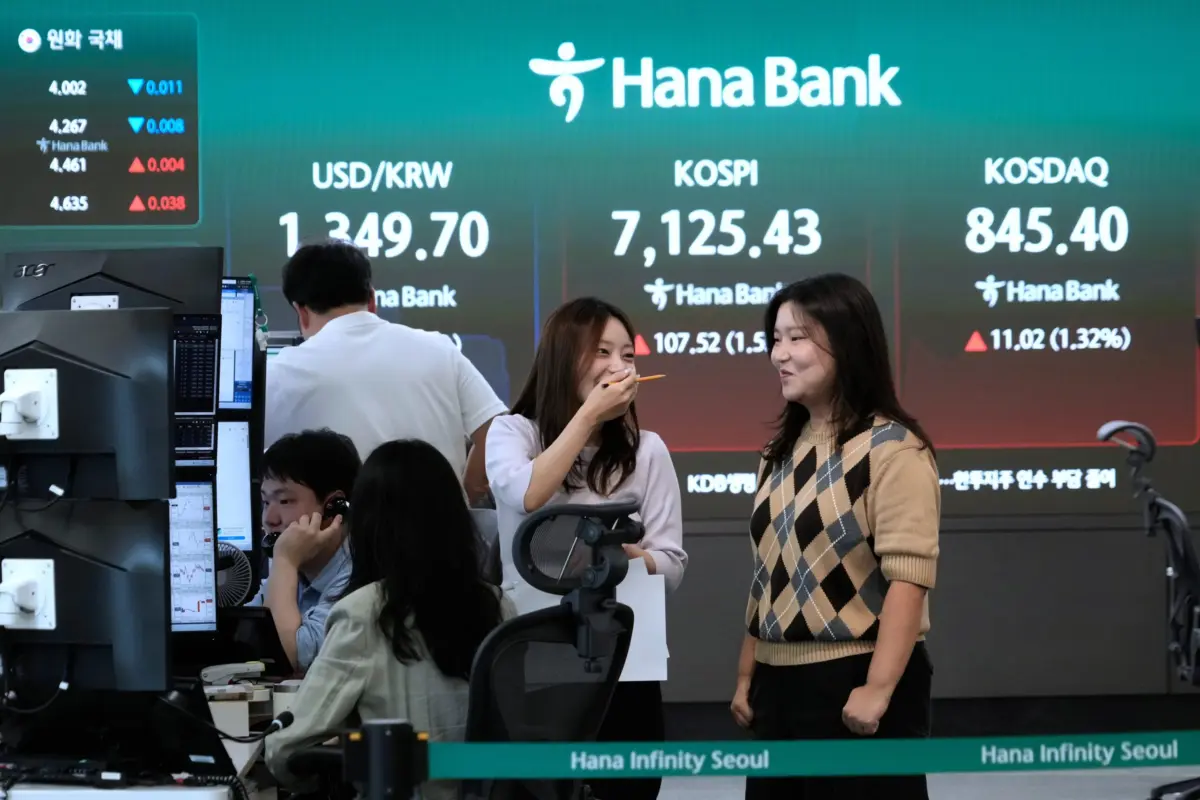

HONG KONG — Asian stock markets presented a mixed picture during Wednesday trading sessions, reacting to a confluence of shifting geopolitical developments, declining oil prices, and the persistent gravitational pull of Wall Street, which continues to hover near historic record highs. Investor sentiment was largely steered by sudden diplomatic overtures between the United States and Iran, ongoing scrutiny over the artificial intelligence (AI) sector, and anticipation surrounding high-stakes macroeconomic events on the horizon.
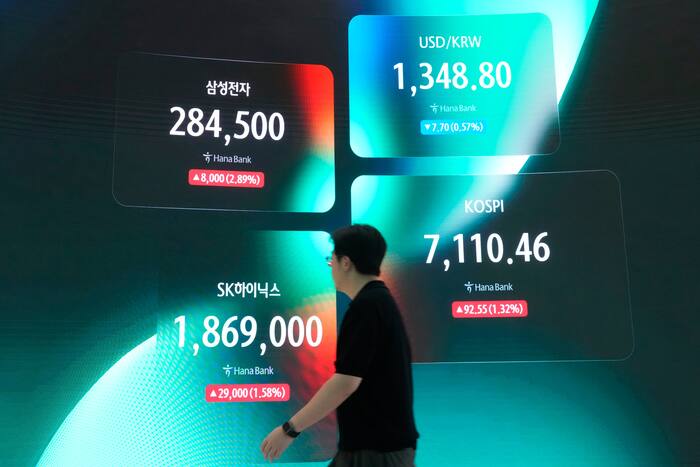
While U.S. stock futures pointed upward during Asian morning hours, regional indexes displayed a divergence in performance. South Korea’s benchmark Kospi advanced 0.5% to close at 7,052.75, heavily supported by rallies in heavyweight technology names. Conversely, Hong Kong’s Hang Seng index pulled back 0.8% to 24,896.04, and mainland China’s Shanghai Composite slipped 0.4% to 3,938.08. Australia’s S&P/ASX 200 gained 0.3% to finish at 8,779.80, while Taiwan’s Taiex rose 0.6% and India’s Sensex ticked up 0.3%. Japan’s benchmark Nikkei 225 remained closed for a national holiday, with normal trading set to resume on Thursday.
Executive Overview
The primary market catalyst for Wednesday’s trading session stemmed from the energy markets, where crude oil prices retreated following a surprising diplomatic breakthrough on the sidelines of the United Nations General Assembly in New York. U.S. President Donald Trump announced that American and Iranian officials had held a "very good" meeting, easing immediate fears of a catastrophic escalation in the Middle East.
This diplomatic window reduced the risk premium baked into global energy supplies, sending international oil benchmarks below the psychological $100-per-barrel threshold. Meanwhile, major Asian technology stocks found renewed footing following a strong session on Wall Street, where the tech-heavy Nasdaq composite reached a fresh record high. Investors across international hubs are increasingly weighing the dual pressures of macroeconomic stabilization and fast-moving technological transformations, notably the global debate over artificial intelligence development and its regulatory and economic implications.
Detailed Chronology of Events
The unfolding market narratives began earlier in the week in New York, setting off a chain reaction across global financial centers:
- Monday Evening (New York Time): President Trump addressed the annual United Nations General Assembly, delivering a fiery speech in which he oscillated between the prospect of a transformative diplomatic arrangement with Tehran and an explicit threat of military annihilation if a comprehensive nuclear and regional stability deal could not be brokered. "Will a deal be made with Iran that lets them rebuild and create a far greater country than it ever was before, maybe one of the greatest in the Middle East or even the world?" Trump asked the assembly. "Or do I annihilate the Islamic Republic and do it quickly, never giving them a chance to kill and destroy people and countries again?"
- Tuesday Afternoon: Despite the aggressive rhetoric, back-channel diplomacy yielded unexpected results. U.S. and Iranian officials met privately on the sidelines of the U.N. summit. President Trump subsequently described the discussions as "very good," sparking immediate relief across global commodities markets.
- Tuesday Close (Wall Street): Buoyed by the cooling geopolitical rhetoric and continued strength in high-growth technology shares, U.S. markets performed resiliently. The benchmark S&P 500 edged down by a negligible margin of less than 0.1%, remaining near its all-time high. The Dow Jones Industrial Average dropped 0.4%, but the technology-heavy Nasdaq composite climbed 0.5% to close at a record high. Major semiconductor and tech giants—including Nvidia, Advanced Micro Devices (AMD), Broadcom, and Intel—posted notable gains.
- Wednesday Trading (Asia-Pacific): As Asian markets opened, traders digested the previous day’s events in New York. Oil prices sustained their downward trajectory below $100 a barrel. Regional equity markets split along sector lines; export-heavy semiconductor and memory chip manufacturers in South Korea and Taiwan rose alongside U.S. tech trends, while select mainland Chinese and Hong Kong indices drifted downward amid profit-taking.
Supporting Context & Metrics
The macroeconomic backdrop in late 2026 continues to be defined by commodity price volatility, central bank policy adjustments, and the exponential growth of artificial intelligence.
Energy Markets and the Iran Factor
Brent crude, the international benchmark, fell 0.9% on Tuesday to settle at $98.40 per barrel. While this drop offered a welcome reprieve to energy importers across Asia, oil prices remain elevated compared to levels seen earlier in the year. In late February—prior to the outbreak of the Iran conflict—Brent crude traded at roughly $72 per barrel. The persistence of prices near the $100 threshold underscores lingering structural anxieties regarding Middle Eastern supply chains, even as diplomatic channels remain open.
Technology Sector Performance and Semiconductor Resilience
In Asia, technology shares experienced localized volatility before finding upward momentum. Major regional players responded directly to Wall Street’s tech rally:
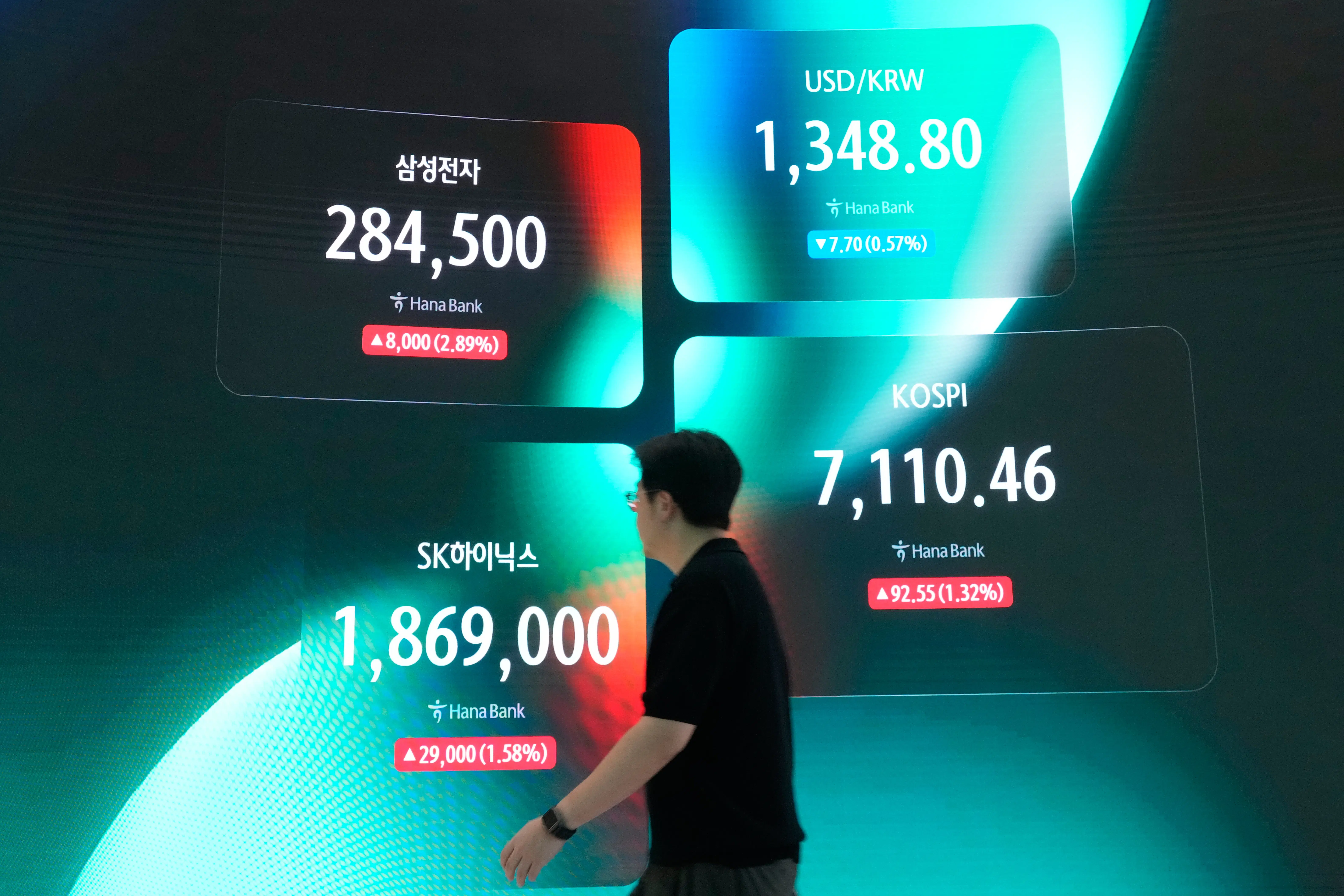
- Samsung Electronics Co.: Rose 2.6%, bolstered by sustained demand for memory chips optimized for AI workloads.
- SK Hynix: Added 0.4%, maintaining a strong trajectory in the memory sector.
- Taiwan Semiconductor Manufacturing Co. (TSMC): Advanced 1.2%, reflecting continued dominance in contract chip manufacturing.
In the United States, similar optimism drove gains:
- Nvidia Corporation: Climbed 0.7%.
- Advanced Micro Devices (AMD): Rose 1.3%.
- Broadcom: Added 0.5%.
- Intel Corporation: Gained 1.7%.
Currency Valuations
Foreign exchange markets reflected mild shifts in risk appetite. The U.S. dollar strengthened slightly against the Japanese yen, rising to 157.59 yen compared to 157.39 yen in the previous session. Meanwhile, the euro edged down to $1.1427 from $1.1449.
Official Statements and Diplomatic Undertones
The sudden shift in U.S.-Iran dynamics has caught international observers by surprise, altering the discourse at the United Nations General Assembly. President Trump’s public remarks juxtaposing sweeping economic prosperity for Iran against total military destruction served as a high-stakes prelude to the closed-door bilateral talks.
While official readouts from both Washington and Tehran regarding the U.N. sidelines meeting remain measured, market reactions indicate a high degree of confidence that immediate military escalation has been averted. Financial analysts note that the mere establishment of dialogue between American and Iranian representatives significantly de-escalates the immediate threat to Strait of Hormuz shipping lanes, which are critical for global petroleum distribution.

Beyond the Middle East, diplomatic focus is shifting toward Washington, where President Trump is scheduled to host Chinese President Xi Jinping for a high-level state visit. The agenda is expected to cover a wide spectrum of bilateral tensions, trade policies, and technological cooperation and competition.
Future Outlook
As global markets look toward the remainder of the week, investors are bracing for several critical developments that could dictate the trajectory of equities, commodities, and currencies:
- AI Regulation and Development Debates: Policymakers and industry leaders in the United States and international markets are increasingly at odds over whether to institute deliberate slowdowns or stringent guardrails on artificial intelligence development. Concerns regarding energy grid consumption, data privacy, and labor market disruptions are clashing with corporate desires to maintain rapid innovation cycles. These regulatory debates will heavily influence tech sector valuations in the coming quarters.
- The Trump-Xi Summit: The upcoming bilateral meeting between U.S. President Donald Trump and Chinese President Xi Jinping in Washington stands out as the premier geopolitical event of the week. Markets will be closely monitoring any announcements concerning trade tariffs, semiconductor export controls, and artificial intelligence frameworks. Any signs of a thaw or a hardening of stances between the world’s two largest economies will inevitably trigger immediate volatility across Asian and Western exchanges.
- Commodity and Energy Stability: While the recent U.S.-Iran meeting has successfully pressured oil prices below $100 a barrel, traders remain cautious. The sustainability of this price decline depends entirely on concrete diplomatic follow-ups and the uninterrupted flow of crude from the Persian Gulf. Any disruption in diplomatic talks could quickly reverse energy market gains, driving inflation concerns back to the forefront of monetary policy discussions.
Ultimately, global financial markets remain suspended in a delicate equilibrium—anchored by robust corporate earnings in the technology sector and resilient consumer demand, yet perpetually sensitive to the shifting winds of international diplomacy and macroeconomic policy.

0 Comments