
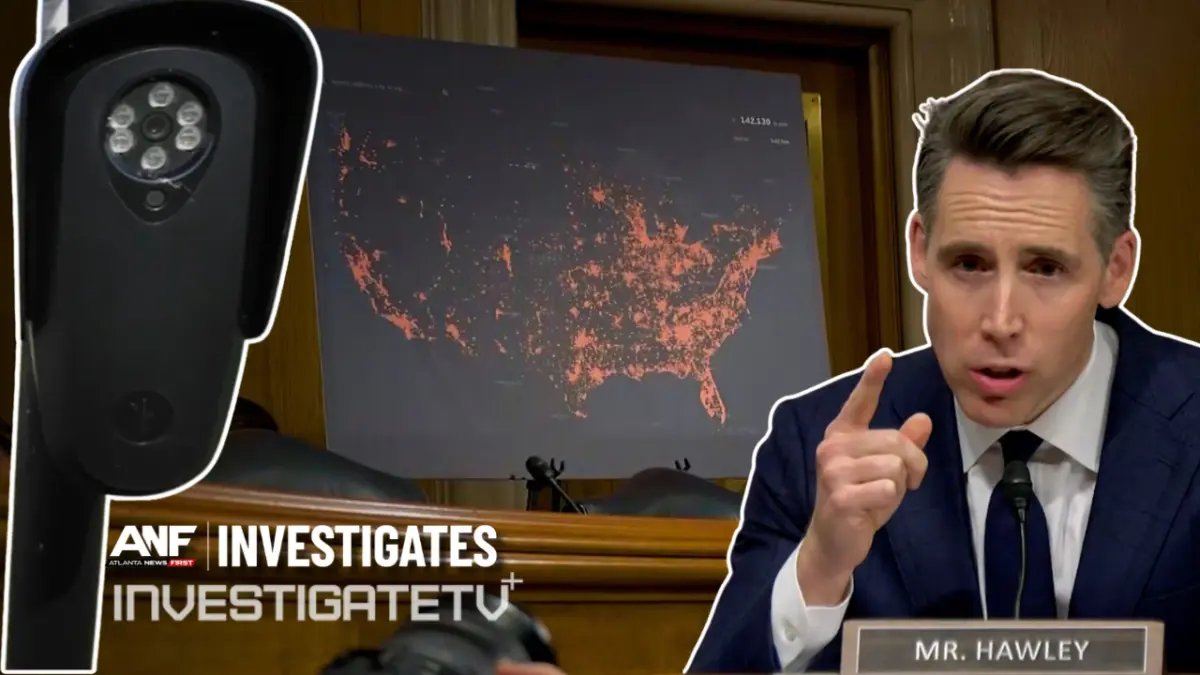

WASHINGTON, D.C. — In an empty row of designated seats at the witness table, the high-profile absence of America’s most powerful surveillance tech chief executives spoke louder than any prepared testimony could have.
Facing an impending wave of federal scrutiny born from months of deep investigative reporting by InvestigateTV and Atlanta News First, the leaders of the nation’s premier automated surveillance and law enforcement technology companies were absolute no-shows on Capitol Hill. The empty chairs underscored a deepening chasm between private tech giants cashing in on public-safety contracts and the lawmakers now scrambling to understand the systemic threats these interconnected systems pose to the United States Constitution.
The hearing before the Senate Judiciary Subcommittee on Crime and Counterterrorism—aptly titled “Always Watching: Flock’s Nationwide AI Surveillance Network”—was convened in direct response to an exhaustive, multi-part investigative series titled “Watching the Watchers.” That reporting laid bare a chilling reality: America’s roadways, neighborhoods, and public spaces are increasingly monitored by a private, cloud-connected intelligence apparatus that tracks the daily movements of everyday citizens, largely hidden from public view and devoid of meaningful federal oversight.
Executive Overview
For decades, the public conversation surrounding law enforcement technology centered on traditional tools like dashboard cameras, radar guns, and localized speed traps. However, the rapid convergence of cloud computing, artificial intelligence (AI), and automated license plate reader (ALPR) technology has transformed local police departments into nodes of a sprawling, nationwide surveillance grid.
At the center of this paradigm shift is Flock Safety, an Atlanta-based tech company operating a network of more than 120,000 automated cameras across the United States. Capturing millions of vehicle movements daily, Flock and its competitors—including Axon Enterprise, Motorola Solutions, and Verkada—have built hyper-connected data ecosystems. Law enforcement agencies across disparate jurisdictions can easily search, share, and cross-reference these historical logs, effectively eroding the practical obscurity that once protected the travel patterns of law-abiding citizens.
The Senate subcommittee hearing brought this quiet technological revolution into the harsh light of day. Lawmakers from both sides of the aisle confronted a litany of alarming findings:
- Police officers abusing state databases to stalk estranged partners and fellow officers;
- Innocent civilians mistakenly jailed for major felonies due to flawed algorithmic matches;
- Venture-capital-driven companies operating in regulatory grey zones with minimal transparency; and
- Major tech executives refusing to answer questions under oath before Congress.
As civil liberties groups demand a hard-line federal response—ranging from strict warrant requirements to outright federal funding bans—the debate over ALPRs has become a crucial test case for digital privacy in the 21st century.
Detailed Chronology: From Local Abuses to Capitol Hill
The Groundwork: Uncovering Systemic Misuse
The road to Capitol Hill began in local newsrooms rather than federal regulatory agencies. Months prior to the Senate hearing, investigative journalists Brendan Keefe of InvestigateTV and Atlanta News First launched a deep dive into how police agencies were utilizing Flock Safety’s sprawling database.
Their findings were startling. In Georgia alone, investigative reports uncovered at least 19 distinct instances over the span of a single year where law enforcement officers were either arrested or stripped of their badges for misusing the database. Rather than tracking violent felons or missing persons, these officers weaponized public safety infrastructure for unauthorized personal reasons: tracking down estranged romantic partners, surveilling neighbors, and stalking fellow law enforcement officers.
The Congressional Reckoning
Alarmed by these local abuses and the broader privacy implications of untettered algorithmic surveillance, U.S. Senator Josh Hawley (R-Missouri), chairman of the subcommittee, spearheaded the push for federal inquiry.
"The reporting on what these cameras can do is really pretty wild," Sen. Hawley remarked during the opening gavel. "The Constitution of the United States is still just as valid and applicable today as it was almost 250 years ago. We have to find a way to protect and enforce the Bill of Rights for every law-abiding citizen of the United States."
Hawley pulled no punches regarding the scale of the operation, warning attendees: "If you haven’t heard of Flock, Flock has probably heard of you."
Yet, despite receiving formal invitations to testify, the chief executives of the industry’s major players declined to appear. The empty seats belonged to:
- Garrett Langley, CEO of Flock Safety;
- Rick Smith, CEO of Axon Enterprise;
- Greg Brown, CEO of Motorola Solutions; and
- Filip Kaliszan, CEO of Verkada.
Their absence drew immediate rebukes from lawmakers, who interpreted the no-shows as a sign of corporate evasion in the face of mounting public accountability.
Supporting Context & Metrics: The Anatomy of Modern Surveillance
To understand why lawmakers are sounding the alarm, one must examine the fundamental evolution of surveillance technology. Traditional license plate readers were bulky, localized tools used primarily to flag stolen vehicles or cars tied to active warrants on a precinct-by-precinct basis. Data retention was typically short, and cross-jurisdictional sharing was tedious.
Today’s AI-powered ALPR networks are entirely different beasts.
[Flock & Competitor Cameras]
       │ (Captures Millions of Daily Vehicle Movements)
       ▼
[Cloud-Connected National Grid]
       │ (Retained & Searchable Across Jurisdictions for 30 Days)
       ▼
[AI Audit Tools & Automated Alerts]
       │ (Prone to Algorithmic Error & Insider Abuse)
       ▼
[Consequences: False Arrests, Stalking, & Civil Liberties Violations]
The Scale of the Grid
- 120,000+: The estimated number of Flock Safety ALPR cameras deployed nationwide.
- Millions: The volume of vehicle movements—including timestamps, vehicle makes, models, colors, and unique physical descriptors like bumper stickers or roof racks—captured and stored daily.
- 30 Days: The standard baseline retention period during which historical data remains searchable by police agencies across jurisdictional lines, though local data policies can vary wildly.
The Illusion of Transparency and Oversight
As public scrutiny mounted, Flock Safety introduced an AI-powered "audit assistance" tool earlier this year designed to flag suspicious internal queries for municipal supervisors. However, investigative findings revealed that this internal guardrail was largely reactive. In many cases, victims of database abuse only discovered they had been unlawfully tracked through independent public records requests or specialized third-party tools like haveibeenflocked.com.
Compounding transparency concerns, civil liberties watchdogs pointed out that Flock actively altered its interface features: removing officer names from external network searches and stripping license plate numbers entirely from system audit logs. Critics argue these changes severely impaired the public’s ability to verify whether their personal vehicles had been unlawfully searched or monitored.
Human Impact: The Human Cost of Algorithmic Errors
Behind the abstract debates over cloud infrastructure and constitutional guardrails lie profound human casualties. The Senate subcommittee heard firsthand testimony from individuals whose lives were upended by technological failures within the surveillance network.
Lindsay Issacs: Thirteen Days Behind Bars
Among the most harrowing accounts delivered to Congress came from Lindsay Issacs, a Florida woman whose life was derailed by an errant camera match.
Issacs was arrested by Florida state troopers and slapped with catastrophic criminal charges alleging she was responsible for a horrific vehicle accident that claimed three lives. The state’s entire case was built around a single automated camera hit generated by an ALPR system.
Despite having nothing to do with the tragedy, Issacs spent 13 days behind bars before a subsequent, thorough investigation proved that law enforcement had flagged the completely wrong vehicle.
"A Flock camera captured my vehicle a few miles from a terrible crash I had nothing to do with that led to 13 days in jail," Issacs testified, painting a vivid picture of how automated data matches can short-circuit basic due process.
Official Statements and Expert Testimony
The subcommittee hearing featured a diverse panel of experts, law enforcement officials, and civil rights advocates who detailed the multi-faceted nature of the surveillance threat.
The Law Enforcement Perspective: A "Chilling" Response
Sheriff Ross Teeple of Pinal County, Arizona, offered a nuanced view from the front lines of policing. While acknowledging the genuine utility of ALPR technology in tracking violent offenders—such as a local incident where cameras successfully tracked an aggressive driver who forced a woman’s car into oncoming traffic—Sheriff Teeple expressed deep alarm over corporate opacity.
Teeple described how he contacted Flock Safety to inquire about the exact role of artificial intelligence within their proprietary equipment. While initial assurances claimed no AI was utilized, subsequent company statements directly contradicted that claim.
"The response I received was chilling," Teeple testified before the Senate panel. "I was told, ‘That wasn’t the AI you were asking about.’"
Digital Vulnerabilities and Security Flaws
Independent security researcher Benn Jordan brought a different sort of warning to Capitol Hill, focusing on systemic digital hygiene and cybersecurity. Jordan famously discovered dozens of Flock cameras streaming sensitive, real-time video feeds openly online due to basic security oversights.
"Why create this much data when we can’t secure it?" Jordan asked lawmakers, emphasizing that any regulatory framework enacted by Congress must apply universally across the entire surveillance industry rather than singling out a single vendor.
The Legal Framework: The Fourth Amendment as a Floor
Alasdair Whitney, legislative counsel for the Institute for Justice, argued that the legal standards governing law enforcement searches have failed to keep pace with technological realities. Whitney urged Congress to establish firm statutory guardrails, chief among them a requirement that police obtain a judicial search warrant before diving into historical license plate databases.
"The Fourth Amendment is a floor, not a ceiling," Whitney emphasized, reminding lawmakers that foundational constitutional protections were designed specifically to prevent exploratory, blanket monitoring of the citizenry.
Bipartisan Alarm on Capitol Hill
While political polarization often paralyzes Washington, the dangers of unregulated mass surveillance have forged a rare and potent bipartisan consensus.
Beyond Chairman Hawley’s opening remarks, U.S. Senator Dick Durbin (D-Illinois) underscored the pressing constitutional balancing act facing the nation.
"We have got to find a way to balance in America privacy and security," Durbin stated. "There is a balance. Congress needs to lead the way."
Further cementing the bipartisan nature of the inquiry, U.S. Senator Katie Britt (R-Alabama) entered an official joint letter into the congressional record alongside U.S. Senator Raphael Warnock (D-Georgia). The letter outlined shared, deep-seated concerns regarding potential civil liberties violations stemming from the rapid, unchecked proliferation of license plate readers in local communities.
Future Outlook: A Call for Radical Reform
As the subcommittee hearing drew to a close, civil liberties advocates pulled no punches regarding the ultimate remedy for the surveillance-industrial complex.
Chad Marlow, senior policy counsel for the American Civil Liberties Union (ACLU), delivered a sweeping critique of how private venture capital has hijacked public safety.
"The explosion of ALPR use and its tracking of innocent people reflects a view that if ALPR use is scaled up, it could produce the massive profits venture capitalists seek," Marlow testified. "Welcome to the surveillance-industrial complex, America."
Arguing that internal corporate safeguards and superficial municipal audit tools are fundamentally incapable of curing systemic privacy violations, Marlow urged Congress to leverage its federal spending power to enact a total prohibition.
"The time has come for Congress to ban any law enforcement entity who receives federal funding from using ALPRs," Marlow concluded. "This prohibition should be without exceptions… when it comes to protecting core American civil rights and civil liberties, if you make one exception, you invite others, and that is a slippery slope we must avoid at all costs."
What Lies Ahead
With the data already collected, the tech executives absent, and the stories of wrongful imprisonment entered into the public record, the ball is now in Congress’s court. Whether federal lawmakers will summon the political will to enact strict warrant requirements, slash federal funding for unchecked surveillance networks, or establish a definitive national privacy standard remains the defining question for the future of American civil liberties.
One thing is certain: as the cameras continue to roll on street corners nationwide, the debate over who is watching the watchers has only just begun.

0 Comments