
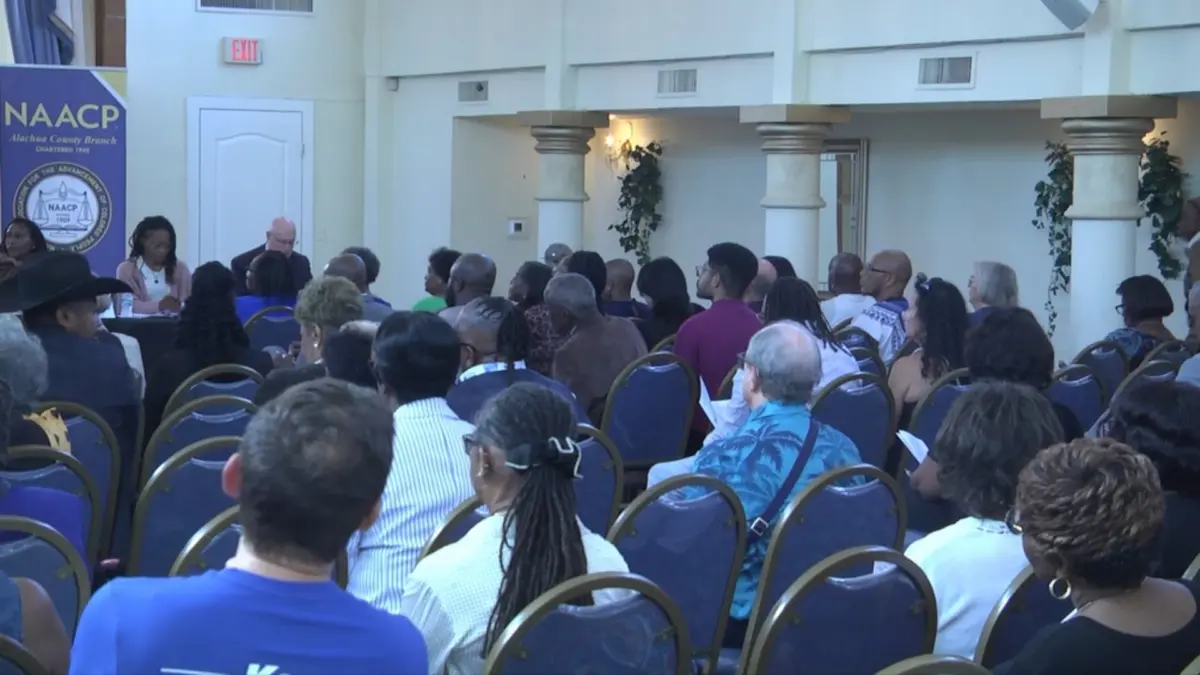

GAINESVILLE, Fla. — As the political machinery prepares for a high-stakes election cycle, Florida voters are increasingly turning their attention down-ballot to initiatives that could fundamentally reshape municipal finance and household economics. On a recent Sunday afternoon, the tension surrounding one such ballot measure—Amendment 3—boiled over into a constructive yet deeply cautious community forum in Gainesville.
Organized by the Greater Gainesville Chapter of the National Coalition of 100 Black Women, the gathering served as a crucible for debate, bringing together municipal mayors, city and county commissioners, the local property appraiser, and hundreds of anxious residents. At the heart of the discourse was a singular, polarizing question: Will a proposed massive expansion of the state’s homestead exemption deliver long-overdue financial relief to overburdened homeowners, or will it trigger an unintended fiscal crisis that starves local governments of essential revenue and shifts the tax burden onto renters and business owners?
With Amendment 3 slated to appear on the November ballot, the stakes could not be higher. If passed, the constitutional amendment would incrementally lift the homestead exemption for non-school property taxes to $150,000 by 2027, and subsequently to $250,000 by 2028. While proponents champion the measure as a vital shield against relentless inflation and soaring housing costs, critics and fiscal analysts warn of severe downstream consequences for public services, municipal infrastructure, and rental affordability.
Executive Overview
The debate over Amendment 3 encapsulates a timeless American policy dilemma: balancing individual tax relief against the collective need for robust public funding. In Florida, where property taxes form the lifeblood of county and municipal budgets—funding everything from police and fire departments to road maintenance and public libraries—any structural alteration to the tax base carries profound systemic risks.
The proposed amendment introduces two phased adjustments to the homestead exemption for non-school property levies:
- The 2027 Phase: An increase of the non-school homestead exemption to $150,000.
- The 2028 Phase: A further expansion of the exemption to $250,000.
Supporters argue that these adjustments are desperately needed to keep pace with the hyper-inflationary real estate market of recent years, which has seen property valuations skyrocket, dragging tax bills upward even for long-term residents who have seen no increase in their personal income. For homesteaded homeowners—particularly fixed-income seniors and working-class families—the savings could translate to thousands of dollars annually, offering a buffer against the rising cost of living.
However, the executive consensus emerging from municipal finance experts and local leaders is one of profound apprehension. Because local governments cannot simply print money to make up for shortfalls, a massive contraction of the taxable property base leaves them with two unpalatable choices: drastically cut public services and infrastructure spending, or shift the tax burden onto non-homesteaded properties—including commercial real estate, second homes, and, crucially, residential rental properties.
As Gainesville residents and leaders debated these mechanics Sunday, it became clear that Amendment 3 is not merely a tax policy tweak; it is a structural stress test for Florida’s local governance model.
Detailed Chronology: The Road to the Gainesville Forum
The journey toward Sunday’s pivotal community forum reflects a grassroots mobilization driven by escalating anxiety over housing costs across North-Central Florida. To understand the gravity of the current debate, it is necessary to trace how the conversation evolved from quiet legislative drafting to front-page community concern.
Early Inception and Legislative Momentum
The groundwork for Amendment 3 was laid months prior in Tallahassee, as lawmakers grappled with constituent complaints regarding skyrocketing property insurance rates and property valuations. While property insurance remains a legislative crisis unto itself, lawmakers targeted property taxes as an area where state-level intervention could provide immediate, tangible relief to homeowners. By proposing an expansion of the homestead exemption through a constitutional amendment, proponents bypassed the standard legislative statute process, placing the ultimate decision directly into the hands of the electorate.
Grassroots Awakening in Alachua and Marion Counties
Recognizing the profound implications of the amendment, the Greater Gainesville Chapter of the National Coalition of 100 Black Women stepped forward to bridge the information gap. Weeks before the forum, outreach coordinators conducted an informal, localized survey across Alachua and Marion counties, polling 12 diverse residents on a foundational question: Do you want your property taxes lowered or raised?
The informal findings highlighted the community’s internal division:
- Seven respondents favored lower taxes, emphasizing the immediate crushing weight of inflation, utility hikes, and general cost-of-living increases.
- Five respondents expressed skepticism or favored maintaining current tax levels, citing concerns over the health of local schools, public safety funding, and municipal maintenance.
This razor-thin local split served as the empirical backdrop for Sunday’s forum, signaling to organizers that the community was deeply conflicted and hungry for authoritative guidance.
The Sunday Forum: A Collision of Perspectives
The event itself drew a capacity crowd, uniting everyday citizens with the policymakers tasked with managing municipal budgets. Mayors from surrounding municipalities, county commissioners, and the local property appraiser took the stage not merely to speechify, but to field rigorous, sometimes pointed questions from a populace trying to decipher complex tax code implications.
The afternoon was characterized by a sharp dichotomy: homeowners voicing relief at the prospect of lower bills, contrasted with housing advocates and renters expressing existential dread over what a non-homestead tax shift could do to the local rental market. By the time the microphone was opened to the floor, it was evident that Gainesville was serving as a microcosm for a statewide debate that will define Florida’s economic landscape for the remainder of the decade.
Supporting Context & Metrics: Analyzing the Numbers Behind Amendment 3
To properly evaluate Amendment 3, one must look past the political rhetoric and examine the hard data governing Florida’s property tax system. The mathematics of municipal finance are unforgiving, and any structural exemption creates a zero-sum game within local tax rolls.
Understanding the Homestead Exemption
Currently, Florida law provides a homestead exemption of up to $50,000 for primary residences. The first $25,000 applies to all property taxes (including school districts), while the second $25,000 applies to non-school taxes for property values between $50,000 and $75,000.
Amendment 3 proposes a radical departure from this baseline by dramatically elevating the non-school exemption thresholds:
- Phase 1 (2027): $150,000 exemption for non-school property taxes.
- Phase 2 (2028): $250,000 exemption for non-school property taxes.
Revenue Implications for Local Governments
When a significant portion of a city or county’s property base is suddenly shielded from taxation, the total taxable value—known as the tax roll—shrinks. For Gainesville and Alachua County, where budgets are already meticulously balanced to fund essential operations, the projected revenue losses are staggering.
Financial analysts note that cities rely heavily on property taxes to fund:
- Law Enforcement and Fire Rescue: Salaries, equipment, and station maintenance.
- Transportation Engineering: Paving, pothole repair, traffic light synchronization, and sidewalk expansion.
- Parks and Recreation: Maintenance of public green spaces, community centers, and youth programs.
If the tax roll contracts by hundreds of millions of dollars, local governments face a statutory requirement to balance their budgets. Without the ability to cut core safety services drastically, governing bodies may be forced to raise millage rates (the tax rate per thousand dollars of taxable value) on the remaining properties that do not qualify for the homestead exemption.
The Rental Market Paradox: A Shift to Renters?
Perhaps the most contentious economic debate surrounding Amendment 3 involves its indirect impact on renters. Because rental properties, commercial enterprises, and second homes are ineligible for homestead exemptions, they do not benefit from the proposed tax cuts.
Instead, economic models suggest that as local governments seek to replace lost revenue from homesteaded properties, they will lean more heavily on non-homesteaded properties. This creates an environment of artificially inflated tax liabilities for landlords. In a competitive housing market, landlords rarely absorb increased operational costs out of goodwill; instead, these costs are systematically passed down to tenants via higher monthly rent checks.
During the Gainesville forum, this potential feedback loop was a primary point of anxiety. With affordable housing already at a premium in Alachua County—driven in part by the student population of the University of Florida—any policy that threatens to accelerate rent hikes is viewed by housing advocates as a dangerous socioeconomic gamble.
Official Statements and Stakeholder Positions
The discourse at the Gainesville community forum underscored the widening gulf between state-level proponents of tax relief and local-level administrators who must balance the books.
Proponents: The Case for Relief
Supporters of Amendment 3 frame the measure as an essential economic lifeline for working families who are being priced out of their own neighborhoods.
- "For too long, soaring property valuations have acted as a hidden tax hike on homeowners who have lived in their communities for decades," noted a policy advocate supporting the initiative. "When a family’s income remains relatively stable while their home value—and consequently their tax assessment—doubles, they are effectively penalized for staying put. Amendment 3 provides a much-needed, predictable cushion that allows families to keep more of their hard-earned money."
Proponents also argue that higher disposable income for homeowners translates directly into local consumer spending, thereby stimulating small businesses and supporting the broader regional economy in ways that offset public sector losses.
Municipal Leaders and Appraisers: The Fiscal Reality Check
Conversely, local elected officials and property valuation experts at the Gainesville forum urged caution, emphasizing the practical difficulties of managing municipal budgets under drastically restricted revenue caps.
- "We all want to see our residents keep more of their money," remarked one participating municipal commissioner during the panel discussion. "However, as local leaders, we have a legal and moral obligation to ensure that when the dust settles, our police cars still run, our wastewater treatment plants are operational, and our roads are safe to drive on. Shifting a massive tax burden off of primary residences and onto rental units could inadvertently spark a housing affordability crisis on the tenant side of the ledger."
The local property appraiser echoed these logistical concerns, highlighting the administrative hurdles of re-indexing property rolls across phased implementation timelines in 2027 and 2028, warning that sudden valuation shifts could lead to a surge in appeals and administrative bottlenecks.
Future Outlook: What Voters Must Consider Before November
As the November election approaches, the conversation initiated by the National Coalition of 100 Black Women in Gainesville must resonate across the entire state of Florida. Amendment 3 represents a classic political conundrum: an intuitively appealing promise of tax relief colliding with complex, systemic economic consequences.
Key Questions for the Electorate
When voters enter the ballot box this November, they will not merely be casting a vote for or against lower taxes; they will be making a profound statement about the future architecture of Florida’s communities. Voters must weigh several critical questions:
- Will the immediate savings for homeowners outweigh the risk of degraded local services? If municipal revenues plummet, are communities prepared to accept fewer parks, slower emergency response times, or deferred infrastructure repairs?
- Can local governments absorb the loss without punishing renters? Given that non-homestead properties will likely bear the brunt of any revenue-replacement strategies, what safeguards exist to protect tenants from predatory rent spikes?
- Is a staggered, aggressive exemption schedule sustainable long-term? With thresholds jumping to $150,000 in 2027 and $250,000 in 2028, will the state provide matching funds or alternative revenue streams to backstop municipalities, or will local governments be left holding an empty bag?
The Broader Economic Horizon
The outcome of the Amendment 3 vote will serve as a bellwether for how fast-growing states manage the friction between runaway real estate appreciation and public finance stability. If it passes, Florida will chart a bold, homeowner-first trajectory that may force radical modernization of municipal budgeting practices. If it fails, the debate over how to achieve equitable tax relief will undoubtedly return to the drawing board in Tallahassee.
For the residents of Gainesville and the broader state of Florida, the Sunday forum was a crucial wake-up call. It transformed an abstract legislative ballot summary into a visceral, community-wide conversation about who pays for society, who benefits from government, and how best to navigate the precarious balance between private prosperity and public infrastructure. As November draws closer, informed civic engagement will be the single most effective tool voters have to ensure they understand the true cost of the ballot box.

0 Comments