
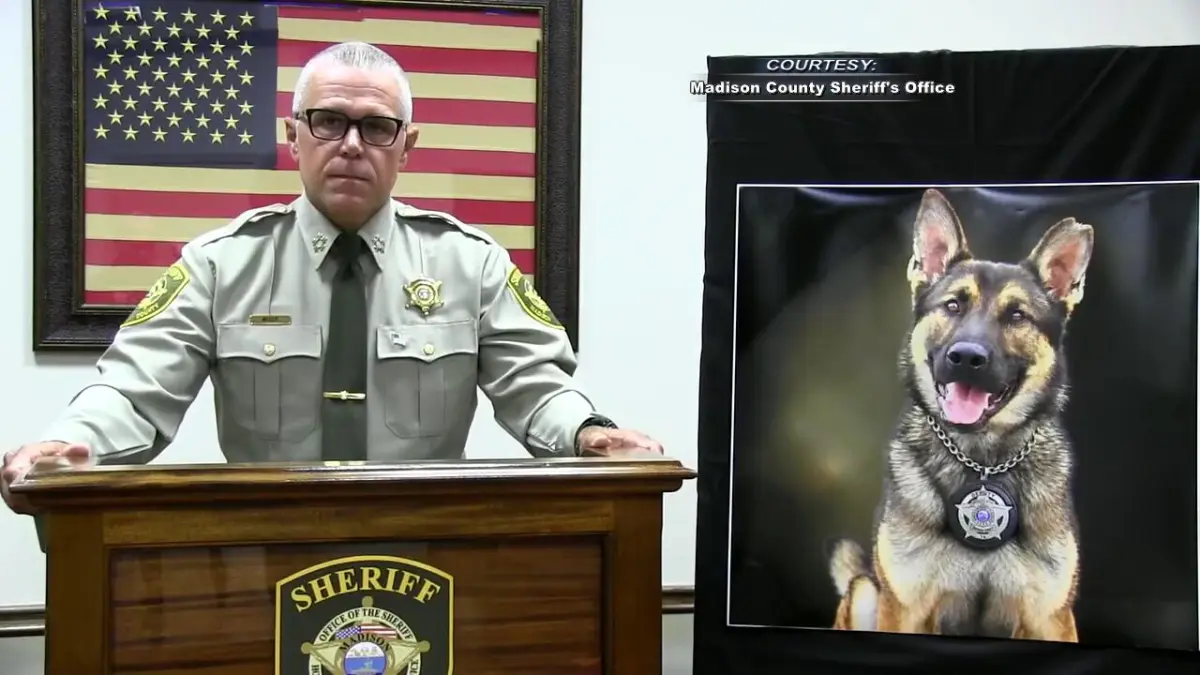

JACKSON, Tenn. — In the wake of a profound institutional and moral failure, law enforcement officials in West Tennessee are confronting the harrowing details surrounding the line-of-duty death of K-9 Bart, a young German shepherd assigned to the Madison County Sheriff’s Office. Just over two years of age, Bart perished from acute heatstroke after being left unattended and unmonitored in an outdoor kennel for approximately a year-and-a-half’s worth of hours—36 agonizing hours—without access to hydration as ambient temperatures soared into triple digits.
The incident, which has sent shockwaves through the local community, the broader law enforcement establishment, and animal welfare advocacy groups nationwide, highlights critical gaps in the chain of command, accountability, and daily care protocols governing working police dogs. As internal affairs investigators and criminal prosecutors parse the evidence, the case has ignited a fierce public debate regarding how law enforcement agencies vet, monitor, and safeguard the welfare of their most vulnerable, non-human officers.
Executive Overview
The grim sequence of events came to light on Friday, September 19, when Madison County Sheriff Julian Wiser formally announced the tragic demise of the department’s patrol and detection dog. According to preliminary findings released by the sheriff’s office, Bart was discovered lifeless inside his designated outdoor kennel by his assigned human handler.
Subsequent forensic veterinary evaluations confirmed what investigators immediately suspected: the canine succumbed to hyperthermia-induced organ failure brought on by severe dehydration. Investigators state that the handler had been absent from the residence for a day and a half, leaving the animal completely exposed to punishing environmental conditions that peaked at 101 degrees Fahrenheit.
The fallout has been swift. The unnamed handler was immediately stripped of enforcement privileges, placed on administrative leave, and has since resigned from the agency. Concurrently, the Madison County Sheriff’s Office is executing a series of search warrants as part of a rigorous, parallel investigation designed to determine whether criminal charges—specifically felony animal cruelty and official misconduct—are warranted.
Sheriff Wiser, visibly shaken during public briefings, categorized the event not merely as an accident, but as a catastrophic failure of duty. Drawing from his own historical background as a former K-9 handler and unit supervisor, Wiser emphasized the sacred covenant that exists between a K-9 officer and their handler—a pact built on mutual protection that was egregiously violated in this instance.
Detailed Chronology of Events
While the investigation remains active and fluid, timeline reconstructions provided by internal investigators offer a chilling window into the final days and hours of K-9 Bart’s life.
The Lead-Up to the Incident
K-9 Bart was a fully certified operational asset, having completed rigorous training modules that rendered him proficient in criminal apprehension, tactical tracking, complex article searches, and narcotics detection. Like many operational police dogs living with their handlers, Bart resided at the officer’s residential property during off-duty hours, housed within a specialized outdoor kennel facility designed to offer shelter while maintaining security.
Under standard operational guidelines, working dogs require meticulous, twice-daily wellness checks, environmental adjustments during extreme weather, and constant verification of nutritional and hydration supplies. However, preliminary interviews and evidence gathered from the scene indicate a total breakdown of these routine checks.
The 36-Hour Window
Investigators have established that Bart’s handler departed the residence and remained away for roughly 36 consecutive hours. During this period, local meteorological stations recorded peak ambient temperatures reaching 101 degrees Fahrenheit in the Jackson area. Without a functioning, temperature-regulated environment, shade mitigation, or replenishment of drinking water, the physical conditions inside and immediately surrounding the kennel deteriorated rapidly.
For a canine, heat dissipation is uniquely challenging; dogs do not possess sweat glands across their bodies and rely almost exclusively on panting and minimal sweating through their paw pads to regulate core body temperature. When exposed to extreme ambient heat without water, canine core temperatures escalate swiftly from normal ranges (101°F to 102.5°F) into dangerous hyperthermic zones (above 106°F). At these elevated temperatures, cellular proteins break down, blood thickens, and multi-organ failure ensues within a matter of hours.
The Discovery
On September 19, the handler returned to the residence and discovered the dog unresponsive within the enclosure. Emergency notifications were triggered, and veterinary professionals were consulted, but clinical assessments quickly confirmed that life had been extinct for some time. The remains were subsequently transported to a specialized veterinary pathology facility for a formal necropsy to definitively establish the cause of death and rule out underlying medical anomalies.
Supporting Context & Metrics: The Crisis of K-9 Heatstroke
The death of K-9 Bart is part of a troubling, broader national trend concerning the welfare and protection of working dogs in law enforcement. While public scrutiny frequently focuses on canine injuries sustained during tactical operations, gunfire, or suspect apprehensions, environmental heat-related fatalities remain one of the leading silent killers of police K-9s across the United States.
Quantifying the Danger
According to data compiled by animal welfare watchdog groups and law enforcement tracking organizations, dozens of working dogs die annually from heat-related illnesses nationwide. These tragedies typically fall into two categories:
- Vehicular Confinement: Dogs accidentally left inside unventilated patrol cruisers equipped with failed or deactivated climate-control systems.
- Residential Neglect: Dogs left in outdoor structural enclosures, tethered, or placed in backyards without adequate shade, cross-ventilation, and continuous water supplies during severe heat waves.
When temperatures cross the 90-degree threshold, the interior of a vehicle or an unshaded outdoor kennel can mimic an oven within minutes. In the case of K-9 Bart, the combination of a 101-degree day and a 36-hour absence of fresh water created a lethal environment from which escape was impossible.
The Role of Specialized Veterinary Necropsies
The definitive finding of the veterinary necropsy—acute heatstroke secondary to severe dehydration—serves as a cornerstone for the ongoing criminal inquiry. Forensic pathology in animal cruelty cases is vital; it provides objective, scientifically indisputable evidence regarding the timeline of suffering, internal organ damage, and environmental exposure. The pathologists’ report documented classic markers of hyperthermic death, including pulmonary congestion, gastrointestinal hemorrhaging, and cellular necrosis of the kidneys and liver, fully corroborating the timeline established by investigators.
Official Statements and Institutional Accountability
The handling of the investigation by the Madison County Sheriff’s Office has been marked by an unusual degree of transparency, driven heavily by the personal and professional anguish expressed by agency leadership.
Sheriff Julian Wiser’s Address
In his public statements, Sheriff Julian Wiser did not attempt to shield the department or soften the reality of the situation. Speaking directly to the press and the public, Wiser framed the incident as an unacceptable breach of trust.
"This is a very sad and unfortunate incident," Wiser stated during the initial press briefing. "We depend on our K-9s to help keep our community safe and our law enforcement officers, but our K-9s depend on us to take care of them. What happened to Bart was completely preventable."
Wiser’s emotional connection to the subject matter is rooted in his personal history. Having served as both a K-9 handler and a unit supervisor earlier in his career, the sheriff understands intimately the daily demands, responsibilities, and protocols required to maintain the health and operational readiness of a working dog. His familiarity with these standards likely informed the swift administrative actions taken against the handler.
Personnel Actions and Legal Status
Upon the discovery of Bart’s remains, the sheriff’s office initiated a dual-track response:
- Internal Affairs Investigation: Focused on policy violations, command-level oversight, and potential infractions regarding the care, housing, and documentation of agency-owned working animals.
- Criminal Investigation: Conducted in parallel, involving the execution of search warrants at the handler’s residence to gather physical evidence, digital communications, and environmental data.
The handler, whose identity has been withheld pending the formal filing of criminal charges, was immediately placed on administrative leave. Recognizing the untenable nature of the situation and the inevitability of termination proceedings, the officer tendered their resignation shortly thereafter. Legal analysts note that withholding the name while criminal warrants are executed is a standard procedural safeguard designed to protect the integrity of the ongoing investigation until prosecutors make a final charging decision.
Future Outlook: Reforming K-9 Care and Oversight
The tragic loss of K-9 Bart has catalyzed urgent discussions regarding the systemic reforms needed within the Madison County Sheriff’s Office and has prompted a broader re-examination of working dog protocols across Tennessee law enforcement agencies.
Policy Overhaul and Mandatory Audits
In the wake of this incident, law enforcement administrators are facing mounting pressure to implement mandatory oversight mechanisms that eliminate reliance on the honor system for off-duty K-9 care. Potential reforms under consideration across various municipal and county agencies include:
- Unannounced Welfare Inspections: Requiring supervisory personnel to conduct random, unannounced physical checks of residential kennels and living quarters for all assigned working dogs.
- Smart Monitoring Technology: Installing remote environmental sensors inside residential kennels and patrol vehicles that transmit real-time temperature, humidity, and water-level data directly to command staff mobile devices.
- Enhanced Training Modules: Mandatory, recurring continuous education for all K-9 handlers focusing on canine physiology, stress recognition, extreme weather protocols, and psychological burnout.
The Path to Justice for K-9 Bart
As the Tennessee Bureau of Investigation and local prosecutors review the completed investigative files and forensic necropsy reports, the legal community watches closely. Animal advocates and community members are calling for aggressive prosecution to set a legal precedent ensuring that law enforcement animals receive the full protection of the law when abused or neglected by those sworn to protect them.
For the Madison County Sheriff’s Office, the journey toward institutional redemption will be long. K-9 Bart’s watch has ended prematurely, robbed of the retirement he deserved after years of dedicated service protecting the citizens of West Tennessee. Yet, if his tragic death serves as the catalyst that permanently alters how agencies monitor, protect, and value their canine partners, his legacy may ultimately force a systemic awakening across the profession—ensuring that no other working dog suffers a similar fate.

0 Comments