
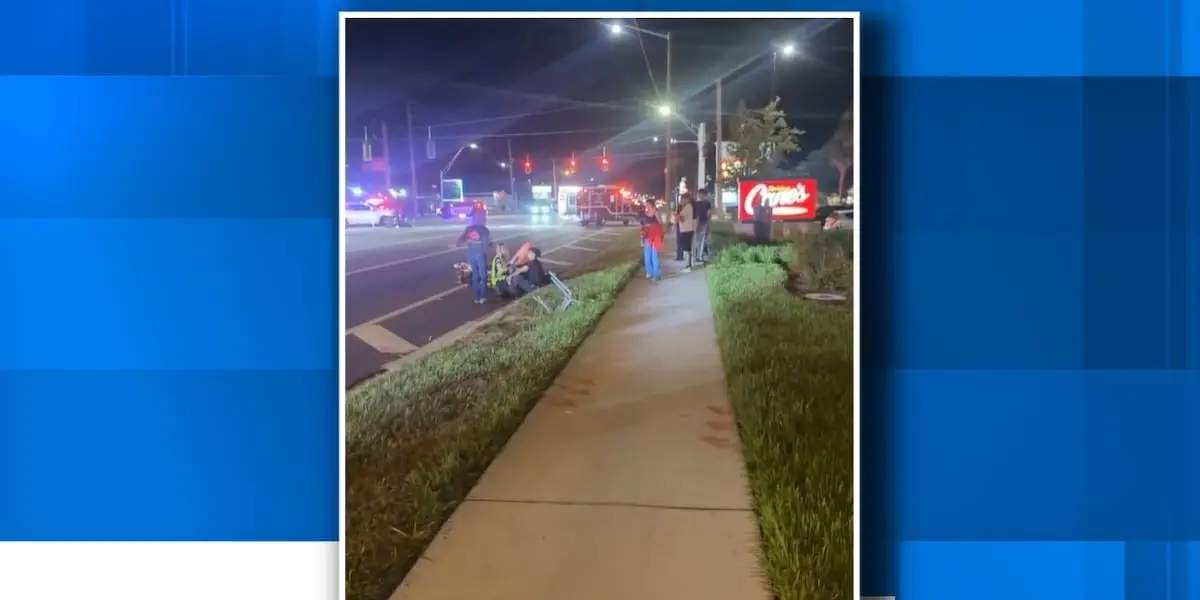

OCALA, Fla. — In an era defined by the relentless pursuit of digital engagement, the line separating creative expression from reckless endangerment continues to blur with potentially catastrophic consequences. An 18-year-old Ocala resident is currently recovering from severe, life-altering injuries following a harrowing accident on Sunday evening. The incident occurred not from typical vehicular negligence alone, but as the direct result of a hazardous social media stunt staged directly within the high-speed median of a busy central Florida thoroughfare.
Local law enforcement and emergency medical services responded to a chaotic scene on Southwest College Road near 17th Road just as dusk settled around 8:00 p.m. What initially registered as a standard two-vehicle intersection collision quickly escalated into a complex investigation when authorities discovered that the injured pedestrian had been seated in a chair appropriated from a nearby fast-food restaurant, serving as the canvas for a live-action haircutting video destined for TikTok.
This incident has ignited urgent conversations among local officials, traffic safety advocates, and digital literacy experts regarding the escalating trend of public disruptions and hazardous stunts executed for online visibility. As investigators continue to piece together the sequence of events that brought high-speed traffic and internet culture into violent collision, the broader community is left confronting the heavy human cost of viral ambition.
Executive Overview
The collision on Southwest College Road highlights a deeply concerning intersection of modern technology, adolescent behavior, and public infrastructure vulnerability. According to reports compiled by the Ocala Police Department (OPD), the 18-year-old victim, joined by at least two peers, positioned themselves directly within a concrete median on a major arterial roadway. Armed with a styling chair—allegedly taken from a nearby Raising Cane’s restaurant—the group sought to capture footage for a viral social media haircutting challenge.
The stunt was abruptly cut short when a westbound Chevy Silverado and a Lexus SUV, the latter attempting to enter the intersection from the Ocala West Plaza, collided. The impact redirected the Silverado, sending it careening into the median where the teenagers were filming. The 18-year-old pedestrian bore the brunt of the kinetic energy, sustaining severe injuries that required immediate emergency trauma care and subsequent hospitalization.
+-------------------------------------------------------------------------+
|                        INCIDENT AT A GLANCE                             |
+--------------------------+----------------------------------------------+
| Date & Time              | Sunday, approximately 8:00 p.m.              |
| Location                 | SW College Rd. & 17th Rd., Ocala, Florida    |
| Primary Subject          | 18-year-old pedestrian (severely injured)    |
| Contributing Activities  | Filming a social media haircutting video     |
| Vehicles Involved        | Chevy Silverado (Westbound) & Lexus SUV      |
| Associated Property      | Stolen/borrowed chair from Raising Cane's    |
| Driver Impairment        | None detected by responding officers         |
+--------------------------+----------------------------------------------+
While preliminary toxicology and field sobriety tests confirmed that neither of the motorists involved was operating under the influence of alcohol or controlled substances, the presence of pedestrians in an active, unlit roadway median underscores a severe lapse in situational awareness. This case has rapidly transcended a localized traffic accident, emerging as a prominent case study in the dangers of prioritizing digital validation over fundamental physical safety.
Detailed Chronology of Events
To understand how a routine Sunday evening transformed into a critical trauma scenario, investigators have reconstructed the timeline leading up to, during, and immediately following the crash.
Phase 1: Pre-Incident Setup and Escalation
In the hours leading up to the crash, the trio of young adults reportedly planned and executed the logistical setup for their social media segment. Witnesses and digital footprint traces indicate that the group targeted Southwest College Road—a notoriously high-traffic commercial corridor in Ocala—to maximize visibility and background movement for their video.
Physical evidence and witness testimony confirm that prior to the accident, the group acquired a dining chair from a nearby Raising Cane’s restaurant. Transporting this furniture into the narrow confines of the road median, the 18-year-old victim took a seat to receive a haircut while the third individual filmed the production. The audacity of the setup drew brief notice from passersby, including witness Yaj Lerom, who interacted with the teens moments before disaster struck. Lerom managed to capture vital smartphone footage showing the teenagers engaged in their setup, oblivious to the impending danger just feet from moving traffic traveling at 45 to 50 miles per hour.
Phase 2: The Collision Sequence
At approximately 8:00 p.m., traffic flow along Southwest College Road remained steady. A Lexus SUV, exiting the Ocala West Plaza complex, attempted to navigate into the flow of traffic heading toward the intersection near 17th Road. Simultaneously, a Chevy Silverado was traveling westbound along College Road.
For reasons still undergoing formal reconstruction by traffic homicide investigators, the Silverado and the Lexus failed to yield or clear the intersection safely, resulting in a violent T-bone or glancing impact. The kinetic force of the crash destabilized the Silverado, causing the driver to lose directional control. The heavy-duty pickup truck veered sharply toward the center of the roadway, jumping or sliding directly into the median where the filming crew was stationed.
Phase 3: Immediate Aftermath and Emergency Response
The transition from recording a lighthearted video to experiencing catastrophic trauma occurred in a fraction of a second. Yaj Lerom, still in the immediate vicinity, recalled the chilling speed of the event: "As soon as I look back, the car hit him," one of the surviving teens remarked in shock.
First responders from Ocala Fire Rescue and the Ocala Police Department arrived within minutes of the 911 dispatch. They found the 18-year-old victim pinned or severely compromised near the wreckage, suffering from acute trauma. Emergency medical personnel initiated life-saving stabilization protocols on site before rapidly transporting the patient to a designated regional trauma center.
Simultaneously, police secured the perimeter, interviewed the shaken drivers of the Silverado and the Lexus, and began gathering digital evidence—including cell phones, cameras, and bystander videos—that would ultimately establish the context of the accident.
Supporting Context & Metrics
This incident does not occur in a vacuum; rather, it reflects a disturbing upward trajectory in distracted behavior, roadway misuse, and public stunts tied to platform-based monetization and social media notoriety.
The Rise of Roadway Stunts and Digital Viral Culture
Over the past five years, law enforcement agencies across the United States have noted a sharp increase in calls regarding individuals staging performances, pranks, and challenge videos in high-risk environments. Highways, interstate off-ramps, active intersections, and pedestrian medians have increasingly been treated by content creators as open-air production sets.
The psychological mechanics behind these actions are well-documented by behavioral scientists:
- The Algorithmic Incentive: Social media algorithms heavily reward novel, shocking, or high-risk content with broader distribution, translating directly to visibility, follower growth, and potential monetization.
- Invulnerability Bias: Adolescents and young adults frequently underestimate physical risk, operating under an internal assumption that catastrophic events happen only to others.
- The Bystander Effect & Group Dynamics: When filming in groups, peers often reinforce risky behaviors, daring one another to escalate the stakes for better footage.
Infrastructure and Vulnerability of Medians
Roadway medians are engineered strictly as structural buffers to separate opposing lanes of traffic, manage left-turn configurations, and offer temporary, emergency refuge for stranded motorists whose vehicles have broken down. They are fundamentally unequipped—and explicitly unsafe—to serve as gathering spaces, recreational zones, or film sets.
+-------------------------------------------------------------------------+
|                  MEDIAN SAFETY & DESIGN PARAMETERS                      |
+--------------------------+----------------------------------------------+
| Primary Engineering Role | Traffic separation & turning safety          |
| Pedestrian Accommodation | None (not rated for sustained foot traffic)  |
| Kinetic Hazard Exposure  | Direct exposure to errant, high-speed vehicles|
| Lighting Conditions      | Variable; often compromised at dusk/night    |
+--------------------------+----------------------------------------------+
When individuals occupy medians for non-emergency purposes, they strip away the safety margin designed into modern roadway architectures. Standing mere feet from multi-ton vehicles traveling at highway speeds leaves zero room for error should a mechanical failure, driver distraction, or intersection collision occur—precisely the scenario that played out on Southwest College Road.
Official Statements & Ongoing Investigation
The Ocala Police Department has maintained a transparent posture regarding the ongoing investigation, emphasizing that while the circumstances surrounding the video production are unusual, the primary focus remains thorough technical reconstruction of the vehicular collision.
Police Findings to Date
In official updates released by public information officers, investigators have clarified several critical parameters of the case:
- Absence of Impairment: Comprehensive evaluations conducted at the scene confirmed that neither the driver of the Chevy Silverado nor the operator of the Lexus SUV showed any signs of impairment involving alcohol, illicit substances, or prescription narcotics.
- The Investigation Focus: Investigators are actively analyzing skid marks, vehicle telemetry data, traffic light cycles, and witness accounts to determine fault in the initial collision between the SUV and the pickup truck.
- Property Recovery: Authorities confirmed the origin of the chair used in the stunt, noting its removal from the nearby Raising Cane’s restaurant, which adds a secondary layer of trespassing or property misappropriation to the timeline, though no formal charges regarding the furniture have been emphasized at this early stage.
"Our investigators are looking at every angle of this crash, from the mechanics of the vehicle impact at the intersection to the human factors that placed pedestrians in a clearly hazardous location," stated an OPD spokesperson during a morning briefing. "This is a tragic reminder that public roadways are transportation corridors, not stages."
Eyewitness Accounts and Digital Footprints
The emergence of digital evidence provided by witnesses such as Yaj Lerom has proven invaluable to investigators seeking to establish intent and positioning prior to the impact. Furthermore, user commentary across local community pages and TikTok itself has corroborated that the group was attempting a specific "haircut challenge" trend—a genre of content where barbers perform cuts in unexpected, public, and often absurd locations to generate shock value.
Legal experts monitoring the case suggest that while the motorists involved appear to bear no criminal liability for the pedestrian strike given the sudden redirection of the Silverado, the incident raises complex questions regarding civil liability, shared fault, and the responsibilities of content creators operating in public rights-of-way.
Future Outlook: Prevention, Policy, and Public Safety
As the 18-year-old victim continues medical treatment and rehabilitation for serious injuries, the ripples of this incident are already prompting calls for institutional change, educational outreach, and heightened vigilance from municipal leaders in Marion County.
The Need for Proactive Digital Literacy
Traditional public service announcements (PSAs) regarding traffic safety have historically focused on seatbelt usage, anti-drunk driving campaigns, and the dangers of texting behind the wheel. However, law enforcement and educational administrators argue that safety campaigns must evolve to address the unique behavioral hazards introduced by social media culture.
- School and Community Outreach: Educational programs targeting high school and college-age demographics must explicitly address the dangers of staging social media stunts on or near public roadways.
- Platform Responsibility: Advocacy groups are increasingly demanding that major social media conglomerates implement stronger content moderation policies, age-gating, and algorithmic penalties for videos that clearly depict illegal, trespassing, or life-endangering stunts.
Municipal Infrastructure and Enforcement
Local governments may also need to evaluate whether existing ordinances regarding loitering, pedestrian obstruction, and unauthorized use of public rights-of-way require stricter enforcement or clearer signage. While police cannot station officers at every intersection, increased patrols targeting pedestrian safety violations in high-traffic commercial zones could deter similar high-risk behavior before tragedy strikes.
Ultimately, the Ocala incident serves as a sobering cautionary tale for the digital age. As the boundary between online clout and offline reality continues to dissolve, the physical laws governing momentum, mass, and human vulnerability remain unforgiving. For the community of Ocala, the hope is that this profound wakeup call prevents future tragedies, reminding creators everywhere that no video, view, or viral moment is worth sacrificing one’s life or physical well-being.

0 Comments