
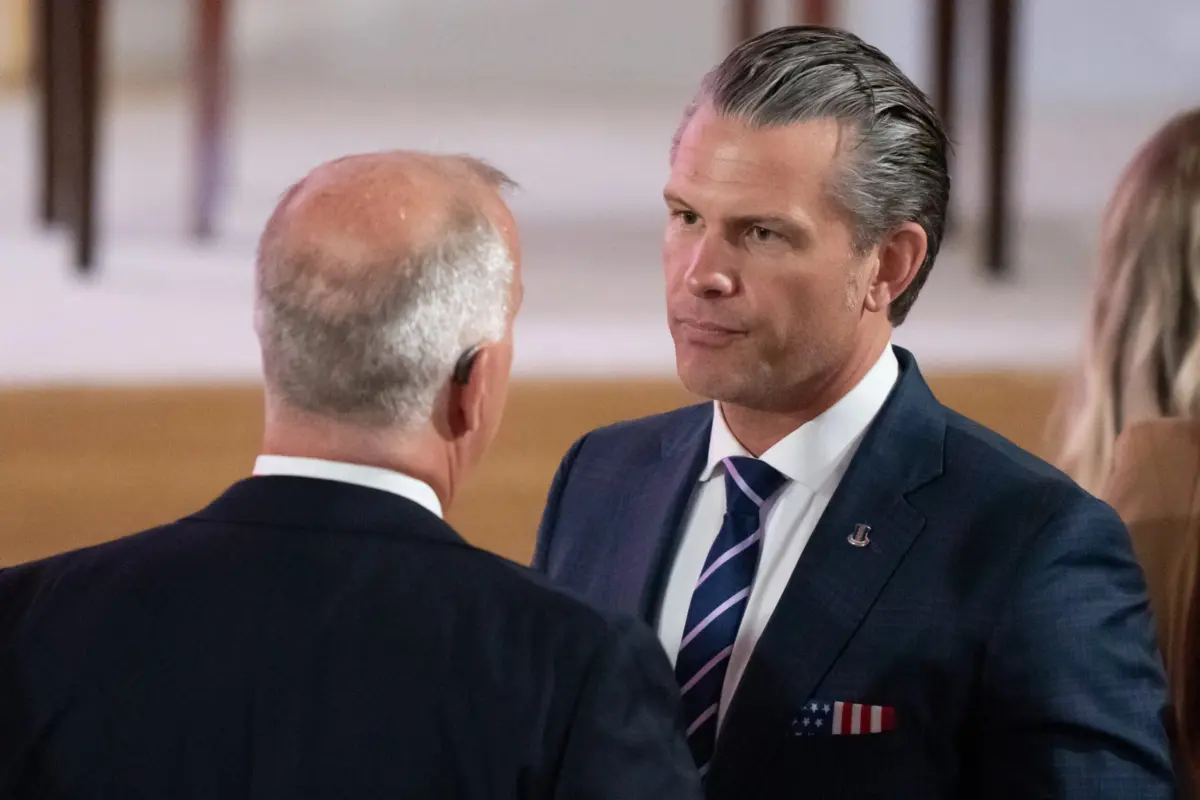

WASHINGTON — In a move set to further convulse the upper echelons of the U.S. Armed Forces, Defense Secretary Pete Hegseth is scheduled to announce a sweeping escalation of military downsizing. According to senior Pentagon officials, Hegseth will direct all military branches to double an earlier 10% reduction—ordered last spring—to the roughly 800 flag and general officer positions across the force.
The revised directive mandates a total 20% decrease in the ranks of generals, admirals, and equivalent-level officers, with the entire restructuring slated for completion by January 1, 2027. Hegseth is expected to unveil these seismic changes during his annual "State of the Force" address to troops at the Marine Corps Base Quantico in Virginia.
The announcement highlights an aggressive, top-down transformation of the nation’s defense apparatus under the Trump administration. Critics, however, warn that the purge of senior leadership risks fracturing institutional knowledge, straining an already overextended global military posture, and setting up a major constitutional showdown with Capitol Hill.
Executive Overview
The impending directive represents one of the most drastic peacetime reductions of senior military leadership in modern American history. By cutting one-fifth of all flag and general officer billets, the Pentagon aims to strip away what administration officials characterize as bloated bureaucratic layers that stifle agility.
However, this structural contraction does not occur in a vacuum. It follows a relentless wave of high-profile firings, forced retirements, and politically charged policy shifts. Since taking office, President Donald Trump and Defense Secretary Hegseth have ousted or pushed out more than two dozen top-tier military leaders. Among them was the Army’s top uniformed officer, Gen. Randy George, who was removed in April.
The administration’s personnel decisions have also drawn intense scrutiny over diversity and equity within the ranks. Notably, the leadership shakeup has claimed the jobs of the only two women serving as four-star generals, alongside a disproportionate number of other senior female officers.
While the White House frames these actions as a necessary corrective to streamline operations and eradicate "woke" institutional culture, lawmakers from both sides of the aisle—particularly congressional Democrats and a handful of dissident Republicans—are raising alarm bells over civilian-military friction, the bypassing of statutory oversight, and the destabilizing effects on global operations.
Detailed Chronology of the Pentagon Overhaul
To understand the trajectory of Secretary Hegseth’s latest announcement, it is crucial to trace the sequence of events that have reshaped the Department of Defense over the past two years:
- May 2025: Secretary Hegseth issues an initial memo outlining a 10% reduction in flag and general officer positions, arguing that the cuts are necessary to eliminate "redundant force structure" and optimize leadership. The active-duty military and National Guard are instructed to trim 20% of their highest-level four-star general positions.
- Late Spring 2025: A series of targeted dismissals begins, focusing on top-ranking military officials deemed misaligned with the administration’s strategic and cultural vision.
- September 2025: Hegseth gathers the military’s entire cadre of generals and admirals for an unprecedented address at Quantico. During the summit, he formally declares an end to "woke" culture in the ranks and introduces rigorous new "gender-neutral" and "male-level" physical fitness standards. The event is heavily overshadowed by President Trump, who delivers a controversial speech proposing the use of American cities as training grounds to combat an "invasion from within."
- April 2026: Army Chief of General Staff Gen. Randy George is ousted, signaling a deepening rift between civilian leadership and the traditional military hierarchy. Around this time, the departures of the military’s remaining female four-star officers are finalized.
- Summer 2026: Tensions between Hegseth and Congress reach a boiling point. Kentucky Republican Rep. Thomas Massie introduces articles of impeachment against Hegseth, citing deep concerns over his handling of the Pentagon and management of the ongoing Iran war.
- September 2026: Preparations are finalized for Hegseth’s second "State of the Force" address, where the 10% reduction target is abruptly doubled to 20%, cementing a rapid and aggressive downsizing timeline.
Supporting Context & Metrics: The Anatomy of a Bureaucratic Purge
The math behind the Pentagon’s restructuring involves roughly 800 flag and general officer positions spanning the Army, Navy, Air Force, Marine Corps, and Space Force, as well as the National Guard.
While the total number of general and flag officer billets is technically capped or guided by federal law, the executive branch maintains significant latitude in how these positions are utilized. By simply declining to submit replacements to the Senate for confirmation when vacancies arise through natural attrition, retirement, or firing, the Department of Defense can effectively hollow out these leadership ranks without requiring immediate legislative approval for a change in statutory caps.
The Strategic Rationale vs. Operational Realities
Proponents of the cuts argue that a leaner command structure fosters faster decision-making. In an era defined by great power competition, rapid technological advancements, and asymmetric warfare, defenders of the policy contend that the military has accumulated too many "brass" and not enough operational flexibility.
Conversely, military analysts and former defense officials argue that flag officers—generals and admirals—do not merely occupy bureaucratic desk jobs; they manage complex logistics, coordinate multinational coalition operations, and provide indispensable tactical and strategic counsel. Slashing 20% of this tier means redistributing heavy workloads onto fewer shoulders. With U.S. forces actively engaged or postured in multiple volatile theaters around the world—including the Middle East and Eastern Europe—critics argue that thinning the command ranks at this juncture introduces severe operational vulnerabilities.
Official Statements and Political Fallout
The impending announcement has triggered immediate and fierce pushback from Capitol Hill, amplifying existing fractures between the legislative branch and the executive.
Congressional Alarm and Defense Oversight
Sen. Jack Reed (D-R.I.), ranking member of the Senate Armed Services Committee, issued a blistering statement condemning the unilateral nature of the cuts. Reed emphasized that reshaping the senior leadership of the armed forces cannot be treated as an internal executive prerogative free from congressional consultation.
"Congress has been clear with the Secretary that he must consult this body and explain his reasoning for senior officer removals and promotion holds," Reed said. "To date, we have not received satisfactory answers. Our military is conducting major operations around the world, and the force is already under strain. Eliminating senior positions and leaders now will add to that strain and disrupt command when continuity matters most."
Reed’s concerns are echoed by national security experts who point out that arbitrary percentage-based cuts risk sweeping away institutional memory and merit-based talent, replacing experienced commanders with political loyalists or leaving critical desks vacant during operational crises.
Strain on Capitol Hill Relationships
Hegseth’s relationship with Congress was already exceptionally fragile prior to this latest decree. Beyond policy disagreements over force structure, the Defense Secretary faces extraordinary political jeopardy. Rep. Thomas Massie (R-Ky.) has introduced articles of impeachment against Hegseth, targeting his stewardship of the Department of Defense and his execution of military policy related to the Iran conflict.
The introduction of impeachment proceedings by a member of the President’s own party underscores the unprecedented nature of the current civil-military dynamic. For many congressional Republicans, the rapid pace of shakeups and the perceived politicization of the armed forces have crossed red lines, turning routine oversight into a bitter partisan battleground.
Future Outlook: What Lies Ahead for the U.S. Military
As Secretary Hegseth takes the podium at Marine Corps Base Quantico to deliver his "State of the Force" address, the implications of his 20% reduction mandate will reverberate far beyond the parade grounds.
1. The January 2027 Deadline and Attrition Mechanics
With the clock ticking toward the January 1, 2027 deadline, the Pentagon must navigate the delicate process of phasing out over 160 senior leadership positions. Whether this will be achieved purely through accelerated retirements and frozen promotions, or if it will require further involuntary separations, remains to be seen. The personnel maneuvers will be closely watched by junior and mid-grade officers evaluating their own long-term career prospects within an increasingly volatile institution.
2. A Looming Constitutional Clash
The administration’s disregard for traditional congressional consultation regarding officer management is virtually guaranteed to provoke legislative retaliation. Armed Services committees in both the House and Senate are expected to summon senior defense officials for grueling oversight hearings. Lawmakers may attempt to use the annual National Defense Authorization Act (NDAA) to place statutory roadblocks in front of the Pentagon’s downsizing plans or to freeze promotions and demotions pending formal congressional review.
3. Impact on Global Readiness
Ultimately, the central question facing the U.S. military is one of operational readiness. As great power competitors monitor American political and military instability, the mass exodus of experienced leadership risks degrading the nation’s capacity for strategic foresight. Whether Secretary Hegseth’s vision of a streamlined, politically aligned force will yield a more efficient warfighting machine—or result in a dangerously fractured command structure—will remain one of the defining national security questions of the decade.

0 Comments