

Executive Overview
Nestled within the quiet rural landscape of Hollandtown, Wisconsin, lies a workshop where artistry meets physics, and raw lumber is systematically transformed into instruments of extraordinary acoustic clarity. For 52 years, master luthier Bruce Petros has dedicated his life to the meticulous craft of building stringed instruments. What began modestly as a fleeting curiosity in the mountains of Colorado has blossomed into Petros Guitars—an internationally recognized enterprise renowned for producing world-class acoustic guitars and ukuleles prized by collectors, hobbyists, and professional musicians alike, including legendary singer-songwriter Paul Simon.
Yet, the story of Petros Guitars extends far beyond the exceptional curly Koa tops and meticulously tuned soundboards that leave its workshop. It is a profound narrative of generational continuity, artisanal resilience, and the rare preservation of a bespoke trade in an era dominated by mass production. As Bruce Petros approaches a well-earned transition, the enterprise is securing its future through family succession. His son, Matt Petros, who literally grew up amidst the sawdust and scent of aged tonewoods, is stepping forward to take the helm.
This seamless transition offers a compelling study in the sustainability of independent craftsmanship. While many bespoke luthiery operations fade away when their founders retire—unable to transfer intangible reputation and hard-earned expertise—Petros Guitars stands as a testament to the power of shared vision, familial mentorship, and an unwavering commitment to sonic excellence. This comprehensive report explores the origins of the workshop, the philosophy guiding its master craftsmen, the mechanics of passing down a legacy, and the vibrant future of independent luthiery in America.
Detailed Chronology: From a $15 Kit to an International Reputation
The genesis of Petros Guitars reads like an artisanal American dream, rooted in serendipity, resourcefulness, and a profound awakening to the potential of working with one’s hands.
The Colorado Catalyst (Early 1970s)
Long before the establishment of the Hollandtown workshop, Bruce Petros found himself working as a tour guide in a picturesque Colorado resort town. Surrounded by the majestic Rocky Mountains, his life took an unexpected turn when he walked into a local curio shop and spotted a rudimentary, unpretentious guitar kit priced at just $15.
Driven by curiosity rather than formal woodworking experience, Petros purchased the kit, brought it back to his modest resort living quarters, and set to work. Assembling the pieces required patience, problem-solving, and a steady hand. When the instrument finally took shape, Petros experienced a transformative moment of realization.
“There was this little tourist town that had, you know, shops,” Petros recalls, reflecting on those formative days. “And I found a guitar kit in this store, and it was like $15. And I took it back to the resort where I was living and put it together. And I looked at it and I went, ‘Wow, this is really cool. I could do this.’”
That single $15 investment planted the seed for a lifelong obsession. Petros began studying the anatomy of stringed instruments, understanding how tension, wood density, and internal bracing interact to produce sound.
The Basement Years and the Move to Wisconsin
In the years following his discovery in Colorado, Petros refined his craft. Working without the benefit of automated machinery or industrial capital, he set up makeshift workshops in the basements of various rental homes. These early years were defined by trial and error—learning how to bend stubborn hardwood sides using heat and moisture, carving neck profiles by hand, and experimenting with different bracing patterns to maximize acoustic projection.
Seeking a permanent home where he could properly expand his operations and raise a family, Petros eventually relocated to Hollandtown, Wisconsin. It was here that the true foundation of the modern business was laid.
“We bought this place and tore down this garage and built the shop, basically,” Petros explains, highlighting the grassroots effort required to establish a dedicated, professional-grade lutherie studio. What began as a backyard construction project evolved into a sophisticated workspace optimized for precision woodworking, climate control, and acoustic testing.
Global Reach and Celebrity Endorsement
Over the decades, the reputation of Petros Guitars grew steadily through word-of-mouth among discerning musicians. Eschewing mass-marketing campaigns in favor of uncompromised quality, the workshop began exporting instruments across the globe. Today, the roster of individuals who play Petros instruments spans continents, encompassing dedicated hobbyists seeking a transcendent playing experience, serious working musicians, and prominent icons of the music industry. Among them is Paul Simon, whose appreciation for fine acoustic tone aligns naturally with the acoustic signature cultivated in the Hollandtown workshop.
Supporting Context & Metrics: The Anatomy of an Independent Luthier
To truly understand the value of Petros Guitars, one must examine the rigorous standards of modern independent luthiery and the unique economic realities facing craft-based businesses in the 21st century.
The Science of Sound: Materials and Resonance
Every instrument produced at the Petros workshop is engineered with a singular objective: to extract the absolute maximum acoustic performance from organic materials. Bruce and Matt Petros do not merely assemble guitars and ukuleles; they sculpt resonance.
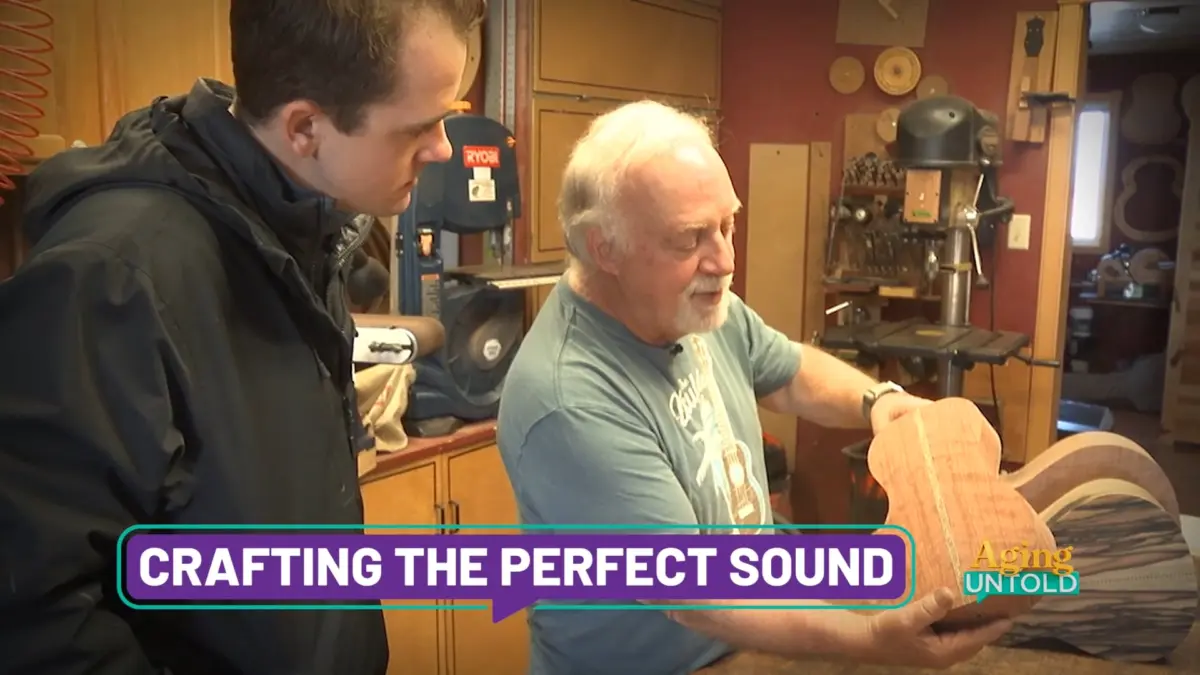
A prime example of this dedication is found in the workshop’s concert ukuleles, which combine rare and visually stunning tonewoods with superior acoustic properties. As Bruce Petros noted while displaying a recent creation featuring a curly Koa top paired with curly bubinga back and sides:
“We’re trying to have lasting, lasting beauty in the instrument.”
Koa, indigenous to Hawaii, is legendary among acoustic builders for its balanced tonal spectrum—offering warmth in the low-end and crisp articulation in the highs—while developing an increasingly rich voice as it ages. Bubinga, a dense and durable African hardwood, provides a robust structural foundation that enhances projection and sustain.
Achieving this level of acoustic quality requires meticulous attention to detail. The father-son duo spends countless hours fine-tuning soundboards, shaving internal bracing by fractions of a millimeter, and balancing structural integrity with vibrational freedom.
“They sound better and they play better,” Bruce Petros emphasizes. “Figuring out the ways to, you know, eke out every little bit of tone.”
The Economics of Artisanal Succession
In the broader landscape of American manufacturing, business succession is frequently treated as a financial transaction—a matter of valuing equipment, real estate, client lists, and patents, followed by a corporate buyout or liquidation. However, in bespoke craftsmanship, standard business models fail to apply.
Bruce Petros succinctly identifies this structural limitation:
“A lot of guitar makers when they quit, what are they going to do? You can’t sell a guitar making shop. You can sell the tools and the wood. You can’t sell your reputation. So this is kind of the ideal situation where the reputation is built in and it continues on.”
This insight highlights the profound vulnerability of independent trades. When a master craftsperson retires without a direct successor, centuries of accumulated empirical knowledge, proprietary techniques, and aesthetic intuition are often lost. By passing the business to his son, Bruce Petros ensures that the "Petros" name remains synonymous with living, evolving excellence rather than becoming a historical footnote or a brand name acquired by a conglomerate.
Official Statements & Generational Perspectives
The transition of leadership at Petros Guitars is unique not only for its operational continuity, but also for the profound emotional harmony and mutual respect that defines the father-son relationship.
Bruce Petros: The Visionary Founder
Looking back over 52 years of shaping wood and sound, Bruce Petros views the impending handover to his son as the ultimate vindication of his life’s work. Building a business from a $15 kit in a Colorado resort town into a globally respected brand required decades of sacrifice, patience, and uncompromising standards. Knowing that the workshop will remain in trusted hands brings a sense of deep professional fulfillment.
Bruce’s philosophy has always centered on longevity—creating instruments that outlive their makers and retain their structural and acoustic integrity across generations. By mentoring Matt from childhood, he has successfully transferred not just physical skills, but an entire ethos of craftsmanship.
Matt Petros: The Next Generation
For Matt Petros, stepping into the role of master luthier is the realization of a lifelong dream rooted in familial warmth and natural immersion. Unlike many professionals who struggle to find their calling, Matt grew up surrounded by the sights, sounds, and smells of the luthier’s shop.
“Well, you grow up in the shop. That’s all I knew,” Matt reflects. “And every little boy wants to be like their dad. And I was just lucky enough to be able to do it.”
Unlike the high-pressure environments typical of corporate career paths, Matt’s professional journey has been characterized by collaborative mentorship and creative autonomy. Working side-by-side with his father has provided an education that no formal trade school could replicate.
“It’s just great to be able to create something with your hands,” Matt says. “There’s never been any pressure. I’ve never been yelled at by my boss or threatened to be fired.”
This nurturing environment has allowed Matt to develop his own voice as a builder while honoring the foundational techniques established by his father. He views taking over the business not as an obligation, but as an extraordinary privilege—an opportunity to carry forward a family musical legacy into a new era.
Future Outlook: Preserving a Legacy in a Mass-Produced World
As Petros Guitars looks toward the future, the workshop stands resilient in an economic climate increasingly dominated by automated, factory-produced instruments and synthetic materials. The demand for authentic, hand-built acoustic guitars and ukuleles remains robust, driven by musicians and collectors who recognize that an exceptional instrument is a work of art with a soul.
The continuity provided by Matt Petros taking over the business ensures that the name "Petros" will continue to represent the pinnacle of American lutherie for decades to come. Future plans for the Hollandtown workshop involve maintaining the uncompromising production standards that built the brand’s international reputation, while subtly incorporating modern efficiencies that do not compromise the integrity of hand-crafting.
Furthermore, the father-son team plans to continue pushing the boundaries of acoustic design, experimenting with new tonewood combinations, and refining internal bracing architectures to achieve even greater harmonic richness.
In a world that moves increasingly fast, where digital efficiency often eclipses physical craftsmanship, the story of Bruce and Matt Petros serves as a powerful reminder of the enduring value of human labor, patience, and dedication. From a humble $15 kit in the Rocky Mountains to a world-renowned workshop in rural Wisconsin, Petros Guitars proves that true quality is timeless—and when nurtured by family, it only gets better with age.

0 Comments