
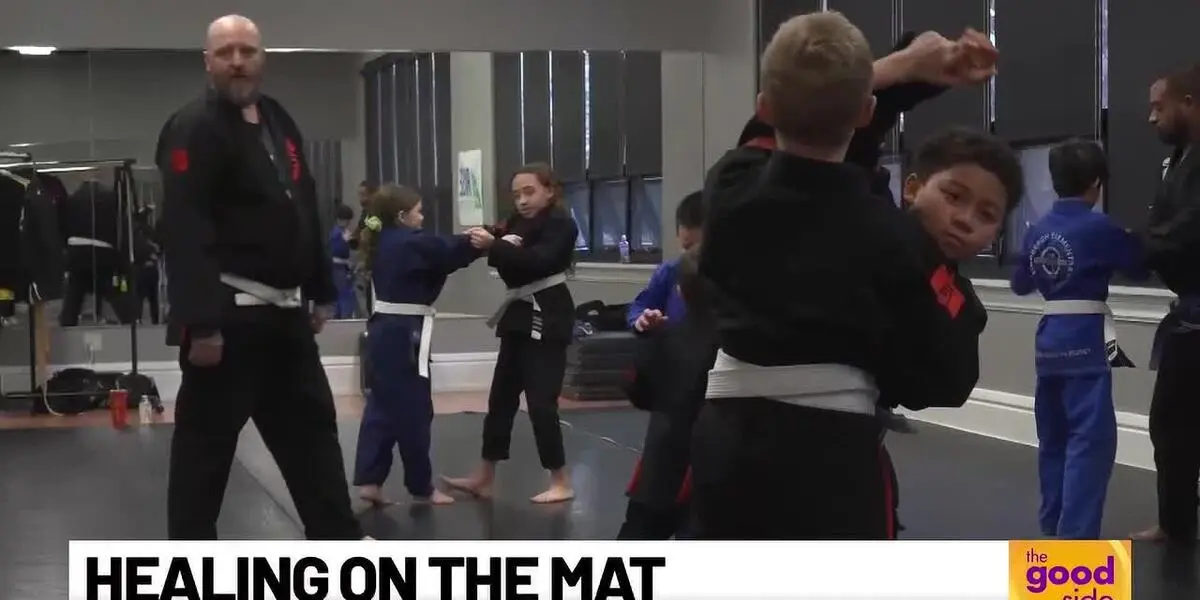

WASHINGTON (Gray DC) — For many young people navigating the complexities of the foster care system, survival is a daily battle. The statistics are well-documented and sobering: youth who age out of the foster care system face disproportionately high risks of homelessness, academic underachievement, incarceration, and chronic mental health struggles. Without a stable familial safety net, the transition into adulthood can feel like an insurmountable climb.
Yet, out of this crucible of systemic vulnerability, stories of radical resilience and community transformation continue to emerge. Six years ago in Wyandotte County, Kansas, Ray Freeman—a former foster youth who intimately understands the profound isolation and trauma of the system—founded One Club Jiu Jitsu. What began as a personal endeavor to master his own past has evolved into a revolutionary community sanctuary. Today, Freeman uses the gentle art of Brazilian jiu-jitsu not merely as a martial art, but as an innovative therapeutic vehicle to help children and adults process trauma, manage ADHD, combat depression, and overcome severe behavioral challenges.
This in-depth investigative report examines the intersection of martial arts, neurobiology, and trauma recovery through the lens of One Club Jiu Jitsu. By analyzing the structural gaps in traditional mental health care, the unique therapeutic applications of combat sports, and the deeply personal journey of its founder, this article explores how the mat is reshaping lives in Wyandotte County and offering a blueprint for community-led healing.
Executive Overview
The modern mental health landscape for at-risk youth and trauma survivors is fraught with systemic bottlenecks. Traditional talk therapy, while effective for many, often falls short for children and adolescents dealing with complex developmental trauma. Furthermore, youth with conditions such as Attention-Deficit/Hyperactivity Disorder (ADHD) and severe behavioral dysregulation frequently find themselves overmedicated or alienated within traditional educational and clinical settings.
Enter One Club Jiu Jitsu. Under the leadership of Ray Freeman, the academy has carved out a distinct niche that bridges the gap between physical conditioning, somatic therapy, and mental health intervention.
- Core Intervention: Brazilian jiu-jitsu (BJJ), a martial art focused on leverage, ground fighting, and submission holds, utilized as a form of somatic processing and nervous system regulation.
- Target Demographics: At-risk youth, foster children and alumni, individuals dealing with clinical depression, ADHD, and behavioral struggles.
- Impact Metrics: Over six years of operation, the academy has served hundreds of students, fostering discipline, emotional regulation, and self-efficacy. Notably, the program’s inclusive model includes Freeman’s own son, Jory, integrating familial rehabilitation with community outreach.
- Significance: One Club Jiu Jitsu represents a paradigm shift away from purely clinical interventions toward community-anchored, embodied healing practices that address trauma where it lives—in the nervous system and the physical body.
Detailed Chronology: From the Foster Care System to the Mat
To understand the profound empathy that drives One Club Jiu Jitsu, one must examine the life trajectory of its founder. Ray Freeman’s journey is not that of a detached martial arts entrepreneur; it is the story of an individual forged in the fires of adversity.
The Formative Years: Navigating the Foster Care System
Growing up, Freeman experienced firsthand the instability, transience, and emotional turbulence of the foster care system. The constant shifting of environments, lack of permanent familial roots, and exposure to early childhood adversity created deep-seated trauma. For many youth in similar positions, the lack of control over their external environment manifests as internal chaos, anxiety, and behavioral outbursts.
As Freeman reached the age of majority, he "aged out" of the system—a critical juncture where thousands of young adults across the United States are abruptly left to fend for themselves without financial resources, housing support, or mentorship. The transition is notoriously perilous; studies indicate that up to 20% of youth who age out of foster care experience homelessness within the first year of emancipation.
Discovering the Mat: A Sanctuary of Control
During his young adult years, seeking a healthy outlet to process his internal struggles and channel his kinetic energy, Freeman discovered Brazilian jiu-jitsu. Often referred to as "human chess," BJJ requires intense physical exertion, strategic thinking, and, above all, absolute presence. On the mats, external chaos fades away. Every movement requires problem-solving under physical pressure, making it an ideal environment for somatic grounding.
Through rigorous training, Freeman found more than just physical fitness; he discovered a therapeutic framework. The mats provided a safe container where he could confront discomfort, learn emotional regulation, and rebuild his self-esteem. As his proficiency in the martial art grew, so did his clarity of purpose: he realized that the very tools saving him could be weaponized against the cycles of trauma affecting other vulnerable youth.
Founding One Club Jiu Jitsu (2018–Present)
Six years ago, driven by a vision to create a safe haven for those who felt disenfranchised, Freeman established One Club Jiu Jitsu in Wyandotte County. Recognizing the socioeconomic barriers that often prevent at-risk populations from accessing specialized fitness or therapeutic programs, Freeman designed his academy to be radically inclusive.
Over the past six years, the gym has grown from a grassroots project into a vital community institution. It operates not merely as a business, but as an ecosystem of mutual support. Here, children from broken homes, adults battling treatment-resistant depression, and individuals striving to overcome behavioral obstacles train side by side. Among these students is Freeman’s own son, Jory, symbolizing a generational break from the cycles of trauma that once defined the founder’s early life.
Supporting Context & Metrics: The Science of Somatic Healing
To fully appreciate the impact of One Club Jiu Jitsu, it is essential to examine the underlying mechanisms of trauma, neurobiology, and martial arts training. Why is jiu-jitsu uniquely positioned to address conditions like ADHD, depression, and complex trauma?
The Somatic Nature of Trauma
Renowned psychiatrist and trauma expert Dr. Bessel van der Kolk, author of The Body Keeps the Score, has extensively documented how psychological trauma is stored not just in the mind, but in the physical body and the autonomic nervous system. Traditional talk therapy engages the prefrontal cortex—the logical, reasoning part of the brain. However, severe trauma often locks individuals in "fight, flight, or freeze" responses controlled by the amygdala and brainstem.
When a person is trapped in hyperarousal or emotional numbness, talking about trauma is frequently insufficient. Somatic therapies—interventions that involve physical movement, breath control, and bodily awareness—are required to help the nervous system recalibrate.
How Jiu-Jitsu Rewires the Brain
Brazilian jiu-jitsu functions as an active form of somatic experiencing for several key reasons:
- Controlled Exposure to Stress: In BJJ, practitioners regularly experience controlled physical restraint and simulated danger (e.g., being pinned under an opponent). By learning to remain calm, regulate their breathing, and think strategically while under physical pressure, students teach their nervous systems that stress does not equal immediate catastrophe. This builds profound emotional resilience that translates directly to everyday life.
- Kinesthetic Focus and ADHD Management: Children and adults with ADHD often struggle with executive dysfunction, impulse control, and excess kinetic energy. The complex, whole-body coordination required in jiu-jitsu demands intense focus, effectively channeling restless energy into structured problem-solving. Every drill and sparring session acts as an exercise in mindfulness and sustained attention.
- Dopamine and Serotonin Regulation: Clinical depression is frequently characterized by dysregulated neurotransmitter levels and a sense of helplessness. The rigorous physical exertion of martial arts triggers the release of endorphins, dopamine, and serotonin. Furthermore, mastering a difficult technique or escaping a difficult position provides an immediate, tangible sense of agency and accomplishment, directly countering the learned helplessness often induced by trauma or chronic depression.
- Tactile Connection and Safe Touch: Many foster youth and trauma survivors struggle with healthy physical boundaries and touch. BJJ, while combative, is governed by strict rules, mutual respect, and consent. It teaches participants how to safely inhabit their physical bodies while respecting the physical boundaries of others in a structured, highly regulated environment.
Socioeconomic Realities in Wyandotte County
The choice of Wyandotte County as the home for One Club Jiu Jitsu is strategically and socially significant. As an urban-suburban county facing distinct socioeconomic challenges—including lower median household incomes and health disparities compared to surrounding regions—access to quality mental health resources and extracurricular enrichment programs can be severely restricted for low-income families. By embedding a high-level martial arts academy directly into this community and maintaining a focus on accessibility, Freeman has filled a critical service gap that municipal and clinical healthcare systems often fail to reach.
Official Statements & Community Perspectives
While formal institutional studies on martial arts as trauma interventions are still emerging, the anecdotal and qualitative evidence from participants, community leaders, and mental health advocates at One Club Jiu Jitsu paints a powerful picture of success.
Ray Freeman has frequently articulated his philosophy regarding the mission of the gym. In reflections on his work, he emphasizes that jiu-jitsu is merely the medium; human connection is the message.
"When you bring a kid off the street who feels like they have no control over their world, and you put them on the mat, you aren’t just teaching them how to defend themselves," Freeman observes. "You are teaching them how to breathe when things get uncomfortable. You are showing them that even when they are pinned down, they have the power to think, to strategize, and to escape. That realization changes everything about how they view themselves and their future."
Parents and adult students echo these sentiments, noting transformations that traditional therapeutic interventions struggled to achieve. One local parent whose child attends the academy shared the profound shift in their household:
"Before coming to One Club, my son struggled intensely with behavioral outbursts at school and emotional dysregulation at home. Traditional therapy helped, but it wasn’t until he started training under Ray that we saw a real shift. On the mat, he found an outlet for his energy and a mentor who truly understands what it feels like to be misunderstood. The discipline and confidence he has gained are night and day."
Mental health professionals who advocate for somatic and holistic interventions have also taken note of grassroots programs like One Club Jiu Jitsu. Dr. Elena Vance, a clinical psychologist specializing in adolescent development, notes the growing validation for movement-based therapies:
"Programs that integrate physical mastery with emotional regulation are invaluable, particularly for underserved populations who may be distrustful of clinical institutions. When a child learns self-defense and discipline in an environment characterized by mutual respect and safety, they are actively rewiring neural pathways associated with fear and impulsivity. It is community-led healing at its finest."
Future Outlook: Scaling the Model of Somatic Empowerment
As One Club Jiu Jitsu marks six years of continuous community impact, the outlook for the academy and its founder centers on expansion, sustainability, and advocacy.
The Vision for Growth
The primary challenge facing community-based initiatives like One Club Jiu Jitsu is resource allocation. Operating an inclusive gym that often absorbs the costs for at-risk youth and foster children requires sustainable funding streams. Looking ahead, Freeman and his supporters are exploring avenues for philanthropic partnerships, grants, and community sponsorships designed to secure the academy’s physical space and expand its outreach capacity.
Key strategic goals for the coming years include:
- Scholarship Programs: Establishing dedicated scholarship funds to ensure that financial barriers never prevent a foster youth or struggling family from accessing training.
- Educational Outreach: Partnering with local schools and social service agencies to integrate basic somatic regulation and martial arts programming into after-school initiatives.
- Mentorship Expansion: Developing a formal leadership pipeline where older students and foster alumni who have graduated through the program can train as assistant instructors, fostering a sustainable cycle of mentorship.
A Blueprint for National Replication
The success of One Club Jiu Jitsu in Wyandotte County offers a compelling blueprint that can be replicated in urban centers across the United States. As policymakers and healthcare systems grapple with the youth mental health crisis and the ongoing challenges within the foster care system, grassroots innovations that combine physical activity, trauma-informed coaching, and community belonging are proving to be indispensable.
By proving that the mat can be a place of profound psychological restoration, Ray Freeman has not only rewritten the narrative of his own life—he has built a sanctuary where countless others can learn to fight for their futures, one roll at a time.
Copyright 2026 The Good Side. All rights reserved.

0 Comments