

Executive Overview
DENVER, COLORADO — In a bruising, high-stakes defensive struggle at Empower Field at Mile High, the Jacksonville Jaguars hold a hard-fought 10-3 advantage over the Denver Broncos at halftime. Sunday afternoon’s matchup has quickly evolved into a classic trench warfare affair, characterized by relentless pass rushes, tactical chess matches, and dramatic, game-altering red-zone stops.
While head coach Liam Coen’s offense has flashed moments of explosive downfield efficiency—highlighted by a precise 32-yard connection from quarterback Trevor Lawrence to wide receiver Parker Washington—the story of the first two quarters belongs entirely to the Jaguars’ resilience when backed against their own goal line. Facing a hostile environment and a ferocious Denver front seven, Jacksonville’s defense delivered two monumental stands: a stubborn four-play goalline denial that forced a Broncos field goal, followed by a stunning, acrobatic end-zone interception by cornerback Jourdan Lewis just before the intermission.
As both teams head to the locker rooms to make critical tactical adjustments, the Jaguars find themselves navigating the dual challenges of protecting their franchise quarterback from a surging Denver pass rush and establishing a consistent ground game. With a slender seven-point cushion, Jacksonville looks to build upon its first-half momentum while the Broncos search for offensive rhythm after squandering multiple golden scoring opportunities.
Detailed Chronology: First-Half Play-by-Play Analysis
Trench Warfare and Early Jitters
From the opening whistle, the high-altitude air of Denver seemed to amplify the intensity of a defensive slugfest. Both teams struggled to establish early continuity as opposing pass rushes dictated the rhythm of the game. For the Jaguars, the primary narrative of the opening quarter was the relentless pressure applied by the Denver front seven. Edge rushers and interior blitzers routinely collapsed the pocket, forcing Trevor Lawrence to make rapid decisions and robbing the Jacksonville passing game of the luxury of time.
Compared to their fluid, rhythmic performance in Week 1, the Jaguars’ offense found itself forced into reactionary adjustments. Lawrence, often operating under duress, displayed poise by stepping up into shrinking pockets rather than retreating backward into the teeth of the pass rush.
Coen’s Offense Strikes: The Washington-Tuten Combination
The defining offensive sequence for Jacksonville in the first half arrived midway through the second quarter. Facing mounting pressure, Lawrence delivered his finest throw of the frame. Stepping decisively into the pocket to avoid collapsing edge pressure, he targeted Parker Washington, who had found a soft spot deep in the center of the Denver zone coverage.
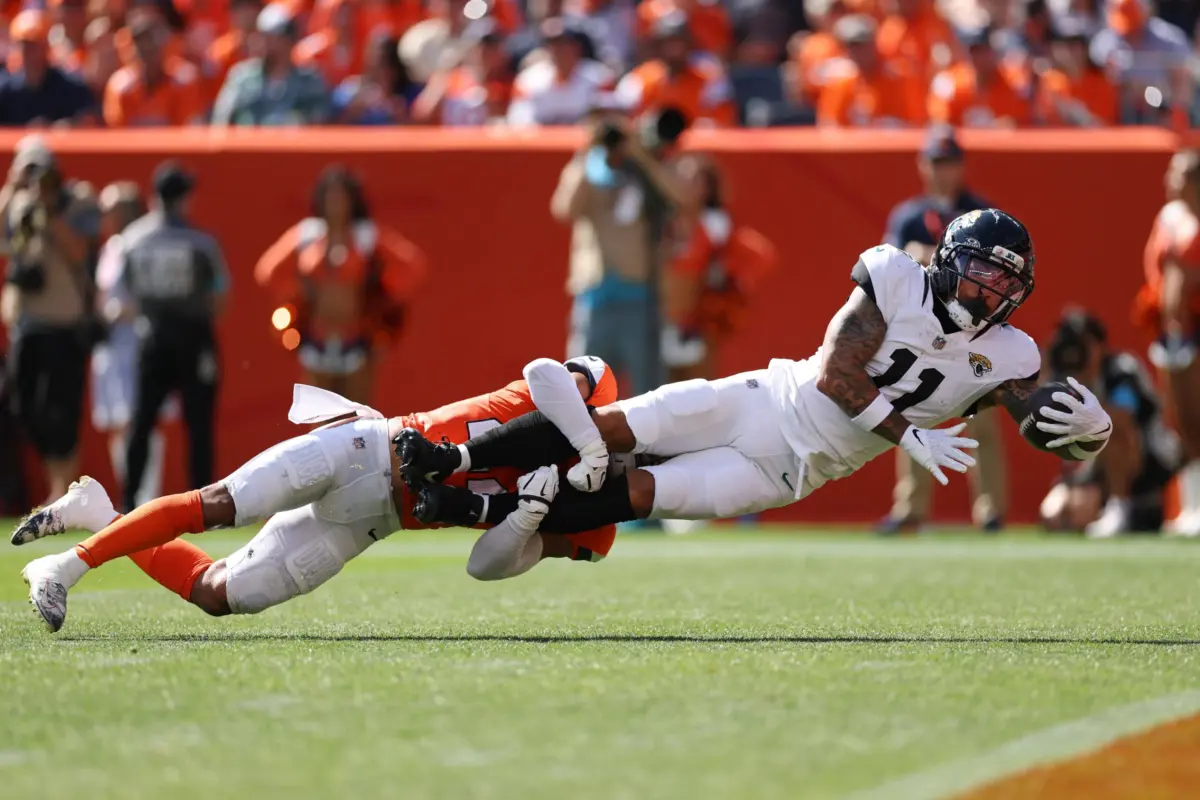
The 32-yard completion sliced through the heart of the Broncos’ secondary, igniting the Jacksonville sideline. Washington raced deep into Denver territory before safety Brandon Jones tracked him down, hauling him to the turf just inches short of the goal line at the 1-yard line to prevent a walk-in touchdown.
The near-miss, however, did not deter the visitors. On the very next snap, offensive coordinator and head coach Liam Coen dialed up a direct snap to running back Bhayshul Tuten. With the offensive line surging forward to win the leverage battle in the trenches, Tuten burst through the clutter, crossing the plane for a gritty 1-yard touchdown plunge. The score capped a methodical drive that underscored Coen’s stated philosophy: pushing the ball aggressively downfield to create spacing, while maintaining the physical toughness required to punch it in when the field compresses.
The Broncos’ Counter-Punch and Defensive Brackets
Denver, determined to respond before the half, manufactured two explosive plays that threatened to flip the momentum of the game entirely.
First, Broncos quarterback Bo Nix connected on a stunning 49-yard deep strike down the sideline. Despite tight, blanket coverage from cornerback Buster Brown, wide receiver Jaylen Waddle—showcasing his elite speed and contested-catch ability—hauled in the deep ball, dragging the offense all the way down to the Jacksonville 1-yard line. Moments later, Denver struck again through the air when wide receiver Troy Franklin pulled down a remarkable, one-handed 27-yard grab that carried the ball to the Jaguars’ 9-yard line.
These explosive gains placed the Jacksonville defense under maximum duress, setting the stage for two of the most critical defensive sequences of the young 2026 NFL season.
The Red-Zone Stand and Lewis’ Heroics
When Waddle’s 49-yard reception placed Denver at the doorstep of the end zone, conventional analytics suggested a certain touchdown. Instead, the Jaguars’ defense bowed their collective backs.
On first and second down, the Denver rushing attack was stonewalled at the line of scrimmage for no gain, as the interior defensive line clogged every available rushing lane. On third down, edge defenders Dennis Gardeck and Josh Hines-Allen converged with violent precision, completely blowing up running back J.K. Dobbins in the backfield for a loss. Deprived of the end zone, Denver was forced to settle for a short field goal, sparing the Jaguars from a devastating momentum swing.
The defensive masterclass continued moments later following Franklin’s one-handed grab. With the Broncos threatening once more inside the 10-yard line, veteran cornerback Jourdan Lewis authored the defensive play of his young tenure in Jacksonville. Matched up against towering 6-foot-4 wide receiver Courtland Sutton in single coverage in the end zone, the 5-foot-10 Lewis used exceptional leverage, body positioning, and timing to outmuscle his taller opponent. Lewis leaped at the apex, ripping the ball away for a magnificent interception that neutralized the threat and preserved the Jaguars’ lead.
Two-Minute Drill and Little’s Leg
Armed with the football and a narrow lead late in the second quarter, Lawrence orchestrated a textbook two-minute drill. Starting from their own 20-yard line, the Jaguars meticulously worked the ball down the field against a tiring Denver defense.
Lawrence twice found Parker Washington on quick-hitting routes to keep the chains moving, before firing a sharp intermediate completion to Brian Thomas Jr. to bleed the clock and push deep into enemy territory. With the clock winding down and no timeouts remaining, rookie-turned-reliable kicker Cam Little trotted onto the field. Little calmly drove a 44-yard field goal cleanly through the uprights as the halftime horn sounded, sending the Jaguars into the locker room with a 10-3 advantage.
Supporting Context & Metrics
Key Statistical Indicators (First Half)
- Score: Jacksonville Jaguars 10, Denver Broncos 3
- Total Yards (Estimated Battle): Evenly contested, with Denver winning the explosive play battle (two plays over 25 yards) and Jacksonville winning the efficiency and red-zone battle.
- Turnovers: Denver: 1 Interception (Bo Nix pass intercepted by Jourdan Lewis); Jacksonville: 0.
- Red-Zone Defense: Jacksonville stopped Denver on 100% of their deep red-zone trips inside the 5-yard line (holding them to a single field goal following a 1-yard line entry).
- Key Passing Connection: Trevor Lawrence to Parker Washington (1 reception, 32 yards, setting up the 1-yard Tuten touchdown).
- Late-Half Scoring Drive: 80 yards, engineered by Trevor Lawrence in under 90 seconds, culminating in Cam Little’s 44-yard field goal.
Tactical Evolution: The Coen Effect
The integration of Liam Coen’s offensive scheme remains a primary focal point for observers tracking the Jaguars’ trajectory this season. Coen has continually emphasized stretching opposing secondaries vertically to open up underneath options for his playmakers.
While the Denver pass rush managed to disrupt timing early on—exposing vulnerabilities in pass protection that Jacksonville’s coaching staff must address during the intermission—the deep shot to Parker Washington proved that the downfield philosophy can yield explosive dividends even against elite defensive fronts.
Simultaneously, defensive coordinator Ryan Nielsen’s unit showcased remarkable situational awareness. Surrendering big plays is an inherent risk in modern NFL defenses, but the ability to clamp down inside the red zone—manifested by the collective efforts of Josh Hines-Allen, Dennis Gardeck, Buster Brown, and Jourdan Lewis—demonstrates a championship-level resilience that will be vital as the second half unfolds.
Official Statements & Sideline Perspectives
While formal post-game press conferences will not occur until the conclusion of regulation, sideline reporters caught up with defensive leaders and coaching staff members during the transition to the locker room.
Reflecting on the grueling nature of the first half, defensive stalwart Josh Hines-Allen emphasized the collective mindset of the front seven during their pivotal goal-line stand:
"They hit us with a couple of big, uncharacteristic plays down the field, but nobody panicked. We understand who we are as a defense. When you get backed up against your own goal line, stats go out the window—it’s about heart, leverage, and winning your individual matchup. We trusted each other, trusted the scheme, and got off the field."
Offensive coordinator Liam Coen addressed the challenges posed by Denver’s aggressive pass-rushing packages during a brief sideline interview with broadcast media:
"They’re bringing heavy pressure and challenging our protection schemes. Trevor [Lawrence] is taking some hits, but he’s standing in there, keeping his eyes downfield, and making elite decisions. We hit that big shot to Park [Washington] because we stayed aggressive. In the second half, we’ve got to help our tackles out with chips and quick game, establish the run, and keep sustaining drives."
Future Outlook & Second-Half Adjustments
As the teams prepare to take the field for the third quarter, both coaching staffs face critical strategic decisions that will dictate the outcome of this defensive heavyweight bout.
For the Jacksonville Jaguars:
- Protect the Quarterback: The primary objective for the offensive line in the second half must be neutralizing Denver’s edge rushers. Expect more maximum protection sets, quick three-step drops, and running back chips to buy Lawrence the necessary fractions of a second to operate efficiently.
- Establish the Ground Game: While Bhayshul Tuten converted his short-yardage opportunity into a touchdown, the Jaguars’ traditional rushing attack has largely been bottled up. Sustaining drives and wearing down the Denver front will require consistent intermediate gains on the ground.
- Maintain Defensive Discipline: The secondary must tighten up on deep crossing routes and contested sideline catches to prevent the type of explosive gains that bailed Denver out in the first half. If Jourdan Lewis, Buster Brown, and the rest of the defensive backfield can sustain their coverage integrity, the high-altitude pressure will heavily favor the visitors.
For the Denver Broncos:
- Capitalize on Red-Zone Opportunities: Leaving points on the field against a disciplined defense is a fatal error. Head coach Sean Payton and quarterback Bo Nix must find creative ways to convert their trips inside the 20-yard line into touchdowns rather than settling for field goals.
- Unleash the Pass Rush: Denver’s defense has successfully disrupted Lawrence’s timing; they must maintain that pressure in the second half to force turnovers and provide their struggling offense with short fields.
With a 10-3 lead hanging in the balance, the second half promises to be an intense continuation of strategic chess and physical dominance. Tune in as the Jaguars fight to secure a statement road victory in the heart of the Rocky Mountains.

0 Comments