
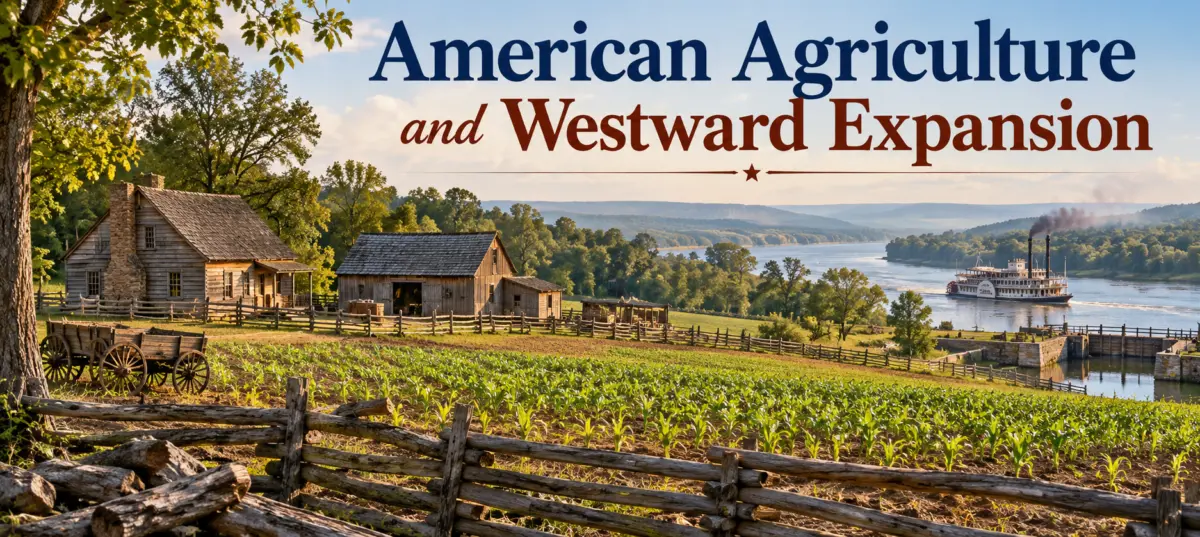

Executive Overview
In the opening decades of the 19th century, the United States was a nation defined by the soil. For the vast majority of early Americans, farming was not merely an occupation; it was a fundamental way of life, a daily struggle for subsistence, and the primary engine of economic activity. The domestic economy was overwhelmingly agrarian, characterized by self-contained family farms that produced nearly all their own food, clothing, and tools, bartering only minimal surpluses with nearby communities.
However, this localized, agrarian existence stood on the brink of a profound transformation. Propelled by monumental territorial acquisitions, groundbreaking innovations in transportation, and an insatiable hunger for economic mobility, American agriculture broke free of its geographic confines. The convergence of westward expansion, the proliferation of canals and steamboats, and a unique cycle of land speculation and development shifted the paradigm from mere subsistence to an interconnected, commercialized agricultural economy.
This deep-dive retrospective examines the pivotal era when the American frontier became the canvas for a sweeping economic revolution. While cheap land offered the promise of prosperity, the realities of frontier farming demanded backbreaking labor, substantial capital investment, and resilience. Ultimately, the synthesis of geography, infrastructure, and human enterprise laid the indispensable foundation for America’s modern agricultural superpower status.
Detailed Chronology: The Milestones of Agricultural Evolution
To understand how American agriculture matured from localized homesteads to a continental commercial network, one must trace the chronological milestones that unlocked the nation’s interior and connected it to the world.
The Louisiana Purchase (1803)
The turning point of early 19th-century American geography was President Thomas Jefferson’s acquisition of the Louisiana Territory from France. Costing $15 million, the purchase effectively doubled the landmass of the United States overnight. By securing control of the Mississippi River basin and millions of acres of fertile, untouched interior land, the federal government provided the raw material necessary for sweeping agricultural migration. This monumental deal transformed the psychological and physical boundaries of the nation, shifting the national gaze firmly toward the West.
The Infrastructure Boom: Canals and Steamboats (1810s–1830s)
Owning fertile land was useless if farmers could not get their crops to market. The early decades of the 1800s witnessed a transportation revolution that systematically dismantled geographic isolation.
- The Steamboat Era: Following Robert Fulton’s commercialization of the steamboat in 1807, rivers—previously one-way highways used only to float rafts downstream—became two-way commercial arteries. Steamboats allowed goods to move rapidly upstream against the currents of the Mississippi, Ohio, and Missouri rivers, linking remote interior farms directly to major trading hubs like New Orleans.
- The Canal Age: The opening of the Erie Canal in 1825 served as a watershed moment. Spanning 365 miles across New York State, it connected the Atlantic seaboard directly to the Great Lakes. Freight costs plummeted, and transit times shrank from weeks to days, proving that human-made infrastructure could artificially bridge the vast expanses of the continent.
The Cycle of Frontier Development (1820s–1850s)
As transportation networks webbed across the East and Midwest, a distinct socio-economic cycle emerged on the frontier. Ambitious settlers acquired cheap federal land under various land acts, cleared dense forests or unbroken prairie, and established homesteads. Through arduous labor, they transformed wild acreage into productive, highly valued farms. Once improved, many of these farmers sold their homesteads at a substantial profit, using the capital to leapfrog further west to secure even larger tracts of land. This repeating cycle accelerated the settlement of the Old Northwest (modern-day Ohio, Indiana, Illinois, Michigan, and Wisconsin) and parts of the Deep South.
Supporting Context & Metrics: The Economics of Early American Farming
To fully appreciate the scope of this transformation, it is necessary to examine the socio-economic metrics, labor dynamics, and financial realities that underpinned early 19th-century agriculture.
The Myth of "Free" Land
A persistent misconception regarding westward expansion is that land was virtually free and easily attained. While the federal government did offer land at relatively low statutory prices (reduced to $1.25 per acre under the Land Act of 1820), the actual cost of establishing a functional farm was astronomical relative to the period’s wages.
Consider the capital requirements for a standard mid-19th-century homestead:
- Land Acquisition: Purchasing a standard 80-to-160-acre quarter section required an upfront cash outlay of $100 to $200—a formidable sum for an average laborer.
- Clearing and Preparation: In the heavily forested regions of the Ohio River Valley, clearing just one acre of dense timber required weeks of grueling axe work, stump-pulling, and burning. On the Midwestern prairies, breaking the thick, matted sod required heavy, specialized iron plows pulled by teams of multiple oxen or horses.
- Capital Infrastructure: Building a habitable log cabin or frame house, constructing barns for livestock, digging wells, and erecting miles of fencing demanded significant investments of both time and money before a single commercial crop could be harvested.
Shifting Demographics: From Farm to Market
Economic data from the era highlights the slow but inexorable shift in labor and production. In 1800, over 80% of the American workforce was engaged in agriculture, primarily producing for household consumption. By 1850, although agriculture remained the dominant sector, the proportion of commercial surplus had risen dramatically.
| Metric / Era | Early 19th Century (c. 1800) | Antebellum Period (c. 1850) |
|---|---|---|
| Primary Economic Focus | Subsistence and localized barter | Regional and international commercial markets |
| Primary Transportation | Pack animals, wagons, flatboats (one-way) | Steamboats, expansive canal systems, early rail |
| Land Availability | Restricted largely to the Eastern Seaboard and Piedmont | Vast interior territories unlocked by the Louisiana Purchase |
| Capital Investment | Low initial cost; minimal mechanization | High initial capital for land clearing, labor, and transport |
Official Statements and Historical Perspectives
Historians, economists, and leaders of the 19th century left an enduring record of how they viewed the rapid expansion of American agriculture and its central role in the nation’s destiny.
Reflecting on the philosophy of agrarianism, President Thomas Jefferson famously wrote in an 1785 letter to John Jay:
"Cultivators of the earth are the most valuable citizens. They are the most vigorous, the most independent, the most virtuous, and they are tied to their country, and wedd[ed] to its liberty and interests, by the most lasting bonds."
Jefferson’s vision of an "Empire of Liberty" rested entirely on the perpetual availability of land for independent yeoman farmers. However, as the 19th century progressed, the practical realities of market forces quickly outgrew Jefferson’s idealized self-sufficient homesteads.
Agricultural historian and modern analysts of the period note:
"The expansion of the American agricultural frontier was never a passive migration. It was an aggressive, capital-intensive enterprise. The farmer of the 1830s and 1840s was simultaneously a pioneer, a real estate speculator, and a small-scale capitalist who depended utterly upon distant financial institutions, commodity prices, and the reliability of steam-powered infrastructure."
Furthermore, contemporary trade journals and agricultural societies of the antebellum era frequently emphasized the urgent need for internal improvements. Advocates argued that without federal and state investment in canals, river dredging, and later, railroads, the vast interior agricultural wealth would remain "locked in the earth, useless to commerce and civilization."
Future Outlook: The Bridge to Industrialized Agriculture
The sweeping changes of the early 19th century—the opening of the western frontier, the harnessing of internal waterways, and the transition from isolated plots to market-driven enterprises—did not merely alter the contemporary landscape. They served as the crucial incubation period for the modern industrial agricultural machine.
As the nineteenth century marched toward the Civil War, the foundational trends established in the 1810s and 1820s accelerated exponentially. The primitive wooden plows and hand-scythes of the early frontier gave way to the mechanized innovations of the 1840s and 1850s, such as Cyrus McCormick’s mechanical reaper and John Deere’s steel plow. Simultaneously, the canal network was rapidly superseded by the iron horse of the railroad, which ignored river courses and topography to bind the entire continent into a single, cohesive agricultural market.
The early 19th-century farmer who cleared a patch of wilderness, risked their savings, and floated their harvest down a muddy river on a steamboat was a pioneer of global commerce. They proved that agriculture could be scaled across an entire continent, transforming the United States from a collection of struggling agrarian outposts into the breadbasket of the world.
This retrospective feature is part of the ongoing American Agriculture History Minute series, brought to you by agricultural historian Mark Oppold, dedicated to preserving and exploring the rich heritage of the nation’s farming roots.

0 Comments