

Executive Overview
The modern landscape of American agricultural education and youth development owes a profound debt to the tireless dedication of grassroots pioneers who recognized that the nation’s future relied upon the instruction of its youngest generations. While contemporary 4-H stands as a massive, federally backed institution engaging millions of youths across the United States, its foundations were laid by local educators, visionary administrators, and community leaders. Among these foundational figures, farm wife and community advocate Jessie Shambaugh holds a pivotal place in history.
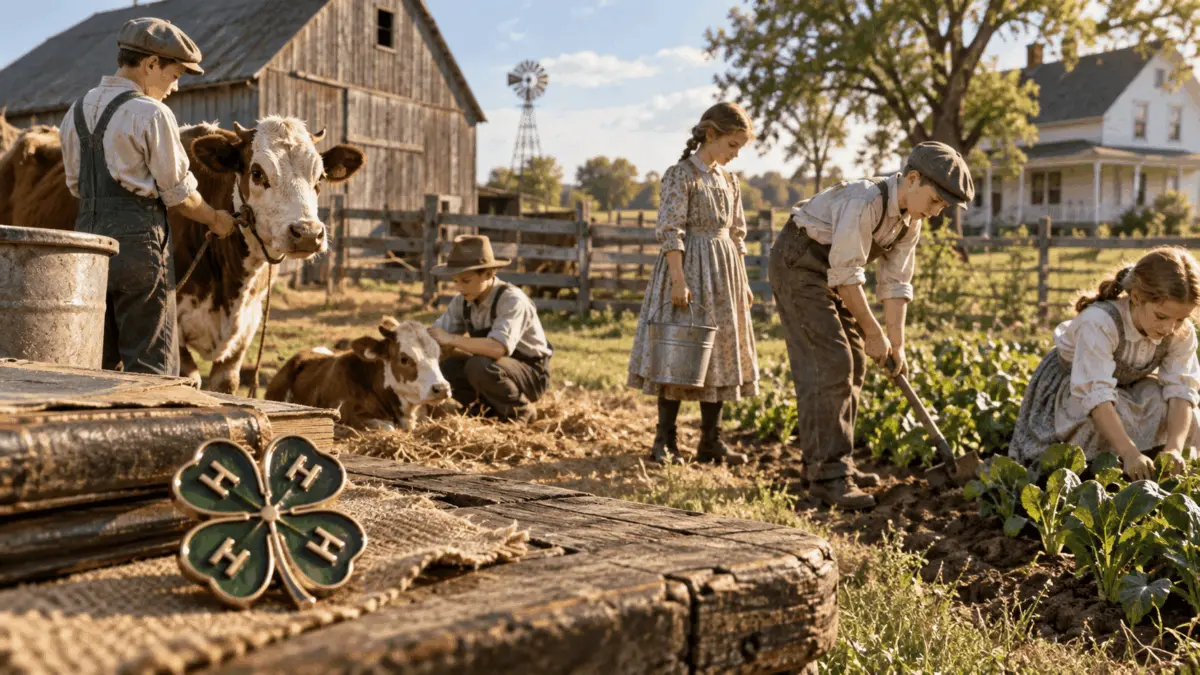
Operating at a time when rural life was undergoing seismic economic and technological transformations, Shambaugh’s localized efforts to engage rural boys and girls in practical agricultural tasks helped catalyze a nationwide phenomenon. Most notably, her creation of the iconic four-leaf clover pin in 1910 provided the visual lexicon and unifying symbol for a movement that officially adopted the "4-H" moniker by 1912.
This comprehensive report explores the origins of the 4-H movement, the specific contributions of Jessie Shambaugh, the legislative milestones—such as the Smith-Lever Act of 1914—that formalized the system, and the enduring legacy of "learn by doing" education in modern American agriculture.
Detailed Chronology: The Evolution of Early Agricultural Youth Clubs
The emergence of youth agricultural clubs in the late 19th and early 20th centuries did not happen in a vacuum. It was a direct response to a changing socio-economic landscape that required greater scientific literacy in farming, as well as an urgent need to stem the migration of disillusioned rural youth toward industrial urban centers.
Pre-1910: The Seeds of Agricultural Education
Before the formalization of 4-H, forward-thinking educators and agriculturalists across the American Midwest began organizing youth groups to test new farming methods. Educators like A.B. Graham in Clark County, Ohio, and Otis Hall in Page County, Iowa, started youth clubs focused on corn growing, soil testing, and domestic science. These early clubs aimed to bridge the gap between academic agricultural research conducted by land-grant universities and the practical application of those techniques on family farms.
It was within this fertile environment of localized experimentation that Jessie Shambaugh operated. As a dedicated farm wife deeply embedded in the rural community of Page County, Iowa, Shambaugh understood that children needed more than just chores; they needed ownership, recognition, and a sense of community pride in agricultural pursuits. She actively mentored boys and girls, involving them in organized growing projects and household skill-building exercises.
1910: The Birth of the Clover Symbol
As these early youth groups grew in popularity, leaders recognized the need for a unifying insignia that could foster a sense of belonging among participants. In 1910, Jessie Shambaugh achieved her most enduring historical breakthrough by designing and crafting a clover pin to distribute to the young people participating in her local agricultural groups.
Shambaugh’s ingenious design featured a four-leaf clover with a letter "H" inscribed on each leaf. While the original iteration of the "H" meanings evolved slightly over the subsequent decade—eventually settling on Head, Heart, Hands, and Health—the visual anchor of the clover immediately resonated with participants. It transformed a loose collection of disparate county clubs into a recognizable, cohesive movement.
1912–1914: Institutionalization and the 4-H Moniker
By 1912, the terminology used to describe these youth groups began to coalesce nationwide. The designation "4-H clubs" officially gained traction, drawing directly from the symbolism introduced by Shambaugh and parallel developments in other Midwestern states.
The momentum generated by these grassroots clubs caught the attention of federal policymakers. In 1914, Congress passed the landmark Smith-Lever Act, establishing the Cooperative Extension System as a partnership between the United States Department of Agriculture (USDA) and land-grant universities. This legislation provided the vital financial and organizational framework necessary to scale youth agricultural clubs from isolated local chapters into a synchronized national network.
Supporting Context & Metrics: The Scale and Impact of Agricultural Extension
To fully appreciate Jessie Shambaugh’s contribution in 1910, one must examine the socio-economic conditions of rural America at the turn of the 20th century. At that time, agriculture was the primary economic engine of the United States, yet farming practices were often inefficient, heavily reliant on tradition rather than science, and vulnerable to environmental degradation and market volatility.
The Rural-Urban Shift and the "Corn Club" Phenomenon
At the dawn of the 20th century, the United States was transitioning from an agrarian society to an industrial powerhouse. Millions of young people were leaving family farms for factory jobs in booming urban centers. Agricultural leaders feared that the foundational knowledge of farming was being lost and that the next generation of rural citizens would lack the skills required to feed a rapidly expanding population.
Early youth clubs—often referred to as "Corn Growing Clubs" for boys and "Tomato Clubs" for girls—served as an antidote to this trend. According to historical agricultural data from the early 1900s:
- Initial Participation: Early clubs in states like Ohio, Iowa, and Illinois started with a few dozen members per county.
- Exponential Growth: Following the implementation of the Smith-Lever Act in 1914, enrollment in extension-backed youth programs surged from tens of thousands to hundreds of thousands within a single decade.
- Curricular Expansion: What began strictly as crop-yield competitions rapidly expanded to encompass livestock management, home economics, food preservation, leadership training, and civic responsibility.
The Anatomy of the 4-H Philosophy
The philosophy championed by Shambaugh and her contemporaries was encapsulated in the core learning methodology of the movement: "Learn by Doing." Rather than relying solely on textbook instruction, young participants were given tangible responsibilities—raising an animal from birth, cultivating a specific plot of land, or managing a household budget.
This hands-on approach achieved two critical objectives:
- Technological Adoption: Adults in rural communities were often skeptical of academic agricultural scientists ("book farmers"). However, when their children successfully utilized modern seed selection, fertilization, and animal husbandry techniques through 4-H projects and dramatically outperformed traditional methods, adult farmers took notice and adopted the innovations.
- Character Development: Beyond technical agricultural skills, programs fostered leadership, public speaking, teamwork, and ethical responsibility—qualities that prepared rural youths for leadership roles far beyond the farm gate.
Official Perspectives and Historical Assessments
Historians of American agriculture and education frequently emphasize that national institutions like 4-H are rarely the product of a single top-down mandate. Instead, they are built on the cumulative efforts of local educators, extension agents, and committed community members like Jessie Shambaugh.
Preserving the Human Element in Agricultural History
Agronomists and agricultural historians note that Shambaugh’s contribution transcends mere artistic design; it represents an early understanding of branding and psychological engagement in education. By giving young people a physical badge of honor—the clover pin—she elevated their labor from mundane farm chores to a badge of distinction and community service.
Mark Oppold, presenter of the American Agriculture History Minute, highlights the importance of recognizing these early, localized roots:
"The history of American agriculture is written by the everyday people who looked at their communities, saw potential in the next generation, and built structures to support them. Jessie Shambaugh didn’t just hand out a pin in 1910; she helped forge an identity for millions of young people who would go on to sustain the American food supply through wars, depressions, and technological revolutions."
Educational sociologists also point out that the involvement of farm women, such as Shambaugh, in the early organizational phases of 4-H challenged the strictly patriarchal structures of early 20th-century agriculture. Women were instrumental in developing the domestic science and home economics branches that eventually merged with agricultural production projects to form the comprehensive 4-H experience we know today.
Future Outlook: The Enduring Legacy of 4-H in the 21st Century
More than a century after Jessie Shambaugh distributed her first clover pins in Page County, Iowa, the 4-H organization remains the largest youth development organization in the United States, administered by the USDA’s National Institute of Food and Agriculture (NIFA) in partnership with land-grant universities.
Adapting to Modern Challenges
While the organization remains deeply rooted in its agricultural heritage, modern 4-H programs have evolved to meet the demands of a high-tech, globalized world. Today’s participants engage in projects that extend far beyond traditional livestock showing and crop cultivation, including:
- STEM Education: Robotics, coding, renewable energy engineering, and aerospace projects.
- Agri-Tech and Precision Agriculture: Utilizing drone technology, GPS-guided mapping, and data analytics in crop management.
- Environmental Stewardship: Water conservation, forestry management, and sustainable food systems.
- Civic Engagement and Leadership: Global youth exchanges, entrepreneurship incubators, and mental health advocacy initiatives.
Sustaining the "Learn by Doing" Mandate
Despite these modern adaptations, the core philosophy established by Shambaugh, Graham, Hall, and other early pioneers remains unchanged. In an era dominated by digital screens and abstract learning environments, the demand for tactile, experiential education is higher than ever.
As agricultural educators look toward the future, ensuring food security for a global population projected to approach 10 billion by 2050 will require the same ingenuity, resilience, and community-minded spirit that motivated early 20th-century farm wives and educators. By connecting young people directly to the land, food production, and community leadership, 4-H continues to fulfill the promise embedded in Shambaugh’s original four-leaf clover: developing better heads, hearts, hands, and health for a sustainable tomorrow.

0 Comments