
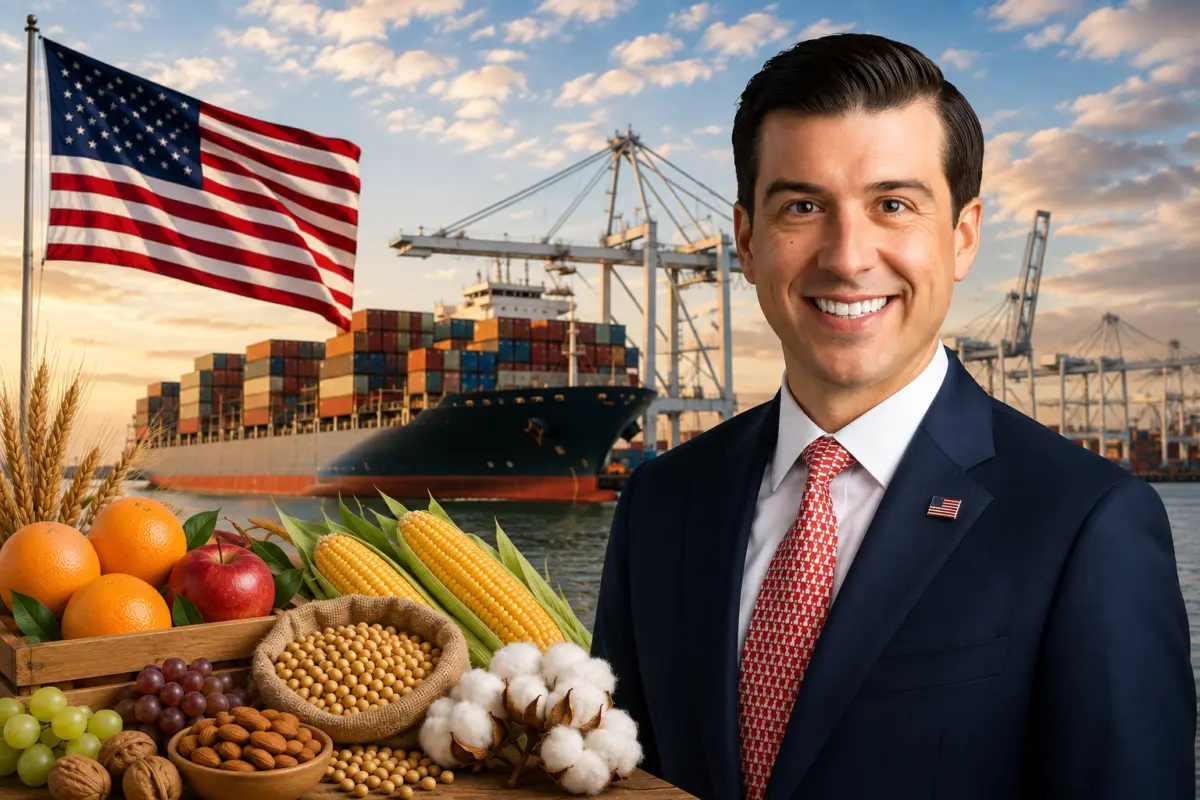

WASHINGTON — In a major development for American farmers, ranchers, and agribusiness leaders, the United States Department of Agriculture (USDA) is aggressively charting a new course for international agricultural commerce. Driven by the newly established "30 for 30" framework with China, alongside targeted initiatives to dismantle regulatory hurdles, federal trade officials are opening unprecedented doors for both traditional bulk commodities and high-value specialty crops.
According to USDA Under Secretary for Trade and Foreign Agricultural Affairs Luke Lindberg, these strategic trade measures are designed to not only boost export volumes across diverse global markets but also systematically shrink the national agricultural trade deficit. Speaking directly with AgNet Media, Lindberg detailed how a combination of formalized tariff reductions, proactive trade missions, and diplomatic engagements are reshaping the landscape for U.S. agricultural competitiveness.
Executive Overview
The global marketplace is shifting, and American agriculture is positioning itself to capture a larger share of international demand. At the core of this strategy is the "30 for 30" framework between the United States and China. Building upon historical agreements that historically centered on massive soybean purchases and multi-billion-dollar commodity buys, this latest bilateral architecture goes a step further. It formalizes critical tariff reductions engineered to turn past agricultural purchasing goals into permanent economic realities.
Crucially, the benefits of this framework extend far beyond major Midwestern row crops. Approximately 90 percent of the U.S.-origin goods listed on the framework bound for China consist of agricultural products, creating a sweeping umbrella of opportunity. From livestock and forestry products to an array of vegetables, fruits, and tree nuts, the agreement represents a comprehensive win for diverse agricultural sectors.
Simultaneously, the USDA is deploying a two-pronged strategy: expanding access to high-growth emerging economies in Southeast Asia while investing heavily in the Assisting Specialty Crop Exporters program. By addressing both tariff walls and non-tariff regulatory frictions, the federal government aims to secure a more resilient, diversified, and profitable future for the American agricultural producer.
Detailed Chronology and Strategic Milestones
The trajectory leading to the current trade expansion has been carefully calibrated by the administration, marked by high-stakes negotiations, legislative support, and timely ground-level implementations.
Laying the Groundwork: Historical Precedents to the "30 for 30" Framework
For years, the U.S.–China agricultural trade relationship experienced significant volatility, characterized by retaliatory tariffs, shifting consumer demands, and complex geopolitical negotiations. Previous agreements achieved milestones in securing multi-billion-dollar purchases of core commodities like soybeans, corn, and wheat. However, enforcement mechanisms and ongoing tariff barriers often created uncertainty for exporters.
The "30 for 30" framework emerged to resolve these operational bottlenecks. Rather than relying solely on voluntary purchasing targets, the framework locks in structural changes. By formalizing systematic tariff reductions, the agreement provides long-term predictability that allows producers and exporters to plan production schedules and supply chains with confidence.
The Upcoming November Trade Missions
To capitalize on these newly minted agreements, the USDA is moving from policy to execution. In early November, a major federal trade delegation will touch down in China. This mission will serve as a high-profile bridge connecting U.S. producer groups, agricultural cooperatives, and major agribusiness firms directly with prospective Chinese buyers.
Participants will showcase top-tier U.S. agricultural products at a premier trade exposition, offering face-to-face networking opportunities that are often essential for closing high-volume international deals.
Following the engagement in China, the USDA trade delegation will pivot toward Southeast Asia, deploying a massive delegation to Vietnam in early November. This coordinated sequence of international visits underscores a deliberate urgency within the administration to seize momentum in multiple high-potential regions simultaneously.
Supporting Context and Metrics: Beyond Bulk Commodities
While corn, soybeans, and wheat remain the backbone of American agricultural export volume, the latest trade developments are uniquely transformative for specialty crop growers. Historically, fruits, vegetables, and specialty items faced disproportionate challenges when attempting to penetrate highly regulated Asian markets. The "30 for 30" framework alters this dynamic fundamentally.
Diversifying the Export Basket
Under Secretary Lindberg emphasized that the commercial pipeline is no longer reserved exclusively for bulk commodities. The updated framework unlocks commercial pathways for a diverse bounty of American agriculture:
- Field Vegetables: Expanded interest and market access for tomatoes, peppers, and cucumbers.
- Deciduous and Berry Fruits: Fresh market opportunities for grapes, peaches, strawberries, and blueberries.
- Tree Nuts: High-demand pathways secured for premium U.S. almonds, pistachios, and walnuts.
According to USDA metrics, the agricultural composition of the U.S. side of the framework destined for China sits at an impressive 90 percent. This heavy weighting highlights the deliberate priority placed on agriculture as a primary driver of bilateral trade balance.
Chipping Away at the Agricultural Trade Deficit
When the current administration assumed office, federal economic forecasts projected a daunting U.S. agricultural trade deficit hovering around $50 billion. Through aggressive trade negotiations, bilateral deal-making, and the opening of new market avenues, that deficit has already been cut roughly in half.
Federal trade officials view the current momentum as a vital catalyst to continue driving that deficit down, proving that export-driven growth remains one of the most effective tools for strengthening the domestic farm economy.
Official Statements and Regulatory Realities
Opening a foreign market requires more than just lowering tariffs; it requires navigating a labyrinth of sanitary, phytosanitary, and regulatory standards. Recognizing this, the USDA is actively utilizing the Assisting Specialty Crop Exporters program to safeguard American shipments.
The High Cost of Regulatory "Friction"
Exporting perishable goods is a high-stakes endeavor. Unlike durable manufactured goods, specialty crops have a finite shelf life. If a cargo container of fresh berries or stone fruit is held up at a foreign port over regulatory disputes, the financial loss can be devastating for the producer.
During his interview with AgNet Media, Under Secretary Lindberg addressed these non-tariff barriers head-on, pointing to disparities in scientific and regulatory standards between nations as a major source of trade friction.
"What this one does is it really formalizes the tariff reductions that are going to allow us to achieve those two outcomes and goals," Lindberg stated, emphasizing the structural integrity of the "30 for 30" agreement.
Furthermore, Lindberg highlighted the vulnerability of perishable commodities to conflicting Maximum Residue Limits (MRLs) and other regulatory thresholds:
"We’re excited about everything from tomatoes and peppers and cucumbers… We’re going to see, I think, opportunities we’ve talked about with grapes, peaches, strawberries, blueberries, almonds, pistachios, walnuts."
Harmonizing Standards and Ensuring a Level Playing Field
To combat unnecessary trade rejections, the USDA is reinvesting resources into the Assisting Specialty Crop Exporters initiative. This program actively engages foreign regulatory bodies to encourage the adoption of science-based standards that align with international best practices.
By pushing for harmonization in MRLs and phytosanitary rules, the USDA is working to ensure that American farmers operate on a fair, predictable, and transparent playing field overseas, minimizing the risk of costly port rejections.
Future Outlook: Diversification and Emerging Asian Markets
While the renewed focus on China represents a monumental opportunity, prudent trade policy demands geographic diversification. The USDA is actively applying its strategic playbook to several other vital Asian markets to insulate American agriculture from regional economic shifts.
Vietnam and Southeast Asia: A Rising Economic Powerhouse
Southeast Asia stands out as one of the most dynamic growth centers for global agricultural demand. Driven by a rapidly expanding middle class and increasing purchasing power, countries like Vietnam are importing record amounts of U.S. agricultural goods across multiple categories.
The upcoming November trade mission to Vietnam is designed to solidify these gains. By embedding U.S. exporters directly into these emerging commercial hubs, the USDA aims to entrench American brands as the preferred source of safe, high-quality food and agricultural inputs throughout the region.
Taiwan: Tariff-Free Horizons for Specialty Crops
In addition to mainland China and Southeast Asia, Taiwan has emerged as a shining example of successful trade diplomacy. A recent comprehensive trade agreement between the United States and Taiwan is slated to eliminate tariffs on nearly all U.S. agricultural products entering the market.
For U.S. specialty crop producers, this agreement is a game-changer. Removing tariff walls in a high-income, high-demand market like Taiwan provides an immediate competitive advantage over regional rivals and creates a reliable, high-value destination for American fruits, nuts, and vegetables.
Conclusion: A Resilient Path Forward
As global trade dynamics continue to evolve, the combination of the "30 for 30" framework, dedicated specialty crop support programs, and aggressive trade missions to China, Vietnam, and Taiwan paints an optimistic picture for U.S. agriculture.
By simultaneously lowering tariffs, eliminating regulatory friction, and diversifying export destinations, the USDA and American agricultural producers are building a robust, forward-looking trade architecture. For the American farmer and rancher, these developments signal a renewed era of global competitiveness, market expansion, and long-term economic stability.

0 Comments