
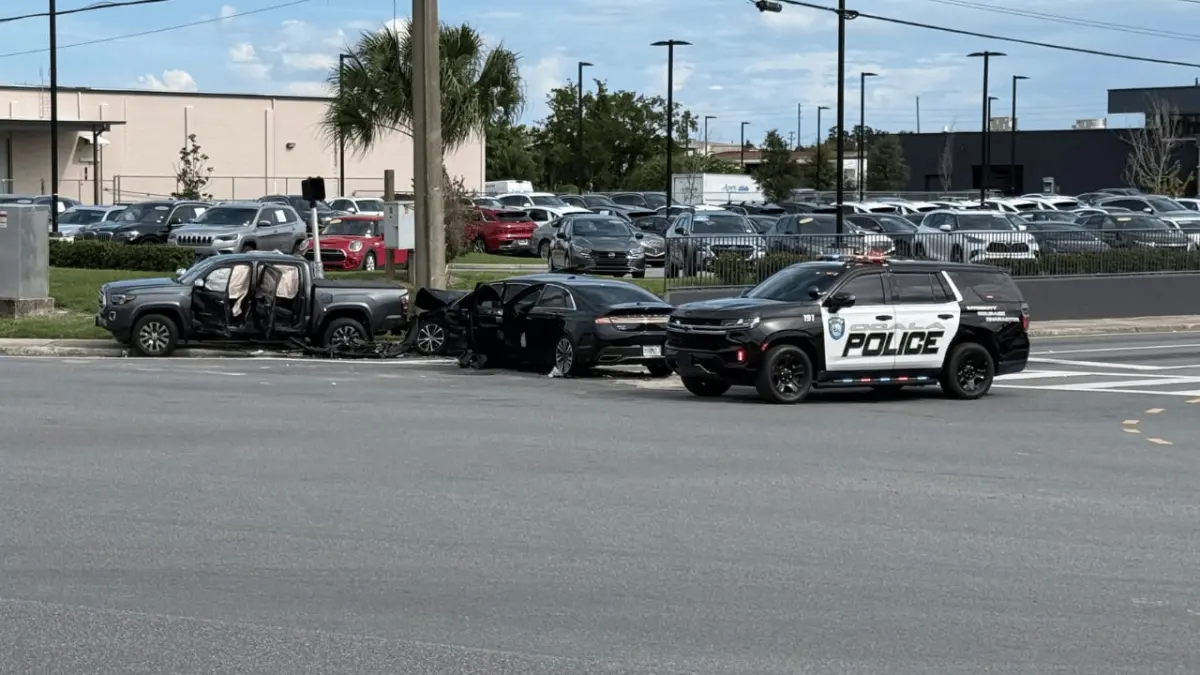

OCALA, Fla. — Investigators with the Ocala Police Department have successfully identified all individuals connected to a violent Sunday afternoon shootout that left one man dead and two others with severe injuries. According to local law enforcement, what began as a planned narcotics transaction quickly descended into a chaotic, armed robbery attempt, culminating in a barrage of gunfire on Northwest 12th Avenue.
The incident, which has sent shockwaves through the local community, highlights the persistent dangers associated with illicit drug trafficking and the increasing prevalence of armed confrontations during street-level transactions. Police have recovered critical evidence, including a rifle at the scene, and are continuing to piece together the moments leading up to the deadly exchange.
Executive Overview
The fatal shooting unfolded in broad daylight on Sunday, drawing a swift and heavy response from emergency services in Ocala. Ocala Police Chief Mike Balken addressed the media, providing a clear—though grim—assessment of the circumstances surrounding the violence.
"At this time we know this was nothing more than a drug rip that had gone bad," Chief Balken stated during a press briefing. Investigators determined that the violent encounter was the result of a pre-planned robbery. One group of individuals arrived at the location under the guise of delivering narcotics, while the opposing faction had already formulated a scheme to ambush and steal the illicit goods.
"Unfortunately, both parties had firearms, both fired back at each other. And the result is where we’re at now," Balken added.
The firefight resulted in the death of 23-year-old Tedarrium Deas, who succumbed to his injuries. Two additional participants sustained serious gunshot wounds and were rushed to area hospitals for emergency medical intervention. The investigation has expanded beyond the initial crime scene on Northwest 12th Avenue, linking the shootout to a secondary motor vehicle collision miles away, as panicked participants attempted to flee the chaotic scene.
Detailed Chronology of Events
While the investigation remains active and detectives continue to interview witnesses and analyze forensic evidence, law enforcement has established a preliminary timeline of Sunday’s tragic events.
The Setup and Inception
The sequence of events began to unfold early Sunday afternoon. According to Ocala Police Department detectives, a rendezvous was arranged between two factions on Northwest 12th Avenue. Investigators believe the primary objective of one group was to execute a standard narcotics delivery. However, the opposing group allegedly viewed the meeting as an opportunity for a "drug rip"—a street term for robbing drug dealers of their product or cash.
The planning on the part of the prospective robbers involved arming themselves before the meet-up, anticipating little to no resistance or attempting to use overwhelming force to secure the narcotics. Unbeknownst to them, the delivering party was similarly armed and prepared to defend their cargo.
The Shootout on Northwest 12th Avenue
As the transaction commenced, the situation rapidly deteriorated. The hidden intentions of the robbing party became clear, prompting an immediate escalation. Rather than submitting to the armed holdup, the targeted individuals drew their weapons.
Within seconds, Northwest 12th Avenue transformed into a war zone. Investigators note that both sides exchanged a flurry of gunfire. The confined space and the presence of multiple shooters firing high-powered weapons dramatically increased the lethality of the encounter. During the exchange, 23-year-old Tedarrium Deas was struck by gunfire, sustaining fatal injuries. At least two other individuals were struck, collapsing at the scene as the remaining participants scattered in panic.
The Flight and Associated Vehicle Crash
As the shooting subsided, surviving participants scrambled to escape police response and medical intervention. The chaotic aftermath extended beyond the immediate neighborhood of Northwest 12th Avenue.
Moments after the gunshots rang out, a violent vehicle crash occurred at a major city intersection: Southwest Martin Luther King Jr. Avenue and State Road 200. Investigators later confirmed that this collision was directly tied to the fleeing suspects from the shooting. The high-stress, high-speed departure resulted in the secondary accident, compounding the hazard to public safety and leaving investigators with multiple interconnected scenes to process.
Supporting Context & Metrics
To fully understand the gravity of Sunday’s incident, it is essential to examine the broader context of gun violence, narcotics-related crime, and public safety trends within Marion County and the city of Ocala.
The Mechanics of a "Drug Rip"
Law enforcement agencies frequently encounter violent crimes classified as "drug rips" or rip-deals. These offenses are inherently volatile because illegal narcotics transactions operate outside the bounds of legal commerce. Participants cannot turn to the civil or criminal justice systems to resolve disputes over product quality, shorted quantities, or unpaid debts. Consequently, disputes are frequently settled with violence, and firearms are routinely brought to these transactions as tools of intimidation or defense.
Criminologists and law enforcement analysts note that the proliferation of firearms in illegal drug markets dramatically elevates the mortality rate of routine street crimes. When both buyers and sellers arrive armed—as was the case on Northwest 12th Avenue—the threshold for lethal escalation is dangerously low. A sudden movement, a misunderstood word, or an overt robbery attempt can instantly trigger a deadly crossfire.
Ocala Public Safety Landscape
Sunday’s fatal shooting is part of a troubling sequence of violent incidents drawing intense scrutiny from Ocala law enforcement and local residents alike. The city has recently grappled with high-profile violent crimes, including drive-by shootings and targeted attacks affecting vulnerable populations.
- Recent Incidents: Just days prior, Ocala police launched an intensive investigation after shots were fired directly into a vehicle, leaving a mother and her 5-year-old child wounded. That incident, which occurred under separate circumstances, underscored the indiscriminate danger posed by gun violence in public spaces.
- Community Impact: Incidents involving daylight shootings, crossfire in residential neighborhoods, and high-speed crashes on major thoroughfares like State Road 200 place immense strain on local emergency medical services, trauma centers, and police resources.
Forensic and Tactical Recoveries
At the scene of Sunday’s shootout, Ocala Police Department crime scene technicians recovered significant physical evidence. Among the recovered items was a rifle, indicating that at least one of the parties utilized a long gun capable of delivering high-velocity rounds over a considerable distance. The recovery of such heavy weaponry highlights the escalating firepower present in modern street-level narcotics conflicts. Forensic ballistics teams are currently analyzing the recovered firearms to determine how many distinct weapons were discharged and to match shell casings recovered from both Northwest 12th Avenue and the secondary vehicle crash site.
Official Statements and Law Enforcement Response
The Ocala Police Department has adopted a posture of absolute transparency coupled with firm resolve as they untangle the web of criminal liability surrounding the incident. Chief Mike Balken’s public briefings have provided clarity to a community unnerved by the afternoon violence.
Chief Mike Balken’s Assessment
Chief Balken did not mince words when describing the nature of the confrontation. By publicly categorizing the incident as a "drug rip that had gone bad," the police department effectively dismantled any narrative suggesting a random act of street violence. Instead, investigators have framed the shooting as a calculated criminal enterprise that devolved into a mutual firefight.
"Unfortunately, both parties had firearms, both fired back at each other. And the result is where we’re at now," Balken reiterated, emphasizing the tragic and entirely preventable loss of life that accompanies armed criminal activities.
Investigative Next Steps
Detectives have successfully identified every single participant involved in the exchange, a significant milestone given the chaotic nature of the scene and the hasty flight of the survivors. However, identifying the individuals is only the first phase of the judicial process.
The state attorney’s office is working closely with Ocala Police investigators to review the collected evidence, witness statements, and forensic reports. Under Florida law, the legal implications for the surviving participants are severe. Even though Tedarrium Deas was a participant in the criminal act, individuals engaged in a felony (such as armed robbery or narcotics trafficking) that results in a death can frequently face felony murder charges or related homicide indictments, depending on their specific role in instigating the deadly escalation.
Furthermore, charges related to aggravated assault, illegal possession of firearms by prohibited persons, and reckless driving resulting in a crash at Southwest Martin Luther King Jr. Avenue and State Road 200 are actively being formulated.
Future Outlook
As the investigation into Sunday’s deadly shootout moves forward, the primary focus for the Ocala Police Department transitions from immediate containment and identification to building airtight legal cases for prosecution.
Legal Proceedings and Accountability
In the coming weeks, the community can expect formal charges to be announced by the state attorney’s office against the surviving individuals involved in the drug rip. The cooperation of witnesses, coupled with advanced forensic mapping of the crime scene and ballistics analysis, will form the backbone of the prosecution’s case. The integration of evidence from both the Northwest 12th Avenue shooting scene and the secondary vehicle crash site on State Road 200 will be crucial in establishing a comprehensive narrative of flight and culpability.
Community Safety and Police Initiatives
Beyond the courtroom, the incident has reignited vital discussions among city leaders, law enforcement officials, and community advocates regarding strategies to combat the root causes of urban gun violence and narcotics trafficking. The Ocala Police Department continues to urge residents to remain vigilant and to report suspicious activities that may signal illegal drug operations within residential and commercial neighborhoods.
Chief Balken and his command staff have emphasized that community partnerships remain the most effective tool in preempting such violence. By encouraging anonymous tips through programs like Crime Stoppers, law enforcement hopes to intercept similar illicit operations before they erupt into fatal gunfights.
Ultimately, Sunday’s tragedy on Northwest 12th Avenue serves as a sobering reminder of the lethal intersection between the illegal drug trade and unregulated firearm use. As Ocala mourns the loss of young life and addresses the injuries sustained by others, the city’s justice system prepares to deliver accountability for an afternoon where a criminal conspiracy violently unraveled.

0 Comments