
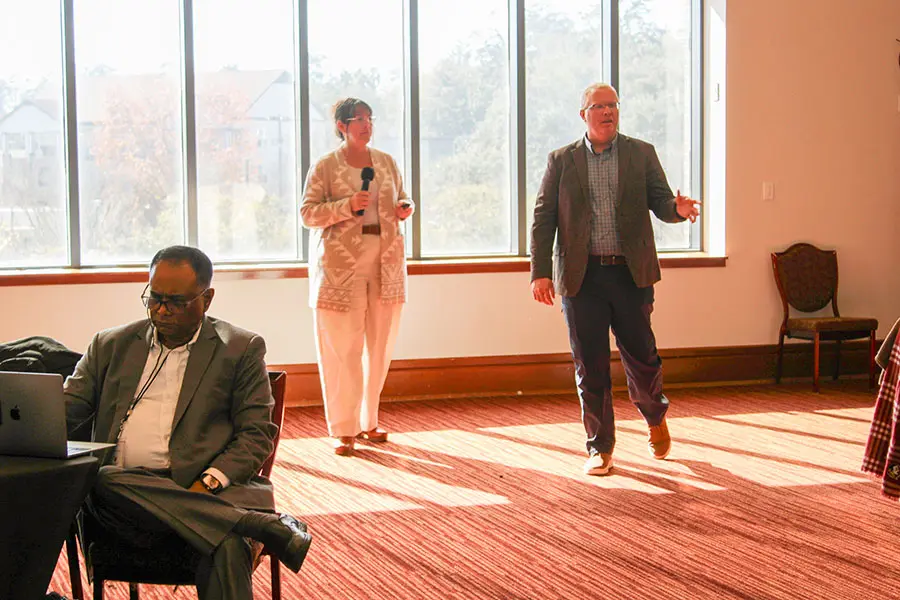

TALLAHASSEE, Fla. — As artificial intelligence continues to fundamentally reshape the architecture of modern instruction, a trio of academic leaders from Florida State University’s (FSU) renowned Learning Systems Institute (LSI) is positioning the university at the vanguard of this global transformation.
This semester, LSI Director Rabieh Razzouk, alongside Carrie Meyers—director of education and workforce talent at FSU’s Institute for Strategic Partnerships, Innovation, Research, and Education (FSU InSPIRE)—and Jim Reynolds, LSI’s director of STEM outreach, are embarking on a high-profile European speaking circuit. Their destinations include major international convenings in Paris and the Netherlands, where they will showcase how FSU is bridging the gap between cutting-edge AI technologies, practical classroom applications, and equitable, standards-aligned learning systems.
This international footprint is no accident. It is the result of years of methodical, research-backed development aimed at ensuring educators are not left behind in the age of algorithms. By combining rigorous educational research with scalable software development and human-centered design, FSU is proving that top-tier public research universities can lead the charge in adopting disruptive technologies without sacrificing pedagogical rigor or public trust.
Executive Overview: A Global Stage for FSU’s AI Innovation
The invitation of FSU faculty to present at prestigious forums such as UNESCO’s Digital Learning Week and the inaugural “Teaching and Learning with AI in Europe” conference underscores a growing international consensus: LSI’s work has transcended regional success to become a global benchmark.
The institute’s strategy focuses heavily on empowering teachers rather than replacing them. Through systemic initiatives like the FSU InSPIRE project, CPALMS (a widely utilized instructional support system in Florida), and international interventions like the Early Grade Education Activity in Jordan, LSI has developed a comprehensive playbook for responsible AI integration.
Key Highlights of FSU’s International Engagement:
- UNESCO Digital Learning Week 2026 (Paris): Rabieh Razzouk will present how AI can customize standards-aligned educational materials efficiently, easing the burden on classroom teachers.
- Teaching and Learning with AI in Europe Conference (Breda, Netherlands): Carrie Meyers and Jim Reynolds will introduce innovative paradigms for transforming complex content into graphic novels and co-designing thought-revealing STEM activities using prompt engineering.
- Global Collaborations: These efforts build upon FSU’s previous high-level partnerships with the World Bank and UNESCO, notably the 2025 Global Knowledge Exchange in Addis Ababa, Ethiopia, which convened over 340 education experts from 41 countries.
Detailed Chronology: From Regional Implementation to International Recognition
The trajectory of FSU’s leadership in educational technology has been deliberate, marked by steady milestones in software deployment, teacher training, and international outreach.
Building the Foundation: CPALMS and State-Level Support
Long before generative AI became a global household conversation, LSI was laying the groundwork for digital instructional support. Under Razzouk’s direction, the institute developed and implemented advanced instructional systems for Florida educators, most notably through CPALMS. This platform became a proving ground for how technology could organize and deliver standards-aligned resources.
By integrating AI-assisted tools into these systems, LSI enabled teachers to adapt existing curricula dynamically to match diverse student needs. This technological capacity caught the eye of international bodies looking for scalable, practical applications of educational software.
Expanding Horizons: The Jordan Early Grade Education Activity
LSI’s expertise quickly expanded beyond domestic borders. The institute was chosen by IREX to collaborate on the U.S. Department of State-funded Early Grade Education Activity in Jordan. This ambitious project utilizes modern technological interventions, including data analytics and digital tools, to strengthen Jordan’s foundational education systems. By tackling literacy and numeracy challenges at an early grade level in a developing nation, LSI demonstrated that its models are adaptable across vastly different cultural and economic landscapes.
The Addis Ababa Milestone (November 2025)
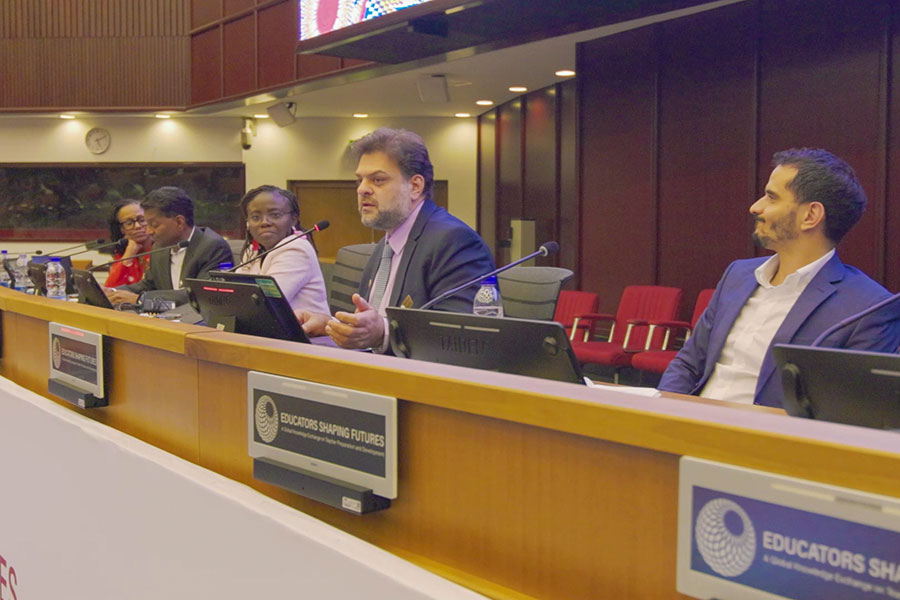
The bridge to Europe and global policy arenas was heavily reinforced in late 2025. LSI partnered directly with the World Bank and UNESCO to host “Educators Shaping Futures: A Global Knowledge Exchange on Teacher Preparation and Development” in Addis Ababa, Ethiopia.
The summit drew more than 340 policymakers, teacher educators, researchers, and practitioners from 41 countries. Razzouk served as a vital voice on panels examining the delicate balance between the immense potential of AI in teacher training and the inherent risks, such as algorithmic bias, data privacy, and the dilution of the human element in pedagogy.
The 2026 European Circuit: Paris and Breda
This semester marks the culmination of these efforts, as Razzouk, Meyers, and Reynolds take their findings directly to European academic and policy leaders.
In September 2026, Razzouk travels to Paris for UNESCO’s flagship Digital Learning Week, centered around the theme "Education in the Age of AI: Facts, Frictions, Frontiers." There, he will present “Customizing Standards-Aligned Lessons with AI: The CPALMS Experience,” offering a masterclass in how institutional platforms can safely harness machine learning to lighten educator workloads.
Immediately following, Meyers and Reynolds will head to Breda, Netherlands, for the inaugural “Teaching and Learning with AI in Europe” conference. Co-hosted by Breda University and the University of Central Florida, the October event aims to forge cross-border networks to share best practices in higher education AI integration.
Supporting Context & Methodologies: Inside the Presentations
To truly understand why FSU’s delegation is in high demand, one must examine the specific pedagogical frameworks they are bringing to the international stage. Rather than relying on generic AI applications, FSI researchers are building structured, highly intentional tools.
1. Customizing Standards-Aligned Lessons (The CPALMS Experience)
Presented by Rabieh Razzouk in Paris, this methodology addresses one of the primary friction points for modern educators: the time-consuming process of tailoring rigid, standards-compliant curriculum to meet the specific learning gaps of individual students.
By utilizing carefully constrained AI models embedded within the CPALMS ecosystem, teachers can input lesson goals and student data profiles to generate differentiated instructional materials instantly. Crucially, the system ensures that all generated outputs remain strictly aligned with established academic standards, mitigating the risk of "hallucinations" or off-track content common in unconstrained consumer-grade AI tools.
2. From Content to Comics: Visual Storytelling via AI
At the Breda conference, Carrie Meyers will lead a session titled "From Content to Comics: Using AI-Supported Graphic Novels to Teach Complex Concepts."
Drawing directly from innovations developed within FSU’s InSPIRE program, Meyers explores how faculty members and instructional designers can leverage generative AI image and text tools to produce graphic novels, digital e-readers, and visual modules. This approach transforms dense, intimidating theoretical concepts—such as complex historical events, advanced scientific processes, or abstract economic theories—into engaging narratives.
"We are creating pathways where students are invited into challenging ideas without reducing academic rigor," Meyers explains. By lowering the barrier to entry through visual media, educators can engage diverse learning styles effectively.
3. Co-Designing Thought-Revealing Activities
Jim Reynolds, LSI’s director of STEM outreach, will tackle the mechanics of classroom engagement in his presentation, "From Prompt to Possibility: Co-Designing Thought-Revealing Activities with AI."
Reynolds focuses on prompt engineering not as a technical trick, but as an instructional design partner. He demonstrates how educators can guide AI models to help co-create authentic, open-ended problem-solving tasks rooted in the pedagogical research behind model-eliciting activities (MEAs). Instead of using AI simply to produce multiple-choice quizzes or surface-level summaries, Reynolds shows how teachers can use the technology to engineer complex scenarios that force students to externalize their reasoning, making their cognitive processes visible to instructors.
Official Statements and Institutional Vision
The success and global visibility of LSI’s initiatives reflect a broader institutional culture at Florida State University that prioritizes digital innovation and public service.
Rabieh Razzouk, LSI Director:
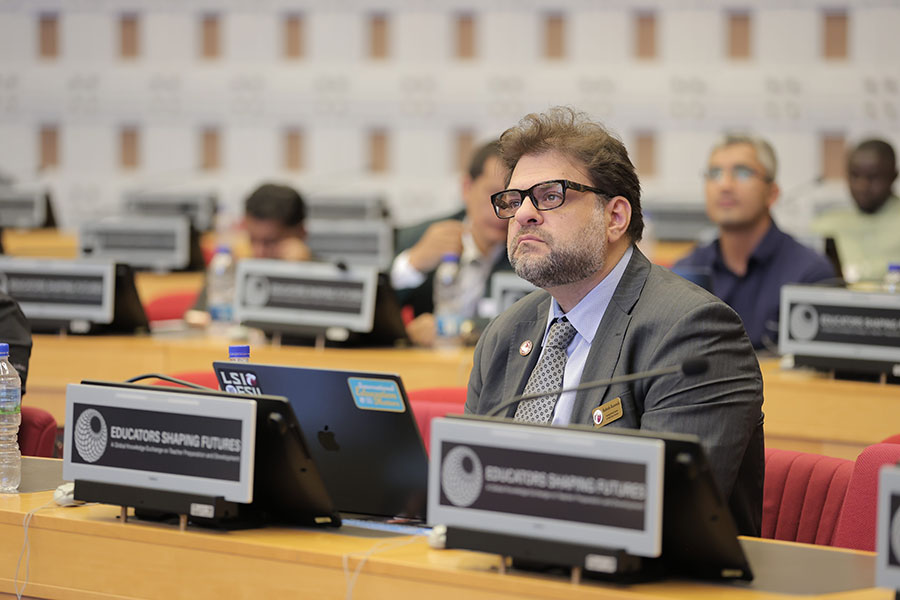
"We are honored to have our team asked to join the global conversation on how to utilize AI in education. LSI has worked to become a leader in utilizing AI for education, workforce development, AI-powered learning tools, and research and innovation in the field. We are thankful that FSU champions innovative research in the field and understands this work raises public awareness and fuels lasting impact in this rapidly growing field."
Carrie Meyers, FSU InSPIRE Director of Education and Workforce Talent:
"It is exciting to share the AI in education work we are leading for FSU InSPIRE and to showcase the pathways we are creating for educators and students. Just as important is the opportunity to learn from others and to discover where our challenges intersect, exchange successful approaches, and identify innovative ideas from around the world. Our students are entering an increasingly global and competitive workforce, and collaboration like this helps ensure they are prepared not only to participate in that future, but to lead it."
Paul Marty, Associate Vice Provost for Academic Innovation:
"When other public universities look at what FSU is accomplishing — from our data-driven campus culture to our deeply engaged faculty, staff, and students — they see a path forward. We are proving that a top public research university can lead the nation in adopting disruptive innovations while keeping student learning and the public good at the center of everything we do."
Future Outlook: Setting the Global Standard
As higher education and K-12 systems worldwide grapple with the rapid acceleration of artificial intelligence, the model established by FSU’s Learning Systems Institute offers a clear roadmap. The challenge facing academic institutions is no longer whether to adopt AI, but how to do so ethically, equitably, and effectively.
By exporting their frameworks to UNESCO, European universities, and international development projects in the Middle East and Africa, LSI researchers are ensuring that American public research universities remain instrumental in shaping international educational policy.
The insights gathered from Paris and Breda will inevitably flow back into FSU’s domestic programs, further refining the InSPIRE project and expanding CPALMS capabilities. For students entering the workforce and the educators guiding them, FSU’s proactive global engagement guarantees that the future of learning will be defined not by passive adaptation to technology, but by active, human-centered mastery of it.
About the Learning Systems Institute (LSI)
The Learning Systems Institute (LSI) partners with schools, universities, governments, and industry to research, develop, implement, and evaluate AI solutions that improve educational outcomes while promoting responsible and human-centered technology use. Combining educational research, AI software development, instructional design, open educational resources, professional learning, and large-scale implementation, LSI helps partners move beyond experimentation to meaningful, evidence-based impact.
For more information about LSI, visit lsi.fsu.edu. To learn more about FSU’s international programs and global footprint, visit global.fsu.edu.

0 Comments