

By Logan Lowery | Published: September 14, 2026
Updated: September 14, 2026, at 1:38 PM EST
Executive Overview
In an era defined by institutional polarization, digital atomization, and a growing crisis of civic trust, the role of higher education in forging a cohesive national culture has rarely been more contested—or more critical. Setting a compelling tone for the academic term, renowned New York Times bestselling author and cultural commentator David Brooks took center stage to launch Florida State University’s (FSU) Institute for Governance and Civics Fall 2026 Speaker Series.
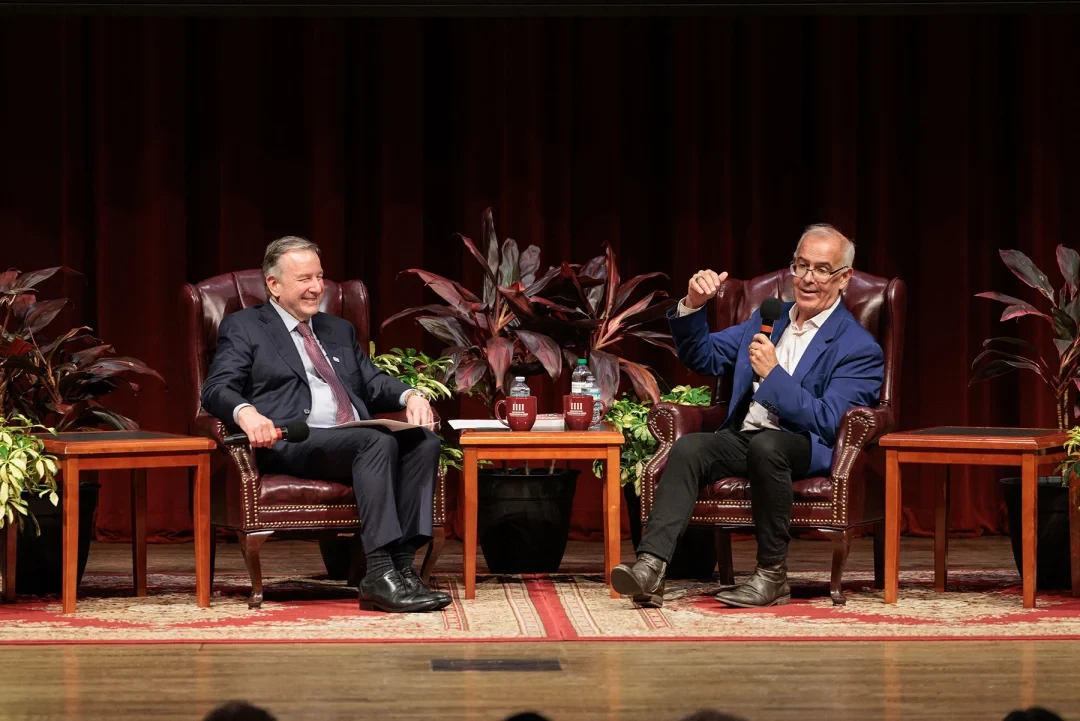
Seated in comfortable leather armchairs on a stage bathed in warm lighting, Brooks engaged a packed auditorium of students, faculty, and community leaders. His keynote address cut straight to the heart of the modern university’s mission: higher education must transcend the mere transmission of technical skills or preparation for the corporate marketplace. Instead, Brooks argued, universities must serve as crucibles for moral formation, emotional literacy, and the cultivation of deep personal passions that bind a democratic society together.
The event, hosted by FSU’s newly prominent Institute for Governance and Civics, marks a cornerstone in the university’s ongoing commitment to fostering rigorous discourse on democracy, governance, and civic responsibility. As universities nationwide grapple with shifting public expectations and ideological divides, Brooks’s visit provided a timely philosophical anchor. His message championed a renaissance of human-centered education—one that teaches young adults not just how to make a living, but how to live meaningfully in community with others.
Detailed Chronology: The Opening Event
The atmosphere inside the auditorium on September 14 was electric well before the event began. Students clutching notebooks and faculty members engaged in animated discussions filled the hall, anticipating a lecture that promised to challenge conventional wisdom regarding the state of American institutions.
As the program commenced, university leadership introduced the mandate of the Institute for Governance and Civics, emphasizing its core goal: to equip the next generation of leaders with the ethical frameworks, critical thinking skills, and democratic resilience required to navigate an increasingly complex world.
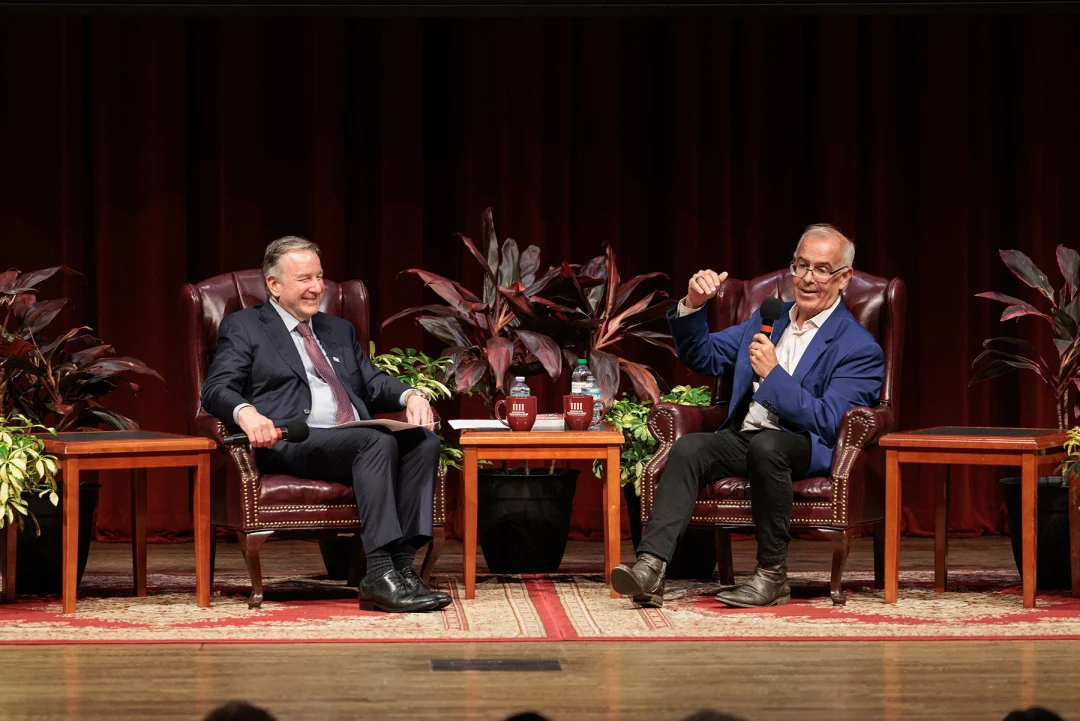
When David Brooks took the stage, he immediately commanded the room not through rhetorical fireworks, but through conversational candor. Rather than delivering a dry, academic lecture, Brooks structured his presentation as an intimate dialogue on the human condition. He walked the audience through the psychological and spiritual toll of modern hyper-individualism, tracing how contemporary society has systematically replaced moral vocabulary with economic and technological metrics.
Midway through the conversation, Brooks shifted focus toward the unique ecosystem of the university campus. He described higher education not as a service provider catering to consumer-driven students, but as a sacred space for transformation. Drawing on decades of observation of American culture, he recounted moments from his own intellectual journey and highlighted stories of young people who found their true callings not through algorithmic career planning, but through serendipitous encounters with great literature, history, and mentors who demanded more of them than they thought they could give.
The formal discussion concluded with an interactive Q&A session, where FSU students stepped up to the microphones to pose probing questions about political polarization, the loneliness epidemic among Gen Z, and how to bridge ideological chasms in everyday life. Brooks responded with characteristic thoughtfulness, urging students to practice radical curiosity and to look people in the eye rather than through the mediated glass of digital screens.
Supporting Context & Metrics: The Crisis of Higher Education and Civic Engagement
To fully appreciate the resonance of David Brooks’s address at FSU, one must examine the broader cultural and institutional landscape of 2026. American higher education stands at a historic crossroads, buffeted by economic pressures, shifting demographics, and intense cultural scrutiny.
The Declining State of Civic Capital
According to recent data from civic research institutions, public trust in higher education has experienced notable fluctuations over the past decade. While universities remain powerful engines of social mobility and scientific innovation, polls indicate that a growing segment of the American public views campuses as ideologically uniform silos rather than marketplaces for robust, open debate.
Simultaneously, the U.S. Surgeon General’s reports on the ongoing loneliness epidemic highlight a staggering rise in social isolation, particularly among young adults aged 18 to 25. Studies consistently show that Gen Z reports higher rates of anxiety, depression, and a lack of clear life purpose than previous generations at the same age.

The Philosophy of David Brooks
This sociological reality forms the backdrop of David Brooks’s recent work, notably his bestselling books The Road to Character and Second Mountain: The Quest for a Moral Life. Brooks has long argued that modern culture overemphasizes "resume virtues"—the skills brought to the marketplace—at the expense of "eulogy virtues," which define who we are at the core: our capacity for love, redemption, courage, and community service.
By inviting Brooks to launch the Fall 2026 series, FSU’s Institute for Governance and Civics is directly addressing this cultural vacuum. The institute recognizes that governance and civic health cannot be sustained solely through structural reforms, constitutional law, or institutional policies. They require what classical philosophers termed civic virtue—habits of the heart and mind that prioritize the common good over narrow self-interest.
Official Statements and Campus Reactions
The launch of the speaker series drew enthusiastic praise from university administrators, faculty, and student leaders alike, who viewed Brooks’s visit as a validation of FSU’s institutional mission.
"David Brooks captures the exact ethos we are trying to build here at Florida State University," noted a senior administrator involved with the Institute for Governance and Civics. "Education is not merely about stuffing heads with data; it is about awakening souls. When our students hear a thinker of Brooks’s caliber challenge them to discover their passions and commit to something larger than themselves, it transforms the entire campus climate."
Faculty members echoed these sentiments, noting that Brooks’s emphasis on moral formation aligns with FSU’s interdisciplinary push to integrate humanities perspectives into professional and technical training programs.
Student leaders who attended the keynote expressed deep appreciation for the speaker’s candor regarding personal vulnerability and the challenges of finding one’s path in a high-pressure world.

"It’s easy to feel like college is just a conveyor belt designed to spit you out into a 9-to-5 job," said an FSU senior majoring in political science. "Hearing Mr. Brooks talk about the ‘second mountain’—about committing to a community, a cause, and a set of deep values—gave me permission to think bigger about my life and my responsibilities as a citizen."
Future Outlook: The Road Ahead for the Institute
David Brooks’s opening keynote has set an exceptionally high bar for the remainder of FSU’s Institute for Governance and Civics Fall 2026 Speaker Series. As the semester unfolds, the institute has scheduled a diverse lineup of scholars, policymakers, journalists, and public intellectuals designed to keep the momentum going.
Upcoming events will dive deeper into specific structural challenges facing modern democracies, including the ethics of artificial intelligence in governance, the mechanics of bipartisan legislative compromise, and the protection of local journalistic ecosystems. However, the foundational theme established by Brooks—that structural reform must be paired with cultural and moral renewal—will remain the guiding thread of the series.
Cultivating FSU’s Next Generation of Leaders
Looking forward, FSU is positioning its Institute for Governance and Civics as a national model for how state universities can foster constructive dialogue across political and ideological divides. By bringing high-profile thinkers to Tallahassee, the university is creating a living laboratory where students do not merely study democracy—they practice it through listening, debating, and reflecting on what it means to live well together.
As the academic year gathers speed, the echoes of Brooks’s advice will undoubtedly reverberate through FSU’s lecture halls, dormitories, and student organizations. In a fractured world searching for steady guidance, Florida State University has proven once again that the modern campus can and should be a sanctuary for deep reflection, moral courage, and the reinvigoration of the civic soul.

0 Comments