

Executive Overview
The transformation of American agriculture from animal power to mechanical combustion is one of the most profound technological and socio-economic shifts in human history. Popular mythology often portrays the agricultural revolution as a sudden explosion of innovation—a swift erasure of the rural past in favor of the roaring, iron-lunged tractor. However, the historical reality, as highlighted in the American Agriculture History Minute series by Mark Oppold, reveals a much more deliberate, cautious, and protracted evolution.
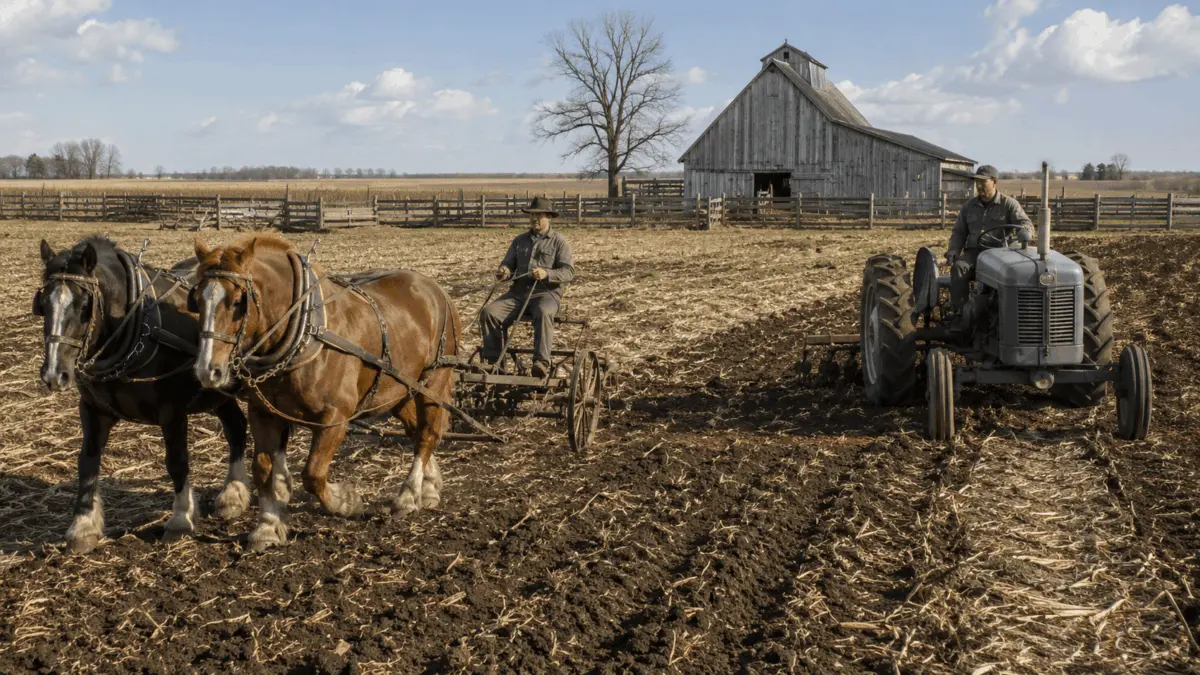
For generations, the heartbeat of the American farm was literal: the rhythmic thud of hooves, the strain of leather harnesses, and the synchronized labor of millions of horses and mules. When internal combustion engines first sputtered onto the rural landscape in the early 20th century, they were met not with an immediate embrace, but with deep skepticism. Farmers—pragmatic, risk-averse, and capital-constrained—weighed the high costs of unproven machinery against the reliable, albeit limited, power of draft animals.
It took more than three decades of engineering refinements, economic shifts, and a generational exchange of knowledge for the internal combustion engine to conquer the countryside. A critical inflection point arrived with the U.S. Department of Agriculture’s (USDA) 1954 Census of Agriculture. For the first time, mechanical horsepower officially outpaced biological horsepower on American farms, with roughly 4.69 million tractors standing against approximately 4.1 million horses and mules.
This deep dive explores the mechanics, economics, and human stories behind the slow agricultural revolution—examining why the transition took generations, how engineering innovations broke the inertia, and the lasting legacy of the day the tractor officially replaced the beast of burden.
Detailed Chronology: The Slow March from Mane to Machine
The Twilight of the Animal Era (Pre-1920)
At the dawn of the 20th century, American agriculture was entirely dependent on biological energy. Over 25 million horses and mules populated U.S. farms, serving as the universal utility engines of the rural economy. They plowed the earth, planted the seed, hauled harvests to railheads, and powered stationary belt-driven machinery through treadmills and sweep-powers.
Caring for these animals required vast swaths of agricultural land. Historians estimate that roughly one-fourth to one-third of all harvested cropland in the United States was dedicated solely to growing feed—oats, hay, and corn—just to keep the farm’s power source alive and working 365 days a year, whether the fields required labor or lay dormant in the dead of winter.
Early steam tractors had made inroads on massive Western wheat farms in the late 19th century, but their immense weight, high cost, and danger of boiler explosions rendered them entirely impractical for the average family farm in the Midwest, East, or South.
The Foothhold: Early Internal Combustion (1920s)
The 1920 census captured the nascent stages of the mechanical shift, recording approximately 246,000 tractors nationwide. These early machines were behemoths—heavy, steel-wheeled, erratic in reliability, and specialized primarily for heavy, brute-force tasks like deep-soil plowing, disking, harrowing, and threshing.
During this decade, farm operators viewed tractors as supplementary rather than replacement technology. A farmer might own a single tractor to break stubborn virgin sod or power a threshing rig, but rely entirely on mules for daily cultivation and planting. The financial panic and agricultural depression of the early 1920s further stifled adoption, as collapsing crop prices left producers with razor-thin profit margins and a profound aversion to long-term equipment debt.
The Turning Point: General-Purpose and Rubber Tires (1930s–1940s)
The true catalyst for the mechanization movement emerged from the engineering drawing boards of the late 1920s and 1930s. The introduction of the "all-purpose" or row-crop tractor—pioneered by iconic models like the Farmall—fundamentally changed the equation. Unlike their predecessors, these machines offered adjustable wheel spacings, high ground clearance, and power take-off (PTO) shafts that could drive mounted implements directly. Suddenly, a tractor could cultivate growing crops like corn and cotton without crushing the rows, replacing teams of cultivators in ways early machines never could.
Compounding this was the introduction of low-pressure pneumatic rubber tires in the early 1930s. Prior to rubber, steel-lugged wheels tore up roads, limited transport speeds to a agonizing crawl, and vibrated machinery (and operators) to pieces. Rubber tires allowed tractors to transition from static field tools to versatile transport vehicles capable of operating on paved roads, reducing transit times between distant fields from hours to minutes.
Even as the Great Depression and World War II presented severe material shortages, the economic argument for mechanization grew irresistible. Every acre previously dedicated to feeding draft horses could now be planted with cash crops for human consumption or livestock meat production.
The 1954 Milestone: Mechanical Supremacy
By the mid-20th century, the cultural and operational landscape of the American farm was unrecognizable compared to fifty years prior. The USDA’s 1954 Census of Agriculture documented the definitive crossover: 4.69 million tractors compared to just 4.1 million horses and mules.
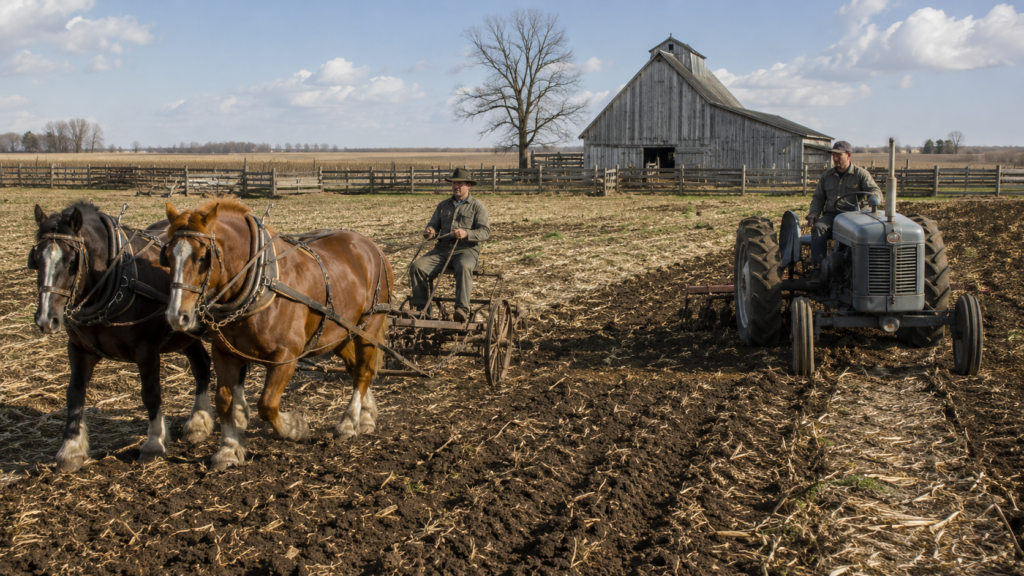
While the transition had reached its mathematical climax, the census data revealed a transitional society. Many mid-century farms operated in a hybrid state, retaining an aging workhorse or mule for odd jobs, light garden work, or sentimental reasons, while relying on fleets of tractors for primary production. Nevertheless, 1954 cemented the reality that the biological age of farming had officially drawn to a close.
Supporting Context & Metrics: Analyzing the Shift
To fully grasp the magnitude of this agricultural pivot, one must examine the hard metrics provided by historical economic and demographic records.
Statistical Trajectory (1920–1954)
| Year | U.S. Tractor Population | U.S. Horses & Mules Population | Ratio (Tractors to Animals) |
|---|---|---|---|
| 1920 | ~246,000 | ~25,000,000+ | 1 : 101 |
| 1930 | ~920,000 | ~18,000,000 | 1 : 19 |
| 1940 | ~1,545,000 | ~10,500,000 | 1 : 7 |
| 1950 | ~3,390,000 | ~5,800,000 | 1 : 1.7 |
| 1954 | ~4,690,000 | ~4,100,000 | 1.14 : 1 |
The Financial Hurdle: Capital Investment vs. Risk
Why did it take over three decades for the tractor to go from a market novelty to a dominant force? The answer lies in microeconomics. In the 1920s and 1930s, a tractor was not merely a tool; it was a major capital expenditure that frequently required commercial financing or high-interest bank loans.
For a smallholder farmer operating on cash-poor margins, taking on debt for a machine that required expensive liquid fuels (gasoline and diesel), specialized lubricants, and fragile replacement parts was a terrifying gamble. If a horse went lame, a farmer could often nurse it back to health or rely on natural reproduction to replace it. If a tractor’s engine seized or a transmission cracked during the height of the harvest, the financial repercussions could force a family into foreclosure.
The Educational Paradigm Shift: Blacksmiths to Mechanics
Equally daunting was the cultural and educational barrier. Operating an animal-powered farm was an intergenerational skill set. Children learned to harness, feed, shoe, and manage livestock from the time they could walk.
Tractors, conversely, demanded an entirely foreign technological literacy. Farmers had to transform themselves overnight from animal husbandmen into amateur combustion engineers. Understanding carburetion, ignition timing, oil viscosity, gear ratios, and metal fatigue became prerequisites for survival. Rural communities saw the rise of a new class of local experts—the tractor mechanic and the implement dealership network—replacing the traditional village blacksmith as the vital hub of agricultural commerce.
Official Insights & Historical Perspectives
Reflecting on this era, agricultural historians emphasize that the slow pace of adoption was a rational response by risk-averse producers rather than institutional stubbornness.
As agricultural historian and broadcaster Mark Oppold points out in the American Agriculture History Minute series, the transition was defined by incremental adaptation rather than a sudden technological shockwave:
"The change from horsepower to tractor power was a long, deliberate process—a journey defined by financial caution, steep learning curves, and gradual engineering triumphs. But by 1954, the cumulative effect of these decades reached a historic, undeniable milestone."
Echoing these findings, historical summaries from the United States Department of Agriculture note that the mechanical revolution fundamentally altered human labor dynamics in rural America. By drastically reducing the hours required for plowing, planting, and harvesting, the tractor liberated human labor, allowing individual farm operators to expand their acreage exponentially. A single farmer with a modern tractor could accomplish in a single afternoon what previously required days of exhausting labor from multiple men and teams of animals.
Furthermore, the shift freed up tens of millions of acres of fertile farmland. Land previously used to cultivate oats and pasture draft animals was suddenly redirected toward feeding a rapidly growing national and international population, supercharging the productivity and global influence of American agribusiness.
Future Outlook: Parallels to Today’s Ag-Tech Revolutions
As contemporary agriculture stands on the precipice of its next great transformation—marked by autonomous machinery, artificial intelligence, electric drivetrains, and precision crop-spraying drones—the history of the tractor’s slow ascent offers profound lessons.
- Technology Outpaces Infrastructure: Just as early 20th-century farmers lacked the fuel distribution networks and mechanical repair shops to maintain early tractors, today’s smart-farming tools often outpace rural broadband infrastructure and localized technical support.
- The Capital Conundrum: Modern autonomous tractors and high-precision sensor rigs command exorbitant price tags, mirroring the prohibitive financing fears of 1920s farmers. The modern debate over "Right to Repair" echoes the early days when farmers fought for the independence to fix their own combustion engines without relying exclusively on manufacturer monopolies.
- Generational Knowledge Transfer: Just as the shift from mules to motors required a complete overhaul of rural education, the current digitization of agriculture demands that modern producers master software systems, data analytics, and telemetry alongside traditional agronomy.
Ultimately, the half-century journey from horsepower to tractor power demonstrates that while cutting-edge hardware can be engineered in a matter of months, integrating that technology into the social, financial, and operational fabric of agriculture is a generational endeavor. As history shows, the true revolution does not occur when a machine is invented, but when it quietly becomes indispensable.

0 Comments