
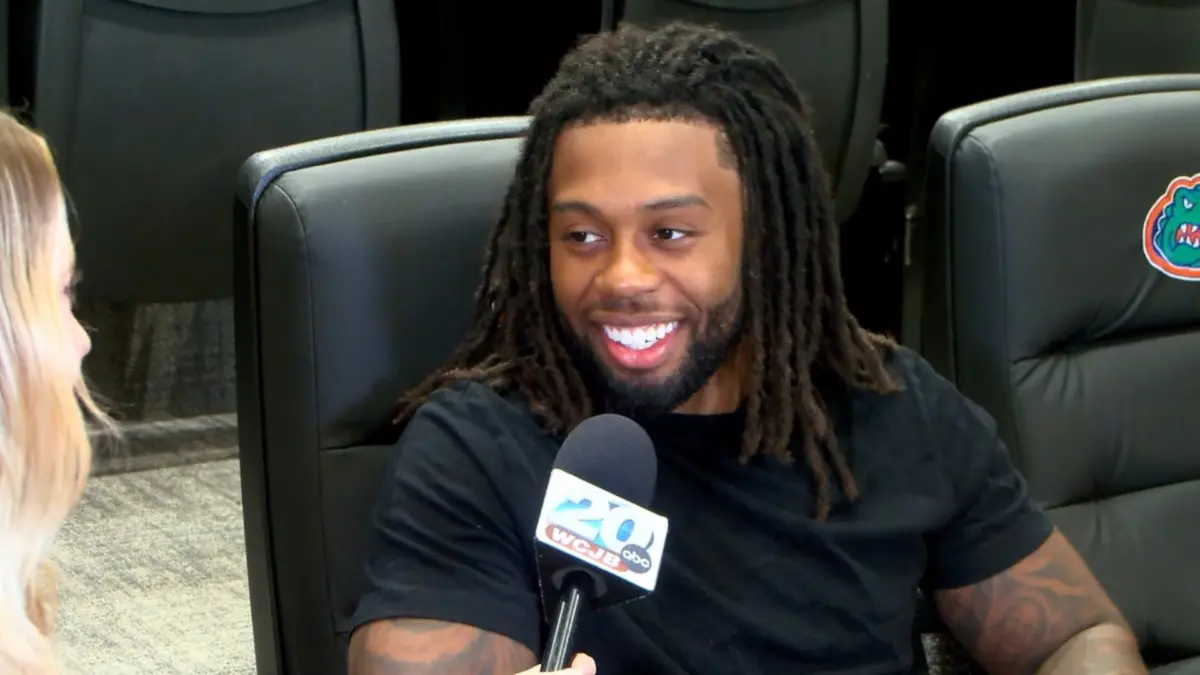

GAINESVILLE, Fla. — As the humid autumn air begins to settle over North Central Florida, the atmosphere inside the Heavener Football Complex and across the broader University of Florida campus reaches a familiar, electric pitch. Fall camp is a distant memory, the non-conference gauntlet is looming, and the orange and blue faithful are once again daring to dream of SEC dominance.
Amidst the high-stakes machinery of modern collegiate football, individual growth remains the ultimate currency. To understand where the Florida Gators defense is heading as the 2026 campaign unfolds, one must look closely at the backend of the secondary—specifically at junior defensive back Bryce Thornton.
In an exclusive, wide-ranging one-on-one interview with WCJB TV20’s Julianna Reichenbach, Thornton pulled back the curtain on his physical evolution, the mental maturation required to thrive in the Southeastern Conference, and the palpable shift in culture under a coaching staff fighting to return the program to elite national prominence.
Executive Overview
The 2026 season represents a critical juncture for both the University of Florida football program and Bryce Thornton personally. Entering his upperclassman years, Thornton has transitioned from a promising, hard-hitting rotational piece into a foundational anchor of the Gators’ secondary.
The conversation between Reichenbach and Thornton captured a player standing at the crossroads of potential and execution. Throughout the exclusive sit-down, Thornton articulated a clear philosophy: raw athleticism is no longer enough in an SEC landscape dominated by hyper-sophisticated passing attacks, run-pass options (RPOs), and alien-like wide receiver talent. Success requires meticulous film study, physical resilience, and an unwavering commitment to team-first accountability.
For Florida, the stakes could not be higher. Following seasons marked by flashes of brilliance interspersed with frustrating inconsistencies, the 2026 squad is under intense pressure to deliver a statement year. Thornton’s development—his ability to diagnose plays pre-snap, cover elite slot receivers, and serve as a physical tone-setter in the box—will go a long way in determining whether the Gators can stymie the conference’s elite high-octane offenses. This report examines Thornton’s journey, the strategic metrics defining his play, the institutional context of the Florida football program, and what lies ahead for the Gators as they navigate the treacherous waters of the 2026 college football schedule.
Detailed Chronology: The Evolution of Bryce Thornton
To fully appreciate the player Bryce Thornton has become ahead of the 2026 kickoff, it is necessary to retrace the steps of his athletic journey, charting the trials and triumphs that forged his current status in Gainesville.
The Foundation: High School Dominance and Recruiting Pedigree
Long before he donned the orange and blue, Thornton was turning heads in the talent-rich breeding ground of high school football in the state of Georgia. Playing at Milton High School—a powerhouse program known for producing elite collegiate talent—Thornton established himself as an uncompromising, physical safety who played with a distinct edge.
Recruiting analysts immediately gravitated toward his tape. Thornton was not merely a passive tackler; he was a momentum-shifter who routinely punished ball carriers in the open field and displayed the spatial awareness required to read quarterback intentions. Offers from premier programs rolled in, but the pull of the Southeastern Conference, coupled with the developmental vision laid out by the Florida coaching staff, ultimately brought him to Gainesville.
Early Trial by Fire: Navigating the SEC as an Underclassman
Arriving on a college campus as an 18-year-old is a jarring experience for any athlete, but stepping into the defensive backfield of an SEC program is an entirely different beast. The speed of the game accelerates exponentially; the playbooks are thicker than entire high school curricula; and the margin for error is razor-thin.
During his initial seasons with the Gators, Thornton experienced the classic growing pains associated with collegiate football. There were missed assignments against motion-heavy spread offenses, and there were physical adjustments required to match the sheer size and speed of elite SEC pass-catchers. However, rather than retreating under the weight of adversity, Thornton utilized every rep—both positive and negative—as a masterclass in development.
Coaching staffs frequently emphasize that true growth occurs during the uncomfortable phases of an athlete’s career. For Thornton, those baptism-by-fire moments on autumn Saturdays laid the bedrock for the poise he now exhibits on the field. He learned how to compartmentalize mistakes, how to study opponents’ tendencies through exhaustive video breakdown, and how to command the respect of older teammates through sheer work ethic.
The 2026 Breakthrough: Entering the Upperclassman Ranks
As media day approached for the 2026 season, observers across the beat noted a distinct physical and mental transformation in Thornton. No longer a wide-eyed newcomer, he projects the quiet confidence of a seasoned veteran.
During his exclusive interview with TV20, Thornton emphasized that the game has visibly "slowed down" for him. This deceleration of chaos is the hallmark of every great defensive back. While casual fans marvel at bone-crunching open-field tackles or acrobatic pass breakups, coaches value the pre-snap recognition that allows a defensive back to align correctly, communicate adjustments to the linebackers, and anticipate route combinations before the ball is even snapped.
Thornton’s emergence as a vocal leader in the secondary has been one of the most encouraging storylines of the fall camp cycle. In a defensive backfield that blends veteran savvy with emerging youthful talent, Thornton has stepped into a mentor role, ensuring that the standard of excellence demanded by the coaching staff is maintained across every rep.
Supporting Context & Metrics: Analyzing the Florida Secondary
To contextualize Bryce Thornton’s role within the broader framework of the Florida defense, one must analyze the tactical demands placed upon modern SEC defensive backs and evaluate the quantitative metrics that define success in the conference.
+-----------------------------------------------------------------+
|                   SEC DEFENSIVE BACK METRICS                    |
+------------------------+----------------------------------------+
| Metric                 | Importance to Defensive Scheme         |
+------------------------+----------------------------------------+
| Pre-Snap Alignment     | Prevents explosive plays via motion    |
| Run Support Efficiency | Stops perimeter runs and RPOs          |
| Pass Coverage Rating   | Limits yards per target against elite  |
|                        | slot receivers/tight ends              |
| Communication Error    | Minimizes misdirection busts           |
+------------------------+----------------------------------------+
The Tactical Complexity of Modern SEC Defenses
The modern collegiate offensive landscape is an ecosystem designed to stress defensive backs to their absolute breaking point. Coordinators deploy complex formations, heavy pre-snap motion, and eye-manipulation techniques to force defenders out of position.
In this chess match, the defensive backfield functions as the last line of defense, but players like Thornton—often operating in hybrid safety/nickel roles—are frequently dragged into the box to combat elite rushing attacks. This requires a rare dual skillset: the fluid hip mobility to run with sub-4.4 slot receivers down the seam, paired with the functional strength to shed blocks from pulling guards and tackle 220-pound running backs in the hole.
Thornton’s physical profile maps neatly onto these modern tactical requirements. Through rigorous winter conditioning and nutritional oversight, he has added functional mass without sacrificing his sideline-to-sideline speed. This allows him to play with the necessary physicality in the tackle box while retaining the deep-third recovery speed required to erase deep balls.
Statistical Benchmarks and Performance Indicators
While traditional box scores often focus on interceptions and total tackles, defensive coordinators evaluate players through a much more granular lens. Key performance indicators for a player of Thornton’s caliber include:
- Yards Per Coverage Snap: Measuring how efficiently a defensive back limits separation when targeted.
- Run Stop Percentage: Quantifying how often a defensive back successfully tackles a ball carrier behind or at the line of scrimmage on running plays directed toward their side of the field.
- Missed Tackle Rate: An essential metric for evaluating consistency in open-field situations, where missed assignments routinely turn five-yard gains into touchdowns.
Thornton’s progression in these advanced metrics has trended upward significantly as he approaches the midpoint of his collegiate career. Coaches have repeatedly praised his discipline in run support and his improved technique in breaking on the football rather than waiting for the receiver to complete the catch.
Official Statements and Institutional Perspective
The atmosphere surrounding the Florida Gators program ahead of the 2026 season is a mixture of cautious optimism and relentless urgency. During media availability sessions leading up to the season opener, both coaching staff members and players addressed the high expectations resting on the defense.
While specific comments from the exclusive TV20 sit-down highlight Thornton’s personal accountability, they mirror the broader organizational messaging emanating from the Heavener Football Complex. Head coach Billy Napier and defensive coordinators have consistently stressed the importance of execution, situational mastery, and culture building.
"When you look at guys who are going to take the next step for us defensively, it always comes down to preparation, attention to detail, and leadership," notes coaching staff consensus regarding the secondary. "Bryce has put in the exhaustive work required to be an everyday player in this league. He understands that physical talent gets you on the field, but mental execution is what keeps you there."
For Thornton himself, the personal accolades and media hype take a backseat to team objectives. Speaking with Julianna Reichenbach, he articulated a mindset anchored in collective success rather than individual statistics.
"It’s not about me making all the plays; it’s about everyone doing their 1/11th on every single snap," Thornton explained during the exclusive interview. "In the SEC, if one guy takes a play off or has his eyes in the wrong place, the other team has the offensive firepower to make you pay instantly. Our focus has been on raising the floor of our communication and playing with unmatched physical intensity from the first whistle to the last."
This perspective resonates throughout a locker room that recognizes the historical weight of the Florida Gators brand. The university’s storied defensive tradition—spanning decades of elite playmakers, lockdown corners, and ferocious hitters—casts a long shadow. Current players carry that legacy not as a burden, but as a standard to be upheld.
Future Outlook: The Road Ahead for the Gators in 2026
As the 2026 college football season unfolds, the spotlight on Bryce Thornton and the Florida Gators defense will only intensify. The SEC remains a brutal gauntlet, featuring traditional powerhouses, high-powered offensive innovators, and weekly battles that test the physical and mental limits of every roster.
Navigating the Schedule
The Gators’ slate presents an uncompromising test of depth, resilience, and tactical adaptability. Navigating this schedule requires a defense capable of playing complementary football—getting off the field on third downs, turning opponents over in high-leverage situations, and keeping points off the board when the offense experiences stalling stretches.
For Thornton, every Saturday serves as a live audition for his ultimate professional aspirations, while simultaneously serving as a battle for the immediate success of the University of Florida. Scouts from across the National Football League monitor SEC tape with microscopic precision; defensive backs who can communicate complex coverages, tackle in space, and play with verified physical toughness routinely find themselves climbing draft boards.
The Legacy of the 2026 Defense
Beyond individual accolades, the ultimate measure of the 2026 Florida defense will be found in wins and losses, trophy implications, and the restoration of defensive dominance in Gainesville.
The physical transformation and mental maturation exhibited by Bryce Thornton encapsulate the broader trajectory of the program. Through hard-fought lessons on the practice field, exhaustive film study in the meeting rooms, and a renewed commitment to culture, the Gators are positioning themselves to make a definitive statement.
As Julianna Reichenbach’s exclusive 1-on-1 interview with Thornton underscores, the confidence pulsing through the secondary is not built on blind optimism, but on sweat equity. When the lights turn on, the crowds roar, and the ball is kicked off, players like Bryce Thornton will be standing in the crosshairs—ready to write the next chapter of Florida Gators football.
For continued coverage of the Florida Gators throughout the 2026 season, including exclusive interviews, post-game analysis, and in-depth tactical breakdowns, stay tuned to WCJB TV20.

0 Comments