

Executive Overview
Four years ago, as the final ballots were tallied in a razor-thin Rhode Island Democratic primary, Governor Dan McKee dismissed a ringing telephone. Surrounded by jubilant supporters celebrating his narrow victory, the incumbent waved the phone away, famously uttering, “That’s not going to happen. Hang up on them.”
The caller on the other end of the line was his primary opponent, attempting to offer a customary concession. Today, the woman McKee so casually brushed aside is back—and she is looking to end his tenure in a high-stakes rematch that has captivated regional politics.
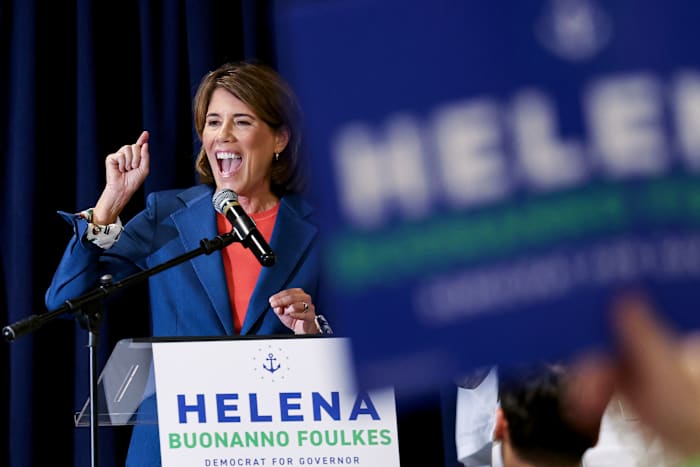
Helena Buonanno Foulkes, a former top-tier corporate executive at CVS Health and Hudson’s Bay Company, has mounted a formidable challenge against McKee ahead of the September 9 primary. For McKee, 75, the stakes could not be higher. He is locked in a fierce battle to avoid a pair of historic political ignominies: becoming the first U.S. governor to lose a primary election since 2018, and the first Rhode Island governor to suffer a primary defeat in more than three decades.
In a heavily Democratic state where the winner of the primary is widely considered the heavy favorite for the general election, the race has evolved into a referendum on executive competence, economic vision, and accountability. Foulkes has leveraged her substantial personal and donor-funded war chest to flood the airwaves, casting the incumbent as an out-of-touch career politician presiding over a sluggish and insular state government.
Conversely, McKee has hit back hard, painting his challenger as a corporate titan whose profit-driven past makes her fundamentally unsuited to represent working-class Rhode Islanders. Compounding these personal and ideological clashes is a very physical, crumbling reminder of administrative failure: the ongoing, multi-year saga of the Washington Bridge. For a governor trying to convince voters that everything is running smoothly, the daily gridlock on Interstate 195 has provided his opponents with an unmistakable and politically devastating visual symbol of dysfunction.
Detailed Chronology: From the 2022 Primary to the 2026 Rematch
The 2022 Primary Threshold
When Dan McKee inherited the governorship in March 2021 following Gina Raimondo’s departure to join the Biden administration as U.S. Secretary of Commerce, he stepped into the role as a familiar face in local politics. A former Cumberland mayor and long-serving lieutenant governor, McKee won a crowded, chaotic five-way Democratic primary in 2022 by a slim margin, edging out Foulkes and a field of other progressive and moderate challengers.
That victory night set the tone for an administration that has often struggled to project smooth, unifying leadership. The abrupt dismissal of Foulkes’s concession call captured the insular, combative nature of McKee’s political inner circle—traits that his opponents have sought to weaponize ever since.
The Washington Bridge Crisis (December 2023)
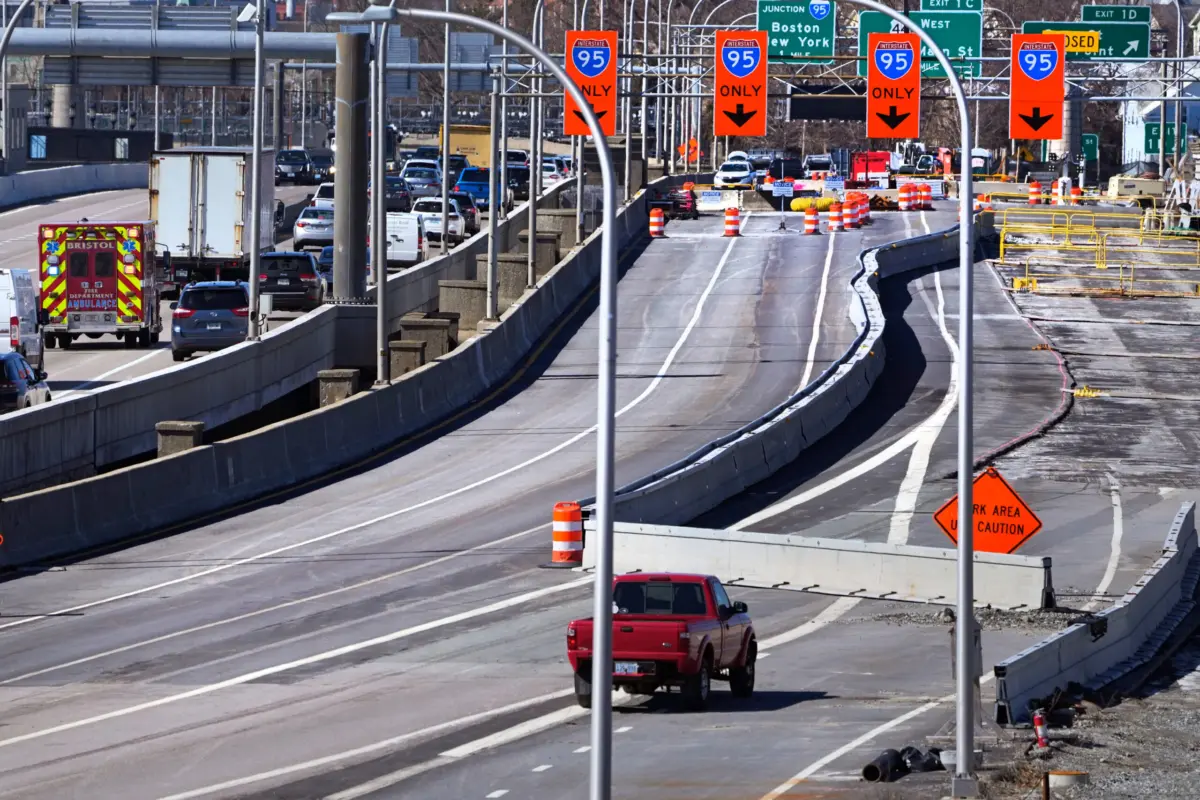
The defining crisis of McKee’s term erupted abruptly in December 2023. State transportation officials, acting on sudden engineering reports, declared a "critical failure" on the westbound side of the Washington Bridge, which carries Interstate 195 over the Seekonk River between Providence and East Providence.
McKee ordered an immediate, emergency closure of the span. The decision sent immediate shockwaves through the regional economy. Nearly 100,000 vehicles traverse the bridge daily, linking Providence to the south coast of Massachusetts and Cape Cod. Overnight, traffic was crammed entirely onto the reconfigured eastbound side, triggering historic gridlock, punishing commutes for everyday workers, and threatening the viability of local businesses.
The Escalation of the 2026 Primary Campaign
As the calendar turned toward the 2026 election cycle, the bridge repairs dragged on far past initial estimates, with costs ballooning and public frustration reaching a boiling point. Capitalizing on this widespread discontent, Foulkes formally launched her renewed gubernatorial bid, out-raising the incumbent and quickly establishing a dominant fundraising footprint.
Throughout the summer of 2026, the campaign intensified. Debates became flashpoints of personal animosity, highlighted by fierce clashes over Foulkes’s corporate past at CVS Health and McKee’s defense of his administrative record. With early voting underway and the primary slated for September 9, 2026, the race has transformed into a referendum on the nature of leadership in the Ocean State.
Supporting Context & Metrics: The Fault Lines of the Race
The Infrastructure Anchor: The Washington Bridge Project
In modern American politics, complex systemic issues like crime, inflation, and healthcare reform often defy easy political attribution, as responsibility is shared across municipal, state, and federal jurisdictions. However, physical infrastructure provides a glaring exception to this rule.
Adam Myers, a political scientist at Providence College, notes that bridge infrastructure represents a direct line of accountability.
“In the case of a bridge, people know that state government is responsible for that,” Myers explained. “And so there appears to be a very clear place on which to put all the blame.”
Governor McKee has repeatedly pushed back against the unrelenting criticism regarding the Washington Bridge, emphasizing that his swift decision-making averted a catastrophic structural collapse and prioritized public safety. He has frequently noted that the Rhode Island Department of Transportation’s current timeline projects completion by 2028—a timeframe he points out is faster than the expected 2030 completion date for the Francis Scott Key Bridge in Baltimore, which tragically collapsed in 2024 after a container ship struck its support columns.
Despite these defenses, the daily reality of traffic bottlenecks remains an inescapable political liability for the incumbent.

The Corporate Battleground: CVS Health and Economic Populism
Sensing vulnerability, Governor McKee has pivoted aggressively on the offensive, framing Foulkes as an out-of-touch corporate executive attempting to buy the governor’s office.
Foulkes boasts deep roots in the New England political establishment—her grandfather and uncle, Thomas and Chris Dodd, both served as prominent U.S. Senators from neighboring Connecticut. However, her professional pedigree is rooted firmly in the corporate sector. She spent 25 years climbing the ranks at CVS Health, ultimately serving as president of the company’s pharmacy division from 2014 to 2018. Following her tenure at CVS, she took the helm as chief executive officer of Canadian retail conglomerate Hudson’s Bay Company before stepping down in 2020.
McKee has seized upon her corporate history, directly accusing Foulkes of contributing to the opioid crisis during her leadership years at CVS—a charge that Foulkes categorically denies.
“Who’s the option here? It’s a corporate person that the Democrats can’t stand,” McKee asserted during a campaign interview. “She’s shown evidence that she’s put profits ahead of people over and over and over again.”
In response, Foulkes has mounted a robust defense of her corporate record, pointing out that under her leadership, CVS actually reduced its opioid dispersal rate by 40 percent. She has also reminded voters that the national settlement agreement—in which CVS agreed to pay $5 billion in 2022 to resolve sweeping opioid lawsuits without admitting liability—occurred well after her departure from the company.
Furthermore, Foulkes has warned that McKee’s relentless attacks on CVS—a massive employer headquartered in Woonsocket, Rhode Island—risk alienating the state’s business community and threatening local jobs. During a high-stakes televised debate in August, Foulkes confronted the governor directly:
"The 50 largest companies’ business leaders in this state wrote a letter to you, asking you to stop criticizing CVS. You are going to drive them out of the state."
Official Statements and Campaign Rhetoric
The ideological divide between the two leading Democrats highlights a broader debate within the party over what type of leader best serves a working-class constituency in an era of economic anxiety.

Helena Buonanno Foulkes on State Government and Insiders:
“I think that what I’ve really learned in the last four years, in a deeper way, is how much people feel like state government just works with a powerful few. They also hear the leader of the state saying ‘everything’s great’ and they’re saying, ‘I really worry about a good paying job.’”
Foulkes has leaned heavily into her identity as a political outsider unburdened by machine politics, even expanding her base into Cumberland—McKee’s own hometown, where he previously served as mayor.
“It’s a great moment to be an outsider,” she remarked on the campaign trail.
Governor Dan McKee on Working-Class Advocacy:
McKee continues to present himself as the authentic champion of Rhode Island’s working families, pointing to numerous grassroots labor endorsements accrued throughout his decades in public service. While organizations like the state AFL-CIO and the Rhode Island Democratic Party opted to withhold official endorsements in the primary, McKee insists his track record speaks for itself against an opponent he characterizes as hostile to traditional Democratic values.
Future Outlook: The Path to September 9 and Beyond
As voters prepare to head to the polls on September 9, 2026, the primary remains too close to call. The outcome will depend heavily on whether primary voters view McKee as a steady hand who guided the state through unprecedented infrastructure crises, or whether they embrace Foulkes’s message of corporate-honed efficiency and fresh executive leadership.
The implications of the race extend far beyond the borders of Providence and the immediate infrastructure woes of the Washington Bridge. Should Foulkes pull off the primary upset, it would signal a profound shift in Rhode Island’s political landscape, proving that anti-incumbent sentiment can pierce even deeply entrenched state political machines. Should McKee survive, it will validate his populist counter-offensive and his messaging of steady, blue-collar resilience.
Regardless of the outcome, the bruising primary has laid bare deep fractures within the Rhode Island Democratic Party—wounds that the eventual nominee will need to heal rapidly before facing the general electorate in the heavily blue state.

0 Comments