

Executive Overview
For beachgoers, coastal property owners, and nature enthusiasts strolling the tidal marshes of the American Southeast, a familiar sight has long been the scurrying scuttle of the native fiddler crab. Measuring just a couple of inches wide, these diminutive crustaceans are a cornerstone of the coastal ecosystem. However, a growing number of beach walkers are encountering what appears to be a supersized imposter: a crustacean that resembles a massive fiddler crab, but dwarfs it in scale, sporting a shell spanning up to five inches across.
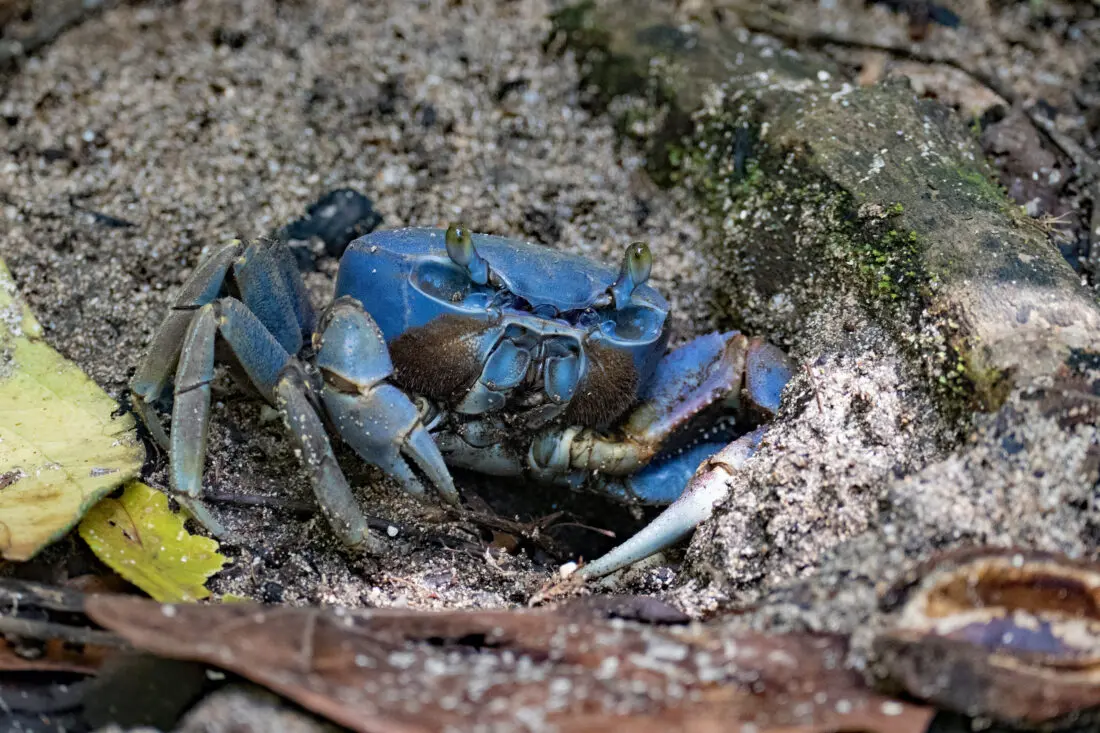
This newcomer is Cardisoma guanhumi, better known as the blue land crab. Native to the tropical and subtropical mangroves, estuaries, and coastal zones of northern South America, Central America, and the Caribbean, this formidable species has traditionally found its northernmost natural limit in the warm sands of southern Florida. In recent years, however, scientists have documented a striking geographical shift. The blue land crab is quietly expanding its range northward, showing up with increasing frequency across Georgia and the Carolinas.
This unexpected migration has sparked urgent interest among marine biologists, ecologists, and state wildlife agencies. While the species is not yet officially classified as "invasive"—a legal and ecological designation reserved for non-native organisms proven to cause significant harm to native ecosystems—its rapid, unauthorized northward push raises pressing questions. Researchers do not yet fully understand how these large, terrestrial-dwelling scavengers will interact with native fauna, alter local food webs, or impact fragile coastal habitats.
To solve this ecological puzzle, state agencies and researchers are turning to an invaluable resource: the general public. Through citizen-science reporting initiatives, scientists are urging coastal residents to document and report every sighting. As researchers race to map the true extent of the population expansion, the public remains the front line of defense in understanding—and potentially managing—this unfolding marine wildlife phenomenon.
Detailed Chronology: Tracking the Northern Creep
The presence of Cardisoma guanhumi outside its historical comfort zone in the American subtropics is not an entirely brand-new phenomenon, but the pace of sightings has accelerated dramatically over the last two decades. Piecing together the chronology of this northward migration reveals a slow-burning ecological shift that has recently broken into the mainstream scientific spotlight.
The First Footprints: 2008
The earliest documented wave of blue land crab sightings in the Carolinas dates back to 2008. At the time, isolated specimens discovered in South Carolina were largely dismissed by local wildlife officials as anomalous events—perhaps the result of accidental transport via commercial shipping ballast water, or exotic pets intentionally or accidentally released into the wild. Because isolated individuals rarely establish self-sustaining breeding populations, these early arrivals did not immediately trigger widespread alarm bells within the scientific community.
The Geographic Leap: 2023
For roughly fifteen years following those initial sporadic encounters, reports remained low. That status quo shattered in 2023. During this period, both Georgia and North Carolina officially logged their own localized sightings of the blue land crab, signaling that the earlier anomalies were likely not isolated incidents, but the vanguard of a broader range expansion.
The uptick in North Carolina was particularly striking. Since 2023, state researchers have officially confirmed twenty-three distinct blue land crab sightings across the state’s coastal counties. In addition to these verified encounters, another thirty-four unconfirmed reports have flooded into state wildlife databases from observant citizens, indicating that the population present in the wild may be significantly larger than official verification numbers suggest.
The Present Day: Emerald Isle and Beyond
The expansion shows no signs of slowing down. Already this year, researchers have verified two high-profile sightings of the blue land crab in Emerald Isle, North Carolina—a popular coastal resort town situated on Bogue Banks. The appearance of these specimens in heavily developed tourist corridors underscores the reality that these crabs are not restricted to remote, untouched marshlands; they are increasingly interacting with human-dominated coastal landscapes.
Supporting Context & Metrics: Biology, Behavior, and the Unknown
To understand why the northern migration of the blue land crab commands such intense scientific interest, one must examine the unique biology of the animal and the distinct environmental niches it occupies.
Anatomy and Identification
Despite its common name, the blue land crab is remarkably chameleon-like in its coloration throughout its life cycle, which often leads to misidentification by the untrained eye.
- Adult Males: Mature males typically display the iconic, striking blue-gray coloration across their broad carapace (shell) and onto their heavy, asymmetric claws.
- Adult Females: Females often exhibit more muted, subtle tones, ranging from pale white to an ashy gray.
- Juveniles: Young blue land crabs can be exceptionally difficult to recognize, frequently sporting bright orange, dark brown, or even deep purple carapaces that camouflage them within leaf litter and marsh grasses.
The single most reliable diagnostic feature for distinguishing an adult blue land crab from native species like the ghost crab or fiddler crab is size. While native fiddler crabs measure a mere fraction of an inch to a couple of inches across, a mature blue land crab boasts a carapace width that can stretch up to five inches.
Terrestrial Adaptations and Habitat
True to their name, blue land crabs spend the vast majority of their adult lives on dry land rather than submerged in the ocean. However, they are bound to the marine environment by a strict biological necessity: moisture.
These crabs must regularly wet their specialized gills with saltwater to breathe. Consequently, they are almost exclusively found within a five-mile radius of the coast. To survive the heat and maintain hydration, blue land crabs are prolific and deep diggers. They construct complex, branching burrow systems that can plunge several feet straight down into the water table, allowing them to access subterranean moisture during dry periods.
Ecological Uncertainties: Friend, Foe, or Neutral Neighbor?
Ecologists divide non-native species into categories based on their impact. A species is only labeled "invasive" when it demonstrates clear negative impacts on native biodiversity, agriculture, or human infrastructure. At present, the blue land crab lacks this invasive classification because scientists simply do not have enough data to determine its ecological footprint.
Primarily herbivores and opportunistic scavengers, blue land crabs feed on fallen leaves, fruits, and organic detritus. However, their voracious appetite and aggressive burrowing habits could theoretically disrupt local ecosystems. Researchers are deeply concerned about how these massive newcomers will interact with native species:
- Competition: Will they outcompete native ghost crabs and fiddler crabs for prime burrowing real estate and food resources?
- Marsh Stability: Can the structural integrity of local salt marshes and coastal dunes withstand thousands of heavy crabs digging extensive subterranean networks?
- Predation and Vulnerability: Do local predators recognize them as prey, or do they lack natural checks in their new northern habitats?
Official Statements and Research Strategies
Because governmental and academic institutions cannot deploy field biologists to monitor every mile of coastline continuously, the scientific approach to tracking the blue land crab relies heavily on public cooperation and centralized data collection.
The Voice of Expertise
Scott Scripter, a respected biologist with the North Carolina Division of Marine Fisheries who is directly overseeing the state’s public reporting initiative, emphasizes the challenges and importance of this undertaking.
"They can actually vary in color, despite the name," Scripter notes, addressing the common confusion among citizens attempting to identify the crabs. "The adult males tend to have the characteristic blue gray coloring all around their carapace and onto their claw, but sometimes the females can be a little more white or even ashy gray."
Scripter points out that unlocking the mystery of the migration requires looking at the big picture. Every verified report contributes a crucial data point toward answering foundational scientific questions: Just how large is the northern population? What specific coastal habitats are they utilizing for shelter and reproduction? What tangible effects might they impose on local environments in the coming decades? And, fundamentally, what is driving this geographical push?
"We’re relying on community engagement to learn more," Scripter explains.
Climate Change vs. Human Transport
The exact catalyst behind the northward expansion remains a subject of intense debate among marine scientists. Two primary hypotheses dominate the discussion:
- Climate Change and Warming Waters: As average winter temperatures along the Southeastern seaboard rise and hard freezes become increasingly rare, tropical and subtropical species that were once killed off by cold snaps are finding northern coastal zones hospitable year-round.
- Anthropogenic Introduction: Human activity—ranging from maritime ballast water discharge to the accidental or deliberate release of exotic pets—may have seeded northern populations directly, which are now growing and spreading naturally.
The Catch-22 of Field Research
In parts of their native Caribbean range, blue land crabs are prized as a culinary delicacy, frequently harvested for local dishes. However, attempting to catch or study them in the wild is no easy task. These crustaceans are remarkably fast, possess an uncanny ability to vanish down deep burrows at the slightest vibration, and are equipped with a formidable, heavy-duty claw capable of delivering a painful defense mechanism.
Given these practical hurdles, Scripter offers simple, pragmatic advice for anyone who encounters one of these giant wanderers: "For now, the best way to capture one is with a camera."
Future Outlook: How the Public Can Help
As the Southeastern coastline faces an era of rapid environmental and climatic transformation, the story of the blue land crab serves as a fascinating case study in modern biogeography. Whether this large crustacean becomes a permanent, benign fixture of the Carolinas and Georgia ecosystems or transforms into a disruptive ecological force remains to be seen.
What is certain, however, is that proactive monitoring is the single best tool scientists have to get ahead of any potential ecological crises. State wildlife divisions across the region are expanding their outreach campaigns to educate coastal communities, fishermen, and beachgoers about the signs of an encroaching blue land crab population.
Call to Action: Report Your Sightings
State and academic researchers are calling on anyone living in or visiting the coastal zones of Georgia, South Carolina, and North Carolina to remain vigilant. If you spot an unusually large, five-inch crab scuttling across a coastal dune, near a marsh, or even making its way across a coastal roadway, do not attempt to capture or handle the animal. Instead, take a clear photograph, note the exact location, and submit your observation to the official monitoring network.
Coastal residents and visitors can easily log their encounters by accessing the dedicated state-managed reporting portal. By taking a few moments to fill out the digital Blue Land Crab Sighting Form, citizens directly empower marine biologists to protect and understand the delicate balance of America’s Southeastern coast for generations to come.

0 Comments