

Executive Overview
The story of American agriculture is inextricably linked to the history of its transportation networks. Long before refrigerated trucks clogged interstate highways or cargo jets spanned continents, the economic viability of a farm was bound tightly to its proximity to a navigable river or a muddy wagon road. For generations, the expansion of the United States was constrained by the physical limits of horse and ox.
The introduction of the railroad altered this paradigm permanently. As chronicled in the American Agriculture History Minute by agricultural historian Mark Oppold, the evolution of rail transportation did more than simply speed up transit times—it fundamentally restructured the geography of American commerce. By shrinking distances, lowering freight costs, and bridging the vast expanse between frontier farms and eastern population centers, railroads transformed the United States from a collection of isolated regional economies into a unified, continental powerhouse.
Today, the modern agricultural supply chain—characterized by high-volume grain shuttles, intermodal shipping containers, and sophisticated logistics—retains its foundation in the daring engineering feats of the early 19th century. This report examines the historical trajectory of America’s rail system, tracing its humble origins as horse-drawn tracks in New England to its status as the lifeblood of rural and agricultural development.
Detailed Chronology: From Iron Tracks to Continental Empires
The development of the American rail network did not happen overnight; it was a piecemeal evolution born out of desperation for better transit infrastructure. As the young nation expanded westward following the War of 1812, moving heavy agricultural commodities like wheat, corn, and livestock overland was frequently cost-prohibitive. Muddy roads turned spring thaws into impassable quagmires, and spoilage rates for perishable goods were devastatingly high.
1812: The Vision of a "Rail Highway"
The ideological genesis of American rail travel is widely credited to Colonel John Stevens of Hoboken, New Jersey. In 1812—years before the first commercial steam locomotive would pull a car in the United States—Stevens boldly petitioned the New Jersey legislature to construct a trans-state "rail highway" powered by steam engines.
At a time when most Americans viewed canals as the ultimate solution for inland navigation, Stevens envisioned a network of parallel iron rails capable of carrying vehicles at unprecedented speeds. Though initially met with skepticism and dismissed by many contemporaries as an eccentric pipe dream, Stevens’ conceptual framework proved prophetic. He understood that natural waterways had geographic limitations, whereas iron tracks could be laid across varied terrain to connect inland agricultural bowls directly to coastal ports.
The Era of Horse-Drawn Innovations
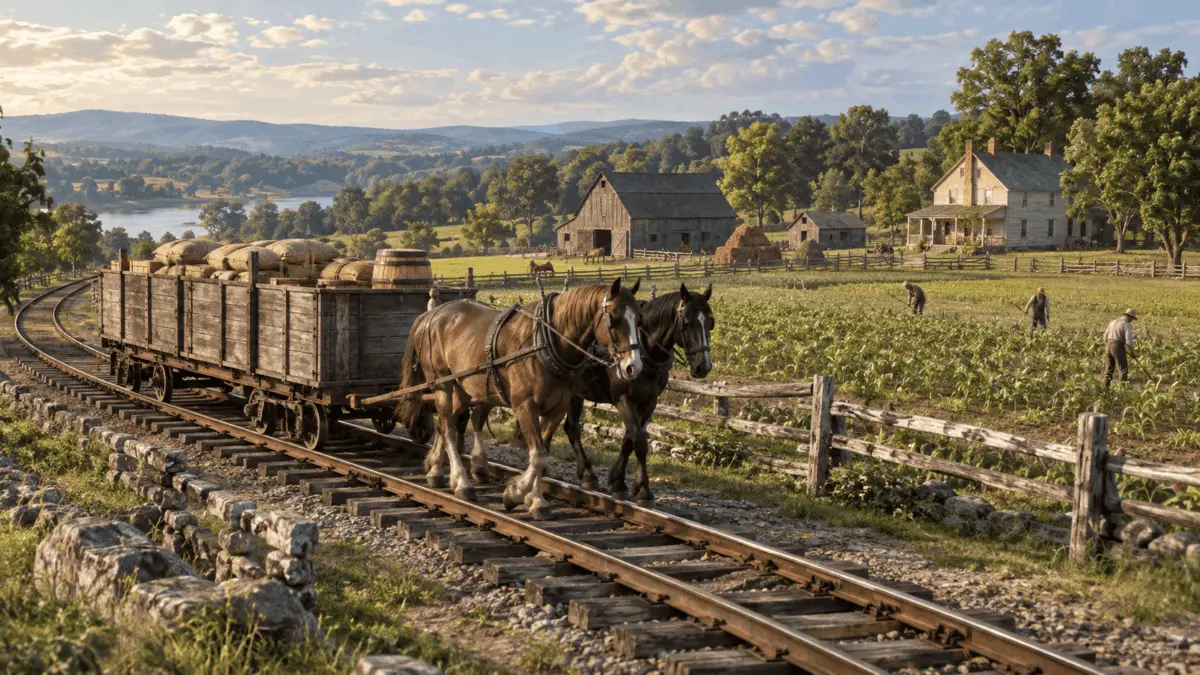
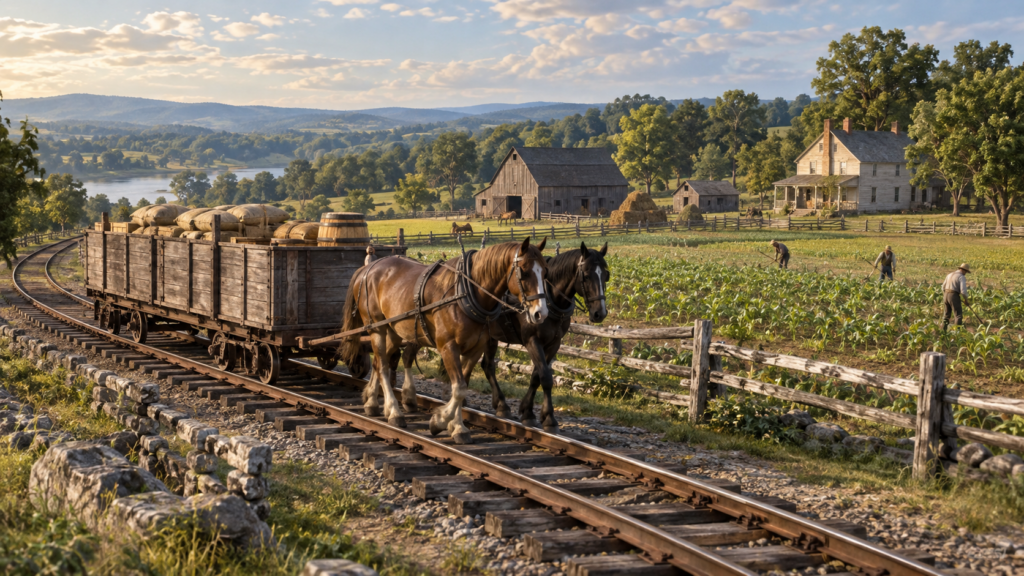
Before steam power dominated the rails, early entrepreneurs experimented with animal-powered systems to test the efficiency of rolling steel or iron wheels over smooth tracks. These early prototypes demonstrated that rolling friction was significantly lower than the rolling resistance of a wagon wheel on dirt or gravel. A single horse could pull a vastly heavier load on iron rails than it could ever manage on a macadamized turnpike. These transitional systems served as vital testbeds for track construction, gauge standardization, and operational logistics.
1826: The Granite Railway Breaks Ground
The true physical turning point for American rail infrastructure occurred in Massachusetts with the construction and launch of the Granite Railway in 1826. Chartered to transport heavy blocks of building granite from the quarries of Quincy, Massachusetts, down to the Neponset River, this modest three-mile railway became a historic milestone.
While short by any standard, the Granite Railway proved the commercial viability of fixed-track logistics. It incorporated crucial engineering advancements, including granite tie-blocks, iron-capped wooden rails, and specialized rolling stock. News of its success reverberated through financial and industrial circles, signaling to farmers, merchants, and investors that rail technology was ready to scale.
1827: The Baltimore and Ohio (B&O) Revolutionizes Freight
If the Granite Railway proved the concept, the Baltimore and Ohio (B&O) Railroad proved the continental potential. Incorporated in February 1827, the B&O achieved a historic breakthrough by becoming the first common-carrier railroad in the United States designed to transport both passengers and freight.
The inclusion of freight capacity was an immediate game-changer for the agricultural sector. As the B&O and subsequent lines pushed westward through the rugged Appalachian topography toward the fertile Ohio River Valley, they unlocked vast tracts of virgin agricultural land. Farmers who had previously grown crops merely for subsistence—because getting surplus yields to market cost more than the crops were worth—suddenly found themselves connected to booming urban markets in Baltimore, Philadelphia, and New York.
Supporting Context & Metrics: The Economic Liberation of Rural America
To fully appreciate the impact of the railroad on rural America, one must understand the crushing economic isolation that defined 18th- and early 19th-century farming. Prior to the iron horse, transportation costs escalated rapidly with distance. Economic historians note that hauling wheat by wagon over land became economically unviable after just a few dozen miles; the horses ate too much grain along the route to make the journey profitable.
Shrinking Space and Time
Railroads shattered these geographic barriers. During the mid-to-late 19th century, the cost of moving freight plummeted by over 80 percent.
- Speed: Overland wagon freight rarely exceeded 2 to 3 miles per hour under optimal conditions. Early locomotives routinely tripled that speed, while late-19th-century freight trains moved goods across states in days rather than months.
- Predictability: Unlike river transport, which was paralyzed by winter freezes, summer droughts, or spring floods, rail transport offered year-round reliability. This consistency allowed farmers to forward-contract crops and livestock with unprecedented confidence.
- Perishability: The eventual integration of refrigerated railcars (reefers) later in the century transformed livestock and produce markets. Cattle could be shipped live or processed in centralized hub cities like Chicago and distributed safely across the nation, changing dietary habits and agricultural production models forever.
The Rise of the Agribusiness Hub
Railroads did not just connect existing towns; they actively manufactured them. Across the Midwest and Great Plains, railroad companies were granted massive land subsidies by the federal government to finance construction. To monetize these land grants and generate ongoing freight business, railroads actively recruited homesteaders and farmers, establishing thousands of planned agricultural communities along their rights-of-way.
Every six to ten miles along a rail line, a grain elevator and a stockyard sprouted. These "line-towns" became the economic centers of rural counties. Farmers hauled their morning harvest to the local elevator, loaded it directly into railcars, and received cash payments tied to national commodity exchanges in Chicago and Minneapolis. Rural isolation was systematically dismantled, replaced by telegraph wires running parallel to the tracks that provided farmers with real-time market pricing.
Official Statements and Historical Perspectives
Reflecting on this monumental era, agricultural historians and industry leaders frequently emphasize the profound symbiosis between rail development and agrarian prosperity. Mark Oppold’s American Agriculture History Minute series captures this essence, reminding modern audiences of the sheer grit required to lace the continent with iron.
"What we often overlook today," Oppold notes in his historical retrospectives, "is that the agricultural abundance we take for granted was built on a foundation of steel and steam. The early pioneers of rail—from Colonel John Stevens dreaming of rail highways to the builders of the B&O—did not just lay tracks; they laid the legal, financial, and logistical framework for modern American commerce."
Economic historians echo this sentiment, pointing out that the American railway boom represented the world’s first integrated national market.
"The railroad converted farming from a localized, subsistence-oriented way of life into a dynamic, export-driven commercial enterprise," states a retrospective report from the Association of American Railroads (AAR). "By bridging the gap between the producer and the consumer, the rail network generated the capital necessary to fuel America’s Industrial Revolution."
State agricultural departments and historical societies frequently celebrate these milestones, noting that rural towns owe their very existence to the whistle of the steam locomotive echoing across the prairie. The convergence of agriculture and rail created a cultural and economic identity for rural America that endures to this day, even as diesel engines and automated grain shuttles have replaced the historic steam-belching giants.
Future Outlook: The Enduring Legacy of Rail in Modern Agriculture
As we look toward the future of American agriculture, the foundational role of rail remains as vital as ever, even as the technology undergoes a profound modernization. Today’s agricultural supply chain relies on heavy-haul Class I railroads to move massive volumes of grain, oilseeds, ethanol, and fertilizer with a fuel efficiency that long-haul trucking simply cannot match.
Sustainability and Efficiency
In an era increasingly focused on carbon reduction and supply chain resilience, railroads offer unmatched environmental advantages. A single freight train can transport the equivalent of hundreds of large semi-trucks, significantly reducing highway congestion, road maintenance costs, and greenhouse gas emissions. Moving a ton of freight by rail is, on average, three to four times more fuel-efficient than moving it by truck.
Technological Advancements
The modern agricultural rail network is undergoing a digital and structural transformation:
- Precision Logistics: GPS tracking, predictive maintenance sensors, and advanced telemetry allow grain elevators and food processors to monitor railcar locations and transit times down to the minute.
- High-Capacity Shuttles: Modern unit trains—consisting of 100 or more dedicated grain cars—load and unload at rapid terminals, moving millions of bushels of corn and soybeans directly from country elevators to export terminals in the Pacific Northwest and the Gulf Coast.
- Infrastructure Upgrades: Ongoing private-sector investments ensure that bridges, tracks, and signaling systems can handle heavier axle loads and larger car designs, keeping American agricultural exports competitive on the global stage.
Conclusion
From Colonel John Stevens’ visionary 1812 proposal to the three-mile stretch of the Granite Railway in 1826, and onward through the westward expansion of the Baltimore and Ohio Railroad, the iron rail has been the silent partner of the American farmer. As Mark Oppold’s historical analyses remind us, understanding where our food system came from provides essential perspective on how it operates today. The rails opened the West, unified a divided nation, and built the most productive agricultural economy the world has ever known—a legacy that continues to drive rural America forward into the 21st century.

0 Comments