
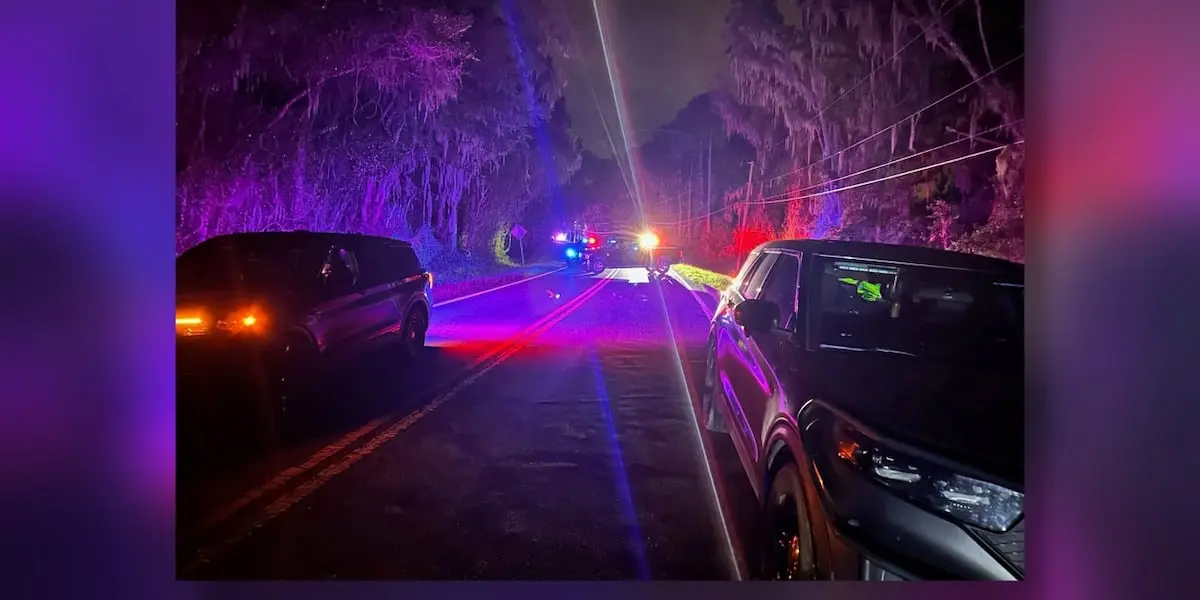

DUNNELLON, Fla. — A major section of West Highway 40 in Dunnellon remained active and heavily secured as multi-agency law enforcement personnel processed a crime scene following a critical-incident shooting involving a Levy County Sheriff’s Office deputy. The confrontation, which occurred on a Tuesday afternoon, has prompted a comprehensive investigation led by state authorities alongside local law enforcement partners.
The incident has resulted in the indefinite closure of a primary thoroughfare, disrupting regional traffic and drawing immediate scrutiny from community stakeholders and regional media outlets. While official disclosures regarding the physical condition of the individuals involved remain tightly controlled, the deployment of the Florida Department of Law Enforcement (FDLE) signals a deep, methodical inquiry standard for all officer-involved uses of lethal force within the state of Florida.
Executive Overview
The unfolding investigative narrative centers around a violent encounter in the 23,200 block of West Highway 40, a semi-rural stretch located within the western boundaries of Marion County, immediately adjacent to the Levy County border. According to initial field reports released by the Marion County Sheriff’s Office (MCSO), the incident began as a tactical or operational encounter involving at least one deputy commissioned by the Levy County Sheriff’s Office.
For reasons still under rigorous forensic and ballistic review, the encounter escalated to the point where firearm discharges occurred. In the immediate aftermath, emergency protocols were activated, sealing off a multi-mile radius of West Highway 40 to preserve transient evidence, ballistic markings, and vehicle trajectories.
Key facets of the initial response include:
- Jurisdictional Collaboration: While the incident occurred within Marion County boundaries, the primary agency involved is the Levy County Sheriff’s Office. Consequently, the independent investigative lead was immediately transferred to the FDLE to maintain impartiality and absolute transparency.
- Infrastructure Disruption: The 23,200 block of West Highway 40 was entirely closed to vehicular and pedestrian traffic, creating localized transit delays and forcing commercial and residential traffic onto protracted detours.
- On-Scene Presence: Investigators from the FDLE, crime scene technicians from Marion County, and administrative supervisors from Levy County converged on the rural corridor to map the scene using advanced 3D laser-scanning technology and traditional physical evidence markers.
- Information Governance: Due to the active nature of the inquiry, law enforcement agencies have exercised strict information-control protocols, restricting deep operational disclosures pending preliminary medical clearances, next-of-kin notifications, and initial autopsy or trauma reports.
Detailed Chronology of Events
Reconstructing the timeline of an officer-involved shooting requires synthesizing dispatch audio logs, witness statements, and formal agency press releases. While the official chronology remains fluid as investigators interview civilian witnesses and review available dashboard and body-worn camera footage, the broad operational arc of the event has begun to crystallize.
Phase One: Pre-Incident Mobilization
Hours before the fatal or injurious shots echoed across West Highway 40, tactical developments or routine patrol operations involving the Levy County Sheriff’s Office had been set into motion across county lines. Law enforcement agencies frequently operate across jurisdictional boundaries under mutual aid agreements, pursuit policies, or targeted fugitive apprehension directives.
As units tracked a subject or responded to a call for service, the operational footprint migrated eastward from Levy County into the western reaches of Marion County. The specific impetus—whether a traffic stop, a warrant execution, or a dynamic emergency response—has not yet been explicitly detailed by public information officers, underscoring the early stage of the judicial process.
Phase Two: The Critical Incident on West Highway 40
The confrontation materialized abruptly in the 23,200 block of West Highway 40. This specific corridor is characterized by a mix of sparse residential parcels, dense tree lines, and rural commercial properties, providing limited cover and distinct tactical challenges for law enforcement officers operating in the field.
According to preliminary briefings, an interaction between the Levy County deputy and the subject rapidly deteriorated. The exact temporal window of the physical altercation—from the initial verbal commands to the deployment of lethal force—is believed to have spanned mere seconds. Witnesses in adjacent properties reported hearing a sudden flurry of gunfire, followed almost immediately by the wailing sirens of secondary responding units and emergency medical services.
Phase Three: Emergency Response and Scene Lockdown
Within moments of the shooting, dispatchers coordinated a massive multi-agency emergency response. Marion County Sheriff’s deputies arrived to secure the perimeter, cutting off access to the 23,200 block of West Highway 40 to prevent contamination of the crime scene.
Paramedics and emergency medical technicians evaluated the scene for safety before rendering aid to any injured parties. Specialized medical transport was mobilized, though official updates regarding patient status were heavily restricted. Simultaneously, patrol vehicles established hard road closures miles away from the core zone, rerouting commuters and setting the stage for a protracted, overnight investigative sweep.
Supporting Context & Metrics
To fully understand the weight of this event, it is necessary to examine the geographic, statistical, and institutional context surrounding law enforcement operations in Marion and Levy counties, as well as the systemic protocols governing officer-involved shootings in the state of Florida.
Geographic and Demographic Profile
Dunnellon and its surrounding unincorporated regions sit at a critical crossroads of west-central Florida.
- Marion County: Spanning over 1,600 square miles, Marion County accommodates a rapidly growing population that exceeds 390,000 residents. The western districts, including Dunnellon, feature expansive rural highways that require significant patrol resources.
- Levy County: Situated immediately to the west, Levy County is more rural, with a population hovering around 45,000. Because of its smaller demographic footprint, Levy County deputies frequently coordinate with neighboring Marion County and regional task forces to manage cross-jurisdictional enforcement operations.
- Highway 40 Dynamics: West Highway 40 serves as a vital arterial route connecting the Gulf Coast regions with Ocala and central Florida. Arterial closures of this magnitude create immediate logistical bottlenecks for emergency services, school bus routes, and commercial freight transport.
The Role of the Florida Department of Law Enforcement (FDLE)
In Florida, the standard operating procedure for any law enforcement agency involved in a shooting—whether resulting in injury or death—is to request an independent criminal investigation by the FDLE. This protocol is designed to eliminate conflicts of interest.
When a deputy from Agency A shoots an individual, Agency A does not investigate its own personnel for potential criminal wrongdoing. Instead:
- The Independent Probe: FDLE agents assume total control of the evidentiary collection, witness interviews, and ballistic analysis.
- The Prosecutor’s Review: Once the FDLE completes its comprehensive investigative file, the dossier is handed over directly to the local State Attorney’s Office (in this case, the Fifth Judicial Circuit, which encompasses Marion County).
- Legal Determination: Prosecutors evaluate the file to determine whether the use of force was legally justified under Florida Statutes Chapter 776 (justifiable use of force), or whether criminal charges are warranted.
- Internal Administrative Review: Concurrently, the Levy County Sheriff’s Office conducts an internal administrative investigation to determine if departmental policies, de-escalation training guidelines, or tactical rules of engagement were violated.
Official Statements and Institutional Responses
As is standard protocol during active, high-stakes investigations involving law enforcement personnel, official communications have been measured, cautious, and tightly compartmentalized.
Public Information Officers (PIOs) from the Marion County Sheriff’s Office issued the initial public alerts via digital channels and media advisories, emphasizing the necessity of avoiding the affected corridor. The statements stressed that while Marion County personnel are managing the immediate perimeter and traffic control, the investigative lead rests firmly with the FDLE and the primary employing agency, the Levy County Sheriff’s Office.
Leadership within the Levy County Sheriff’s Office has pledged full cooperation with state investigators. In preliminary statements released to regional media, agency representatives acknowledged the gravity of the incident and expressed commitment to transparency once the foundational phases of the forensic audit are concluded.
Civil rights advocates and legal analysts monitoring the case have emphasized the importance of timely evidence preservation, calling for the eventual release of body-worn camera footage, dash-cam recordings, and forensic autopsy reports to ensure public trust in the judicial outcome. Historically, agencies across Florida face mounting pressure to release critical incident recordings within 30 to 60 days of an event, provided such disclosures do not compromise the integrity of ongoing witness interviews.
Future Outlook
As the investigation enters its subsequent phases, several critical milestones will dictate how the narrative evolves and how the community processes the trauma of the event.
1. Reopening of West Highway 40
The immediate logistical priority for local residents and motorists is the restoration of normal traffic flow. Crime scene technicians must complete meticulous mapping, trajectory analysis, and physical evidence recovery before heavy machinery and barricades can be cleared. Law enforcement agencies typically aim to restore roadway operations within 12 to 24 hours of an incident, though complex or nighttime shootings can extend road closures significantly.
2. Completion of the FDLE Investigation
The core investigative process led by the FDLE will take weeks, if not months. Forensic ballistics, toxicological screenings, digital data extraction from mobile devices and vehicle computers, and comprehensive depositions of civilian and officer witnesses are non-negotiable components of a thorough case file. Rushing this phase risks compromising the legal integrity of the final report.
3. State Attorney Review and Public Disclosure
Ultimately, the findings of the state investigation will land on the desk of the State Attorney for the Fifth Judicial Circuit. The public can anticipate formal press briefings, the potential release of investigative summaries, and, depending on the findings, decisions regarding grand jury presentations or criminal indictments.
For the communities of Dunnellon, Marion County, and Levy County, the incident serves as a stark reminder of the unpredictable, high-risk environments navigated daily by rural law enforcement officers—and the rigorous institutional mechanisms required to maintain accountability when lethal force is deployed. Further updates will be provided as authorized agencies release verified details.

0 Comments