
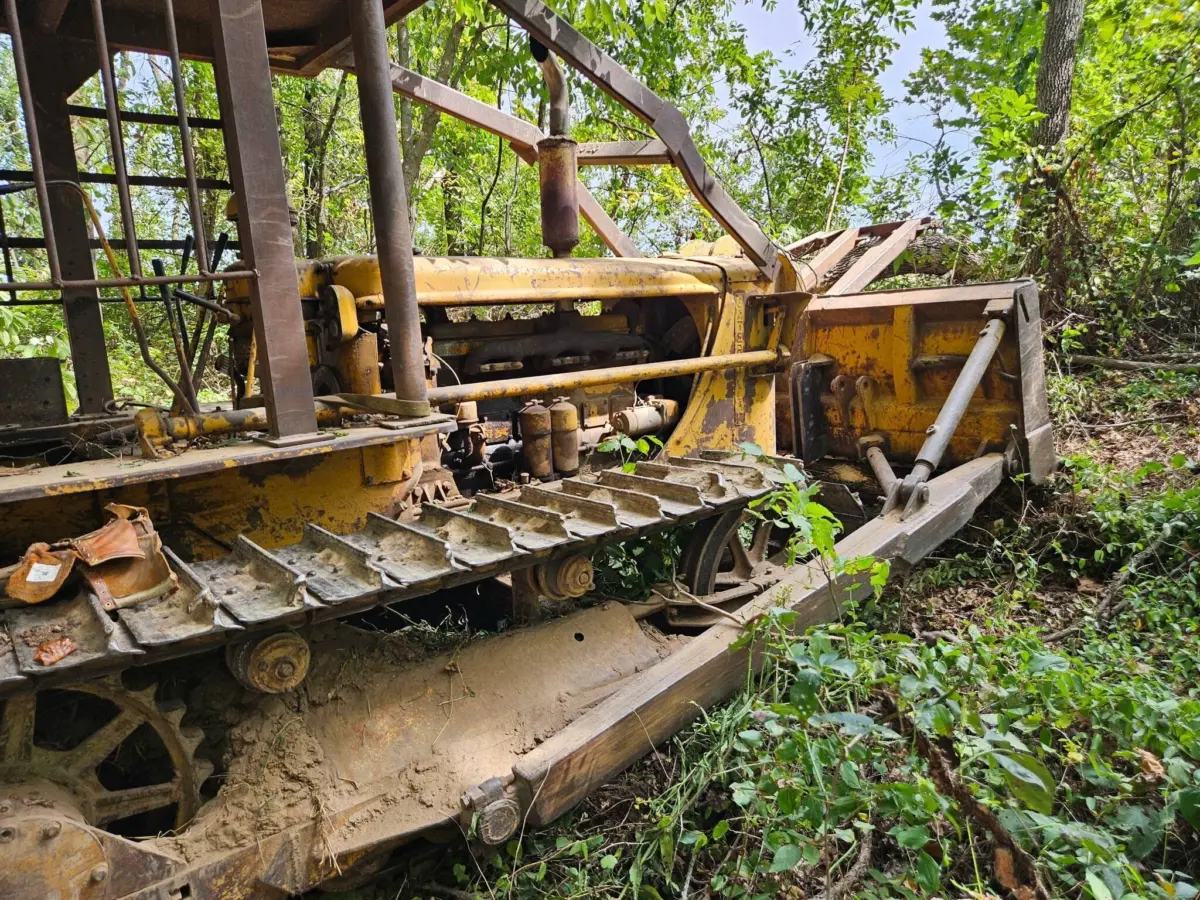

OLYMPIA, Mo. — In the realm of industrial and agricultural labor, heavy machinery accidents are frequently catastrophic. The immense weight, dense steel, and raw power of earthmoving equipment leave little margin for human error or mechanical failure. Yet, on a quiet Thursday afternoon in late August, an incident unfolded in rural Cedar County, Missouri, that defies standard statistical expectations. A 76-year-old local resident survived being partially crushed by a multi-ton bulldozer in a sequence of events so bizarre and statistically improbable that local rescue personnel have described it as nothing short of a miracle.
The accident, which occurred on August 29, underscores the delicate balance between occupational safety, catastrophic mechanical failure, and the bizarre physics of sheer luck. While operating a heavy-tracked vehicle on an elevated embankment, the operator experienced a cascading series of equipment failures that ejected him directly into the path of the reversing machine. Remarkably, due to an extraordinary configuration of displaced debris, the machine halted its descent mere inches from claiming his life. The victim walked away from the hospital the very same day, leaving emergency responders and safety experts marveling at the fortune that intervened in his favor.
Executive Overview
The incident took place shortly after noon on August 29 in the unincorporated community of Olympia, situated within Cedar County, Missouri. According to incident reports filed by the Olympia Rural Fire Department and regional emergency services, a 76-year-old man was performing routine property maintenance or earthmoving operations utilizing a heavy crawler bulldozer.
While navigating an incline—a maneuver known to significantly alter the center of gravity of tracked heavy machinery—the operator experienced a catastrophic structural failure inside the cab. The driver’s seat dislodged entirely from its mounting assembly, precipitating a chain reaction that knocked the vehicle’s fuel cell loose and violently ejected the operator onto the ground directly behind the descending treads of the machine.
Unmanned and shifting under the influence of gravity, the multi-ton bulldozer began rolling backward down the embankment. The left track passed directly over both of the victim’s legs, inflicting significant trauma, including a fractured ankle and a severe crush injury to the foot.
However, a freak alignment of the dislodged fuel cell intervened. The heavy container wedged itself directly beneath the path of the right track, acting as an improvised chock block that arrested the machine’s momentum before it could inflict fatal torso or head injuries. A coordinated multi-agency rescue effort successfully stabilized the hazardous environment, extricated the victim from beneath the heavy tracks, and transported him to a regional medical facility. In a testament to either exceptional resilience or unimaginable fortune, medical staff treated his injuries and discharged him later that same evening.
Detailed Chronology: The Anatomy of a Freak Accident
To understand how a routine afternoon operation transformed into a life-or-threatening scenario, investigators must reconstruct the events of August 29 minute by minute. Heavy machinery operations demand absolute structural integrity; when foundational components begin to fail simultaneously, the consequences escalate exponentially within seconds.
The Ascent: Pre-Incident Conditions
At approximately 12:00 PM on August 29, the 76-year-old operator was navigating his property in Olympia, Missouri. Operating a bulldozer requires continuous micro-adjustments to the steering clutches, brakes, and throttle, especially when ascending or descending uneven terrain. The operator was attempting to drive the heavy tracked vehicle up an earthen embankment—a common task in land clearing, agricultural terracing, and general construction.
As the bulldozer climbed the incline, the angle of the slope placed immense gravitational stress on the chassis, the undercarriage, and the internal components of the operator’s compartment. It was at this precise mechanical tipping point that the first failure occurred.
The Primary Failure: Seat Mount Dislodgement
Under the combined forces of the incline and the vibrations inherent to heavy diesel engines, the operator’s seat violently detached from its structural floor mountings. In heavy equipment, the operator’s seat is not merely a place of comfort; it is a critical restraint and positioning anchor. When the seat broke free, the operator lost his primary point of stability.
Lacking structural support to keep him braced against the operational controls, the operator was thrown forward and off-balance. In his attempt to steady himself, his momentum carried him against the vehicle’s internal infrastructure.
The Secondary Failure: The Fuel Cell Dislodgement
The kinetic energy of the dislodged seat, compounded by the operator’s sudden shift in weight, struck the bulldozer’s fuel cell. This secondary impact proved critical: the fuel cell—a heavy, fluid-filled structural component typically bolted securely to the chassis or engine compartment bulkhead—sheared free from its mountings.
With both the seat and the fuel cell dislodged, the containment integrity of the cab was compromised. The operator, now completely unseated and destabilized, slipped through the open operator’s station and fell backward out of the machine, landing directly on the ground behind the moving tracks of the bulldozer.
The Rollback and the Impact
Left without an operator and resting on an upward incline, the bulldozer immediately shifted into reverse. Earthmoving tracked vehicles lack the dynamic parking brakes common in passenger automobiles; once disengaged from forward gear or hydraulic lock on a slope, they are susceptible to free-rolling under the pull of gravity.
The multi-ton machine rolled backward down the embankment. As it moved, its left steel track passed directly over the victim’s lower extremities, crushing his foot and fracturing his ankle. At this juncture, the accident possessed all the hallmarks of a fatal crushing incident. The weight of a standard utility bulldozer ranges anywhere from 15,000 to over 40,000 pounds, meaning even a fraction of that weight passing over human bone and tissue carries devastating potential.
The Intervention of the Fuel Cell
What prevented this incident from turning into a tragedy lies in the realm of statistical anomalies. As the bulldozer rolled backward, the dislodged fuel cell—which had also fallen from the machine during the initial chaos—happened to tumble into the path of the right track.
According to officials with the Olympia Rural Fire Department, the fuel cell lodged firmly beneath the right track assembly. Because the cell was structurally rigid and positioned directly in the path of the moving steel grousers, it acted as an improvised wedge. The resistance provided by the fuel cell was just sufficient to absorb the remaining momentum and halt the dozer from traveling any further backward, stopping the machinery inches away from pressing its full weight over the victim’s upper body.
Supporting Context & Metrics: The Physics and Statistics of Heavy Equipment Hazards
The incident in Cedar County highlights the inherent dangers associated with heavy machinery operation, particularly among aging populations and in rural settings where equipment maintenance may span decades. To contextualize the severity of the accident, it is vital to examine the mechanics of bulldozers, the ergonomics of heavy equipment safety, and the broader statistics governing agricultural and industrial machinery mishaps in the United States.
The Mechanics of Crawler Tractors
Bulldozers, or crawler tractors, are engineering marvels designed to move massive quantities of earth through the application of low-speed, high-torque tractive effort. Key mechanical components include:
- The Undercarriage: Comprising tracks, rollers, idlers, and sprockets, the undercarriage distributes the immense weight of the machine across a broad surface area to minimize ground pressure. However, this heavy steel track system also presents severe crush hazards.
- The Operator’s Station (ROPS/FOPS): Modern machinery is equipped with Rollover Protective Structures (ROPS) and Falling Object Protective Structures (FOPS) designed to protect operators during catastrophic structural failures. However, older or vintage equipment may lack modern ergonomic and restraint integrations, leaving components vulnerable to structural fatigue.
- Weight Distribution: A mid-sized utility bulldozer typically weighs between 16,000 and 25,000 pounds. When a machine of this magnitude rolls unassisted down an incline, the kinetic energy involved is staggering.
Agricultural and Industrial Machinery Statistics
According to data compiled by the Occupational Safety and Health Administration (OSHA) and the National Institute for Occupational Safety and Health (NIOSH), heavy machinery accidents remain a leading cause of severe injury and mortality in agricultural and construction sectors.
- Age Demographics: Statistics consistently show that older operators—particularly those aged 65 and older—face unique occupational risks. While experience often mitigates risk, factors such as reduced reaction times, decreased bone density, and physical vulnerability can turn mechanical failures into severe trauma events.
- Rollover Incidents: Tractor and heavy equipment rollovers account for a significant percentage of fatalities in rural industries. While most fatal rollovers involve side-slips or steep grade turnovers where the entire machine flips, stationary rollbacks on embankments represent a distinct hazard category.
- Component Failure: Equipment aging plays a critical role in structural failures. Rust, metal fatigue, vibration-induced bolt loosening, and compromised welds on seating platforms or fuel systems can create silent hazards that go unnoticed until physical stress tests them to the limit.
| Factor | Description | Risk Mitigation Strategy |
|---|---|---|
| Embankment Navigation | Operating on slopes increases the risk of loss of control or rollback. | Approach slopes perpendicularly; ensure functional parking brakes and hydraulic locks. |
| Equipment Aging | Vibration and wear cause structural mounts for seats and fuel cells to fail. | Conduct rigorous pre-operational inspections of internal cab components and frame welds. |
| Operator Restraints | Absence of secure seating or seatbelts leads to ejection hazards. | Install and utilize heavy-duty four-point harnesses and certified ROPS-compliant seats. |
Official Statements and Rescue Operations
The successful rescue of the 76-year-old victim was the result of a swift, multi-agency response involving specialized local emergency services trained in heavy extrication.
The Olympia Rural Fire Department Response
Emergency responders from the Olympia Rural Fire Department arrived at the scene shortly after the distress call was logged. First responders found a chaotic and potentially lethal scene: an unmanned bulldozer resting precariously on an embankment, its tracks settled heavily over the legs of an elderly man, with a dislodged fuel cell miraculously wedged beneath the right track preventing further movement.
An official spokesperson for the Olympia Rural Fire Department detailed the delicate nature of the stabilization process:
"When units arrived on scene, the immediate priority was machine stabilization. You cannot simply pull a patient out from under a tracked vehicle without first ensuring the dead weight of the machinery is completely immobilized. Any secondary shift could have catastrophic consequences for the patient’s remaining limbs or torso."
The official further highlighted the incredible stroke of fortune regarding the fuel cell’s final resting place:
"Fortunately, the fuel cell was behind the other track and was just enough to stop the dozer from coming back any farther. Without that specific piece of debris lodging right where it did, the machine likely would have continued its descent over his entire body."
Collaborative Multi-Agency Effort
Due to the technical complexities of heavy machinery extrication—which requires specialized cribbing, hydraulic lifting bags, and stabilization struts—mutual aid protocols were activated. Firefighters and emergency medical technicians from neighboring rural districts responded to assist.
Rescue personnel utilized specialized heavy-rescue equipment to crib and shore the bulldozer, locking the tracks in place mechanically before carefully lifting the weight off the victim’s lower extremities.
Medical Outcome and Discharge
Once extricated, the patient was assessed by paramedics and transported to a regional trauma center. Initial diagnostic evaluations revealed that despite the terrifying nature of the accident, the patient had sustained a fractured ankle and a severe crush injury to his foot, but had miraculously avoided internal organ damage, spinal trauma, or life-threatening arterial bleeding.
In a display of astounding resilience, medical professionals cleared the 76-year-old man for discharge later that same evening. He returned home to recover surrounded by family, leaving local emergency responders and medical staff shaking their heads at the sheer improbability of his survival.
Future Outlook: Safety Recommendations and Lessons Learned
While the Cedar County incident ended with a remarkable recovery rather than a fatality, it serves as a powerful cautionary tale for property owners, farmers, and construction operators who utilize heavy machinery. As rural communities process the news of this "freak accident," local safety advocates and emergency personnel are emphasizing the importance of rigorous equipment maintenance and situational awareness.
Key Takeaways for Heavy Equipment Safety
-
Comprehensive Pre-Operational Inspections:
Operators must look beyond fluid levels and track tension during routine walk-arounds. Internal structural elements—including seat brackets, ROPS bolts, cab flooring integrity, and fuel cell mounting straps—must be inspected regularly for signs of metal fatigue, rust-through, and stress fractures. -
The Danger of Embankments:
Operating heavy machinery on inclines requires extreme caution. Operators should be acutely aware of how shifting weight alters the center of gravity. Whenever possible, grading and earthmoving on slopes should be approached with engineered precision rather than ad-hoc maneuvering. -
The Critical Role of Restraints:
The primary catalyst for this accident was the failure of the seat mount. Had the seat remained secured—or had the operator been wearing a certified seatbelt or harness—he would not have been ejected into the path of the machine. Upgrading aging equipment with modern restraint systems is a vital investment in operator safety. -
Mutual Aid Preparedness in Rural Areas:
The successful outcome in Cedar County demonstrates the vital importance of well-equipped rural fire departments and rapid multi-agency coordination. Continued investment in specialized heavy-rescue training and equipment for volunteer and rural departments remains essential for saving lives in agricultural communities.
Conclusion
Accidents involving heavy machinery rarely offer a second chance. The laws of physics dictate that soft human tissue cannot withstand the crushing force of steel tracks and multi-ton earthmovers. Yet, the events of August 29 in Olympia, Missouri, remind us that rare intersections of mechanical malfunction and accidental debris placement can occasionally tilt the scales toward survival.
As the 76-year-old resident continues his recovery at home from a fractured ankle and crush injuries, his story will undoubtedly be retold across Cedar County—not just as a cautionary tale of equipment failure, but as a staggering testament to a very fortunate turn of events.

0 Comments