

Executive Overview
The global agricultural supply chain—a marvel of modern engineering, logistics, and bulk commodity management—did not materialize overnight. For centuries, the journey of grain from the sprawling furrows of the farm to distant domestic markets and international ports was crippled by the physical limitations of manual labor. Burlap sacks, human muscle, wooden shovels, and cumbersome block-and-tackle systems dictated the pace of commerce. This bottleneck choked the economic potential of the American interior just as the nation’s agricultural output was beginning to surge.
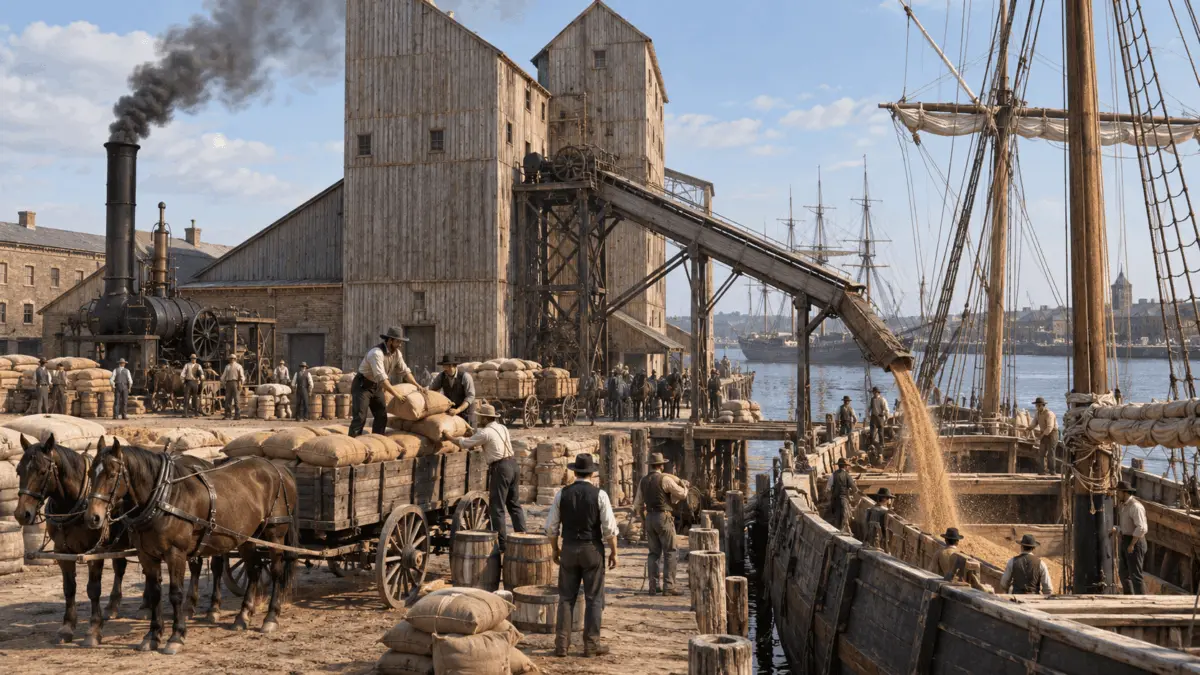
Everything changed in the early 1840s along the waterfront of Buffalo, New York. Situated at the critical geographic crossroads where the freshwater highway of the Great Lakes met the eastern terminus leading to the Erie Canal and New York Harbor, Buffalo was primed to become the epicenter of agricultural transit. It was here that merchant and visionary engineer Joseph Dart, alongside Scottish engineer Robert Dunbar, invented and deployed the world’s first steam-powered grain elevator.
By marrying high-pressure steam power with an ingenious continuous-belt bucket elevator system, Dart transformed a sluggish, multi-day manual chore into an automated powerhouse. The new technology could transfer grain from hulking lake vessels to storage bins and waiting canal boats roughly seven times faster than human workforces. This quantum leap in efficiency slashed port turnaround times, lowered freight costs, and fundamentally redefined how bulk commodities were stored, graded, and traded.
Though Buffalo’s absolute monopoly on the grain trade would eventually face fierce competition from expanding rail networks and southern corridors like the Mississippi River system leading to New Orleans, Dart’s invention permanently altered the global agricultural landscape. Today, the foundational principles of bulk vertical storage and mechanical transfer remain the beating heart of the worldwide food supply chain. This is the definitive account of how Joseph Dart, Buffalo, and the birth of the grain elevator laid the mechanical bedrock for modern agrarian capitalism.
Detailed Chronology: The Evolution of Grain Handling
To understand the magnitude of Joseph Dart’s breakthrough, one must trace the timeline of American agricultural expansion and the desperate logistics crisis that preceded the 1840s.
Pre-1840s: The Era of the Manual Bottleneck
- The Sacking System: Prior to the mid-19th century, grain was rarely transported loose. Farmers, millers, and merchants packed wheat, corn, and oats into individual canvas or burlap sacks, typically weighing around two to three bushels each.
- The Human Engine: Unloading a typical mid-sized grain schooner required a small army of laborers. Workers descended into the dark, stifling holds of the ships, filled sacks manually using hand shovels, hoisted them using rudimentary block-and-tackle setups powered by horses or human muscle, and carried them ashore to damp, vulnerable warehouses.
- Economic Toll: This process was not only excruciatingly slow—taking days or even weeks to unload a single cargo hold—but it resulted in massive financial losses. Sacks tore, grain spoiled from moisture, rodents feasted on the exposed piles, and labor costs ate deeply into merchant profit margins. As the fertile lands of Ohio, Michigan, Illinois, and Wisconsin began producing bumper crops, the transportation infrastructure of the Eastern seaboard faced an impending catastrophic logjam.
The 1842 Turning Point: Joseph Dart’s Gamble
- The Partnership: Recognizing the desperate need for mechanization, Joseph Dart teamed up with Robert Dunbar, a talented engineer who understood the mechanics of mills and industrial power transmission.
- The First Elevator: In 1842, along the Buffalo River, Dart constructed a multi-story wooden warehouse equipped with a revolutionary apparatus. Drawing inspiration from the continuous bucket-conveyor systems used in flour mills (pioneered decades earlier by Oliver Evans), Dart and Dunbar scaled the concept up for marine bulk transfers.
- Steam Power Integration: Dart’s elevator utilized a stationary steam engine to drive a leather or canvas belt studded with metal cups (buckets). This "leg" could be lowered directly into the hold of a grain ship. As the belt raced upward, the buckets scooped up loose grain, carried it to the top of the tower, and tipped it onto a series of horizontal conveyor belts or chutes that directed the harvest into towering vertical storage bins.
Rapid Industrial Scaling (Late 1840s – 1850s)
- Proof of Concept: The initial 1842 elevator proved instantly profitable. Shippers realized that vessels could be unloaded in hours instead of days.
- Proliferation Along the Buffalo Waterfront: Emboldened by Dart’s success, entrepreneurs across Buffalo raced to build their own elevators. By the 1850s, Buffalo’s skyline was being redefined by colossal timber and stone towers. These structures could hold hundreds of thousands—and eventually millions—of bushels of grain, effectively turning Buffalo into the world’s premier inland grain port.
- The Birth of Commercial Grading: Because grain was now dumped into massive shared bins rather than kept in segregated bags, the industry had to invent standardized grain inspection and grading systems. This standardization made commodities fungible, paving the way for the creation of modern futures exchanges, such as the Chicago Board of Trade (founded in 1848).
Supporting Context & Metrics: The Mathematics of Mechanical Revolution
The impact of Joseph Dart’s invention can be measured not just in historical narrative, but in hard, transformative metrics that altered the economics of nineteenth-century trade.
The Speed Multiplier
According to historical agricultural archives, traditional manual labor methods allowed a crew of workers to move roughly 1,000 to 2,000 bushels of grain per day, depending on crew size and weather conditions. Joseph Dart’s steam-powered elevator shattered these limits immediately, surging transfer speeds to approximately seven times faster than human labor alone. Within a decade of iterative engineering improvements, subsequent elevators in Buffalo were capable of unloading up to 10,000 to 20,000 bushels per hour.
Geographic and Economic Synergy
Buffalo’s unique geography made it the ideal incubator for this technology:
- The Great Lakes Highway: Fleets of schooners and early steamships hauled immense volumes of cheap bulk grain from western breadbaskets (such as Chicago, Milwaukee, and Toledo) eastward.
- The Erie Canal Link: Upon reaching Buffalo, the grain was transferred via Dart’s elevators directly into canal boats bound for New York City, Albany, and transatlantic export markets.
- Cost Compression: By driving down handling costs and port turnaround times, the grain elevator drastically lowered the per-bushel cost of food delivery. This fueled urbanization in the Northeast, as cheap bread fed the rapidly expanding manufacturing centers of the Industrial Revolution.
Technological Anatomy of the Early Elevator
A standard mid-19th-century grain elevator comprised three primary functional zones:
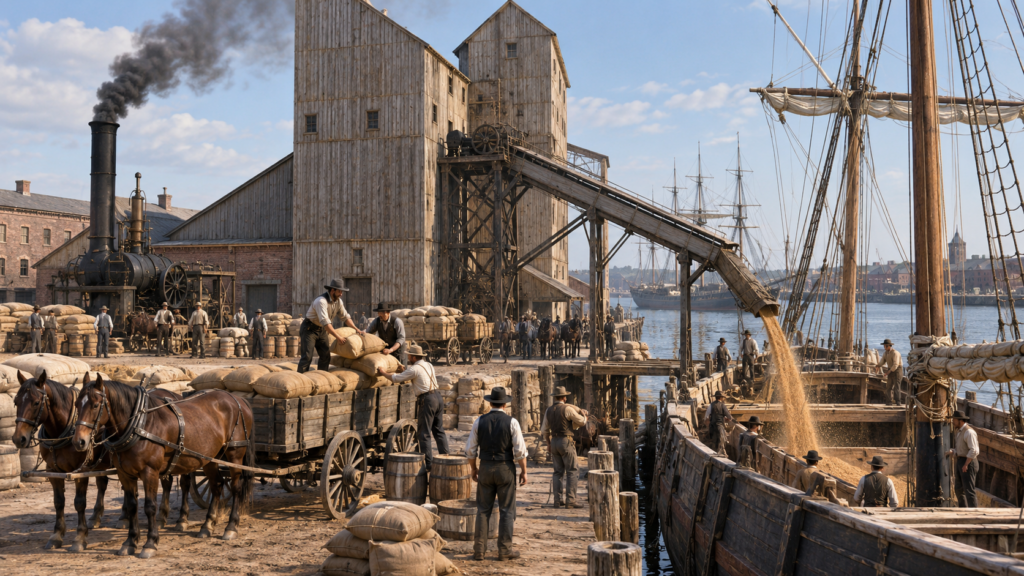
- The Marine Tower: The section that extended out over the water, housing the vertically adjustable marine "leg" and the bucket belt system that dipped into ship holds.
- The Bin House: A vast honeycombed interior made of heavy timber cribbing (later replaced by reinforced concrete and steel), designed to withstand the immense lateral pressure exerted by millions of pounds of loose grain.
- The Weighing and Shipping Floor: A system of hoppers and scales located at the base or upper levels that accurately measured grain volume before gravity-feeding it into waiting railcars or canal barges.
Shifting Tides: Competition from Mississippi River Ports
While Buffalo held an undisputed monopoly on eastern grain routes for decades, the geography of American commerce is dynamic and unforgiving. As the United States expanded westward and infrastructure matured, Buffalo’s golden age faced formidable challengers.
The Rise of the Southern Corridor
By the late 19th and early 20th centuries, the development of robust railway networks and the deepening of the Mississippi River channel empowered southern shipping ports—most notably New Orleans, Louisiana.
- The Downriver Route: Instead of shipping grain north and east through the Great Lakes and the Erie Canal, agricultural producers in the Midwest increasingly found it economical to load grain onto barges drifting southward down the Mississippi River.
- Global Access: New Orleans offered direct access to the Gulf of Mexico, opening frictionless maritime shipping lanes to European markets, the Caribbean, and South America without the need for multi-modal transfers in upstate New York.
The Lesson of Infrastructure Adaptability
The fierce competition between the Great Lakes-Erie Canal corridor and the Mississippi River system underscored a fundamental reality of agricultural economics: A region’s agricultural prosperity relies just as much on logistics, transportation efficiency, and infrastructure innovation as it does on fertile soil and high crop yields.
When transportation bottlenecks occurred, capital and commerce shifted rapidly to competing corridors. This competitive pressure forced northern ports to continuously upgrade their elevator technologies, adopt rail-car dumping systems, and increase storage capacities to remain viable.
Future Outlook: The Enduring Legacy of the Grain Elevator
Today, when one gazes across the rural and industrial landscapes of the American Midwest, the towering silhouettes of modern grain elevators remain ubiquitous landmarks. Though constructed of slip-form concrete and alloy steel rather than the heavy timber cribbing of Joseph Dart’s era, their operational DNA remains entirely unchanged.
Modern Technological Integration
Modern grain elevators are high-tech nerve centers equipped with:
- Automated Samplers and Near-Infrared (NIR) Spectrometers: Instantly assessing protein, moisture, and oil content upon delivery.
- High-Speed Pneumatic and Mechanical Legs: Capable of moving tens of thousands of bushels per hour with minimal grain damage.
- Digital Inventory and Climate Control Systems: Monitoring internal bin temperatures, humidity, and pest activity via IoT (Internet of Things) sensors to prevent spoilage and dust explosions.
The Nexus of Agriculture, Technology, and Global Trade
As global populations surge and climate volatility tests the resilience of international food supply chains, the fundamental challenge of agriculture remains what it was in 1842: How to move massive volumes of harvested commodities safely, rapidly, and economically from the farm gate to the consumer plate.
Joseph Dart’s ingenious marriage of the steam engine and the bucket conveyor did more than solve a local labor shortage in Buffalo, New York. It birthed the modern bulk-handling economy, establishing a structural blueprint that enabled the scaling of global food security. As engineers continue to refine supply chain logistics through artificial intelligence, automated rail loops, and precision port management, they walk a path first paved by a 19th-century merchant who looked at a pile of wheat, listened to the rhythmic chugging of a steam engine, and envisioned a faster way to feed the world.

0 Comments