

Executive Overview
The landscape of American agriculture is a tapestry woven from perseverance, cross-continental migration, experimentation, and critical industrial breakthroughs. While names like Eli Whitney and Cyrus McCormick are permanently etched into the public consciousness for their mechanical inventions, the agricultural bedrock of the American South owes an equally profound debt to figures who unlocked processing and agronomic chemistry. Among these visionary pioneers is Étienne de Boré, a French-born planter whose pioneering work in the late 18th century birthed Louisiana’s commercial granulated sugar industry.
Born in 1741 along the banks of the Mississippi River, de Boré’s life bridged the colonial struggles of New France, Spanish Louisiana, and the early geopolitical shifts of the fledgling United States. Though sugarcane had been planted intermittently in the fertile soils of the Gulf Coast for decades, local attempts to crystallize the sweet juice into a stable, marketable commodity had repeatedly failed. Sugarcane juice proved notoriously difficult to boil, clarify, and granulate under the humid and unpredictable conditions of the lower Mississippi delta.
Through meticulous trial, error, and an unwillingness to accept localized agricultural limitations, de Boré mastered the granulation process on his plantation just above New Orleans in 1795. His success was nothing short of an economic earthquake. It transformed sugarcane from a struggling, localized garden crop into a commercial juggernaut, established a plantation-based commodity economy that defined the region for generations, and integrated Louisiana permanently into the global trade of sweet commodities. This comprehensive retrospective examines the life, innovations, and lasting legacy of Étienne de Boré, exploring how a single processing breakthrough reshaped a state’s economic identity and left an indelible mark on American agricultural history.
Detailed Chronology: From the Illinois Frontier to the New Orleans Delta
To understand the magnitude of Étienne de Boré’s achievement, one must trace a life that spanned some of the most turbulent decades of North American history.
Early Life and Origins (1741–1770s)
Jean-Étienne de Boré was born in 1741 in a small French settlement along the upper Mississippi River in the Illinois Country. At the time of his birth, the region was governed by New France, serving as an expansive agricultural and trading corridor connecting Canada to the Gulf of Mexico. De Boré hailed from a family of noble French extraction with deep military and administrative ties.
As a young man, de Boré was sent back to France to complete his education and pursue a military career. He served as an officer in the prestigious Maison du Roi (the French King’s Household cavalry), where he developed the discipline, worldly perspective, and scientific curiosity that would later inform his agricultural pursuits. However, changing geopolitical winds and personal opportunities soon drew his gaze back across the Atlantic.
Following the Treaty of Paris in 1763, the vast territory of Louisiana had been transferred to Spain, though French culture, language, and social networks remained deeply entrenched in New Orleans and the surrounding parishes. In the late 1770s, de Boré returned to North America, settling permanently in Louisiana. He married Marie-Françoise Destrehan, the daughter of a prominent colonial treasurer and planter, thereby acquiring substantial landholdings and firmly embedding himself in the upper echelon of Louisiana society.
The Wilderness Years of Experimentation (1780s–1794)
Initially, de Boré focused his considerable energies on indigo cultivation—at the time, one of the primary cash crops of the Louisiana colony. However, the indigo industry faced severe ecological and economic threats. Successive insect infestations, combined with rising competition from indigo producers in other global markets, sent the local industry into a steep and irreversible decline.
By the early 1790s, de Boré faced mounting financial pressures. Like many of his contemporary planters, he realized that if his estate was to survive, he needed to pivot to a new agricultural enterprise. His attention naturally drifted toward sugarcane.
Sugarcane had been introduced to Louisiana as early as 1751 by Jesuit priests, and subsequent waves of Acadian refugees and Spanish colonists had attempted to grow it. Yet, these efforts were plagued by frustration. Planters could successfully cultivate the tall, green stalks and extract the sweet, raw juice, but every attempt to boil the syrup down into dry, marketable granulated sugar resulted in sticky, unmanageable molasses. Frustrated by these repeated failures, many agricultural experts in New Orleans concluded that Louisiana’s climate, soil chemistry, and humidity were fundamentally unsuited for sugar production, resigning themselves to using sugarcane merely for making syrup and tafia (a crude rum).
De Boré, undeterred by conventional wisdom, refused to accept that sugarcane was a dead end. Recognizing that the secret lay in processing rather than cultivation alone, he began scouring the Caribbean and Latin America for techniques, purchasing sugarcane varieties (specifically the "Creole" cane) and hiring experienced sugar-makers—including a refugee from the burgeoning Haitian Revolution named Saint-Jean—who understood the intricate chemistry of the boiling house.
The Breakthrough Harvest of 1795
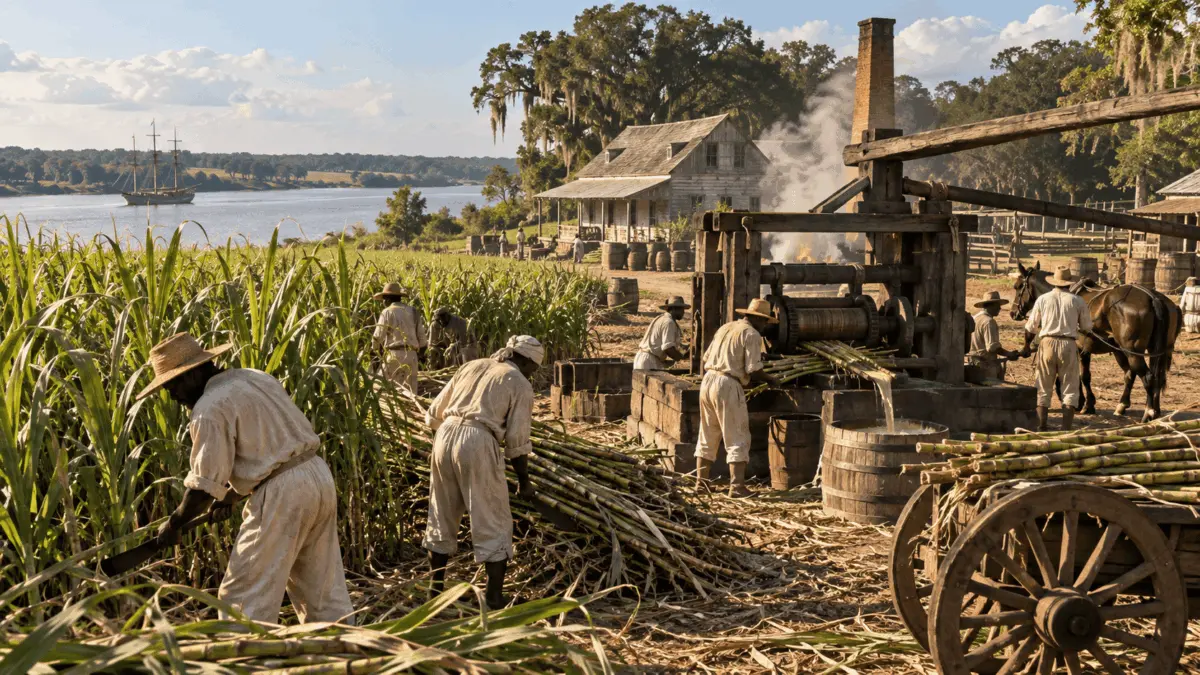
The defining moment of de Boré’s life, and a watershed moment for American agriculture, occurred in the autumn and winter of 1795. Having dedicated a significant portion of his plantation (located just a few miles upstream from New Orleans, on property that is today part of Audubon Park) to sugarcane, de Boré invested heavily in building a brick sugarhouse, installing specialized copper kettles, and constructing a robust processing mill powered by draft animals.
As the harvest season peaked, tension gripped the local agricultural community. Observers and skeptical neighbors gathered at de Boré’s estate, anticipating yet another expensive failure. As the raw juice was extracted and pumped into the massive boiling kettles, de Boré closely monitored the temperature, skimming impurities from the surface with meticulous precision.
When the boiling syrup reached the critical "strike point," de Boré introduced cooling agents and watched anxiously as the heavy mass was transferred to curing coolers. To the astonishment of all present, the viscous syrup began to crystallize. The result was pure, sparkling, granulated sugar.
According to historical accounts, when the successful batch was completed, de Boré turned to the stunned crowd of onlookers and proclaimed: "It makes granulated sugar! The crop is made!"
The financial return was astronomical for the era. De Boré sold his inaugural 1795 sugar crop in New Orleans for more than $12,000—a small fortune at the time—proving once and for all that Louisiana was capable of producing commercial sugar on a profitable scale.
Supporting Context & Metrics: The Economic Revolution of Louisiana Sugar
To fully grasp the weight of Étienne de Boré’s 1795 breakthrough, one must analyze the macroeconomic landscape of the late 18th and early 19th centuries. Sugar was one of the most fiercely contested and lucrative commodities in the global mercantilist system, often referred to by historians as "white gold." European powers fought bloody colonial wars largely over the control of Caribbean sugar islands like Saint-Domingue (now Haiti) and Jamaica.
The Catalyst of the Haitian Revolution
De Boré’s timing was not merely a stroke of personal genius; it was a profound alignment with global economic history. Just as de Boré was perfecting his granulation techniques in Louisiana, the Haitian Revolution (1791–1804) was utterly decimating Saint-Domingue, which had previously supplied nearly half of all the sugar consumed in Europe and North America.
With Caribbean sugar production crippled by warfare and the abolition of slavery in French territories, a massive vacuum opened in the international market. The global price of sugar skyrocketed. De Boré’s success meant that Louisiana was uniquely positioned to step into this supply gap.
Exponential Growth of the Louisiana Sugar Economy
The ripple effects of de Boré’s innovation were immediate and measurable across the Gulf Coast:
- Explosion of Plantations: Within a decade of the 1795 harvest, the number of sugar mills along the Mississippi River multiplied exponentially. Planters across St. Bernard, Plaquemines, St. Charles, and Jefferson parishes rapidly converted their indigo and tobacco fields into vast expanses of sugarcane.
- Capital Investment: The high profitability of granulated sugar attracted massive amounts of domestic and foreign capital, leading to the rapid industrialization of sugarhouses. Traditional animal-powered mills were soon supplemented and replaced by heavy steam-powered engines, marking an early industrial revolution in American agriculture.
- Infrastructure and Trade: The burgeoning sugar industry spurred the development of New Orleans as one of the premier commercial hubs and ports in the Western Hemisphere, driving the construction of levees, riverboats, and vast distribution networks that connected southern agriculture to northeastern markets and European consumers.
By the time Louisiana was officially integrated into the United States via the Louisiana Purchase in 1803—an acquisition eagerly championed by Thomas Jefferson, who was well aware of the region’s rising agricultural potential—sugar had become the bedrock of the Louisiana economy. Étienne de Boré was subsequently rewarded for his civic and economic leadership, being appointed the first mayor of New Orleans under American rule in 1803.
Perspectives on Agricultural Innovation
While modern agricultural history rightly acknowledges the complex, deeply intertwined, and often dark socio-economic realities of the antebellum plantation system—which relied entirely on enslaved labor to plant, tend, harvest, and process the grueling sugarcane crops—historians and agricultural scientists continue to study de Boré’s technical mastery as a masterclass in problem-solving.
Agricultural historians emphasize that de Boré’s contribution lay in his ability to synthesize empirical science with local adaptation. In agricultural bulletins and historical retrospectives, experts frequently note that farming progress often stalls when producers attempt to blindly apply foreign techniques to native soils. De Boré’s triumph was his willingness to experiment with chemistry, temperature, and variety until he found the exact formula that respected the unique environmental variables of the Mississippi floodplains.
Furthermore, his success served as a vital psychological turning point. In agriculture, fear of failure often prevents investment in new crops. By proving that economic viability was possible, de Boré broke the psychological barrier of doubt that had paralyzed Louisiana planters for decades. His enterprise demonstrated that American agriculture could successfully diversify into high-value processed commodities, paving the way for the sophisticated agricultural processing industries that characterize modern farming today.
Future Outlook: Preserving Ag-History and Looking Forward
Today, more than two centuries after Étienne de Boré’s historic harvest, the Louisiana sugarcane industry remains a vital pillar of the state’s modern agricultural economy. Generating hundreds of millions of dollars annually, Louisiana produces millions of tons of sugarcane across thousands of acres, supplying raw and refined sugar to domestic and international markets.
Modern Louisiana agriculture has evolved far beyond the copper kettles and animal-powered mills of de Boré’s era. Today’s sugarcane production utilizes advanced GPS-guided machinery, sustainable green-cane harvesting methods that eliminate the need for traditional field burning, precision fertilizer application, and high-tech milling facilities capable of extracting maximum sucrose while generating renewable energy from sugarcane bagasse (the fibrous residue left over after juice extraction).
Yet, the modern industry frequently looks backward to honor its roots. Initiatives like the American Agriculture History Minute—hosted by agricultural broadcaster Mark Oppold—play a crucial role in ensuring that the stories of pioneers like Étienne de Boré are not lost to the sands of time. By educating the public, students, and contemporary farmers about the trials and triumphs of early agricultural innovators, these historical segments bridge the gap between ancient grit and modern agronomic science.
As modern growers face contemporary challenges—ranging from unpredictable weather patterns and climate change to shifting global trade dynamics and supply chain pressures—the legacy of Étienne de Boré offers a timeless reminder: American agriculture is driven forward not merely by the passage of time, but by the relentless curiosity, ingenuity, and resilience of individuals willing to transform raw potential into a lasting harvest.

0 Comments