

Executive Overview
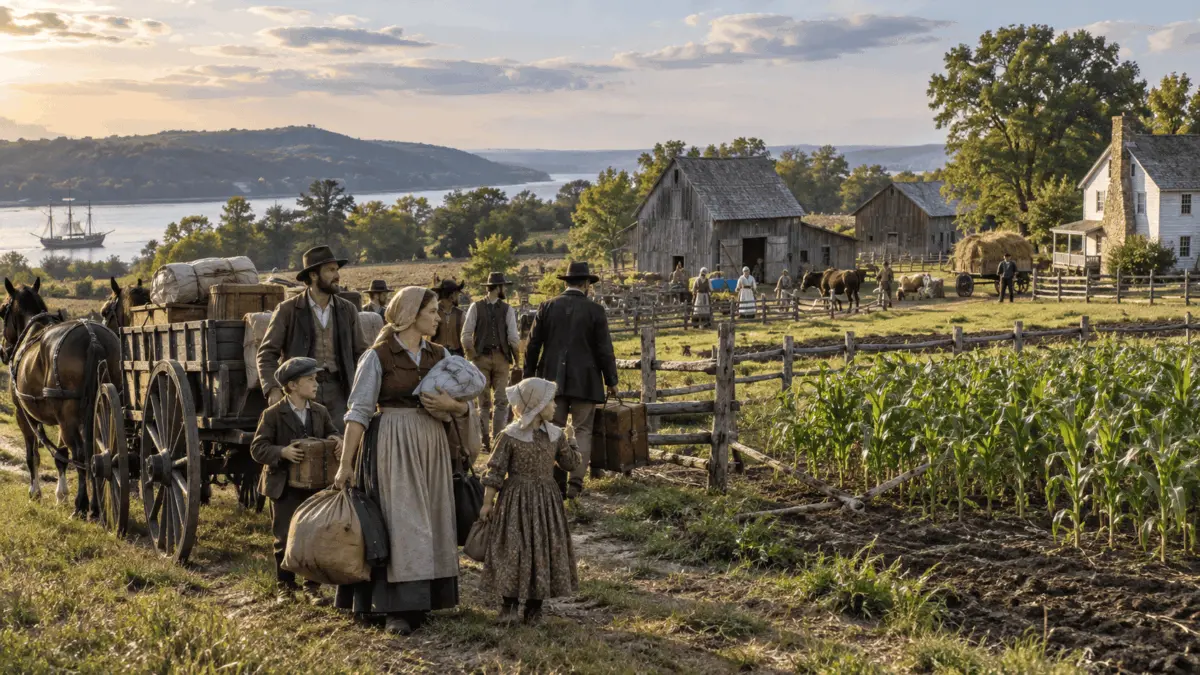
The tapestry of early American agriculture is far more complex than the traditional narrative of isolated pioneers clearing virgin timberlands. At the core of the nation’s agricultural genesis was a dynamic, multicultural mosaic driven heavily by European immigration. From the fertile valleys of Pennsylvania to the bustling merchant hubs of the Northeast, immigrants from Germany, Ireland, Scotland, and beyond imported invaluable agricultural methodologies, specialized trades, and cultural traditions that fundamentally shaped the rural landscape.
However, the journey from a newly arrived European immigrant to an established American landowner was rarely instantaneous or easy. For the vast majority of newcomers, the agrarian economy served first as a vital entry point into the workforce through wage labor. Whether bound by indenture systems, drawn to burgeoning textile mills, or hired out as seasonal farmhands, these immigrants forged a critical bridge between nascent American manufacturing and traditional farming.
This comprehensive report explores the multifaceted contributions of European immigrants to early American agriculture. Drawing on historical insights from the American Agriculture History Minute, hosted by Mark Oppold, we examine how these newcomers transitioned from wage laborers to independent landowners, diversifying the nation’s rural communities and laying the cornerstone for modern agribusiness.
Detailed Chronology: The Waves of Immigrant Agricultural Influence
To fully understand how European immigrants transformed early American agriculture, one must trace the chronological evolution of immigration patterns and the socio-economic mechanisms that integrated newcomers into the agrarian sector.
The Colonial Era and the German Agricultural Vanguard
During the 18th century, the British North American colonies experienced a significant influx of non-English Europeans, most notably German-speaking immigrants who settled predominantly in Pennsylvania, the Hudson Valley, and parts of Maryland and the Carolinas.
While English, Scottish, and Irish farmers often utilized extensive farming techniques that required large tracts of land—sometimes leading to rapid soil exhaustion—German immigrants brought intensive, sustainable farming practices honed in Central Europe. These practices included:
- Advanced Crop Rotation: Utilizing clover and other nitrogen-fixing crops to maintain long-term soil fertility.
- Specialized Livestock Management: Breeding hardier livestock and constructing large, multi-level banked barns that protected animals and stored fodder efficiently.
- Manure Management: Systematic collection and application of animal manure to enrich cropland, a practice less common among early colonial farmers who relied on simply clearing new land once old plots degraded.
These innovations did not merely sustain German farming families; they set a higher standard for productivity and land stewardship that neighbors of other cultural backgrounds quickly observed and adopted.
The Industrial Interconnection: Labor and the Textile Boom
As the United States moved into the late 18th and early 19th centuries, the path of immigration shifted. While many still held aspirations of owning land, economic realities dictated that newly arrived Europeans often entered the workforce as wage laborers. Merchants and agrarian entrepreneurs frequently recruited young workers from Europe, covering the cost of their transatlantic passage in exchange for a period of contracted labor.
Simultaneously, the nascent American textile industry created a symbiotic relationship between urban manufacturing and rural agriculture. Merchants purchased raw materials—such as wool and flax—from American farming families and funneled them into manufacturing centers.
Immigrants arriving from Ireland and Germany who possessed specialized textile manufacturing skills found immediate employment in these mills and workshops. Their European expertise allowed them to hit the ground running, providing them with steady wages while directly supporting the market for agricultural commodities produced by rural farming households.
The Ladder of Mobility: From Wage Earner to Landowner
For many immigrants, wage labor in agriculture, trade, or manufacturing was viewed strictly as a stepping stone. The ultimate objective remained the acquisition of private property.
Through years of disciplined saving, frugality, and relentless physical labor, a significant percentage of immigrant workers managed to accumulate the capital necessary to purchase acreage. As the American frontier expanded westward through the early-to-mid 1800s, these established immigrant families joined the wave of homesteaders, bringing their accumulated agricultural knowledge to the Ohio River Valley, the Great Lakes region, and beyond. This upward economic mobility proved that early American agriculture was not static; it was fueled by a continuous cycle of labor, capital accumulation, and generational land acquisition.
Supporting Context & Metrics: The Economic Engine of Early Farming
The integration of immigrants into the early American agricultural economy cannot be separated from the broader macroeconomic trends of the era. Agriculture was the dominant sector of the United States economy, employing the vast majority of the population and generating the primary export commodities that funded the young nation’s global trade.
Demographic Shifts and Labor Force Participation
During the peak periods of pre-Civil War immigration (particularly following the European potato famines and political upheavals of the 1840s), hundreds of thousands of Irish and German immigrants arrived on American shores annually. While a large portion remained in eastern cities due to immediate financial constraints, a critical percentage trickled into rural counties as farm laborers, canal builders, and clearing crews.
| Immigrant Group | Primary Areas of Settlement | Key Agricultural Contributions | Primary Economic Entry Point |
|---|---|---|---|
| Germans | Pennsylvania, Ohio, Midwest | Crop rotation, banked barns, livestock care | Independent farming / Skilled trades |
| Irish | Northeast, Mid-Atlantic | Infrastructure building, textile labor, seasonal farm work | Wage labor / Urban manufacturing |
| Scots-Irish | Appalachian frontier | Livestock grazing, frontier cultivation, grain production | Subsistence farming / Hunting & trapping |
The Capital Challenge: Overcoming Financial Barriers
The cost of land in the early United States, while relatively low compared to Western Europe, was still prohibitive for penniless immigrants. According to historical economic data from the era, acquiring even a modest plot of uncleared land required capital for:
- Land Purchase: Paying federal or state land office minimums per acre.
- Clearing Costs: Hiring labor or owning tools (axes, crosscut saws) to fell timber—a process that could take years per acre.
- Initial Subsistence: Sustaining a family through the first planting and harvest cycle before turning a profit.
Wage labor bridged this financial gap. By working on established farms, participating in commercial fisheries, or engaging in early industrial manufacturing, immigrants generated the necessary liquidity to transition from landless laborers to independent agricultural proprietors.
Perspectives from Historians and Agricultural Experts
The profound impact of European immigration on the architecture of early American farming has long been a subject of study among agricultural historians, economists, and cultural anthropologists.
Mark Oppold, host of the American Agriculture History Minute, emphasizes that the narrative of American farming is fundamentally incomplete without acknowledging the diverse origins of its workforce.
"When we look back at the roots of American agriculture, we often picture a singular archetype of the self-reliant pioneer," Oppold notes. "Yet, the historical record shows that our agricultural success was a collaborative, multi-ethnic achievement. Newcomers from Germany, Ireland, and across Europe brought time-tested traditions, specialized skills, and an incredible work ethic that directly influenced how the land was farmed, valued, and developed."
Furthermore, economic historians point out that the flexibility of the immigrant labor force acted as a shock absorber for the volatile early American market. When crop failures or shifting trade policies disrupted farming communities, immigrant labor provided the adaptable workforce needed to pivot production, expand infrastructure, or scale up manufacturing sectors tied to agrarian supply chains.
Future Outlook: Legacy in Modern American Agriculture
As modern American agriculture navigates contemporary debates surrounding labor, immigration policy, and global food security, looking back at the 18th and 19th centuries offers valuable historical context.
The structural reliance of American agriculture on immigrant labor is not a modern phenomenon; it is a foundational pillar upon which the entire industry was built. The evolution from European indentured servant and wage laborer to independent landowner established a template for economic mobility that defined the American Dream for generations.
Today, the traditions introduced by those early German, Irish, and European immigrants—ranging from sustainable soil management to diversified crop production—remain embedded in modern farming practices. As agricultural technology advances and globalized supply chains evolve, the enduring lesson from early American history remains clear: the strength, resilience, and growth of American agriculture have always been deeply intertwined with the contributions of those who crossed oceans to build a future on the land.
For more stories, historical insights, and deep dives into the people and traditions that built the nation’s farming roots, listeners can explore the full collection of episodes from the American Agriculture History Minute.

0 Comments