

Executive Overview
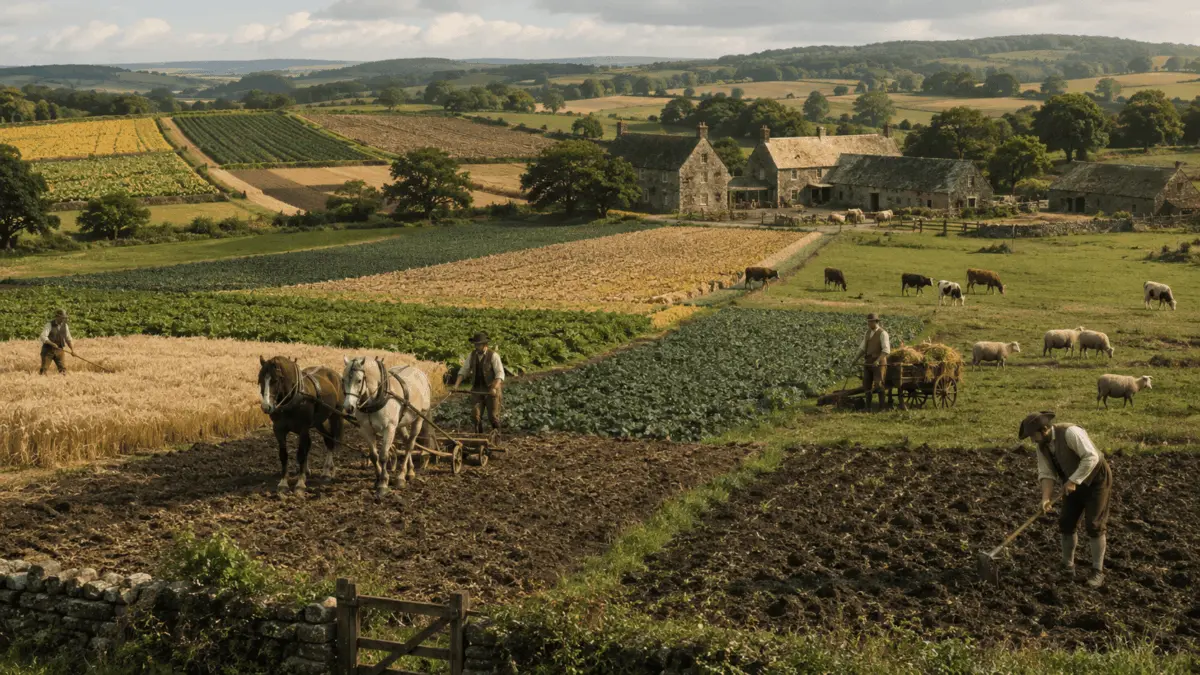
Long before the advent of satellite-guided tractors, precision nitrogen sensors, and gene-edited crops, the trajectory of global food production was fundamentally altered by a quiet, sweeping transformation in 18th-century Britain. Known historically as the British Agricultural Revolution, this era of intensive innovation did not rely on internal combustion engines or synthetic chemistry. Instead, it was forged through an unprecedented convergence of systematic land management, pioneering agronomic theory, and sophisticated animal husbandry.
As highlighted by agricultural historian Mark Oppold in his ongoing American Agriculture History Minute series, humanity had farmed for millennia prior to the 1700s. Cultivating crops and domesticating livestock were ancient arts. However, the 18th century witnessed a rare historical concentration of practical breakthroughs that dismantled traditional, inefficient subsistence farming and replaced it with a high-yield, commercially viable enterprise.
The ripples of this European transformation eventually crossed the Atlantic, laying the groundwork for the modern American agricultural economy. By mastering the science of the soil through structured crop rotation, refining livestock genetics, and transitioning from localized subsistence to interconnected commercial markets, 18th-century innovators established the fundamental principles that still govern farming today. This comprehensive analysis explores how the British Agricultural Revolution reshaped agrarian practices, the mechanics of its primary innovations, and its enduring legacy on contemporary food production systems.
Detailed Chronology: The Evolution of 18th-Century Agribusiness
To understand how modern agriculture came to be, one must look back at a time when European farming was trapped in rigid, unproductive cycles. For centuries, the predominant method of cultivation was the open-field system, which left vast tracts of arable land fallow every few years to recover its nutrients. The 18th-century revolution systematically dismantled these archaic structures, establishing a timeline of rapid, compounding advancements.
Early 1700s: The Dawn of Mechanical and Agronomic Ingenuity
The transformation began in earnest during the early decades of the 18th century, driven by visionary practitioners who questioned conventional wisdom. Jethro Tull’s introduction of the seed drill in 1701 marked a critical turning point. Before this invention, seeds were broadcast by hand—a wasteful method that left them vulnerable to birds, wind, and uneven germination. Tull’s mechanical device dug precise trenches, dropped seeds at optimal depths, and covered them with soil in a single, efficient pass. This not only conserved vital seed stock but also dramatically improved crop emergence and weed control.
Concurrently, innovators like Charles "Turnip" Townshend recognized the severe limitations of the traditional two-field and three-field crop rotation systems, which forced farmers to leave a third of their land idle annually. Townshend championed the Norfolk Four-Course system, a continuous-cropping rotation that eliminated the fallow year entirely while actively rebuilding soil fertility.
Mid-to-Late 1700s: The Rise of Scientific Breeding and Enclosure
As crop yields surged, visionaries like Robert Bakewell turned their attention to the farmyard. Moving away from haphazard breeding practices, Bakewell pioneered systematic animal husbandry in the mid-18th century. By implementing rigorous selection criteria—culling inferior animals and breeding only those with superior traits for meat and wool production—he revolutionized livestock genetics. His work with Leicester sheep and Dishley Longhorn cattle set a new global standard for efficient meat and dairy production.
Simultaneously, the British Parliament enacted the Enclosure Acts, consolidating fragmented strip-farms into larger, fenced private properties. While socially disruptive to rural peasants, this consolidation allowed enterprising landowners to invest capital into long-term infrastructural improvements, drainage systems, and large-scale mechanized experiments that would have been impossible under communal farming systems.
Supporting Context & Metrics: Breaking the Fallow Cycle
The true genius of the British Agricultural Revolution lay in its ability to solve a fundamental biological paradox: how to grow more food without permanently depleting the soil, and how to feed livestock through harsh winters so they could provide manure to fertilize the spring crops.
The Mathematics of the Norfolk Four-Course System
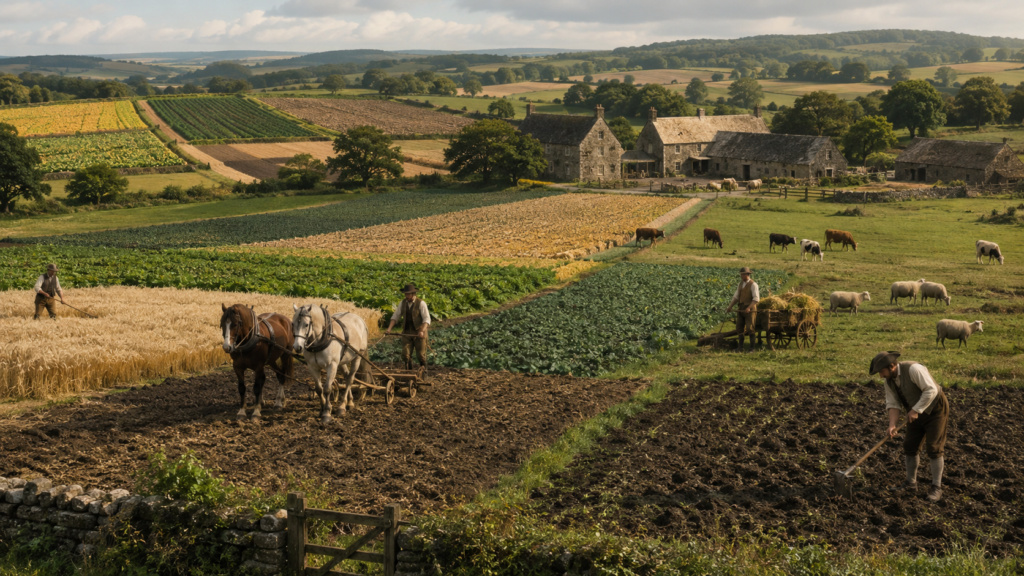
At the heart of the revolution was the Norfolk Four-Course rotation, which structured agricultural land use across a four-year cycle:
- Year One (Wheat): A high-value grain crop that utilized the primary fertility of the soil.
- Year Two (Turnips): A root crop that served a dual purpose. It broke the weed cycle through hoeing and provided essential winter feed for livestock.
- Year Three (Barley): A hardy grain undersown with clover.
- Year Four (Clover and Ryegrass): Leguminous crops that replenished the soil.
Legumes possess the unique biological ability to fix atmospheric nitrogen into the soil through a symbiotic relationship with rhizobia bacteria. By integrating clover and turnips into the rotation, farmers effectively manufactured their own natural fertilizer and eliminated the need for fallow periods.
Exponential Yield and Surplus Metrics
The impact of these combined innovations on productivity was staggering. Historical agricultural data indicates that:
- Grain Yields: Wheat and barley yields per acre roughly doubled between 1700 and 1850.
- Livestock Weights: The average weight of cattle and sheep sold at London’s Smithfield Market more than doubled over the course of the 18th and 19th centuries due to selective breeding and improved winter forage.
- Labor Efficiency: While the proportion of the population engaged in agriculture declined, total food production skyrocketed. Fewer farmers were required to feed a rapidly urbanizing industrial workforce.
This surplus production fundamentally altered rural economies. Farming shifted from a localized, hand-to-mouth existence to a commercial enterprise. Surpluses generated on the farm required transport, storage, and organized distribution, spurring the growth of regional markets, banking systems, and early agricultural supply chains.
Official & Historical Perspectives
Historians and agricultural educators continue to emphasize the profound continuity between 18th-century British breakthroughs and modern agricultural systems.
Mark Oppold, host of the American Agriculture History Minute, frequently underscores the interconnected nature of these historical developments. In his commentary, Oppold notes:
"Agriculture certainly existed long before the 1700s… However, the 18th century brought a remarkable concentration of agricultural improvements that increased productivity and changed how farming operations were managed. These developments would eventually influence agricultural practices in the United States and contribute to the evolution of farming into a more productive and commercially oriented industry."
Agricultural economists and historians echo this sentiment, pointing out that modern regenerative agriculture—with its emphasis on cover crops, reduced tillage, and integrated livestock—is, in many ways, a sophisticated, science-backed return to the foundational principles discovered during the British Agricultural Revolution.
Dr. Jonathan Hughes, an economic historian specializing in agrarian development, observes:
"The 18th-century shift was not merely technological; it was conceptual. For the first time, farmers began to view the farm as an integrated biological system rather than a collection of isolated fields. Every input—whether a turnip crop, a clover seeding, or a breeding decision—was calculated to optimize the output of the entire enterprise."
Future Outlook: The Enduring Legacy of 18th-Century Innovation
As modern agriculture faces unprecedented 21st-century challenges—including climate change, water scarcity, and the imperative to sustainably feed a projected global population of nearly 10 billion by 2050—the lessons of the British Agricultural Revolution remain startlingly relevant.
Today’s cutting-edge agronomy is essentially a digital evolution of the principles established centuries ago:
- Precision Crop Rotation: Modern data analytics and hyperspectral imaging allow agronomists to design complex, multi-species cover crop rotations tailored to micro-zones within a single field, maximizing nitrogen fixation and soil microbiome health, much like the pioneers of the Norfolk system intended.
- Genetics and Genomics: Where Robert Bakewell relied on phenotypic observation and meticulous record-keeping to improve his livestock, modern breeders utilize genomic selection, marker-assisted breeding, and CRISPR technology to enhance disease resistance, feed conversion efficiency, and heat tolerance in crops and livestock at an accelerated pace.
- Commercial Integration: The shift from localized subsistence to globalized supply chains, sparked by the 18th-century agricultural surplus, has evolved into a hyper-connected global ag-tech ecosystem where blockchain traceability, real-time commodity futures, and international logistics dictate farm management decisions.
The story of modern farming is not defined by a single, miraculous invention, but by a continuous lineage of incremental adaptations, scientific inquiry, and environmental stewardship. By understanding the breakthroughs of the British Agricultural Revolution, contemporary producers and consumers gain a vital perspective on how human ingenuity transformed the dirt beneath our feet into one of the world’s most sophisticated and productive life-support systems. As agriculture marches into the future, the foundational ethos remains unchanged: smarter management, biological harmony, and the relentless pursuit of sustainable abundance.

0 Comments