

Executive Overview
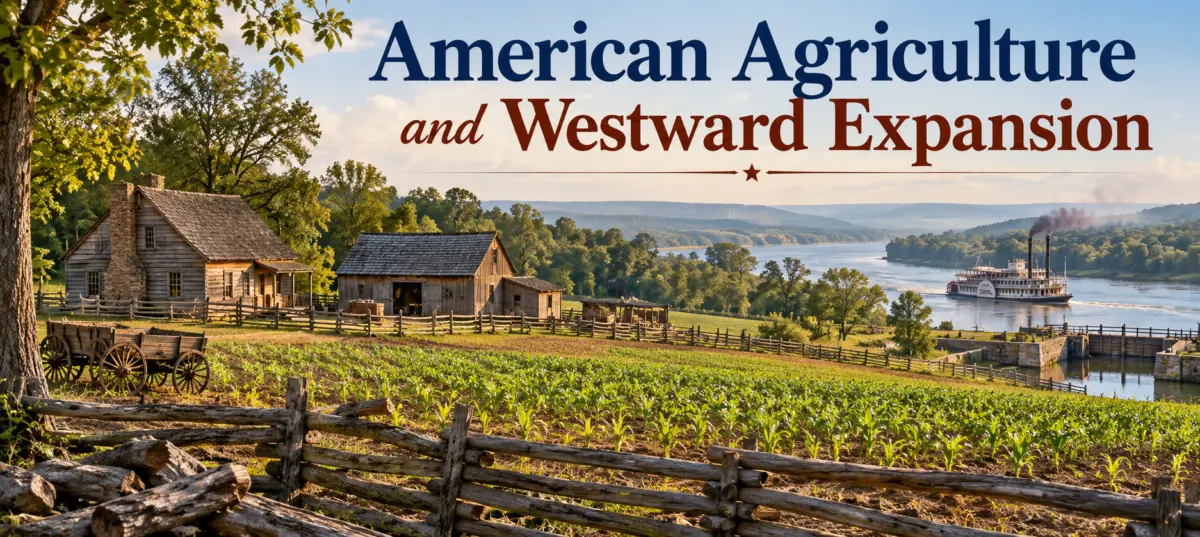
In the opening decades of the 19th century, the United States was a nation defined by the plow. The vast majority of its citizens lived on the land, tied directly to the rhythms of planting, cultivation, and harvest. Yet, this era was far from a static period of quiet agrarianism; it was a crucible of profound economic and geographic transformation. Driven by relentless territorial acquisition, a transportation revolution, and a unique culture of land development, American agriculture shifted from isolated, subsistence-level family farming into a burgeoning, interconnected commercial enterprise.
This historical evolution laid the bedrock for the nation’s modern economic might. The acquisition of sweeping new territories—most notably through the Louisiana Purchase—unlocked millions of acres of fertile soil, fueling a national narrative of manifest destiny and economic opportunity. Simultaneously, groundbreaking innovations in transit, including the proliferation of canals and the dominance of the steamboat, shattered the geographic barriers that had long isolated frontier farmers from major markets.
However, this transition was neither simple nor cheap. While federal land policies made purchasing acreage affordable, the actual labor of transforming dense wilderness or virgin prairie into a productive farmstead demanded immense physical endurance, capital, and resilience. Farmers engaged in a dynamic cycle of land development, often clearing plots, boosting property values, and selling out to push further west. Through an examination of early 19th-century agricultural history, this report explores how land, labor, and logistics converged to build the foundation of America’s agricultural future.
Detailed Chronology: Milestones in 19th-Century Agricultural Evolution
To understand how American farming transformed during the 1800s, it is essential to trace the chronological milestones that steadily integrated isolated homesteads into a national and international commercial network.
The Post-Revolutionary Baseline (1800–1810)
At the dawn of the 19th century, American agriculture was overwhelmingly local. The typical farm family operated on a subsistence or near-subsistence model. Grain was ground at local mills, clothing was spun from home-produced wool or flax, and tools were crafted by regional blacksmiths. Barter systems frequently substituted for hard currency. While coastal cities and European markets demanded American staples like wheat, tobacco, and cotton, the logistical challenges of overland transport meant that only farmers situated near navigable waterways could reliably participate in export trade.
The Louisiana Purchase and Territorial Expansion (1803)
The geopolitical landscape shifted dramatically with the Louisiana Purchase of 1803. President Thomas Jefferson’s acquisition of approximately 828,000 square miles of land from France doubled the size of the United States. This vast territory—stretching from the Mississippi River to the Rocky Mountains—secured control of the vital port of New Orleans and opened up seemingly endless vistas of fertile interior land. It cemented Jefferson’s vision of an "Empire of Liberty" populated by independent, land-owning yeoman farmers.
The Canal Era and the Steamboat Revolution (1810s–1830s)
As settlers pushed westward into the Ohio and Mississippi River Valleys, the lack of efficient overland transportation remained a primary bottleneck. This challenge sparked a massive infrastructure boom:
- 1807: Robert Fulton successfully demonstrates the commercial viability of the steamboat on the Hudson River, forever altering upstream and downstream river navigation.
- 1825: The completion of the Erie Canal connects the Hudson River at Albany to Lake Erie at Buffalo. This engineering marvel slashes shipping costs and transit times between the Great Lakes region and New York City, turning the interior into a direct economic partner with eastern financial hubs.
- 1830s: A rapid expansion of canal networks across Pennsylvania, Ohio, Indiana, and Illinois creates an intricate web of internal waterways that dramatically enhances market access for inland agricultural producers.
The Rise of the Frontier Land Cycle (1830s–1850s)
With shipping lanes established and land offices pushing west, a distinct socio-economic cycle emerged. Farmers capitalized on cheap federal land prices, purchased undeveloped acreage, and invested heavy labor into "improving" the tract. Once a farmstead possessed cleared fields, a dwelling, barns, and fencing, its market value surged. Many settlers chose to sell these developed properties at a substantial profit, packing their belongings to repeat the cycle further west in territories like Iowa, Missouri, and eventually the Great Plains.
Supporting Context & Metrics: The Economics of Early Farming
The transformation of American agriculture cannot be fully grasped without examining the underlying economics of land acquisition, infrastructure efficiency, and labor investment.
The Real Cost of "Cheap" Land
Federal land policies in the early 19th century progressively lowered the financial barrier to entry for prospective farmers. Through legislation like the Land Act of 1820, the minimum tract size and per-acre price were reduced, allowing individuals with modest savings to stake a claim.
However, historians emphasize a critical distinction between purchasing land and establishing a farm. The ledger of early farm-making included staggering non-monetary and capital costs:
- Clearing Timber: In the heavily wooded trans-Appalachian East and Midwest, felling centuries-old trees, pulling stumps, and burning brush required weeks or months of exhausting manual labor per acre.
- Infrastructure Construction: Building habitable log cabins, protective livestock barns, and secure perimeter fencing demanded specialized tools, hardware, and timber resources.
- Initial Crop Yield Lag: Newly cleared forest soils were often acidic, choked with roots, and difficult to plow with early cast-iron implements. It often took several seasons of careful soil management and manuring before yields reached commercial viability.
The Logistics of Markets: Canals and Steamboats
The economic impact of the transportation revolution can be measured in dramatic drops in freight costs. Prior to the canal era, hauling freight overland by wagon was so expensive that it was economically unviable to move bulk agricultural goods like grain or corn more than a few dozen miles.
| Transportation Mode | Average Cost per Ton-Mile (Circa 1800–1830) | Impact on Agriculture |
|---|---|---|
| Wagon (Overland) | High (approx. 15 to 30 cents) | Restricted to high-value, low-bulk goods; isolated local markets. |
| Steamboat (River) | Moderate (approx. 2 to 5 cents) | Revolutionized upstream and downstream commerce in the Mississippi basin. |
| Canal (Waterway) | Low (approx. 1 to 2 cents) | Connected interior farms directly to major coastal cities and international ports. |
As freight costs plummeted, the incentive to produce an agricultural surplus skyrocketed. Farmers transitioned from growing diverse crops purely for household consumption to specializing in cash crops tailored to regional and international demands.
Official Perspectives and Historical Analysis
Agricultural historians and institutional experts continue to study this foundational era to understand the roots of modern American agribusiness.
Mark Oppold, noting the complexities of this historical period through his work on agricultural heritage, emphasizes that the romanticized view of westward expansion often overlooks the grinding reality of frontier labor:
"The availability of inexpensive land created unprecedented opportunities, but turning that wilderness into a functioning farm required a massive investment of sweat, time, and capital. The process of clearing land and establishing farmsteads became the defining crucible of early American agricultural development."
Economic historians further point out that the institutional framework established during the early 19th century—including surveying systems, land patent offices, and internal improvement funding—created a predictable, standardized market environment. This predictability encouraged eastern and foreign investors to pour capital into western ventures, accelerating the pace of development.
Furthermore, government policy actively encouraged this expansion, viewing a nation of independent farmers as the sturdiest bulwark of republican virtue and political stability. Yet, this expansion was accompanied by profound geopolitical friction, notably the displacement of Native American nations whose ancestral lands were systematically surveyed, seized, and incorporated into the federal land market.
Future Outlook: Echoes of 19th-Century Expansion in Modern Agriculture
While the frontier era of axe-wielding pioneers and canal-boat shipping belongs firmly to the history books, the fundamental economic principles forged in the early 19th century continue to echo through modern American agriculture.
The Imperative of Supply Chain Efficiency
Just as the Erie Canal and Mississippi steamboats unlocked global markets for 19th-century grain producers, today’s agricultural sector relies entirely on sophisticated logistics networks. Modern farmers depend on complex multimodal supply chains—comprising freight rail, interstate trucking, inland barge systems, and deep-water container ports—to move record harvests of corn, soybeans, and wheat to domestic processors and international destinations. The historical lesson remains unchanged: agricultural productivity is meaningless without efficient access to markets.
Land Valuation and Asset Management
The 19th-century practice of improving raw land to increase its equity value mirrors modern agricultural real estate dynamics. Today, farmers, land trusts, and corporate agribusinesses continually invest in precision agriculture, soil conservation, drainage tile installation, and technological infrastructure to enhance land productivity and asset value. The cyclical mindset of agricultural investment, land stewardship, and strategic expansion traces its direct lineage back to the homesteaders who traversed the Appalachians two centuries ago.
Embracing Agribusiness Evolution
Ultimately, the transition from subsistence farming to a commercialized, interconnected market economy set the trajectory for the United States to become an agricultural superpower. By marrying vast natural resources with continuous innovations in transport, land policy, and labor investment, early 19th-century Americans built a resilient agricultural foundation. As the sector faces 21st-century challenges—ranging from climate variability to shifting global trade dynamics—the core traits of the American farmer—adaptability, resilience, and a forward-looking commitment to development—remain as vital today as they were when the first flatboats navigated the Ohio River.

0 Comments