
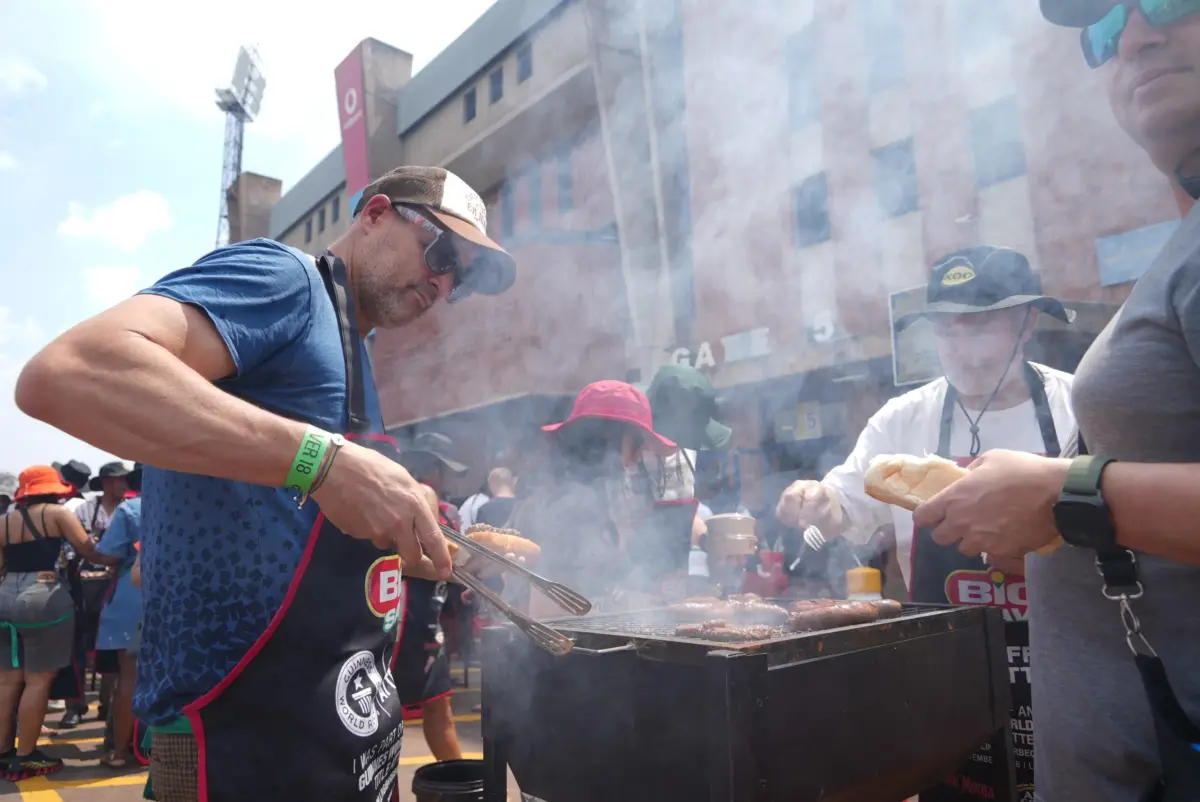

PRETORIA — Armed with stainless-steel tongs, folding camping chairs, and an unmistakable national appetite, thousands of determined South Africans converged on the iconic Loftus Versfeld Stadium on Thursday, September 24, 2026. Against a backdrop of swirling hickory smoke, the rhythmic sizzle of rendering fats, and the bright colors of the national flag, these culinary hopefuls gathered not merely to share a meal, but to seize a coveted global title.
The objective was as simple as it was daunting: shatter the Guinness World Record for the most people grilling simultaneously at a single barbecue event. The benchmark to beat stood at 2,220 participants—a record established in Ishigaki City, Japan, in 2023. For the citizens of Pretoria and participants hailing from across the broader Gauteng province, Thursday’s gathering was more than a statistical pursuit. It was a manifestation of cultural identity, an exercise in national resilience following a previous heartbreaking defeat, and a high-stakes celebration of South Africa’s most sacred culinary ritual: the braai.
Executive Overview: The Anatomy of a Record Attempt
The stakes were exceptionally high from the moment the gates of the Loftus Versfeld Stadium opened early Thursday morning. Coming on the heels of a failed attempt in 2025—where technical disqualifications and straying participants cost the nation the crown—organizers left nothing to chance. Around 500 meticulously arranged grilling stations spanned the stadium turf, designed to accommodate an expected turnout of roughly 3,000 participants.
Under the watchful eyes of official Guinness World Records adjudicators, the event transformed a beloved social pastime into a rigorous operational exercise. The rules of engagement were absolute: every single participant had to be actively barbecuing simultaneously for an uninterrupted minimum of five minutes. Deviation, premature eating, or unauthorized wandering from a designated station meant immediate disqualification for the individual and a potential deduction from the cumulative total.
As the aromatic smoke cleared and the final coals dimmed, the atmosphere remained suspended between triumphant celebration and nervous anticipation. While participants tucked into their well-earned feasts, the official verdict remained under wraps, leaving an entire nation waiting to hear whether their sizzling display of unity had successfully clinched the world record.

Detailed Chronology: A Day of Smoke, Sweat, and Steaks
Morning Arrival and Station Setup
The day began well before dawn as logistics teams, safety officials, and eager competitors streamed into the historic Loftus Versfeld Stadium, a venue usually reserved for the thunderous roars of rugby union test matches. By 8:00 AM local time, the stadium floor had been transformed into a gridiron of open-fire pits, gas burners, and charcoal braais.
Participants registered at security checkpoints, each assigned a specific grid coordinate to ensure accurate counting by the adjudication team. The air quickly grew thick with the scent of kindling, firelighters, and seasoned hardwoods. Veteran attendees of the 2025 attempt could be heard coaching newcomers on the strict guidelines, emphasizing that discipline was just as critical as cooking prowess.
The Five-Minute Window
At precisely 12:30 PM, a synchronized countdown echoed through the stadium’s public address system, signaling the start of the official record attempt. A hush fell over the roaring crowd as thousands of pairs of tongs hovered over grills loaded with a diverse array of meats—from marinated chicken breasts and thick-cut ribeye steaks to spiced lamb chops.
Guinness World Records adjudicator Paulina Sapinska, impeccably dressed in a sharp blue blazer and tie, patrolled the perimeter clutching an official clipboard. Flanked by a team of independent stewards, Sapinska meticulously scanned the rows of grilling stations.
"Everyone needs to be barbecuing simultaneously for a minimum of five minutes to be counted," Sapinska reiterated to media crews stationed at the touchline. "And if anyone leaves their station, they do get disqualified."

For 300 agonizingly long seconds, the stadium floor operated like a well-oiled military operation. Participants flipped sausages, adjusted dampers on charcoal drums, and fanned flames to maintain consistent heat. Not a single soul dared to step away, ensuring that every grill remained active throughout the mandatory time threshold.
The Feast and Post-Attempt Verification
As the final buzzer sounded, signaling the end of the five-minute verification window, a massive roar of relief and jubilation erupted across the stands. The tension immediately dissolved into camaraderie. Grills that had served as instruments of record-breaking pressure were quickly repurposed to feed the masses.
Participants poured generous portions of food onto communal paper plates, sharing side salads, pap (traditional maize meal), and freshly grilled meats. However, despite the celebratory feasting, a layer of suspense lingered. Adjudicator Sapinska announced that video evidence, steward logs, and headcounts needed to undergo a thorough cross-examination before a final tally could be certified. Consequently, the ultimate announcement of whether South Africa reclaimed the crown was deferred to Friday morning, leaving the nation on a collective knife-edge.
Supporting Context & Metrics: The Cultural Significance of the "Braai"
To understand why thousands of South Africans would spend a national holiday standing over blistering hot coals, one must understand the profound cultural weight of the braai.
In South Africa, a braai is far more than a method of cooking meat; it is a foundational social institution that cuts across racial, linguistic, and socioeconomic divides. Whether fueled by sustainably harvested wood, charcoal, or modern gas cylinders, the braai serves as an equalizer. It is the default setting for celebrations, family reunions, weekend leisure, and community gatherings.

+-------------------------------------------------------------------------+
|                    THE ANATOMY OF A SOUTH AFRICAN BRAAI                 |
+-------------------------------------------------------------------------+
|  Primary Fuels  | Hardwood logs, lump charcoal, briquettes, gas         |
|  Staple Meats   | Boerewors (farmer's sausage), steaks, chops, kebabs   |
|  Cultural Role  | Cross-cultural equalizer, community unifier           |
|  Key Holiday    | Heritage Day / "National Braai Day" (Sept. 24)        |
+-------------------------------------------------------------------------+
While steaks, chops, and chicken wings are standard fixtures at any outdoor cookout, no South African braai is complete without boerewors—a traditional, heavily spiced, coarse-ground sausage traditionally coiled into a spiral shape. Translating literally to "farmer’s sausage," its distinctive blend of coriander, cloves, allspice, and beef or pork provides the unmistakable aromatic baseline of any authentic braai.
Heritage Day Transformed into "National Braai Day"
The timing of Thursday’s record attempt was no coincidence. September 24 is celebrated annually in South Africa as Heritage Day, a statutory public holiday where citizens are encouraged to celebrate their cultural roots, diverse languages, and historical traditions within the country’s vibrant "Rainbow Nation" framework.
In recent decades, Heritage Day has been affectionately and widely rebranded as "National Braai Day." This grassroots cultural movement was heavily championed by media figures and civil society organizations who recognized that, regardless of ethnic background or cultural heritage, the love of gathering around an open fire to cook meat is a universal language shared by virtually all South Africans. Staging a massive world record attempt on this specific day transformed a quirky numbers game into a profound display of national solidarity and shared joy.
Official Statements and Participant Perspectives
The emotional investment of the participants underscored the deeper motivations driving Thursday’s gathering at Loftus Versfeld Stadium. For many, the sting of the 2025 failure was still fresh, fueling a determination to set the record straight.
Alex Coetzee, a Pretoria resident who proudly sported a custom shirt bearing the bold colors of the South African national flag, reflected on the redemption arc of the 2026 attempt. Coetzee had also participated in the previous year’s unsuccessful bid, where the delegation fell short due to administrative dropouts and participants wandering away from their posts.

"It’s gonna be better this time," Coetzee told reporters mid-grill, wiping sweat from his brow. "We’re actually gonna break the world record now. South Africans have the record in our hearts, and bringing it home officially is the most important part."
Organizers echoed this sentiment, emphasizing that the event required months of careful coordination, municipal permissions, and safety planning. Local emergency medical services and fire marshals were stationed strategically around the stadium bowl to manage potential flare-ups, smoke inhalation, and heat exhaustion, ensuring that the massive culinary undertaking proceeded without safety incidents.
Meanwhile, official Guinness World Records representatives maintained a strict adherence to protocol. Adjudicator Paulina Sapinska praised the organizational structure of the event while underscoring the uncompromising nature of global recordkeeping standards.
"We evaluate every single station with absolute precision," Sapinska noted during an interim briefing. "A record of this magnitude relies entirely on compliance. The energy in this stadium is undeniable, but the numbers must speak for themselves once the evidence review is complete."
Future Outlook: What Lies Ahead for the Global Grilling Crown?
As stakeholders await the official ruling from Guinness World Records headquarters, the implications of Thursday’s event stretch far beyond a simple line entry in a reference book.

If successful, South Africa will eclipse Japan’s 2023 benchmark of 2,220 simultaneous grillers, reclaiming a unique form of bragging rights that resonates deeply within the Southern Hemisphere. More importantly, the event has cemented Pretoria’s Loftus Versfeld Stadium as a premier venue for large-scale public spectacles, proving that massive logistical undertakings can be executed smoothly with community-driven enthusiasm.
Should the verdict favor the South African delegation, plans are already being whispered among culinary societies to institutionalize the gathering on an even grander scale for future Heritage Days, potentially inviting international competitors to test their skills against the masters of the boerewors.
Conversely, if technical discrepancies result in another narrow defeat, the cultural resolve of the nation suggests that the fires will simply be relit with greater determination next year. After all, in a country where the braai is a way of life, perfecting the art of the cookout is a journey, not a destination.

0 Comments