

Executive Overview
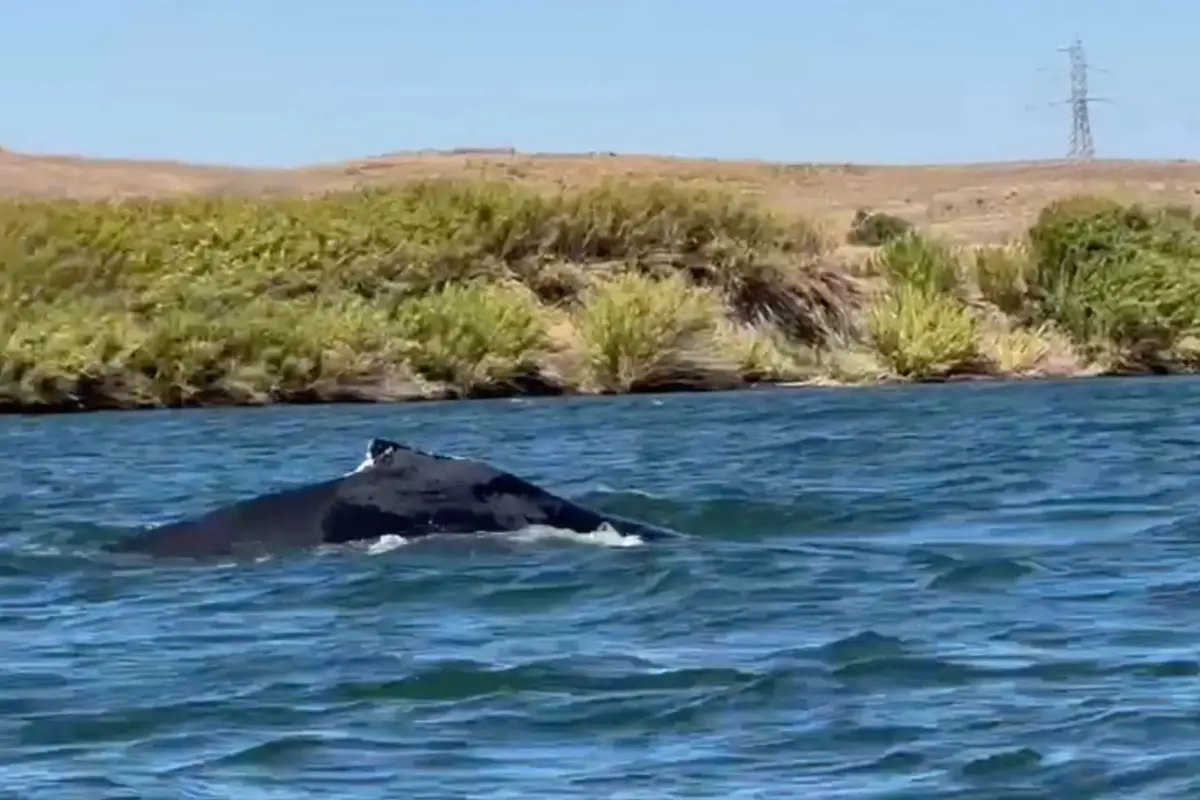
What began as a routine day of angling on California’s storied Sacramento River quickly transformed into a once-in-a-lifetime wildlife encounter when local fisherman Denny Glover and his companions locked eyes with an unexpected visitor: a fully grown humpback whale. Breaching the freshwater surface near Rio Vista on Wednesday, the massive marine mammal upended expectations, sparking widespread fascination and urgent mobilization among marine biologists, conservationists, and federal wildlife authorities.
Located roughly 60 miles inland from the Pacific Ocean, this unexpected visitor is far from its natural marine habitat. Swimming through the labyrinthine channels of the Sacramento-San Joaquin Delta—California’s largest river delta—the adult whale has drawn immediate oversight from The Marine Mammal Center, headquartered in Sausalito. While initial observations suggest the animal is maintaining a steady rhythm and respectable pace, its presence so far upstream poses profound ecological, navigational, and physiological questions.
Historically, such inland excursions by baleen whales are exceptionally rare, yet they are not entirely unprecedented. This occurrence echoes legendary historical anomalies, most notably the 1985 odyssey of "Humphrey" and the 2007 journey of a mother-calf pair, "Delta" and "Dawn." As researchers race to identify the underlying physiological or navigational triggers guiding this majestic creature into fresh water, experts are issuing stern warnings to the public. Boaters, kayakers, and curious onlookers must maintain a safe, respectful distance to prevent adding undue stress to an already vulnerable animal navigating an unfamiliar, highly artificial aquatic ecosystem.
Detailed Chronology: From the Open Pacific to the Freshwater Delta
The remarkable journey of this adult humpback whale did not begin in the freshwater arteries of Northern California, but rather deep within the vast expanse of the Pacific Ocean. Marine mammal experts, utilizing historical photo-identification catalogs, quickly matched the distinct markings of the whale’s flukes and dorsal fin, revealing a well-documented individual. According to records maintained by The Marine Mammal Center, this specific whale has been tracked by researchers over the span of 24 years, appearing in cataloged sightings roughly 15 times. Most recently, the animal was logged off the coast of Baja California, Mexico, in February.
Sometime during the early days of the week, the whale crossed through the Golden Gate, entering the complex tidal currents of the San Francisco Bay. Eschewing the open ocean, the animal navigated past urban centers and industrial shipping lanes, turning eastward into the Sacramento-San Joaquin Delta. By Wednesday, September 16, 2026, the leviathan had traversed nearly 60 miles inland, reaching the waters near Rio Vista, California.
It was here that Denny Glover and his fellow anglers encountered the animal. Aboard a modest 21-foot (6.4-meter) fishing boat—measuring less than half the total length of the whale—the group was targeting salmon and striped bass.
"One of the guys on the boat, he said, ‘I see a whale.’ He saw the spout," Glover recalled. "At first we didn’t believe it. We thought he had mistaken a dolphin or a porpoise. Then we saw the spout again, and there’s no mistaking a whale spout."
Capturing the encounter on video, Glover noted that despite the surreal nature of the setting, the animal appeared outwardly robust and oriented. Unlike animals suffering from acute disorientation or terminal distress, this humpback maintained regular surfacing intervals. It moved at a steady, deliberate clip against the river’s current, showing no outward signs of erratic panic or physical trauma beyond the bizarre reality of its freshwater surroundings.
Supporting Context & Metrics: Biology, Geography, and Historical Precedents
To fully comprehend the gravity of a humpback whale navigating the Sacramento River, one must examine the stark biological and geographical contrasts between the open ocean and inland riverine systems.
The Physical Scale of Humpback Whales
Humpback whales (Megaptera novaeangliae) are among the most colossal creatures on Earth. Fully grown adults can reach lengths of up to 50 feet (15 meters) and weigh a staggering 80,000 pounds (35,287 kilograms). They are renowned globally for their complex underwater vocalizations—often referred to as whale songs—and their dramatic surface displays, including breaching and pectoral fin slaps. Sustaining such massive biomass requires an immense caloric intake, primarily consisting of krill and small schooling fish found exclusively in rich marine environments.
The Geography of the Sacramento-San Joaquin Delta
In stark contrast to the saline, deep-water pelagic zones where humpbacks thrive, the Sacramento River and its surrounding delta represent a complex, highly managed freshwater network.
- Distance Inland: Approximately 60 miles (97 kilometers) upstream from the Pacific Ocean.
- Vessel Proportionality: Glover’s 21-foot fishing boat served as a stark spatial metric, emphasizing that the adult whale dwarfed standard recreational watercraft populating the river.
- Environmental Pressures: Transitioning from saltwater to freshwater exposes marine mammals to osmotic stress, potential skin lesions from prolonged freshwater exposure, and a severe lack of adequate food sources. Furthermore, the delta is laced with commercial shipping channels, underwater infrastructure, and heavy boat traffic, compounding the hazards for a disoriented pelagic animal.
Historical Paragons: Humphrey, Delta, and Dawn
While rare, this is not the first time California’s central waterways have hosted wayward cetaceans:
- Humphrey (1985): Perhaps the most famous inland visitor, a humpback whale named Humphrey captured international headlines by spending several weeks in the Rio Vista area. Humphrey’s journey triggered a massive rescue effort involving acoustic deterrents and human intervention before the whale successfully found its way back to the Pacific.
- Delta and Dawn (2007): A mother-calf pair of humpbacks spent nearly three weeks navigating the murky waters of the Sacramento River Delta. Their extended stay generated immense public anxiety regarding their health before the pair ultimately navigated back to the ocean unassisted.
These historical milestones offer a glimmer of hope, suggesting that humpbacks possess an inherent capacity to eventually retrace their steps, provided they do not succumb to illness, vessel strikes, or malnutrition during their inland detours.
Official Statements and Conservation Response
As news of the sighting rippled across local and national media outlets, conservation organizations and governmental agencies mobilized to assess the situation.
The Marine Mammal Center, a premier rescue and research institution based in Sausalito, California, immediately dispatched its specialized cetacean conservation biology team. Kathi George, the center’s director of cetacean conservation biology, emphasized the need for a measured, science-based response centered on observation rather than immediate physical intervention.
"While it’s unknown whether this whale is just passing through or if there is an underlying, unknown ailment, the best thing people can do is experience this adult whale’s presence from a respectful distance," George stated.
Conservationists are deeply concerned about the potential for human interference. Well-meaning onlookers, photographers, and recreational boaters frequently swarm marine wildlife sightings, inadvertently cornering the animals, blocking their downstream pathways, or causing dangerous collisions. Federal guidelines mandate maintaining a strict buffer zone, yet the novelty of a whale in a narrow river frequently tempts individuals to breach these safety margins.
Meanwhile, institutional response has been notably cautious. Representatives from the California Department of Fish and Wildlife (CDFW) and the National Oceanic and Atmospheric Administration (NOAA) both declined to comment on the unfolding situation upon initial inquiries. The hesitation from regulatory bodies often stems from the complex jurisdictional challenges of managing marine wildlife in inland freshwater habitats, as well as a strategic preference to let natural behavioral patterns play out before committing to high-risk, resource-intensive rescue operations.
Future Outlook: Monitoring, Management, and Mitigation
The immediate future of the Sacramento River humpback whale remains precarious yet closely monitored. Marine mammal specialists from The Marine Mammal Center, alongside allied environmental agencies, are maintaining continuous surveillance of the animal’s geographic progression, physical condition, and behavioral cues.
Key Scenarios for the Days Ahead:
- Spontaneous Return: Given historical precedents like Humphrey, Delta, and Dawn, the most optimistic outcome involves the whale organically recognizing tidal shifts, salinity gradients, or navigational cues, slowly reversing its course and heading back down the Sacramento-San Joaquin Delta toward the San Francisco Bay and the open Pacific.
- Physiological Monitoring: Researchers will continue analyzing aerial and surface documentation to check for signs of skin degradation, emaciation, or physical injuries sustained from previous vessel interactions or river obstructions.
- Active Intervention Plans: If the whale becomes permanently stuck in shallow waters, shows severe signs of cognitive decline or illness, or fails to make westward progress over an extended period, federal and private rescue networks may be forced to convene emergency task forces. Such interventions could involve acoustic herding techniques—similar to those deployed during Humphrey’s 1985 ordeal—to guide the animal away from dangerous inland dead-ends.
For now, the riverbanks near Rio Vista remain a focal point of quiet tension. As Denny Glover and other local anglers process the surreal reality of sharing prime fishing waters with an ocean giant, the broader scientific community remains vigilant. The presence of this majestic humpback serves as a powerful, humbling reminder of the interconnectedness of our marine ecosystems—and the unpredictable, wild nature of the creatures with which we share our coastal environment.

0 Comments