
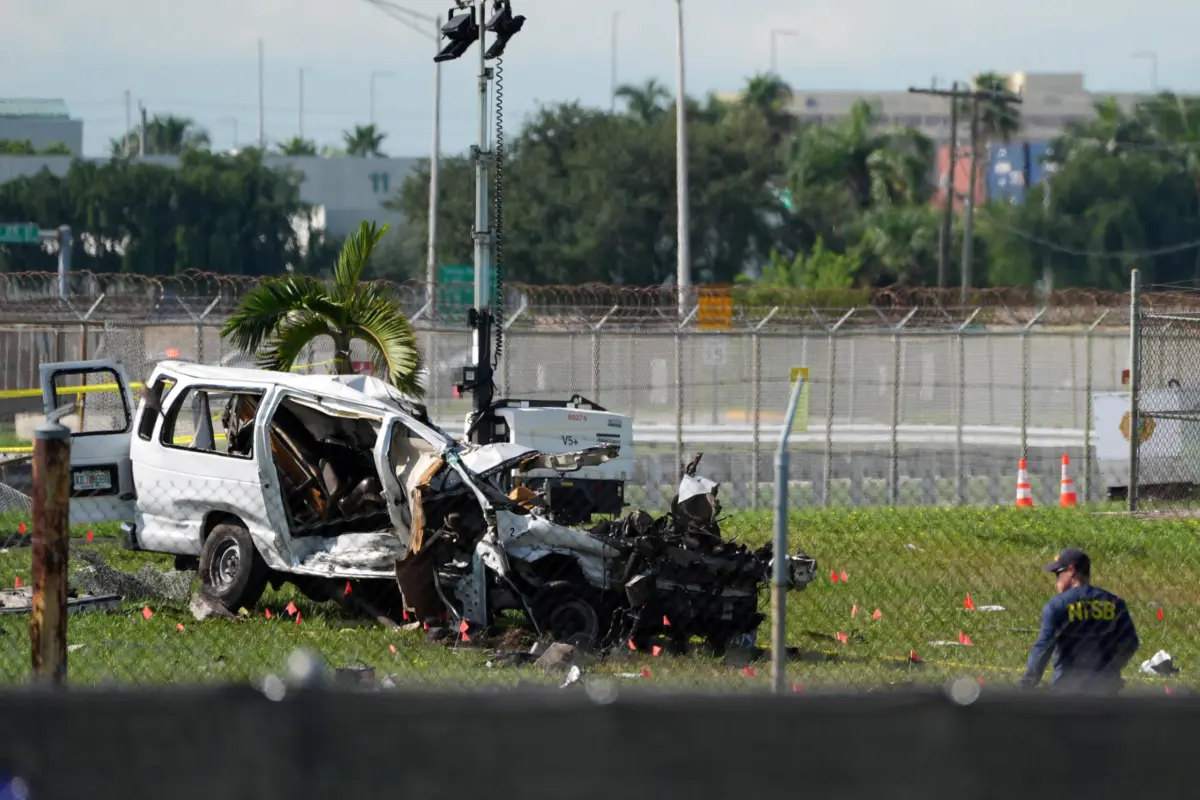

MIAMI — In the quiet hours following what federal investigators have described as a scene of "utter devastation," the aviation community and the city of Miami are grappling with the aftermath of a catastrophic runway excursion. The fatal accident—involving an Amazon-contracted cargo jet that overshot a wet runway at Miami International Airport (MIA)—has claimed five lives, injured several others, and reignited a fierce, long-standing debate over runway safety systems at major American airports.
As federal inspectors comb through the wreckage, fresh scrutiny is falling on a complex web of contributing factors: severe weather patterns, air traffic management decisions, the operational history of an aging aircraft, and a glaring absence of specialized safety infrastructure designed to halt runaway planes before they breach airport perimeters.
Executive Overview
On Sunday, September 7, 2026, a Boeing 767 cargo aircraft operating on behalf of e-commerce giant Amazon plowed off the end of a runway at Miami International Airport. The flight, which had originated two hours prior in Puerto Rico, arrived amid volatile regional weather conditions characterized by heavy storms and shifting, high-velocity winds.
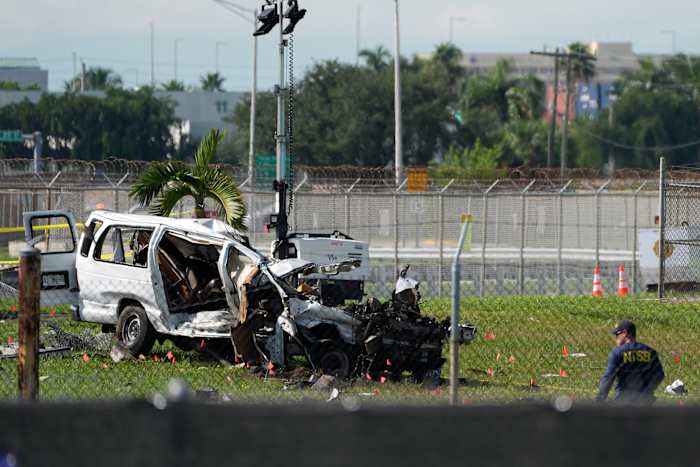
Unable to arrest its momentum, the heavy freighter careened roughly 1,300 feet past the paved runway surface. In its destructive path, the aircraft smashed directly into a service van transporting contract cleaning personnel across airport property, burst through a perimeter security fence, and subsequently crushed an SUV traveling on an adjacent city street.
The human toll was immediate and severe. All five individuals killed in the collision were occupants of the airport service van, ranging in age from 47 to 75. Five others sustained injuries, including the flight’s pilot and co-pilot, who have since been discharged from local hospitals. Two victims remain in critical condition, while a third is recovering in stable condition.
The National Transportation Safety Board (NTSB) has launched a full-scale investigation into the disaster. Led by NTSB Chairwoman Jennifer Homendy, the probe is examining not only the immediate cockpit decisions and environmental factors leading up to the crash, but also systemic vulnerabilities at MIA—chief among them, the lack of an Engineered Materials Arrestor System (EMAS) at the runway’s terminus.
Detailed Chronology of the Disaster
The Flight and Approach
The incident flight was operated by 21 Air, a North Carolina-based cargo carrier fulfilling logistical routes for Amazon Air. The aircraft involved was a 32-year-old Boeing 767, originally manufactured as a passenger liner before undergoing a freighter conversion in 2015.
Having departed Puerto Rico without incident, the cargo plane began its approach into Miami International Airport late Sunday afternoon. Meteorological data and pilot reports indicate that severe convective activity and thunderstorms were brewing in the immediate vicinity of the airfield.
Compounding the weather challenges were strong winds. Preliminary analyses and expert reviews of landing footage suggest that a powerful tailwind—exceeding 25 knots at the surface—was active at the time of touchdown. Aviation experts reviewing the initial data note that the aircraft appeared to be propelled significantly further down the runway than standard operating parameters dictate, failing to execute the conventional nose flare required to force the landing gear firmly onto the pavement.
The Fatal Breaches
Rather than initiating a "go-around" maneuver—a standard procedure when an approach becomes unstable or lands long—the pilot attempted to bring the heavy aircraft to a halt on the remaining runway surface. Witnesses and preliminary NTSB findings show that the Boeing 767 failed to decelerate in time, overrunning the pavement by approximately 1,300 feet (396 meters).
The sequence of impacts that followed was catastrophic:
- The Airport Perimeter: As the aircraft left the paved surface, it traversed unpaved safety areas before striking a service van owned by Professional Ocean Service Corp., a contractor providing cabin cleaning services. The five occupants inside the vehicle were killed instantly.
- The Airport Boundary: The plane smashed violently through the airport’s perimeter fencing, scattering debris, navigational equipment, and shredded metal across a wide radius.
- The City Street: Emerging onto a public roadway outside the direct airport boundary, the fuselage and landing gear struck an innocent civilian SUV, causing severe injuries to its occupants.
First responders arrived at a scene described by NTSB Chairwoman Homendy as exceptionally hazardous. Pungent pools of unignited jet fuel pooled across the tarmac and surrounding roads for more than 24 hours, requiring specialized hazardous materials crews to secure the perimeter before investigators could safely begin cataloging the wreckage.
Supporting Context & Metrics: Infrastructure and Regulatory Oversight
The EMAS Controversy
In the wake of the tragedy, federal safety officials and aviation experts have zeroed in on a critical infrastructure gap at Miami International Airport: the absence of an Engineered Materials Arrestor System (EMAS).
EMAS technology utilizes beds of lightweight, crushable concrete blocks installed at the end of runways. When an aircraft overruns the pavement, the wheels sink into the material, which collapses under the aircraft’s weight and systematically decelerates it in a controlled manner without causing catastrophic structural damage to the plane or its occupants.
According to Federal Aviation Administration (FAA) data, EMAS installations have successfully prevented major accidents and saved approximately 500 lives across the United States. However, these systems are not universally mandated. Miami International Airport is notably not one of the approximately 120 U.S. airports currently equipped with the technology.
Despite lacking an EMAS bed, MIA is technically compliant with current federal regulations. The airport features a standard 1,000-foot (305-meter) safety buffer—known as a Runway Safety Area (RSA)—at the end of the incident runway. While federal rules deem this 1,000-foot buffer sufficient under normal circumstances, critics and safety advocates argue that extreme weather, heavy cargo loads, and tailwinds can easily overwhelm a passive dirt-and-grass buffer, rendering it inadequate against a multi-ton commercial jet moving at high speeds.

Meteorological and Air Traffic Management Factors
Investigators are also scrutinizing the decisions made by air traffic control (ATC) in the moments leading up to the approach. Weather records indicate that shifting winds had created strong tailwind conditions.
In standard commercial aviation operations, airports routinely reconfigure their active runways—switching the direction of landings and takeoffs—to ensure that aircraft land into a headwind, which provides natural aerodynamic braking and shorter stopping distances. Air traffic controllers in Miami did not alter the runway configuration prior to the Amazon flight’s arrival, raising questions about whether operational pressures or traffic volume delayed a necessary directional shift.
Furthermore, the human factors in the cockpit remain a core pillar of the investigation. Flight data recorders (the "black boxes") and cockpit voice recorders are currently undergoing extraction and analysis at NTSB laboratories in Washington, D.C., to determine why the flight crew elected to press forward with the landing rather than executing a missed approach.
Official Statements and Stakeholder Reactions
The human cost of the disaster has reverberated across corporate boardrooms, municipal offices, and labor organizations.
The NTSB Perspective
During a tense press conference near the crash site, NTSB Chairwoman Jennifer Homendy did not mince words regarding the persistent lag in implementing safety recommendations across the nation’s aviation network.
"Our recommendations must be implemented or we’re going to be here again," Homendy stated firmly, highlighting the fact that runway excursions continue to occur despite repeated NTSB warnings urging airports to adopt advanced arresting technologies like EMAS. "We are looking at every single variable—from the weather and air traffic control procedures to the physical infrastructure of this airport."
Local Law Enforcement and Medical Response
Miami-Dade County Sheriff Rosie Cordero-Stutz provided updates on the injured survivors and the demographic profile of the victims, confirming that the deceased individuals ranged in age from 47 to 75.
"The pilot and co-pilot have been treated and released from the hospital, which has allowed our investigators to begin conducting formal interviews," Sheriff Cordero-Stutz said. She praised the rapid response of local police, fire rescue, and hazardous materials units who secured the chaotic scene and prevented secondary explosions from the spilled jet fuel.

The Employer’s Response
Professional Ocean Service Corp., the contractor whose cleaning crew was decimated in the crash, released a poignant statement expressing profound grief over the loss of its personnel.
"Our employees are far more than the people who work beside us each day, they are family, and they are deeply loved," the company’s statement read. "Our hearts and prayers are with every employee and every family whose lives have been forever changed."
Out of respect for the grieving families, company executives declined to comment further on the specifics of the deployment of their personnel on airport property at the time of the accident.
Future Outlook and Industry Implications
As the investigation enters its second week, the NTSB’s preliminary report is expected to be released within 30 days, though a comprehensive, final determination of probable cause could take anywhere from 12 to 24 months.
In the interim, the crash is expected to trigger widespread repercussions throughout the American aviation landscape:
- Infrastructure Funding and Mandates: Pressure is mounting on Congress and the FAA to reevaluate federal funding formulas for airport safety improvements. Lawmakers from Florida and other aviation hubs are expected to introduce bipartisan queries regarding whether federal grants should be expanded to accelerate the installation of EMAS beds at high-volume airports currently relying solely on standard RSAs.
- Cargo Airline Operations and Oversight: With Amazon Air continuing to expand its logistics footprint through third-party operators like 21 Air, the accident will likely prompt internal safety audits across outsourced cargo networks. Regulators will be looking closely at pilot training standards for dealing with contaminated runways and severe crosswind/tailwind scenarios.
- Airport Ground Safety Protocols: The fact that the fatalities occurred entirely within a service vehicle underscores the inherent risks of ground operations on active airfield boundaries. Airports nationwide may be forced to re-examine perimeter security, the positioning of service roads, and the real-time tracking of ground-support vehicles during adverse weather events.
For the families of the five cleaning crew members, the aviation workers union, and the traveling public, the tragedy at Miami International Airport serves as a grim reminder of the unforgiving margins of error in commercial aviation—and the urgent necessity of aligning modern infrastructure with the realities of extreme weather and heavy transport operations.

0 Comments