

Executive Overview
The American specialty crop sector—encompassing the producers of the nation’s fresh fruits, vegetables, tree nuts, and nursery plants—stands at a critical policy crossroads in Washington, D.C. As regulatory deadlines approach, international trade pressures mount, and domestic labor markets strain under chronic shortages, leaders of agricultural advocacy organizations are warning that the very survival of domestic production is on the line.
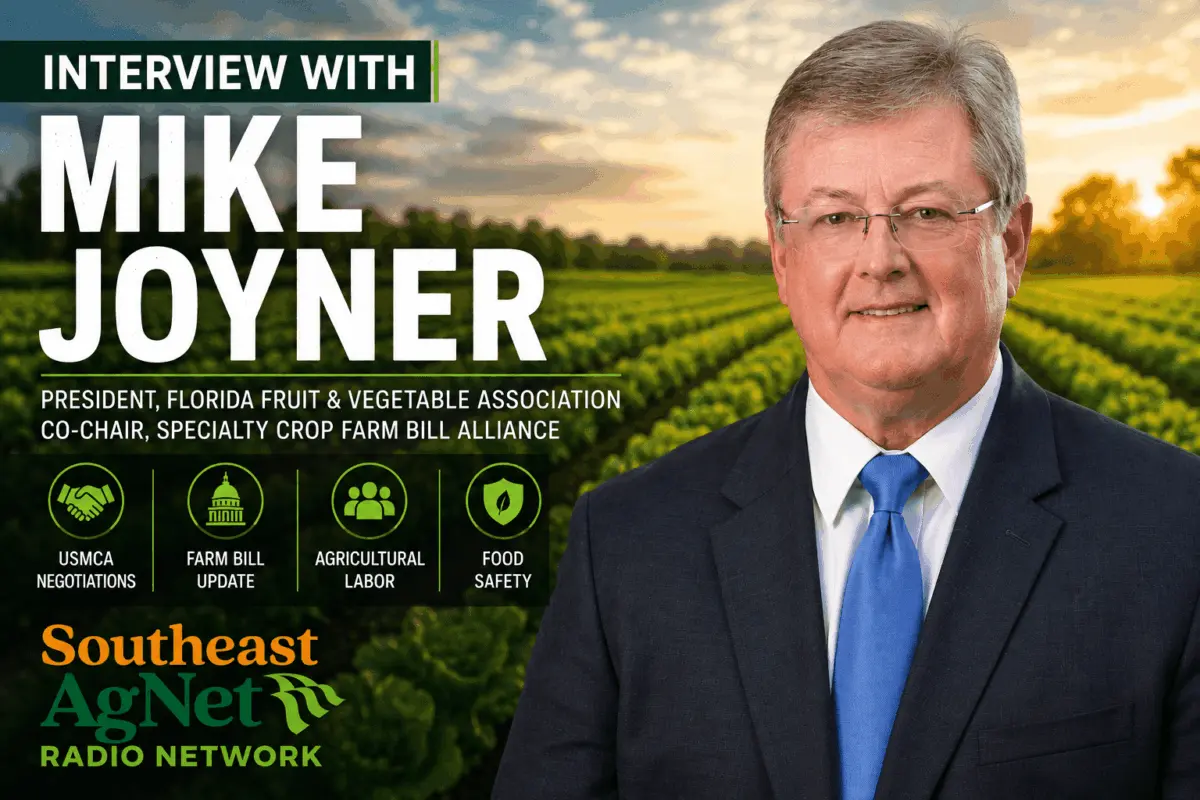
Recently, Mike Joyner, President of the Florida Fruit & Vegetable Association (FFVA) and co-chair of the Specialty Crop Farm Bill Alliance (SCFBA), sat down with AgNet Media for an extensive, high-level briefing. The discussion illuminated a daunting legislative and regulatory agenda facing Congress and federal agencies over the coming months. From battling subsidized foreign competition under the United States-Mexico-Canada Agreement (USMCA) to securing a long-delayed, modernized Farm Bill, the decisions made in the nation’s capital this year will reverberate across every major agricultural region in the country.
This report examines the core challenges highlighted by Joyner, exploring the multi-front legislative battles over international trade, labor reform, safety standards, and federal agricultural support. With the livelihoods of thousands of family farms hanging in the balance, industry leaders are mobilizing an unprecedented lobbying effort to ensure that Washington policymakers do not leave specialty crop growers behind.
Detailed Chronology: Policy Milestones and Legislative Hurdles
The current policy debate did not emerge in a vacuum; it is the cumulative result of years of escalating trade friction, legislative gridlock, and regulatory shifts. Tracing the chronology of these developments reveals why the stakes are currently higher than ever for domestic producers.
The Trade Front: The USMCA and the Siege of the Southeast
For over a decade, growers in Florida and across the Southeast have sounded the alarm regarding seasonal surges of heavily subsidized produce imported from Mexico. Under the framework of the North American Free Trade Agreement (NAFTA) and its successor, the USMCA, domestic specialty crop producers have watched their market share erode during traditional domestic harvest windows.
- 2018–2020: As negotiations for the USMCA advanced, Southeast growers pushed hard for enforceable seasonal import relief mechanisms. While the final agreement included monitoring language and promises of stakeholder engagement, it failed to deliver the binding trade remedies that producers argued were necessary to counteract unfair pricing practices and government-backed agricultural subsidies south of the border.
- 2021–2023: Trade data consistently demonstrated sharp increases in Mexican tomato, berry, cucumber, and squash imports, driving down domestic prices and forcing many multi-generational farms out of business. Industry coalitions petitioned the Office of the United States Trade Representative (USTR) repeatedly, seeking targeted interventions.
- 2024–Present: The debate has intensified as the statutory timeline for the joint review of the USMCA approaches. Growers are aggressively lobbying the current administration to utilize tariff-rate quotas (TRQs) and other emergency safeguard tools to protect vulnerable, labor-intensive domestic commodities.
The Farm Bill Saga: A Chronology of Delay
The Farm Bill, the primary legislative vehicle guiding U.S. agricultural and nutrition policy, operates on a roughly five-year cycle. The path to the current reauthorization has been fraught with unprecedented legislative paralysis.
- Late 2023: The expiration of the 2018 Farm Bill forced Congress to pass a one-year extension, pushing major legislative debates into 2024.
- Spring and Summer 2024: House and Senate Agriculture Committees released competing conceptual frameworks. While traditional row crops like corn, soybeans, and cotton found substantial bipartisan consensus, specialty crop advocates fought hard to secure expanded provisions for research, block grants, and crop insurance.
- Late 2024–2025: Partisan gridlock over nutrition assistance funding (Supplemental Nutrition Assistance Program, or SNAP) and climate-smart agriculture spending brought the legislative process to a near-halt.
- Recent Months: A fresh setback in the Senate Agriculture Committee dealt another blow to legislative momentum. Despite this, agricultural leaders like Joyner maintain that a legislative window remains open for lawmakers to pass a comprehensive Farm Bill before the conclusion of the calendar year, staving off another year of paralyzing uncertainty.
Supporting Context & Metrics: The Vulnerability of Specialty Agriculture
To fully grasp the urgency behind the policy demands of organizations like the FFVA and the Specialty Crop Farm Bill Alliance, one must examine the economic and operational realities facing modern specialty crop production.
The Economic Weight of Specialty Crops
Unlike major commodity crops that benefit from a deep cushion of federally subsidized shallow-loss programs, price supports, and extensive baseline safety nets, specialty crops have historically received a smaller slice of federal agricultural spending relative to their economic footprint.
- Specialty crops account for a massive share of U.S. agricultural cash receipts, generating tens of billions of dollars annually and supporting hundreds of thousands of jobs in rural and urban economies alike.
- Unlike corn or wheat, which can be stored in grain elevators for months waiting for optimal market conditions, specialty crops are highly perishable. A delay of days in harvesting, packing, or shipping can result in total economic loss.
Import Pressures and Market Disruption
The economic vulnerability of the Southeast specialty crop sector is starkly illustrated by trade metrics. According to agricultural economists, imports of fresh fruits and vegetables from Mexico have grown exponentially over the past twenty years.
- Labor and Input Cost Disparities: U.S. growers face stringent federal and state labor regulations, higher minimum wages, mandatory housing and transportation costs for guest workers, and strict environmental compliance rules. In contrast, foreign competitors frequently operate with significantly lower labor and compliance costs, creating an asymmetrical playing field.
- Pricing Volatility: When massive influxes of foreign produce hit U.S. distribution hubs simultaneously, domestic prices routinely plummet below the cost of production. For a Florida tomato or bell pepper grower, a single bad season can spell insolvency.
The Case for Technological Investment
Because manual labor represents the single largest variable cost for specialty crop production—often consuming 40% to 60% of total operating expenses—automation and mechanization are no longer futuristic concepts; they are prerequisites for survival. However, research and development for robotics, artificial intelligence-driven harvesters, and specialized automated grading equipment require massive capital outlays. Federal grant programs, such as the Specialty Crop Research Initiative (SCRI), have become vital lifelines, though current funding levels lag far behind the soaring demand from the scientific and farming communities.
Official Statements and Industry Perspectives
The policy direction advocated by agricultural leaders reflects a unified front across multiple regional and national associations.
Mike Joyner on the Survival of Southeast Agriculture
During his conversation with AgNet Media, Mike Joyner did not mince words regarding the existential threats facing producers.
"I don’t think it’s an exaggeration to say that the survival of the Southeast specialty crop industry is at stake," Joyner stated bluntly, capturing the gravity of the trade imbalances threatening regional producers.
Joyner emphasized that while the challenges are immense, there are glimmers of hope within the federal bureaucracy. He specifically pointed to the engagement demonstrated by U.S. Trade Representative Jamieson Greer as an encouraging sign that Washington is finally beginning to listen to the cries of domestic fruit and vegetable farmers.
"We are seeing a recognition from trade officials that seasonal perishables operate under entirely different economic rules than storable commodities," Joyner noted. “We must have structural trade remedies that reflect these realities before our production capacity is permanently wiped out.”
The Specialty Crop Farm Bill Alliance Agenda
As co-chair of the SCFBA—a powerful coalition representing more than 200 specialty crop organizations nationwide—Joyner has helped spearhead a targeted legislative platform for the ongoing Farm Bill negotiations. The coalition’s core priorities include:
- Enhanced Crop Insurance: Expanding and refining risk management tools tailored specifically to high-value, perishable crops, making policies more affordable and accessible.
- Predictable Disaster Assistance: Creating a permanent, streamlined framework for disaster relief that does not force farmers to rely on ad-hoc congressional appropriations following hurricanes, freezes, or droughts.
- Research and Innovation Funding: Increasing mandatory baseline funding for the Specialty Crop Research Initiative to fast-track automation, pest and disease management, and sustainable production practices.
- Trade and Export Promotion: Boosting investments in programs like the Market Access Program (MAP) and the Foreign Market Development (FMD) program to help U.S. growers expand into international markets.
Labor Reform and Food Safety Imperatives
Beyond trade and the Farm Bill, Joyner addressed the persistent labor crisis. Discussing initiatives like the Securing America’s Workforce Act, he stressed that the current H-2A agricultural guest worker program is outdated, overly bureaucratic, and economically burdensome for producers. A reliable, predictable workforce system remains foundational to keeping food production domestic.
Additionally, Joyner touched upon evolving food safety regulations. As consumers demand absolute assurance regarding the safety of fresh produce, growers are navigating an increasingly complex web of federal compliance standards. Maintaining consumer confidence through rigorous, science-based safety protocols is vital to protecting market demand and preventing consumption-dampening foodborne illness outbreaks.
Future Outlook: What Lies Ahead for Growers?
The coming months will test the resolve of lawmakers and the advocacy strength of the agricultural community. As Washington navigates a complex political landscape, several key milestones will determine the trajectory of the specialty crop industry:
- The USMCA Review Process: With trade officials actively reviewing agricultural trade flows, industry advocates will press for enforceable seasonal relief measures. Failure to secure these protections could lead to accelerated farm closures across Florida, Georgia, and other southeastern states.
- The Final Stretch for the Farm Bill: Despite committee setbacks, bipartisan pressure to avoid another multi-year extension could force lawmakers to forge a compromise during the lame-duck session or early next year. Specialty crop groups will remain vigilant to ensure that their core priorities—research, disaster aid, and crop insurance—are preserved in any final text.
- Workforce Legislative Momentum: Advocacy for agricultural labor reform will continue to mount. Until a bipartisan solution is forged to stabilize the domestic farm labor pool, production costs will remain volatile, accelerating the push toward automation.
Ultimately, the future of the American specialty crop industry depends on Washington’s willingness to adapt trade, labor, and agricultural policies to the unique, high-risk realities of perishable food production. As Mike Joyner and his colleagues continue to press their case in the halls of Congress and federal agencies, the decisions made today will dictate whether the nation continues to grow its own fresh, nutritious food supply or becomes entirely dependent on foreign imports.

0 Comments