For decades, the dominant cultural narrative surrounding retirement has been painted with idyllic brushstrokes: endless mornings unbothered by alarm clocks, sun-drenched golf courses, spontaneous travel, and the guilt-free pursuit of lifelong passions. Most working professionals carry an expansive, mental "bucket list"—a vibrant compendium of hobbies, creative endeavors, and dream destinations waiting to be unlocked the moment they hand in their final resignation letter.
Yet, as millions of retirees discover too late, the chasm between a fantasy retirement and a fulfilled reality is vast, bridged only by a commodity most people are fundamentally reluctant to spend: intentional change.
Recent sociological data and time-use studies reveal a sobering truth about the post-work transition. When the rigid scaffolding of employment is removed, human beings rarely reinvent themselves. Instead, they default to deeply ingrained behavioral loops. Rather than launching ambitious artistic projects, mastering new languages, or traversing the globe, the vast majority of retirees simply expand their existing habits. The vacuum left by forty-hour workweeks is routinely swallowed by passive consumption—predominantly television and screen time—while ambitious bucket-list items gather dust.
Achieving a "fabulously" vibrant retirement requires more than a healthy investment portfolio or a well-funded 401(k); it demands a psychological and behavioral metamorphosis. Without a conscious, deliberate restructuring of daily routines, lifelong habits will quietly hijack your golden years, leaving you with the exact same lifestyle you sought to escape, simply wrapped in unstructured leisure.
Detailed Chronology: The Anatomy of Procrastination in Retirement
The path to a stagnant retirement rarely begins on the first day of freedom. It is a slow, decades-long accumulation of habits, inertia, and unfulfilled intentions that can be traced across distinct phases of the pre- and post-retirement timeline.
Phase 1: The Decades of Accumulation (Pre-Retirement)
Throughout an active working life, individuals develop coping mechanisms and comfort zones dictated by external structures. Corporate projects, email inboxes, and meeting calendars dictate daily rhythms. Outside of work, habits form organically:
The Accumulation Loop: Over decades, homes fill with books, redundant tools, half-used renovation supplies, and nostalgic keepsakes. The thought of discarding them is perpetually deferred because "there is always time later."
The Comfort of Routine: Mental bandwidth is largely consumed by career and family obligations. Self-directed discipline outside of work structures remains largely undeveloped, breeding a reliance on passive relaxation (such as television or digital browsing) to unwind from occupational stress.
Phase 2: The Seven-Year Itch of Intention
Consider the common trajectory of prospective retirees. Years before leaving the workforce, many vow to radically transform their living spaces and schedules. A classic example is the pledge to downsize: sorting through attics, garages, and packed closets to purge decades of accumulated clutter.
Yet, longitudinal reflections from retirees reveal a recurring phenomenon. Seven years into retirement, those noble declarations often remain unfulfilled. The garage still houses paint cans from a decade ago; the spare room remains a storage unit. Why? Because the absence of an immediate catalyst—such as an impending cross-country move—combined with lifelong habits of retention, ensures that nothing changes. Inertia triumphs over intention.
Phase 3: The Creative Stalling Point
The struggle extends far beyond physical clutter into creative aspirations. Many professionals dream of writing a novel, launching an art career, or mastering a musical instrument. The concepts exist fully formed in their minds, waiting for the mythical "free time" that retirement promises.
However, when retirement finally arrives, the daily discipline required to nurture these ambitions is missing. Writing a book demands carving out sacred, non-negotiable blocks of time every single day, immunizing oneself against household chores, digital distractions, and social media. Because the individual has spent a lifetime reacting to external demands rather than self-directing their hours, the creative project stalls. The dream remains locked inside the mind, starved of the daily behavioral fuel it requires to grow.
Supporting Context & Metrics: How We Actually Spend Our Time
Popular imagination paints retirement as a whirlwind of active leisure. Hard demographic data, however, tells a profoundly different story. According to comprehensive time-use data compiled by the Bureau of Labor Statistics (BLS), the reality of post-work life is defined more by continuity than reinvention.
The Bureau of Labor Statistics Findings
When researchers analyze how older Americans transition from employment to retirement, the structural shift in daily time allocation is remarkably predictable:
The Expansion Effect: When work is removed from the daily equation, existing habits do not vanish; they simply expand to fill the void.
The Television Monopolization: BLS charts tracking daily leisure time demonstrate that while "Leisure and Sports" categories experience a predictable surge upon retirement, the lion’s share of that newfound time is absorbed by television viewing.
The Physical Activity Gap: Detailed breakdowns of daily leisure reveal that actual physical exercise, active community engagement, or skill-acquisition hobbies account for a remarkably small fraction of a retiree’s day—often hovering near single-digit percentages of total leisure time.
Activity Category
Pre-Retirement Allocation
Post-Retirement Allocation
Primary Driver of Change
Work / Career
High (35–50 hrs/week)
Zero
Full retirement transition
Household Chores
Moderate
Moderate to Slightly Higher
Natural time-expansion
Passive Leisure (TV/Media)
Low to Moderate
Significant Surge
Default comfort habit
Active Hobbies / Travel
Minimal
Marginally Higher
Requires intentional planning
As these metrics illustrate, statistically speaking, the average retiree does not naturally gravitate toward high-effort, high-reward endeavors like intensive travel, mastery-level arts, or rigorous volunteering. Without a deliberate behavioral framework, the path of least resistance leads straight to the living room couch.
Expert Perspectives and Psychological Insights
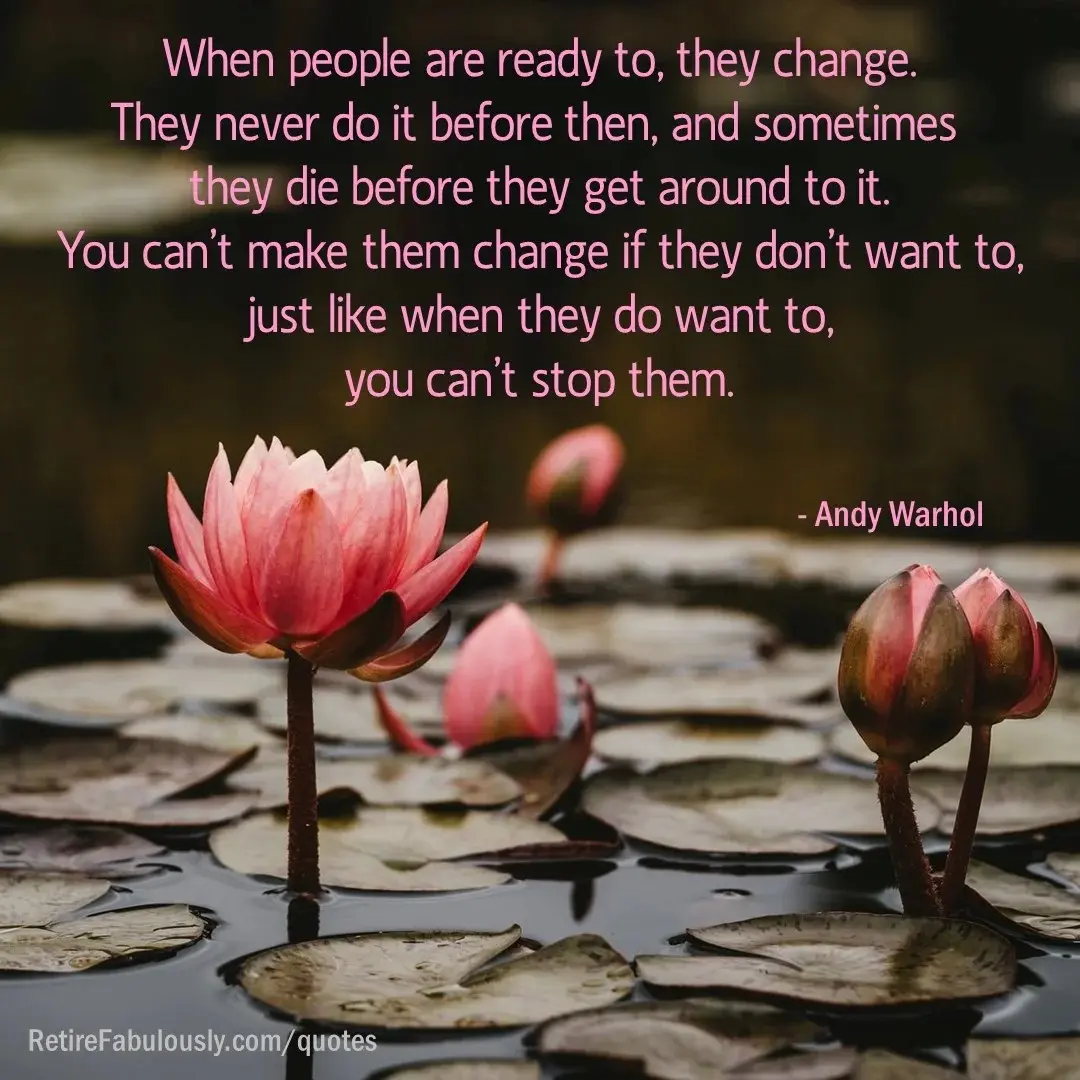
Behavioral psychologists and lifestyle strategists emphasize that change is not a passive wish; it is an active, deliberate discipline. As the legendary artist Andy Warhol famously observed:
"When people are ready to, they change. They never do it before then, and sometimes they die before they get around to it. You can’t make them change if they don’t want to, just like when they do want to, you can’t stop them."
The Trap of Environmental and Social Continuity
Retirement experts note that many individuals fail to account for the secondary losses of leaving the workforce—chief among them being social structure and identity.
Social Reliance: For decades, the workplace acts as the primary engine for human connection. When workers retire without cultivating external social networks, loneliness frequently sets in because they lack the habit of initiating social outreach independently.
Financial Habits: Long-standing consumer patterns—such as habitual dining out or impulse purchasing—frequently persist into retirement, colliding painfully with fixed-income realities. Adjusting these behaviors requires deep psychological realignment.
Redefining Identity Beyond the Job Title
Transition guides, such as Dave Hughes’s Smooth Sailing Into Retirement, emphasize that successful retirees must consciously design their new day-to-day existence to reflect intrinsic passions rather than former job titles. This requires identifying the psychological barriers preventing action—fear of failure, attachment to physical objects, or sheer comfort with the status quo—and dismantling them systematically.
Future Outlook: Crafting Your Intentional Retirement
The definition of insanity is often attributed to doing the same thing over and over while expecting different results. Expecting a vibrant, transformative retirement while maintaining the exact same behavioral patterns, routines, and risk-aversion strategies of your working years is a recipe for profound disappointment.
If your ideal retirement involves moving to a vibrant new city, mastering oil painting, learning a foreign language, or establishing a minimalist household, you cannot wait for the inspiration to strike magically on your first day out of the office. You must begin planting the seeds of change today.
Actionable Steps for the Aspiring Retiree:
Audit Your Daily Habits: Identify which current routines are serving your future goals and which are simply comfort zones designed to kill time.
Practice Micro-Changes Now: If you want to write a book in retirement, carve out 15 minutes every morning right now to write. If you want to declutter, commit to discarding three items a day. Build the "change muscle" before you need it.
Design Your Schedule: Treat your retirement goals with the same professional rigor you applied to your corporate calendar. Allocate non-negotiable blocks of time for your passions.
The golden years can indeed be a period of unprecedented personal renaissance, but they will not construct themselves. Change is intentional, demanding, and utterly non-negotiable. The question is no longer what you hope to do when you retire—it is whether you are finally willing to change the person you are today to make it happen.



0 Comments