

Executive Overview
When Americans are taught the foundational narrative of European settlement in the United States, textbooks traditionally direct their attention northward—to the windswept shores of Virginia’s Jamestown, established in 1607, or the iconic landing of the Pilgrims at Plymouth Rock in 1620. Yet, tucked along the northeastern coast of Florida lies a historic enclave that quietly rewrites this traditional chronology. St. Augustine, founded on September 8, 1565, stands as the oldest continuously occupied European-established settlement in the United States. Its origins predate Jamestown by more than four decades and outdate Plymouth Rock by over half a century.
Far from being a mere historical footnote, St. Augustine is a living, breathing testament to the tumultuous geopolitics of the 16th-century Age of Discovery. Driven by imperial ambition, religious zeal, and strategic naval positioning, Spanish explorers carved a foothold out of the subtropical wilderness long before the English flag was planted in North America. Today, this coastal city draws approximately two million visitors annually, balancing the preservation of its formidable coquina fortresses, narrow cobblestone corridors, and centuries-old landmarks with a vibrant modern economy. This investigative feature explores the deep historical currents, bloody geopolitical conflicts, and enduring cultural legacies that cement St. Augustine’s unmatched status in American history.
Detailed Chronology: From First Contact to Permanent Settlement
The story of St. Augustine cannot be separated from the broader tapestry of Spanish exploration that defined the early 1500s. To understand how a Spanish garrison transformed into the oldest continuously occupied European city in the country, one must trace a century marked by failed expeditions, fierce indigenous resistance, and relentless European rivalry.
The Dawn of Spanish Florida: Ponce de León (1513)
The narrative begins more than half a century before the founding of the city, when Spanish conquistador Juan Ponce de León sighted the eastern coast of the Florida peninsula in the spring of 1513. Landing somewhere near present-day St. Augustine or Melbourne Beach, Ponce de León claimed the lush, verdant territory for the Spanish Crown, naming it La Florida in honor of Pascua Florida (the Feast of Flowers, or Easter season).
While popular mythology long tied Ponce de León’s journey to a mythical "Fountain of Youth"—a legend later commercialized heavily in the region—his primary motivations were geopolitical and economic. Spain sought to expand its New World empire, secure vital shipping lanes, and counter French and British incursions into the Caribbean basin. However, Ponce de León’s initial contact with the native Timucua people and subsequent attempts at colonization ended in failure and violence, setting a perilous precedent for the Spanish crown’s early ambitions in the region.
A Century of Failed Attempts (1513–1565)
For the next five decades, Spain launched at least half a dozen major expeditions to colonize the Florida peninsula, nearly all of which met with catastrophic ends. Hurricanes, starvation, tropical diseases, hostile indigenous populations, and internal mutinies repeatedly thwarted Spanish efforts. Names like Pánfilo de Narváez and Hernando de Soto launched massive, ill-fated inland expeditions that brought devastation to local indigenous societies without establishing a permanent European foothold.
By the mid-16th century, Spain’s inability to secure Florida became an acute vulnerability. The vast treasure fleets of the Spanish Empire—laden with gold, silver, and precious commodities from Central and South America—routinely sailed through the narrow Florida Straits, caught in the powerful Gulf Stream current. This maritime corridor made Florida an indispensable strategic asset, and leaving it unprotected invited foreign rivals to establish forward operating bases right in Spain’s backyard.
The French Threat and the Arrival of Menéndez (1565)
The tipping point arrived in 1564 when French Huguenots under the command of Jean Ribault established Fort Caroline on the banks of the St. Johns River (near modern-day Jacksonville). For Catholic Spain, the presence of French Protestants so close to the vital shipping lanes was an existential threat—not only a challenge to territorial sovereignty, but a perceived heresy within striking distance of the Spanish Caribbean.
Responding decisively, King Philip II dispatched Admiral Don Pedro Menéndez de Avilés to command an expedition with a clear mandate: expel the French and secure the territory for Spain. Menéndez arrived off the coast of Florida on August 28, 1565—the feast day of St. Augustine of Hippo.
On September 8, 1565, Menéndez officially stepped ashore, massed his troops, and founded the settlement of St. Augustine. Shortly thereafter, in a brutal campaign that reflected the ruthless religious and imperial wars of 16th-century Europe, Menéndez marched north and successfully eradicated the French presence at Fort Caroline, executing most of the French combatants near the mouth of a nearby inlet forever known as Matanzas (Spanish for "slaughters"). With the French threat neutralized, Menéndez set about fortifying St. Augustine, ensuring that the Spanish flag would remain planted in Florida soil.
Supporting Context & Metrics: Architecture, Demographics, and Economy
St. Augustine’s unique historical timeline has profoundly shaped its physical layout, architectural heritage, and modern economic engine. Unlike many early American settlements that were abandoned, relocated, or destroyed, St. Augustine evolved organically around its original 16th-century grid system.
Architectural Marvels and Material Culture
The city’s built environment reflects centuries of rebuilding following various sieges, fires, and pirate attacks. The most iconic structural monument is the Castillo de San Marcos, constructed between 1672 and 1695. Commissioned by the Spanish Crown following a devastating pirate raid led by the English privateer Robert Searles, the fortress was engineered to withstand cannon fire.
Uniquely, the Castillo is built entirely of coquina—a sedimentary rock composed of ancient, crushed microscopic mollusk shells bound together naturally over millennia. Sourced from nearby Anastasia Island, coquina proved to be a brilliant architectural choice. When struck by enemy cannonballs, the porous, spongy stone did not shatter or fracture like traditional brick or granite; instead, it simply absorbed the impact, causing cannonballs to embed harmlessly into the walls like bullets hitting thick timber.
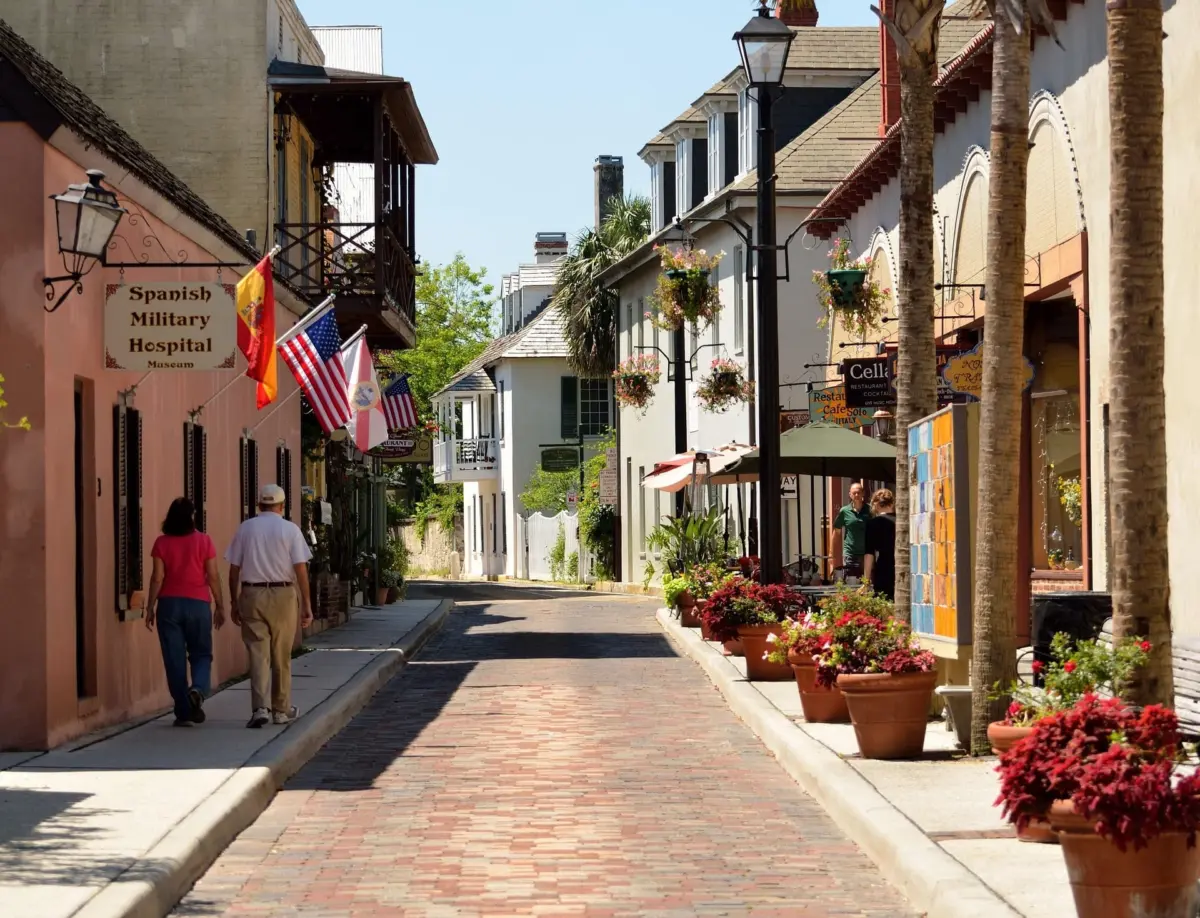
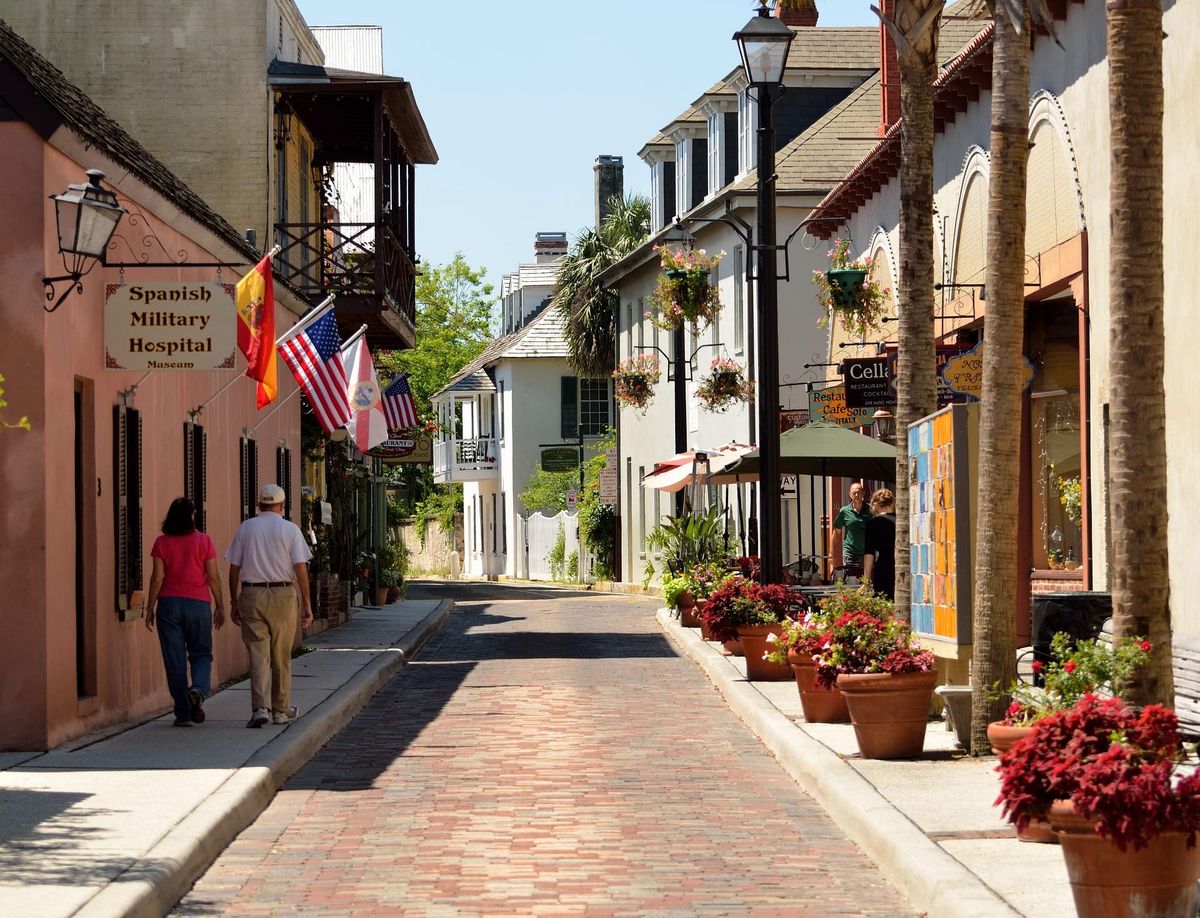
Complementing the fortress is Avilés Street, widely recognized as the oldest continuously used public street in the United States. Lined with historic Spanish colonial buildings featuring overhanging wooden balconies, hidden courtyards, and ancient brick pathways, Avilés Street encapsulates the distinct Mediterranean aesthetic that sets St. Augustine apart from colonial towns in New England or the Mid-Atlantic.
Tourism Metrics and Modern Demographics
Today, St. Augustine is the anchor of Florida’s Historic Coast, located within St. Johns County—consistently ranked as one of the fastest-growing and healthiest counties in Florida.
- Annual Visitor Volume: Approximately 2 million tourists visit St. Augustine annually, driven by heritage tourism, culinary travel, and coastal recreation.
- Economic Impact: Tourism generates hundreds of millions of dollars in direct economic output, supporting thousands of local jobs in hospitality, retail, and historic preservation.
- Preservation Framework: The city operates under stringent historic preservation ordinances managed by the St. Augustine Historic Architectural Review Board (HARB), ensuring that new commercial and residential developments maintain the architectural integrity of the historic core.
Official Statements and Preservation Perspectives
Preserving a city with over 450 years of continuous history requires a delicate balance between public accessibility, archaeological stewardship, and modern infrastructural demands. Leaders in historical preservation and municipal government emphasize the ongoing responsibility of maintaining America’s oldest urban landscape.
"St. Augustine is not merely a collection of old buildings; it is the physical archive of our nation’s complex, multicultural beginnings," notes Dr. Elena Vance, Professor of Early American History at the University of Florida. "Long before Jamestown built its palisades or the Pilgrims drafted the Mayflower Compact, a multi-ethnic society of Spaniards, enslaved Africans, free people of color, and indigenous Timucua peoples was already establishing roots, intermarrying, and shaping the early geopolitical reality of the North American continent."
Municipal authorities work closely with federal agencies, such as the National Park Service, to safeguard sites like the Castillo de San Marcos and Fort Matanzas.
"Our mandate is twofold," states Marcus Holloway, Director of St. Augustine’s Cultural and Historic Resources Division. "We must honor the immense historical weight of our past while ensuring that a living city of nearly 15,000 residents functions efficiently in the 21st century. Sea-level rise, coastal erosion, and urban development present real challenges to our coquina monuments and low-lying historic districts. Preserving St. Augustine requires cutting-edge archaeological science combined with proactive climate adaptation strategies."
Furthermore, historians increasingly emphasize the need to broaden the narrative of St. Augustine beyond European conquistadors. Recent archaeological discoveries and interpretive programs at the Fountain of Youth Archaeological Park and Mission Nombre de Dios highlight the complex interactions between Spanish settlers and the indigenous Timucua, as well as the history of Fort Mose—established just north of St. Augustine in 1738 as the first legally sanctioned free African settlement in what is now the United States.
Future Outlook: Challenges and Preservation in the 21st Century
As St. Augustine looks toward its 500th anniversary in 2065, the city faces a unique set of challenges that test its resilience. While heritage tourism remains robust, the pressures of modern climate change, particularly chronic tidal flooding and severe storm surges, pose an existential threat to low-lying coastal historic districts.
Climate Adaptation and Resiliency Planning
In response to rising sea levels and increasingly intense Atlantic hurricanes, the City of St. Augustine, in partnership with federal and state agencies, has invested heavily in resiliency infrastructure. Projects include raising vulnerable seawalls, upgrading stormwater drainage systems in the historic downtown, and utilizing advanced hydrodynamic modeling to predict how storm surges will impact foundational coquina structures.
Expanding the Historical Narrative
Looking forward, the educational and cultural footprint of St. Augustine is expanding. The city is shifting toward a more inclusive historical presentation that honors all the cultures that contributed to its survival. The ongoing preservation and celebration of Fort Mose, alongside broader archaeological digs examining early colonial domestic life, offer visitors a multi-faceted view of American origins.
Ultimately, St. Augustine stands as a timeless bridge between the past and the future. By fiercely protecting its architectural heritage while adapting to modern environmental realities, the nation’s oldest city ensures that the foundational chapters of American history will remain vibrant, accessible, and instructive for generations to come.

0 Comments