

Executive Overview
Long before the Mayflower dropped anchor at Plymouth Rock, and decades prior to the establishment of the English colony at Jamestown, the northeastern coast of Florida was already echoing with the sounds of Spanish civilization. St. Augustine, a picturesque coastal destination renowned today for its Spanish colonial architecture, coquina fortifications, and historic brick-lined streets, holds a unique and undisputed distinction in the annals of North American history: it is the oldest continuously occupied European settlement in the United States.
Founded on September 8, 1565, by Spanish Admiral Don Pedro Menéndez de Avilés, St. Augustine predates Jamestown, Virginia, by 42 years, and the Pilgrims’ historic arrival at Plymouth Rock in Massachusetts by 55 years. While other European outposts were attempted and abandoned across the continent, St. Augustine endured through hurricanes, pirate raids, regional conflicts, and imperial shifts of power.
Today, this vibrant municipality welcomes approximately two million visitors annually, serving as a living museum where the past seamlessly intersects with the present. Beyond its famous status as the nation’s elder statesman among cities, St. Augustine represents a complex mosaic of Indigenous heritage, Spanish imperial ambition, British colonial governance, and modern-day historic preservation. This comprehensive investigation examines the chronology, historical context, architectural legacy, and enduring cultural impact of America’s oldest city.
Detailed Chronology: From Indigenous Horizons to Spanish Stronghold
To truly understand the founding and persistence of St. Augustine, one must look far beyond the European arrival, examining the deep, rich history of the land’s original inhabitants and the decades of failed exploration that preceded the city’s birth.
The Indigenous Era and the Timucua People
Long before Spanish caravels appeared on the horizon, the region surrounding modern-day St. Augustine was the ancestral homeland of the Timucua people. Comprising a loose network of chiefdoms, the Timucua inhabited a vast territory spanning North and Central Florida, as well as parts of southern Georgia. They were sophisticated hunter-gatherers, agriculturists, and master fishermen who navigated the intricate waterways of the Atlantic coast and the St. Johns River.
When European explorers first made contact, the local Timucua chiefdom in the St. Augustine area was known as the Seloy. Archaeological excavations and historical accounts indicate that the Seloy lived in complex villages, harvested oysters and fish from the coastal estuaries, and cultivated maize, beans, and squash. The initial interaction between the Spanish and the Timucua was complex, characterized by early cooperation, mutual curiosity, and eventual tragic devastation brought on by European-borne diseases and territorial displacement.
Juan Ponce de León and the Spark of Exploration (1513)
The European chapter of Florida’s history formally began in the spring of 1513. Spanish conquistador Juan Ponce de León, seeking new lands, wealth, and the legendary waters of rejuvenation, sighted the Florida peninsula. Landing somewhere near the modern-day northeastern coast—believed by many historians to be in the vicinity of St. Augustine or Melbourne Beach—he claimed the territory for the Spanish Crown, naming it La Florida in honor of Pascua Florida (the Feast of Flowers, or the Easter season).
Despite Ponce de León’s grand claim, establishing a permanent footprint in Florida proved to be an elusive and perilous dream. Over the next five decades, the Spanish Crown and other European powers launched at least a half-dozen major attempts to colonize the Florida peninsula. Every single one of them ended in failure. Hurricanes, hostile native resistance, starvation, and disease decimated early expeditions, such as those led by Pánfilo de Narváez (1528) and Hernando de Soto (1539).
The French Threat and the Rise of Menéndez de Avilés (1565)
The geopolitical calculus of North America shifted dramatically in 1564 when French Huguenots, led by Jean Ribault and René Goulaine de Laudonnière, established Fort Caroline along the banks of the St. Johns River (near modern-day Jacksonville). For Catholic Spain, a French Protestant colony so close to the vital shipping lanes used by the treasure fleets returning from the Caribbean and South America represented an intolerable strategic and religious threat.
King Philip II of Spain charged Don Pedro Menéndez de Avilés with a decisive mission: expel the French and secure La Florida for the Spanish Empire once and for all.
Menéndez de Avilés arrived off the coast of Florida on August 28, 1565—the feast day of St. Augustine of Hippo. Recognizing the strategic advantages of the protected harbor and the proximity of the friendly Seloy village, Menéndez officially founded the settlement on September 8, 1565.
Swift military action followed. Menéndez marched his troops overland through torrential rains to launch a surprise dawn attack on Fort Caroline, successfully routing the French. Shortly thereafter, shipwrecked French survivors, including Ribault, were intercepted south of St. Augustine at a site that would forever bear the grim name Matanzas (meaning "slaughters"). With the French threat neutralized, Menéndez solidified Spain’s foothold, laying the groundwork for a multi-century imperial outpost.
Supporting Context & Metrics: Architecture, Geography, and Tourism
St. Augustine’s survival and modern identity are intimately tied to its geography, its architectural evolution, and its economic transformation into a premier cultural tourism destination.
The Coquina Defense: The Castillo de San Marcos
For more than a century after its founding, St. Augustine was a vulnerable target. Built primarily from timber and thatch in its early decades, the town suffered catastrophic destruction in 1586 when the English privateer Sir Francis Drake raided and burned the settlement. Subsequent attacks by pirates and rival European nations underscored the urgent need for permanent, impenetrable fortifications.
Construction of the Castillo de San Marcos—the oldest masonry fort in the continental United States—began in 1672 under the direction of the Spanish Crown. Completed in 1695, the fortress was constructed from coquina, a unique sedimentary rock composed of millions of tiny fossilized seashells bonded together naturally over thousands of years.
The coquina walls proved to be an engineering marvel. Rather than shattering under cannon fire like traditional brick or granite, the porous coquina absorbed the impact of enemy cannonballs, compressing around the projectiles without crumbling. This legendary defense helped the Castillo withstand multiple sieges, including attacks by English forces under South Carolina Governor James Moore in 1702 and British General James Oglethorpe in 1740.
Aviles Street and Historic Preservation
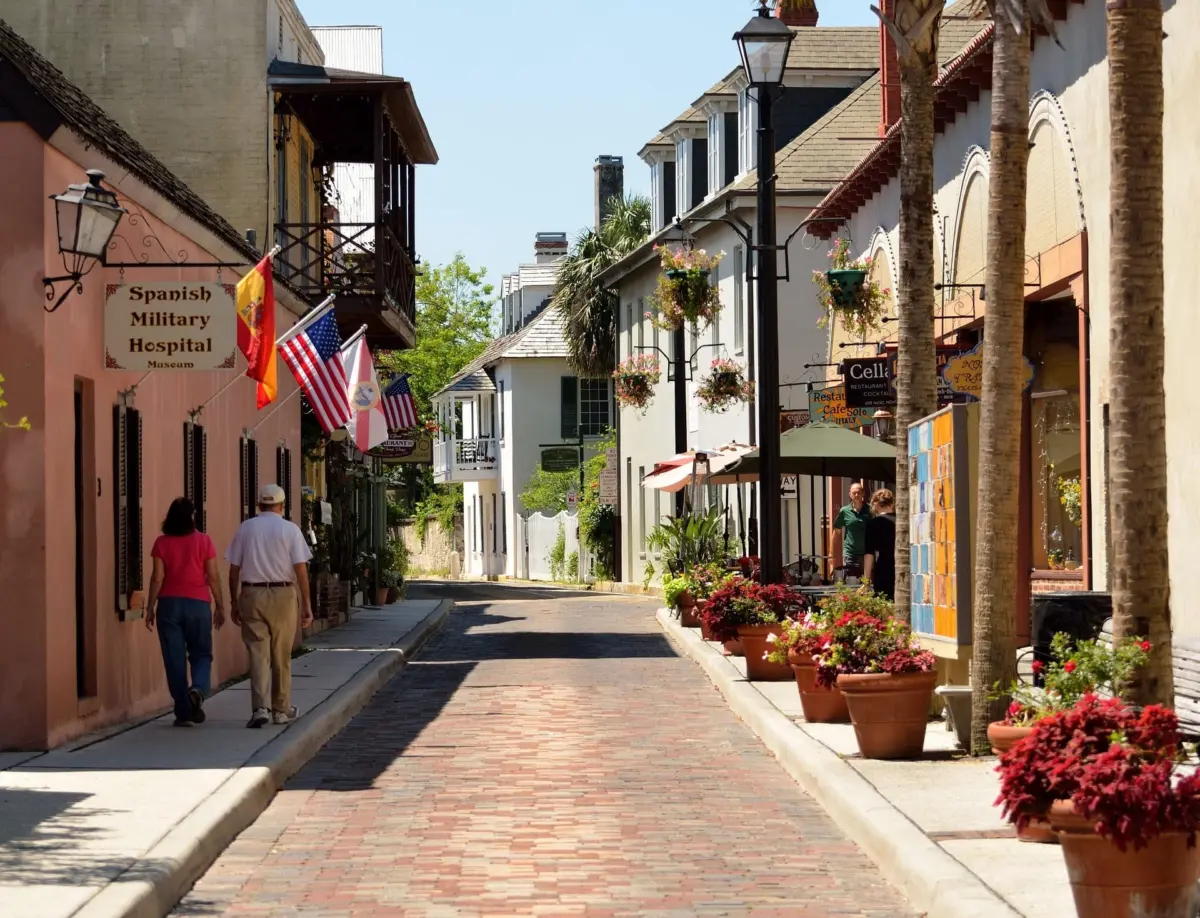
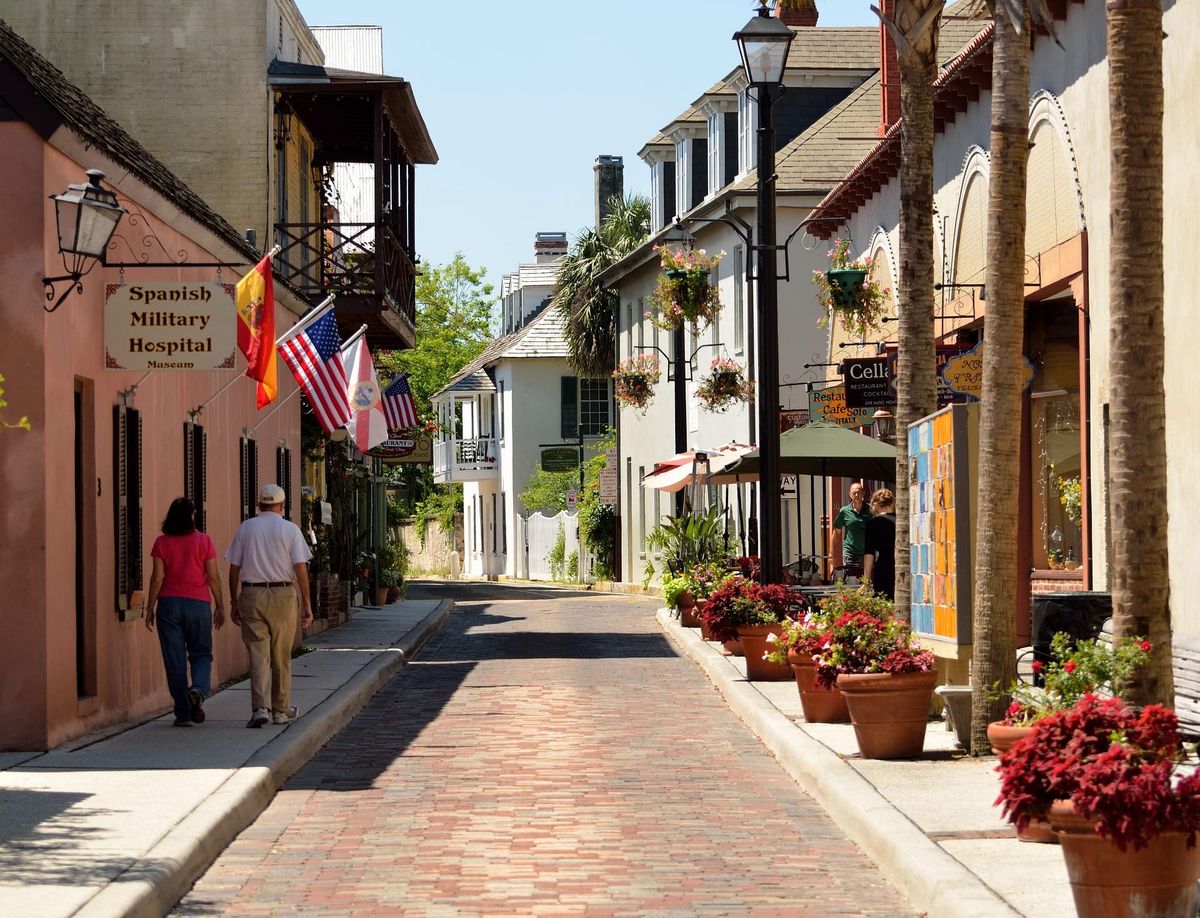
Running through the heart of the historic district is Aviles Street, widely recognized as the oldest street in the United States. Lined with brick pathways, gas-style lamps, historic Spanish colonial homes, art galleries, and quaint cafes, Aviles Street preserves the narrow, pedestrian-friendly urban planning style of 16th-century Spanish settlements.
The city’s dedication to historical preservation is not a modern accident; it is the result of decades of civic activism. In the 19th and early 20th centuries, visionaries like railroad tycoon Henry Flagler recognized St. Augustine’s unique charm. Flagler transformed the sleepy garrison town into a luxurious winter resort destination for the American gilded elite, constructing architectural masterpieces such as the Ponce de Leon Hotel (now part of Flagler College) and the Alcazar Hotel (now the Lightner Museum).
Key Metrics and Economic Impact
- Year of Foundation: 1565 (predating Jamestown by 42 years and Plymouth Rock by 55 years).
- Annual Visitors: Approximately 2 million tourists visit St. Augustine annually, driven by cultural, historical, and architectural tourism.
- National Historic Landmark District: Designated in 1970, the historic district spans 36 blocks, encompassing the highest concentration of authentic colonial-era architecture in the nation.
- Primary Fortification: The Castillo de San Marcos National Monument receives over 750,000 visitors per year, managed by the National Park Service.
Official Statements & Expert Perspectives
Historians, preservationists, and municipal leaders frequently emphasize the profound historical weight and educational value held within St. Augustine’s ancient boundaries.
Dr. Michael J. Gannon, the late, preeminent historian of Florida and professor emeritus at the University of Florida, frequently noted the underestimated historical importance of Spain’s early presence in North America:
"American history has traditionally been taught through an Anglo-centric lens—focusing heavily on Jamestown and Plymouth. Yet, the story of the United States is far older, more diverse, and deeply rooted in Spanish, French, and Indigenous foundations that predate the English arrival by generations. St. Augustine is the living proof of that expansive heritage."
National Park Service representatives overseeing the Castillo de San Marcos have similarly highlighted the fort’s role as a testament to early American engineering and cross-cultural conflict:
"The Castillo de San Marcos is not merely a collection of old stones; it is a physical chronicle of empire, endurance, and human perseverance. It reflects the convergence of Spanish soldiers, African slaves, British invaders, and Indigenous nations—all of whom shaped the destiny of this region long before the United States became a nation."
Local tourism and historic preservation officials emphasize that maintaining the city’s authenticity remains paramount as visitor numbers continue to rise. City planners coordinate closely with state and federal agencies to balance modern infrastructure demands with the rigorous preservation of 16th-, 17th-, and 18th-century structures.
Future Outlook: Preserving Antiquity in a Modern Era
As St. Augustine looks toward its future, it faces challenges and opportunities common to many historic coastal communities worldwide.
Climate Resilience and Sea-Level Rise
One of the most pressing challenges facing St. Augustine in the 21st century is environmental vulnerability. Situated squarely on the Atlantic coast and crisscrossed by tidal marshes, the historic downtown area is increasingly susceptible to tidal flooding, severe storm surges, and sea-level rise associated with climate change.
In response, municipal leaders, historic preservationists, and federal agencies have launched comprehensive resilience initiatives. Projects include raising seawalls, improving stormwater drainage systems without compromising archaeological integrity, and utilizing advanced technological modeling to protect vulnerable coquina structures like the Castillo de San Marcos and the adjacent historic neighborhoods.
Cultural Education and Heritage Tourism
Looking ahead, St. Augustine is expanding its narrative scope to ensure that the city’s full history is represented accurately. Recent historical initiatives place a stronger emphasis on interpreting the lives of the enslaved Africans who built the settlement, the experiences of the free Black community at Fort Mose (the first legally sanctioned free Black town in North America, established in 1738 just north of St. Augustine), and the profound heritage of the Timucua people.
By broadening the historical lens beyond European conquerors to encompass a multi-ethnic, inclusive narrative, St. Augustine is positioning itself as a leader in modern heritage tourism.
Conclusion
Nearly 460 years after Don Pedro Menéndez de Avilés stepped ashore to establish a precarious outpost against the Atlantic tide, St. Augustine stands as a triumphant monument to human endurance. From its origins as a Timucua fishing ground to its centuries as a strategic Spanish bastion, and onward to its modern role as a beloved cultural capital, America’s oldest city continues to invite travelers to step back in time. As preservation efforts adapt to the environmental and cultural demands of the future, St. Augustine is poised to protect its ancient legacy for generations yet unborn.

0 Comments