

Executive Overview
For decades, the cultural narrative surrounding retirement has painted a picture of absolute liberation. We are conditioned to envision a golden era free from the relentless tyranny of alarm clocks, morning commutes, and corporate bureaucracy. In its place, society promises a vibrant canvas of stress-free days dedicated entirely to self-actualization, unhurried travel, long-deferred creative pursuits, and deep personal fulfillment. Most working adults carry a mental—if not literal—bucket list detailing the grand adventures they will undertake once they finally walk out of the office for the last time.
Yet, a stark and uncomfortable reality underpins this idyllic fantasy: very few people actually execute the items on their retirement bucket lists.
As explored in depth by retirement lifestyle planners and behavioral experts alike, the primary obstacle preventing individuals from achieving their ideal retirement is not financial shortfall or a lack of time; it is an unwillingness to change. Human beings are creatures of habit, shaped by decades of ingrained routines, psychological safety nets, and day-to-day patterns. When the structure of a career is abruptly removed, people rarely invent a daring new lifestyle from scratch. Instead, they default to what is comfortable.
To bridge the gap between the retirement of our imaginations and the reality of our golden years, an intentional, often uncomfortable shift in lifestyle and habits is required. Without deliberate behavioral modification, the retirement dream risks dissolving into an extended routine of passive consumption and unfulfilled potential.

Detailed Chronology: The Evolution of Unfulfilled Intentions
The gap between retirement aspirations and actualized lifestyle changes can be tracked through common behavioral patterns that develop over a lifetime. Understanding how these patterns form—and why they persist long after leaving the workforce—sheds light on why so many retirees fail to transform their daily existence.
Phase 1: The Accumulation Years (Decades Before Retirement)
Throughout our working lives, routines are dictated by external forces. Corporate projects, email inboxes, meeting schedules, and domestic obligations provide an invisible scaffolding for our time. During this phase, individuals accumulate far more than financial assets; they accumulate physical possessions, psychological crutches, and rigid behavioral habits.
For instance, many adults spend decades collecting books, tools, keepsakes, and household items with the vague notion that they "might need them someday." Similarly, reliance on a corporate network provides an automatic, low-effort social structure, while unstructured evenings frequently dissolve into passive habits like browsing the internet or watching television.
Phase 2: The Proclamation Period (The Eve of Retirement)
As retirement approaches, anticipation peaks. Individuals frequently make bold declarations about how they will radically reinvent their lives. Common refrains include promises to downsize into a minimalist home, purge decades of accumulated clutter from attics and garages, write the great American novel, learn a new language, or relocate to an entirely new region or country. At this stage, the emotional momentum of leaving the workforce creates a powerful illusion that monumental lifestyle changes will happen effortlessly once time is no longer an obstacle.

Phase 3: The Inertia Trap (The First Seven Years of Retirement)
When the reality of retirement finally sets in, the lack of an immediate, forced catalyst often paralyzes ambitious plans. Studies of retirees tracking their progress over five- to seven-year intervals frequently reveal a startling disconnect: the cluttered garage remains full, the unfinished manuscripts sit untouched in digital folders, and daily routines mirror pre-retirement habits minus the commute.
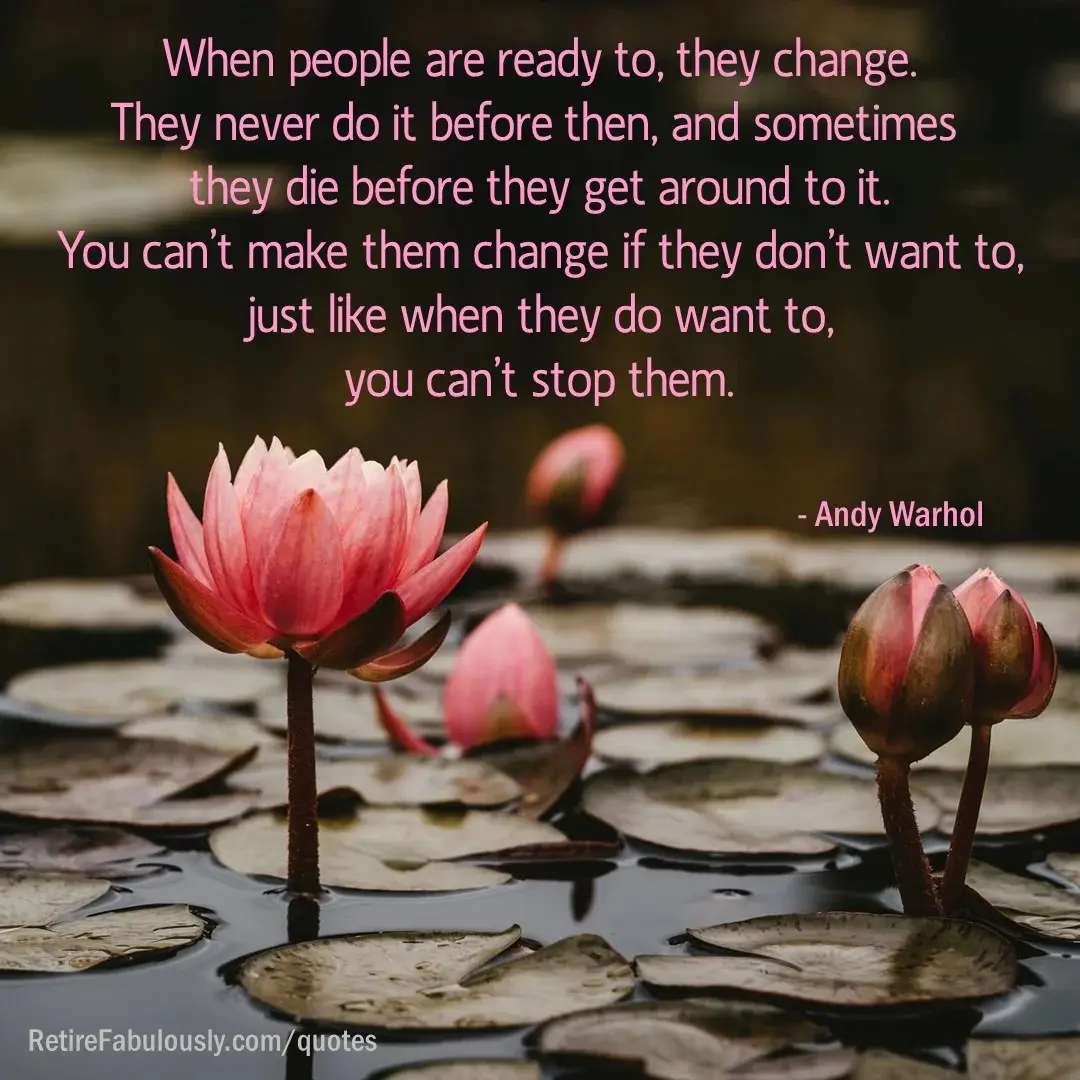
Without the external pressures of a job, individuals discover just how deeply entrenched their lifelong behaviors are. Procrastination is no longer fueled by a lack of time, but by a lack of self-directed discipline. As famous artist Andy Warhol once observed regarding human behavior: "When people are ready to, they change. They never do it before then, and sometimes they die before they get around to it. You can’t make them change if they don’t want to, just like when they do want to, you can’t stop them."
Supporting Context & Metrics: What the Data Reveals About Retiree Time Use
While cultural myths suggest that retirement triggers a massive wave of adventure, exhaustive data compiled by institutions such as the Bureau of Labor Statistics (BLS) tells a vastly different story. Time-use surveys tracking older populations and retirees provide empirical evidence of how people actually allocate their newfound freedom.
The Expansion of Existing Habits
When work is permanently removed from an individual’s schedule, the vacuum is rarely filled with groundbreaking new endeavors. Instead, existing daily habits simply expand to occupy the newly available hours.

According to BLS time-use charts comparing employed versus non-employed individuals, the most significant statistical jump in daily activity is not found in international travel, intensive volunteering, or masterclasses in the arts. Rather, the greatest surge occurs in television viewing and passive media consumption.
Breaking Down "Leisure and Sports"
At first glance, BLS data regarding "Leisure and Sports" time among older adults appears encouraging, showing a sharp upward spike upon leaving the workforce. However, a deeper investigative look into the numbers shatters optimistic assumptions:
- Passive vs. Active Leisure: More than half of all time categorized under "Leisure and Sports" for retirees is claimed entirely by watching television and listening to media.
- Physical Activity Realities: Actual, intentional physical activity—such as exercising, sports, or active recreation—comprises a minuscule fraction of this leisure time, hovering around a mere 5%.
- Creative and Intellectual Pursuits: Statistically significant numbers of retirees taking up rigorous new hobbies, such as advanced writing, complex painting, musical mastery, or community leadership, register as statistical anomalies rather than mainstream trends.
The Psychology of Comfort Zones
Why do these statistics remain so stubbornly consistent? The answer lies in the friction of stepping outside one’s comfort zone.
Consider the prospect of moving to a new city or country during retirement. While enticing on paper, relocating demands that an individual forge an entirely new support ecosystem: finding new doctors, discovering unfamiliar grocery stores, learning local geography, and building a social circle from scratch. For someone accustomed to decades of geographical and social stability, the cognitive load of these changes can trigger latent anxiety, causing them to retreat into familiar surroundings.

Similarly, financial habits built over a lifetime—such as dining out frequently or impulsive retail spending—require conscious, disciplined restraint to modify. Without a deliberate plan to curb these expenses in favor of long-term experiential goals, retirees often find their spending patterns remaining completely unchanged.
Official Insights: Expert Perspectives on Navigating the Transition
Transitioning from a career-driven identity to a self-directed retirement lifestyle is widely recognized by psychologists and transition specialists as one of life’s most profound psychological hurdles.
In specialized literature addressing this phase—such as the guidance compiled in retirement planning guides like Smooth Sailing Into Retirement—experts emphasize that the emotional and behavioral adjustments required are frequently underestimated.
Shedding the Former Job Title
One of the most insidious traps of retirement is identity stagnation. For decades, an individual’s self-worth, social standing, and daily purpose are inextricably linked to a job title. When that title is stripped away, a vacuum forms.

Transition experts note that successful retirees do not merely stop working; they proactively architect a new identity. This requires stepping away from the safety net of corporate validation and cultivating internal motivation. Writing, painting, mentoring, or community organizing require a high degree of self-regulation—qualities that corporate environments often stifled in favor of compliance and project management.
The Myth of Natural Transition
A core takeaway from retirement lifestyle authorities is that change is never accidental; it is strictly intentional.
People often operate under the subconscious belief that once they have all the time in the world, inspiration will strike and motivate them to take action. Professional coaches argue the opposite: without rigid personal frameworks, daily routines naturally degrade into passivity. If a retiree wants to become a writer, they must ruthlessly protect a 15-to-30-minute window every single day, insulating that time from household chores, administrative distractions, and digital noise. If they wish to learn a musical instrument, they must endure the humbling frustration of being a beginner—a psychological barrier that many adults, accustomed to decades of professional competence, find difficult to tolerate.
Future Outlook: How to Guarantee Your Ideal Retirement
Recognizing the "Retirement Paradox" is the first step toward overcoming it. If the statistical reality shows that most retirees simply watch more television and repeat old patterns, how can an individual ensure their golden years genuinely reflect their ambitions?

1. Conduct a Brutal Audit of Daily Habits
Before retiring, individuals must evaluate their current behavior with objective honesty. Look at how free time is spent on weekends or vacations. If weekends are routinely squandered on chores and binge-watching, retirement will likely look the same—just scaled up to seven days a week. Identifying these baseline habits allows for targeted intervention.
2. Practice Self-Discipline Before You Leave the Workforce
Do not wait until your final day on the job to start living your ideal retirement. If you want to write a book, paint, or practice an instrument in retirement, start carving out those blocks of time now, while you are still working. Developing the mental discipline to protect your passions amidst a busy schedule builds the behavioral muscle memory required for long-term retirement success.
3. Embrace the Discomfort of Change
True fulfillment lives outside the comfort zone. Whether it is finally downsizing decades of accumulated household clutter, forcing yourself to initiate conversations with strangers to build a new social circle, or committing to a strict daily creative routine, growth requires friction. Accept that feeling uncomfortable is a sign of progress, not a signal to quit.
4. Redefine Your Metrics of Success
In the corporate world, success is measured by promotions, titles, and performance reviews. In retirement, success must be redefined entirely by personal engagement, curiosity, and vitality. By setting intentional, non-negotiable milestones—such as visiting three new countries a year, completing a creative manuscript, or volunteering weekly—retirees can escape the gravitational pull of passivity.

Ultimately, the ideal retirement lifestyle is not something you stumble into the moment you stop working. It is something you must actively build, habit by habit, choice by choice. As the data clearly shows, doing nothing different guarantees nothing will change. The choice to make your retirement truly fabulous belongs entirely to you.

0 Comments