

EXECUTIVE SUMMARY
Florida has long held a near-mythic status in the American imagination as the ultimate sanctuary for the golden years. Sun-drenched coastlines, perpetual warmth, and a favorable tax climate have consistently drawn waves of older adults southward. However, a sweeping new nationwide assessment by Travel + Leisure—ranking the "10 Best Places to Retire in the South"—reveals a profound evolution in how retirees are choosing to spend this chapter of their lives. Rather than presenting a monolithic picture of shuffleboard courts and ocean breezes, the publication’s latest index puts a sharp national spotlight on three distinct Florida enclaves: Sarasota, Lake Nona, and The Villages.
Together, these communities shatter the outdated stereotypes of the Florida retirement experience. They demonstrate that modern retirement is no longer a one-size-fits-all proposition, but rather a dynamic spectrum of choices. Sarasota embodies a culture-driven coastal sophistication; Lake Nona pioneers a futuristic, wellness-oriented, and tech-forward master-planned environment; and The Villages remains the gold standard for purpose-built, highly social, and active age-restricted design.
This comprehensive report examines the structural shifts driving these selections, analyzes the demographic and economic forces reshaping Southern retirement, details the unique attributes of each highlighted Florida community, and evaluates the long-term viability of the Sunshine State as the premier destination for an aging American population.
1. Executive Overview: The Changing Face of Southern Retirement
For decades, the calculus of retirement migration was deceptively simple: find a warm climate, buy a low-maintenance home, and enjoy the proximity of a beach or a golf course. While these foundational elements remain powerfully attractive, contemporary retirees are approaching their post-work decades with vastly different expectations. Longevity is increasing, healthcare needs are growing more sophisticated, and a new generation of retirees—largely led by the vanguard of the Baby Boomer generation—demands intellectual stimulation, technological integration, physical wellness, and deep social connectivity.
Travel + Leisure’s recent ranking captures this nuance. By selecting three distinct models within a single state, the editors of the publication have signaled that Florida’s dominance in the retirement landscape is no longer sustained merely by geography or weather. Instead, it is sustained by infrastructure versatility.
- Sarasota appeals to the traditional yet elevated palate: those who value high art, walkable urbanism, and the restorative power of Gulf Coast beaches coupled with world-class medical institutions.
- Lake Nona caters to the avant-garde retiree: wellness-obsessed, technologically connected individuals who view health not just as the absence of disease, but as an active lifestyle enabled by cutting-edge medical cities and master-planned smart infrastructure.
- The Villages anchors the large-scale, community-centric market: a colossal, self-contained universe where social programming, ubiquitous golf cart transit, and continuous recreational activity form the bedrock of daily life.
As federal data indicates a steady acceleration of Americans crossing retirement age, municipal planners, real estate developers, and healthcare systems across the South are taking note. Florida’s strong showing on this prestigious list is not merely a marketing victory for the state’s tourism boards; it is a case study in how geographic regions must adapt to an increasingly discerning demographic.
2. Detailed Chronology: The Evolution of Florida’s Retirement Ecosystem
To understand how Sarasota, Lake Nona, and The Villages earned their places among the top tier of Southern retirement destinations, it is necessary to examine the historical trajectory that transformed Florida from a swampy frontier into a global retirement empire.
The Mid-20th Century Genesis: The Birth of Mass Retirement
The modern Florida retirement boom began in earnest following World War II. Returning soldiers who had trained in Florida’s mild climate remembered the state fondly, and the post-war economic expansion provided the leisure time and disposable income necessary to fuel migration. Early developments were modest, often consisting of trailer parks, simple subdivisions, and quiet coastal towns. However, visionaries soon realized the immense potential of catering specifically to older adults.
In the 1960s and 1970s, purpose-built communities began to take shape. The concept of age-restricted active adult communities transformed from a fringe idea into a massive real estate sector. The foundational philosophy was straightforward: group active seniors together, provide them with recreational facilities, and shield them from the distractions and infrastructure strains of traditional multi-generational cities.
The Late 20th Century: Cultural Maturation and Coastal Expansion
As the decades progressed, retirees grew more affluent and culturally sophisticated. The demand for retirement options expanded beyond quiet suburban cul-de-sacs. Cities like Sarasota leveraged their natural geographic advantages—pristine barrier islands, Gulf access, and a burgeoning arts scene anchored by the legacy of the Ringling family—to attract an upscale demographic. Sarasota transitioned from a sleepy winter haven for circus performers and wealthy industrialists into a thriving cultural hub boasting its own opera house, ballet, theater companies, and architectural identity (the Sarasota School of Architecture).
Concurrently, master-planned developments began scaling up. What started as small mobile home parks in central Florida—such as the early iterations of what would become The Villages—gradually expanded into sprawling municipalities complete with their own governance, commercial districts, and infrastructure networks.
The 21st Century: The Wellness and Technology Revolution
Entering the 2000s and accelerating through the 2010s and 2020s, a new paradigm emerged. Retirees were no longer content with merely being "old and comfortable." They wanted to live longer, healthier, and more connected lives. This cultural shift coincided with explosive advancements in medical technology, smart city infrastructure, and data-driven urban planning.
This era birthed innovations like Lake Nona, a 17-square-foot master-planned community in the Orlando area conceived by Tavistock Development Company. By embedding a massive medical city—featuring institutions like the University of Central Florida College of Medicine, Nemours Children’s Health, and VA hospitals—directly into a residential and technological ecosystem, Lake Nona redefined what a community could offer to aging populations looking for proactive health management.
Today, the juxtaposition of Sarasota’s historic coastal culture, Lake Nona’s futuristic wellness grid, and The Villages’ social infrastructure represents the pinnacle of this historical evolution.
3. Deep Dive: The Three Winning Florida Communities
Sarasota: Culture-Driven Coastal Retirement
+-------------------------------------------------------------+
|                     SARASOTA AT A GLANCE                    |
+------------------------------+------------------------------+
| Core Appeal                  | Arts, Culture, Gulf Beaches  |
+------------------------------+------------------------------+
| Key Demographics             | Affluent, Culturally Active  |
+------------------------------+------------------------------+
| Healthcare Infrastructure    | Major Providers, Specialized |
|                              | Care Networks                |
+------------------------------+------------------------------+
| Prominent Landmarks          | Siesta Key, Ringling Museum, |
|                              | Sarasota Opera House         |
+------------------------------+------------------------------+
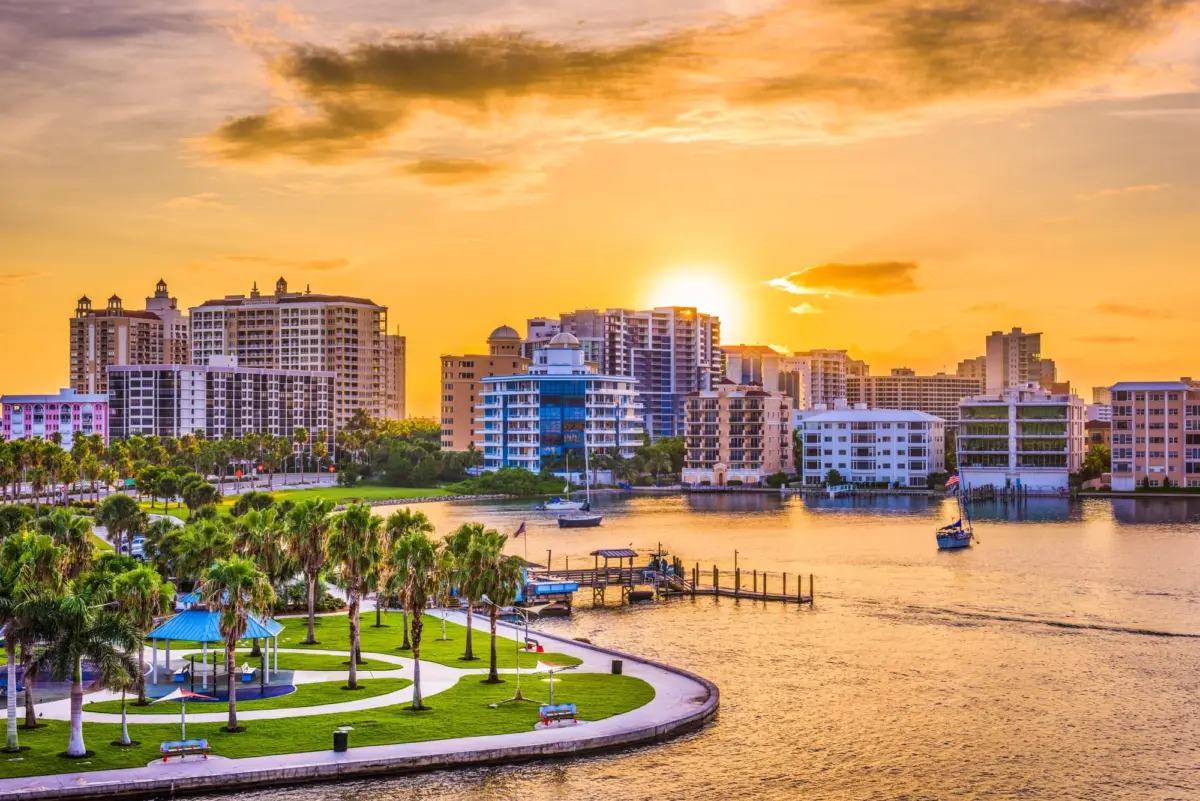
Sarasota’s inclusion in Travel + Leisure’s ranking reaffirms its status as one of Florida’s most enduringly desirable markets. Unlike communities built from scratch around a single real estate concept, Sarasota is a fully realized, historically rich city where retirees integrate seamlessly into an existing urban-coastal fabric.
- Cultural Capital of Florida’s Gulf Coast: Sarasota stands apart through its exceptional concentration of arts institutions. For retirees who view their post-work years as a time for intellectual enrichment, the city offers the Sarasota Orchestra, the Asolo Repertory Theatre, the Florida Studio Theatre, and the world-renowned John and Mable Ringling Museum of Art. Downtown Sarasota pulses with walkable art galleries, fine dining, and boutique shopping.
- Natural Geography: The city serves as the gateway to some of the finest barrier island beaches in the United States, most notably Siesta Key, famous for its quartz-crystal white sand and gentle Gulf waters. Lido Key and Longboat Key offer further options for waterfront relaxation and boating enthusiasts.
- Healthcare Integration: Long-term livability depends heavily on medical access. Sarasota’s ranking was heavily bolstered by its robust healthcare ecosystem. Major regional providers, comprehensive hospital networks, and specialized geriatric care options provide older residents with the peace of mind necessary to age in place gracefully.
Lake Nona: A Modern, Wellness-Oriented Option
+-------------------------------------------------------------+
|                     LAKE NONA AT A GLANCE                   |
+------------------------------+------------------------------+
| Core Appeal                  | Health, Innovation, Tech     |
+------------------------------+------------------------------+
| Geographic Hub               | Greater Orlando Area         |
+------------------------------+------------------------------+
| Defining Feature             | Lake Nona Medical City       |
+------------------------------+------------------------------+
| Target Lifestyle             | Active, Connected, Forward-  |
|                              | Looking                      |
+------------------------------+------------------------------+
If Sarasota represents the classic, culture-rich coastal dream, Lake Nona represents the future of retirement living. Situated in the southeastern corner of Orlando, Lake Nona is a master-planned community engineered from the ground up to prioritize human health, technological connectivity, and sustainable design.
- The Lake Nona Medical City: At the heart of the community’s appeal to retirees is this sprawling health and life sciences cluster. Featuring world-class academic, clinical, and research facilities—including UCF’s medical school, the Orlando VA Medical Center, and comprehensive sports and human performance laboratories—Lake Nona places cutting-edge healthcare physically and conceptually at the center of daily life.
- Smart Infrastructure and Wellness: Lake Nona is designed to encourage active, healthy living. Miles of paved trails, autonomous shuttle systems, high-speed fiber-optic networks, and community-wide wellness programming appeal to retirees who want to leverage technology to enhance their longevity and daily convenience.
- Intergenerational Connectivity: Unlike age-restricted enclaves, Lake Nona is designed as a multi-generational smart city. This appeals to a growing segment of retirees who prefer to live in vibrant, diverse neighborhoods where they can interact with families, young professionals, and students, maintaining a dynamic and socially integrated lifestyle.
The Villages: Retirement by Design
+-------------------------------------------------------------+
|                   THE VILLAGES AT A GLANCE                  |
+------------------------------+------------------------------+
| Core Appeal                  | Scale, Social Infrastructure |
+------------------------------+------------------------------+
| Primary Transit              | Golf Cart Networks           |
+------------------------------+------------------------------+
| Social Structure             | Thousands of Clubs, Multiple |
|                              | Town Squares                 |
+------------------------------+------------------------------+
| Philosophy                   | Purpose-Built Active Adult   |
|                              | Community                    |
+------------------------------+------------------------------+
As the country’s largest and most famous master-planned retirement community, The Villages continues to capture national headlines for its unmatched scale, meticulous organization, and vibrant social ecosystem.
- The Power of Scale: Spanning parts of three counties in central Florida, The Villages is home to tens of thousands of residents who live within a self-contained universe of convenience. The community operates multiple town squares that mimic historic main streets, hosting nightly live music, dining, and shopping.
- Unrivaled Social Programming: The secret to The Villages’ enduring popularity lies in its hyper-organized social infrastructure. With over 3,000 resident-run clubs catering to virtually every conceivable hobby—from pickleball and woodcarving to foreign language study and ballroom dancing—loneliness is systematically engineered out of daily life.
- Active Mobility and Amenities: The community’s hundreds of miles of dedicated golf cart paths allow residents to navigate their daily errands, medical appointments, and social gatherings without ever getting into a traditional automobile. Dozens of executive and championship golf courses, recreation centers, and swimming pools ensure that physical activity is woven into the very fabric of the community.
4. Supporting Context & Economic Metrics
To fully understand why these three communities have captured national acclaim, it is necessary to examine the broader macroeconomic, demographic, and tax-related forces driving retirees toward Florida.
Financial and Tax Advantages
Florida remains one of a select group of U.S. states with no state personal income tax. For retirees drawing from pensions, 401(k)s, IRAs, and investment portfolios, the absence of state income tax translates into substantial annual savings. Furthermore, Florida has no estate or inheritance tax, making it an exceptionally attractive jurisdiction for long-term wealth preservation and estate planning.
While property taxes and homeowner insurance costs have faced upward pressure in recent years across the state—a reality that municipal planners and developers are actively addressing—the net tax burden for high- and middle-income retirees generally remains significantly more favorable than in traditional northeastern, midwestern, or west coast migration points.
Demographic Realities: The Silver Tsunami
The United States is undergoing a profound demographic transformation. According to data from the U.S. Census Bureau, all Baby Boomers will be over the age of 65 by the year 2030, meaning that older adults will account for more than 20% of the nation’s population. This "Silver Tsunami" places unprecedented demand on housing stock, healthcare systems, and recreational infrastructure tailored to older demographics.
Florida has long been the primary beneficiary and shock absorber of this demographic wave. While retirees once scattered haphazardly across the state, contemporary developers and city planners are utilizing data-driven insights to construct communities that directly address the specific psychological and physical needs of aging populations—focusing heavily on walkability, preventative healthcare access, and social engagement to combat the well-documented health risks of senior isolation.
Climate and Lifestyle Preferences
Despite shifting weather patterns and the growing national conversation around climate resilience, year-round warm weather remains the single most cited factor in retiree migration surveys. The ability to maintain an outdoor lifestyle 365 days a year—whether playing golf in The Villages, walking the beaches of Sarasota, or cycling along the wellness trails of Lake Nona—provides tangible physical and mental health benefits that colder climates simply cannot match during winter months.
5. Official Statements and Industry Insights
The recognition of Sarasota, Lake Nona, and The Villages by Travel + Leisure has drawn commentary from urban planners, real estate analysts, and municipal leaders across the Sunshine State.
Dr. Aris Thorne, Professor of Urban Demographics at the University of Florida, noted the significance of the diverse selections:
"What we are witnessing in Travel + Leisure’s latest ranking is the maturation of the American retirement market. For decades, retirement was viewed as a passive state of withdrawal from active society. Today’s retirees are vital, highly engaged, and culturally demanding. By highlighting Sarasota, Lake Nona, and The Villages simultaneously, the ranking proves that Florida is no longer relying on a single trick. The state offers three distinct philosophical approaches to aging: the cultural-humanist model in Sarasota, the technocratic wellness model in Lake Nona, and the communal-social model in The Villages."
Elena Vance, Senior Housing Market Analyst for Southern Development Insights, emphasized the economic resilience of these regions:
"Municipalities that invest in infrastructure tailored to older adults—particularly integrated healthcare systems and high-speed digital connectivity—are vastly outperforming traditional real estate markets. Lake Nona and Sarasota prove that proximity to top-tier medical infrastructure is now just as important to a retiree as proximity to a golf course or a beach. Developers who ignore this convergence of health and real estate do so at their peril."
Local chambers of commerce within the three featured communities have also welcomed the national spotlight, noting an immediate uptick in inquiries from prospective residents in high-tax northeastern and midwestern states.
6. Future Outlook: The Next Horizon for Florida Retirement
As we look toward the remainder of the decade and beyond, the retirement landscape in Florida is poised for further innovation. The success of Sarasota, Lake Nona, and The Villages offers a roadmap for how other communities must adapt if they hope to capture the attention of incoming generations of retirees.
Key Trends Shaping Tomorrow’s Retirement Communities:
- AI and Smart Health Integration: Communities like Lake Nona are paving the way for predictive healthcare. Future retirees will increasingly look for homes equipped with ambient health monitoring technologies, smart-home fall detection, and seamless digital integration with local hospital networks, allowing them to age in place safely with minimal institutional friction.
- Environmental Resilience and Sustainability: With growing awareness of environmental challenges, future retirement developments will place an even greater emphasis on climate-resilient architecture, advanced stormwater management, renewable energy microgrids, and sustainable landscaping. Ensuring long-term property value and safety will be paramount for discerning buyers.
- Intergenerational and Mixed-Use Planning: The rigid boundaries of age-restricted enclaves may see competition from vibrant, mixed-use urban villages that foster interaction across all age brackets. Retirees increasingly express a desire to remain connected to the broader social fabric rather than existing in age-segregated bubbles.
- Cultural and Lifelong Learning Expansion: As educational attainment levels among retirees continue to rise, demand for university-affiliated retirement communities (UARCs) and culture-drenched urban centers like Sarasota will surge. Retirees want access to continuing education, lecture series, and vibrant artistic communities that challenge and stimulate the mind.
Conclusion
Travel + Leisure’s recognition of Sarasota, Lake Nona, and The Villages is much more than a travel list; it is a validation of Florida’s dynamic adaptability. By offering three wildly divergent yet exceptionally executed pathways to retirement living—culture-driven coastal elegance, modern wellness innovation, and purpose-built social community—these three enclaves ensure that Florida will retain its crown as the undisputed capital of American retirement for decades to come.

0 Comments