

Executive Overview
GAINESVILLE, Fla. — As the final hours of the fall move-in weekend draw to a close, the University of Florida (UF) campus is alive with a vibrant mix of bittersweet farewells, energetic anticipation, and the unmistakable hum of academic reawakening. Marking the unofficial commencement of the 2026–2027 academic cycle, thousands of incoming freshmen, returning upperclassmen, and their families have converged on Gainesville to establish their home away from home.
While the transition to higher education is universally recognized as one of the most structurally complex and emotionally taxing periods in a young adult’s life, UF’s housing division, alongside a dedicated vanguard of resident assistants (RAs) and student volunteers, has executed a masterclass in logistical coordination. Operating under grueling physical conditions—battling both North Florida’s relentless late-summer humidity and high-volume vehicular traffic—this operational backbone has worked around the clock. Their mission: to transform what could easily be a chaotic, high-stress ordeal into a seamless, welcoming introduction to the Gator Nation.
The official first day of classes for the Fall 2026 semester is slated for Thursday, August 20. However, the campus ecosystem has been operating at peak capacity for days. Strategically positioned across residential complexes from Beaty Towers to Rawlings Hall and the Graham Area, volunteers have stood as the frontline ambassadors of the university. Armed with rolling bins, hydration stations, and boundless enthusiasm, they have absorbed the initial shockwave of the university’s massive influx of students.
This in-depth report explores the meticulous orchestration behind UF’s Fall 2026 move-in weekend. Through firsthand accounts from student leaders, analysis of residential logistics, and a broader look at the socio-emotional dimensions of collegiate transitions, we examine how the University of Florida successfully manages one of the largest campus migrations in the American Southeast.
Detailed Chronology: A Weekend of Controlled Chaos and Community Spirit
The anatomy of a major university move-in weekend resembles a military deployment more than a traditional administrative event. For UF housing officials, public safety personnel, and student volunteers, the timeline of operations began months in advance, but the physical reality materialized in a carefully timed, high-stakes choreography over a grueling 48-hour window.
Day One: The Early Wave and the First Line of Defense
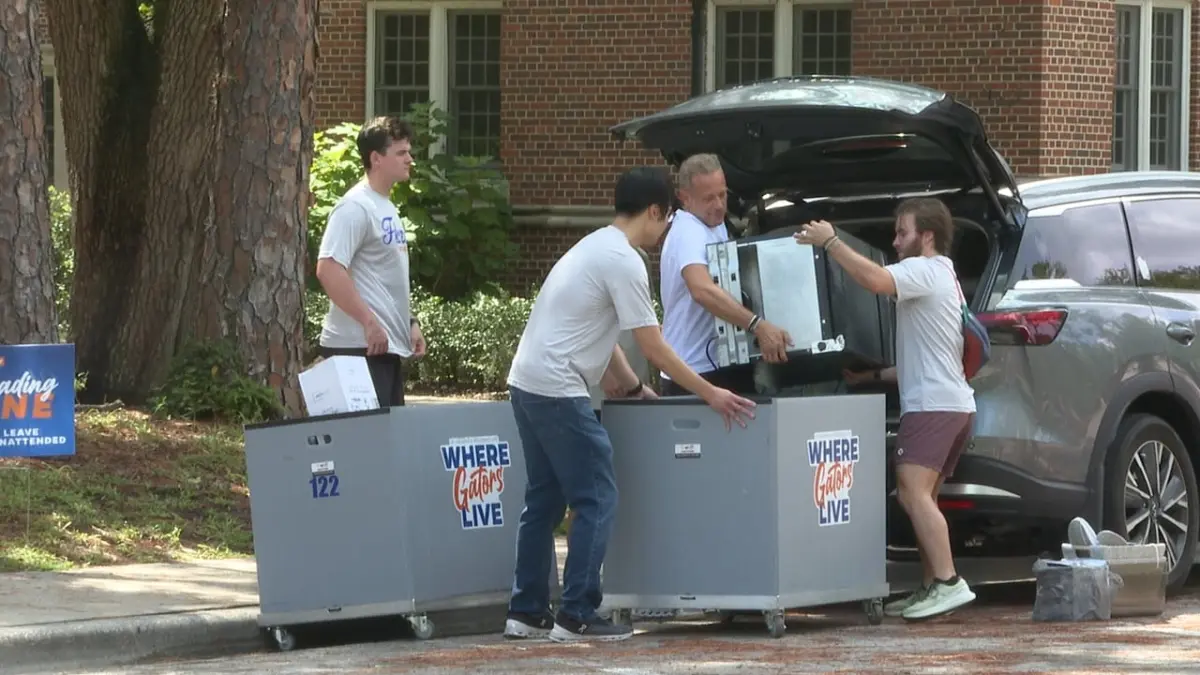
As the gates and parking corridors surrounding UF’s sprawling residential areas opened early Saturday morning, a steady stream of minivans, SUVs, and U-Haul trucks began to materialize. The air was thick with humidity, characteristic of late August in north-central Florida, yet the energy among the student staff was palpable.
Volunteers arrived well before the first vehicles pulled up to the unloading zones. Briefings were conducted at dawn, outlining traffic flow management, emergency protocols, and the critical importance of maintaining a welcoming demeanor despite the impending physical exhaustion.
By mid-morning, the traffic volume reached a crescendo. In residential zones like the Graham Area—comprising multiple high-density residence halls—the operational targets were unforgiving. Student coordinators established a rigorous throughput quota: the goal was nothing short of processing 30 vehicles every 30 minutes, distributed efficiently across three distinct building drops.
For Aidan Hosler, a junior resident assistant working the frontlines of the operation, the frenetic pace was secondary to the deeper purpose of the role.
"As a resident assistant, this is one of the ways that we get to welcome residents to our community," Hosler reflected during a brief respite between vehicle rotations. "It helps them settle into the community, feel part of that area, and just bring positivity to other people’s lives."
Hosler’s residential precinct alone braced for an influx exceeding one thousand incoming students over the weekend. Navigating this volume required precise timing. If a vehicle lingered too long at a loading dock, the cascading delay threatened to back up traffic onto major campus thoroughfares, drawing the attention of campus police and parking enforcement. Yet, thanks to the synchronized efforts of teams unloading boxes, collapsing cardboard, and directing elevators, major bottlenecks were largely averted.
Day Two: Sustaining Momentum Amidst the Elements
By Sunday morning, the physical toll of the operation began to weigh heavily on the volunteer corps. Temperatures soared past the low 90s, with heat indices climbing well into the triple digits. For veterans of the move-in process, the environment was punishing.
Gretta Burke, a senior resident assistant who has weathered multiple move-in cycles, described the experience with a mixture of pragmatic realism and deep affection for the campus community.
"I know it’s so warm, and it’s brutal. We do two eight-hour days; I just think it’s so much fun," Burke said, wiping sweat from her brow as she directed a family toward the nearest service elevator. "I love welcoming the students to campus, and I also really love seeing the parents."
Burke’s perspective highlights a unique duality inherent in the move-in experience. While the physical labor—lifting heavy minifridges, navigating awkward storage totes up narrow stairwells, and pushing overloaded flatbeds—is exhausting, the emotional landscape offers an equally compelling narrative.
Throughout Sunday, volunteers witnessed a spectrum of human emotion. There were tears of anxiety from students stepping away from their family support systems for the first time, matched by the proud, tearful goodbyes of parents entrusting their young adults to the university’s care.
"I remember when I moved in," Burke shared, her voice softening as she recalled her own freshman arrival. "And I just think it’s so sweet to see all of the both sad and happy moments where the families are saying goodbye for the year and trusting their kids with us."
As Sunday evening approached, organizers projected that individual volunteers would have directly assisted an average of 90 families each over the course of the weekend. As the final boxes were unpacked and the cardboard was recycled, the campus transitioned from a staging ground of transit to a settled community of scholars preparing for the week ahead.
Supporting Context & Metrics: The Scale of UF Housing Operations
To fully appreciate the success of the Fall 2026 move-in weekend, one must understand the sheer scale of the University of Florida’s housing infrastructure and the demographic realities driving these operations.
Enrollment Demographics and Housing Capacity
As one of the premier public research institutions in the United States, UF consistently attracts tens of thousands of applicants globally, yielding massive freshman cohorts year after year. Housing more than 7,000 to 8,000 students on campus requires an intricate network of residence halls ranging from traditional corridor-style rooms to modern suite-style complexes.
- Total On-Campus Residential Capacity: Approximately 8,500 students.
- Peak Hourly Vehicle Processing Rate (Per Zone): 60 vehicles per hour across multi-building sectors.
- Average Volunteer Contact Rate: ~90 families per volunteer over a standard two-day, 16-hour shift rotation.
- Duration of Volunteer Shifts: Two mandatory 8-hour blocks, executed under extreme thermal conditions.
The Logistics of Campus Flow
Managing vehicle traffic during move-in is one of the university’s most formidable logistical challenges. Gainesville’s local infrastructure—interfacing with arterial roads such as University Avenue and SW 13th Street—experiences localized gridlock whenever major campus events occur.
To mitigate this, UF Transportation and Parking Services, in collaboration with Housing and Residence Education (HRE), implemented a restricted-access routing system. Families were assigned precise arrival windows, drastically reducing the concentration of vehicles at any single loading zone. Temporary signage, color-coded parking passes, and mobile-friendly directional maps ensured that out-of-state parents, many unfamiliar with Gainesville’s layout, could navigate the campus topography with minimal friction.
Furthermore, the environmental factor cannot be understated. Operating in North Florida during August exposes outdoor workers to severe heat-stress risks. UF environmental health and safety protocols mandated regular hydration breaks, mandatory rotation of personnel from sun-exposed loading docks to shaded indoor check-in desks, and the deployment of cooling stations equipped with electrolytes and medical support.
Official Statements and Leadership Perspectives
The institutional philosophy driving UF’s student-centric move-in model emphasizes community integration from the very first point of contact. University administrators have long recognized that student retention and mental well-being are deeply influenced by the initial transition experience.
In statements released ahead of the Fall 2026 term, university housing executives emphasized the vital role played by student leaders like Aidan Hosler and Gretta Burke. RAs are no longer viewed merely as rule-enforcers or administrative liaisons; they serve as the foundational bedrock of the university’s pastoral care network.
"The resident assistant corps embodies the core values of the University of Florida: leadership, service, and community," noted a senior housing administrator. "When an incoming freshman is overwhelmed by the size of the campus, the anxiety of coursework, or the reality of living away from home for the first time, it is often the RA who serves as the crucial bridge to institutional resources and emotional stability."
The decision to deploy veteran RAs as the vanguard of the move-in process is a deliberate pedagogical strategy. By utilizing peers who have successfully navigated the exact same cultural and academic milestones, the university fosters an immediate sense of belonging. The message communicated to families during the chaotic unloading process is clear: You are not alone; you are entering a structured, supportive ecosystem designed to help you thrive.
Future Outlook: Preparing for the August 20 Kickoff
With the physical transition of move-in weekend successfully concluded, the University of Florida pivots immediately toward academic readiness.
The Road to August 20
The final days leading up to Thursday, August 20, are designated for orientation programming, college-specific welcome events, and campus tours. Organizations such as "Weeks of Welcome" (WOW) have planned a comprehensive schedule of social and academic mixers designed to help students form peer networks before the rigors of lectures and examinations set in.
Key milestones for the opening week include:
- Convocation Ceremonies: Formal academic inductions welcoming the freshman class into the scholarly community of the university.
- College Open Houses: Informational sessions hosted by the Warrington College of Business, the Herbert Wertheim College of Engineering, the College of Liberal Arts and Sciences, and other academic units.
- Safety and Wellness Workshops: Mandatory orientations covering campus security, mental health resources, and academic support services such as the Reitz Union tutoring hubs.
Long-Term Residential Strategy
Looking beyond the immediate horizon of the Fall 2026 semester, UF’s housing division continues to evaluate infrastructure needs to meet growing enrollment pressures. With demand for on-campus living remaining intensely competitive, future capital improvement projects will focus on modernizing older residential stock and expanding sustainable building practices across campus housing complexes.
As the sun sets on Gainesville this Sunday evening, the frantic shouts of volunteers directing traffic and the slam of trunk doors have begun to fade, replaced by the quiet hum of air conditioning units, the soft glow of desk lamps, and the tentative laughter of roommates meeting for the very first time. The logistics of arrival are complete; the journey of higher education has officially begun.

0 Comments