

Executive Overview
In an era dominated by mass production, automated assembly lines, and plastic-molded consumer goods, the quiet rural community of Hollandtown, Wisconsin, houses a masterclass in patient craftsmanship. For over half a century, Petros Guitars has operated as a monument to uncompromising artisanal quality. Founded by master luthier Bruce Petros, the workshop has evolved from a humble basement venture into an internationally revered institution. Today, Petros Guitars supplies bespoke acoustic guitars and concert-grade ukuleles to discerning collectors, hobbyists, and legendary working musicians worldwide—including cultural icons such as Paul Simon.
Yet, the true narrative of Petros Guitars extends far beyond the polished woods and hand-carved braces; it is a profound study in generational continuity. As Bruce Petros looks toward a well-earned future, the enterprise is undergoing a seamless succession, passing from father to son. Matt Petros, who literally grew up surrounded by the aromatic dust of exotic tonewoods, is stepping into the leadership role. In an industry where retiring artisans often liquidate their tools and watch their hard-earned legacies fade into obscurity, the Petros family has engineered the ultimate succession plan: a living, breathing continuity of art, reputation, and acoustic science.
This in-depth feature explores the half-century trajectory of Petros Guitars, examining the accidental beginnings in the Rocky Mountains, the meticulous physics of eking out every ounce of tone, the unique dynamics of a multi-generational family enterprise, and the bright, resonant future awaiting the Hollandtown workshop.
Detailed Chronology: From a $15 Kit to a Global Luthier Empire
The Rocky Mountain Genesis (Early 1970s)
The story of Petros Guitars does not begin in a high-tech laboratory or a prestigious European trade school. It begins with serendipity, curiosity, and a fifteen-dollar bill. In the early 1970s, Bruce Petros was working as a tour guide in a picturesque Colorado mountain town. Like many young people of his generation, he was captivated by the acoustic revival sweeping American music, yet he lacked the financial means to purchase a high-end instrument.
While browsing the shelves of a local tourist shop, Petros stumbled upon an unassuming item: a rudimentary guitar kit priced at just $15. Intrigued by the challenge, he purchased the box of raw components, hauled it back to the resort housing where he lived, and set to work. Armed with basic tools and boundless patience, he pieced the instrument together.
When the glue dried and the strings were finally brought to tension, Petros experienced a moment of profound clarity. He struck a chord, examined the handmade creation, and realized a fundamental truth about his own capabilities. "There was this little tourist town that had, you know, shops," Petros recalls, reflecting on the turning point of his life. "And I found a guitar kit in this store, and it was like $15. And I took it back to the resort where I was living and put it together. And I looked at it and I went, ‘Wow, this is really cool. I could do this.’"
The Basement Years and the Move to Hollandtown
That initial spark quickly transformed into an all-consuming vocation. In the years immediately following his Colorado discovery, Bruce Petros committed himself to the demanding art of lutherie. Before establishing a permanent commercial footprint, he honed his skills in the damp basements of various rental homes, refining his woodworking techniques and studying the structural physics that govern stringed instruments.
As his ambition outgrew temporary dwellings, Petros sought a permanent homestead where he could establish a dedicated workshop—a sanctuary devoted entirely to the pursuit of acoustic perfection. This search ultimately led him and his young family to Hollandtown, Wisconsin.
"We bought this place and tore down this garage and built the shop, basically," Petros explains. This physical transition from subterranean workshops to a purpose-built rural facility marked the official birth of Petros Guitars as a professional commercial entity. It transformed a transient hobby into a permanent fixtures of the Wisconsin artisanal landscape.
Establishing International Acclaim
Over the decades that followed, the Hollandtown workshop became a crucible of acoustic engineering. Bruce Petros did not merely replicate traditional designs; he innovated, experimented, and relentlessly pursued structural efficiency. By optimizing top-bracing patterns, experimenting with exotic and domestic tonewoods, and hand-tuning every soundboard, he elevated Petros instruments into the upper echelon of the global guitar market.
Word of mouth among acoustic purists travels fast. Soon, regional folk musicians, international fingerstyle players, and serious collectors were placing orders. The ultimate validation of the shop’s world-class status arrived when legendary singer-songwriter Paul Simon acquired and integrated a Petros instrument into his collection. Today, whether crafting a deep-throated grand concert guitar or a vibrant, highly ornamented concert ukulele featuring curly Koa tops and curly bubinga backs and sides, the workshop maintains a standard of excellence that rivals centuries-old European guilds.
Supporting Context & Metrics: The Anatomy of a Petros Masterpiece
To understand the enduring allure of a Petros instrument, one must examine the intersection of material science, artistic vision, and economic reality that defines modern high-end lutherie.
The Economics of Independent Lutherie
The handmade instrument market operates on razor-thin margins and immense labor investments. Unlike mass-market manufacturers who produce thousands of units daily using computer-numerical-control (CNC) routers and synthetic finishes, independent luthiers invest hundreds of hours into a single creation.
Bruce Petros points out a stark industry reality regarding retirement and legacy:
"A lot of guitar makers when they quit, what are they going to do? You can’t sell a guitar-making shop. You can sell the tools and the wood. You can’t sell your reputation. So this is kind of the ideal situation where the reputation is built in and it continues on."
In the artisanal sector, a workshop’s true capital is intangible. It is locked in the accumulated wisdom of decades: knowing precisely how much to thin a soundboard by hand, understanding how a specific piece of aged spruce will react to seasonal humidity shifts, and predicting how an instrument’s voice will mature over twenty years of playing. By passing the operational helm to his son, Bruce has effectively preserved this intangible capital, ensuring that the brand equity built over 52 years remains intact.
The Physics of Tone: "Eking Out Every Little Bit"
For the Petros family, woodworking is merely the preliminary phase; the true art lies in acoustic tuning. Every instrument produced in the Hollandtown shop is engineered to elicit a specific emotional and sonic response.
"They sound better and they play better," Bruce Petros notes, describing the core philosophy of the workshop. "Figuring out the ways to, you know, eke out every little bit of tone."
This process involves dynamic soundboard voicing. Unlike commercial guitars built with uniform, thick wooden tops designed to withstand factory warranty claims regardless of abuse, Petros instruments feature graduated top plates. Master luthiers meticulously scrape and tap the wood, listening to its resonant frequencies, adjusting the stiffness of the internal braces, and balancing bass response against crisp, articulate trebles. The result is an instrument that responds dynamically to the lightest fingerstyle touch while maintaining structural integrity under heavy flatpicking.
Material Selection and Aesthetic Mastery
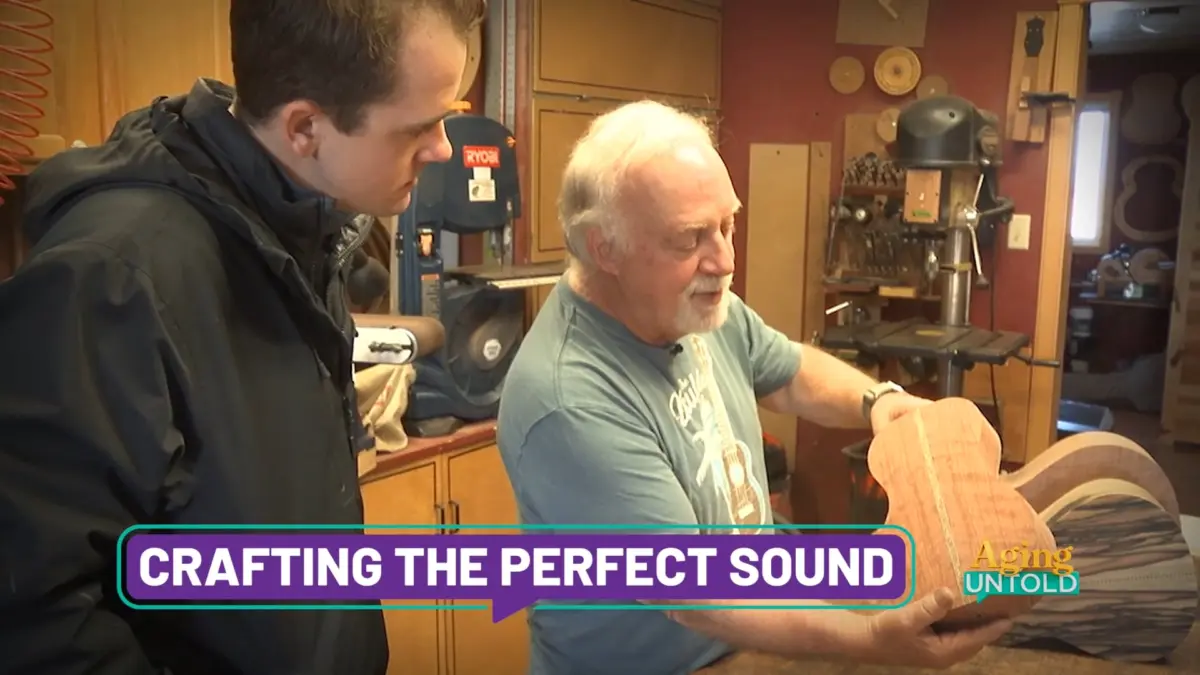
The aesthetic presentation of a Petros instrument is matched only by its acoustic fidelity. The workshop utilizes a curated inventory of rare, highly figured tonewoods. During a recent showcase of the shop’s inventory, Bruce highlighted a concert ukulele exemplifying this material mastery: "a little concert ukulele that’s got a curly Koa top and curly bubinga back and sides."
Koa, indigenous to the Hawaiian Islands, is prized for its balanced mid-range and striking golden-brown figure, while bubinga—often referred to as African rosewood—provides exceptional punch, deep low-end resonance, and stunning visual depth. By pairing these exotic materials with meticulous hand-inlaid rosettes and flawless nitrocellulose or oil finishes, the Petros duo ensures that every piece functions simultaneously as a world-class musical tool and a breathtaking visual sculpture.
Official Statements: Perspectives from the Father-Son Duo
The operational dynamic between Bruce and Matt Petros offers a refreshing counter-narrative to the standard pressures of modern corporate enterprise. Their partnership is rooted in mutual respect, shared heritage, and an organic division of labor.
Bruce Petros on the Philosophy of Legacy
Reflecting on over half a century at the workbench, Bruce emphasizes that the longevity of Petros Guitars is rooted in uncompromising standards and generational continuity:
- "We’re trying to have lasting, lasting beauty in the instrument."
- "You can’t sell your reputation. So this is kind of the ideal situation where the reputation is built in and it continues on."
- "Figuring out the ways to, you know, eke out every little bit of tone."
Matt Petros on Growing Up in the Shop and Taking the Reins
For Matt Petros, stepping into the role of principal builder and eventual successor was not the result of corporate headhunting or forced familial obligation, but rather the natural culmination of a childhood spent in an environment of creativity.
"Well, you grow up in the shop. That’s all I knew," Matt reflects. "And every little boy wants to be like their dad. And I was just lucky enough to be able to do it."
Unlike many workers navigating high-stress corporate environments, Matt speaks of his career choice with profound gratitude and psychological ease:
"It’s just great to be able to create something with your hands. There’s never been any pressure. I’ve never been yelled at by my boss or threatened to be fired."
This low-stress, high-focus environment has allowed Matt to absorb the subtle nuances of lutherie that cannot be taught in manuals or instructional videos. He possesses the intuitive muscle memory that comes from decades of observation and hands-on practice, positioning him perfectly to shepherd Petros Guitars into its next half-century.
Future Outlook: Preserving Craftsmanship in a Digital Age
As Petros Guitars looks toward the future, the enterprise stands as a beacon of sustainable, localized craftsmanship. In a global marketplace increasingly saturated by mass-produced overseas imports and digitally fabricated instruments, the demand for authentic, human-made artistry has never been higher.
Musicians and collectors are increasingly recognizing that an acoustic guitar or ukulele is not merely a tool for producing sound, but a collaborative partner that ages, breathes, and evolves alongside the player. By maintaining their rigorous standards in Hollandtown, Wisconsin, Bruce and Matt Petros have insulated their brand from the fickle tides of commercial trends.
The future outlook for Petros Guitars is defined by stability, evolution, and dedication to the craft. With Matt securely at the workbench and Bruce serving as an invaluable mentor and master consultant, the shop is poised to continue fulfilling custom orders for international clientele without compromising the intimate, bespoke nature of their production.
Ultimately, the story of Petros Guitars is a testament to what can be achieved when patience, family, and uncompromising standards converge. From a modest $15 kit assembled in a Colorado resort room to a globally celebrated lutherie workshop with instruments in the hands of music legends, the journey of Bruce and Matt Petros proves that true quality cannot be rushed—and when built upon a foundation of genuine passion, it can last for generations.

0 Comments