

Executive Overview
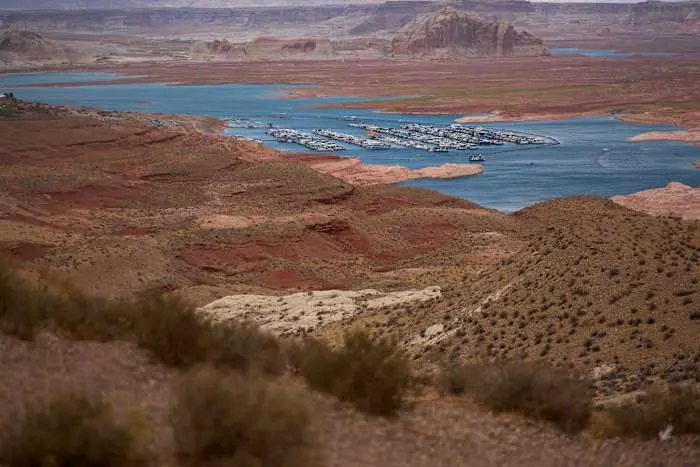
The unfolding environmental and infrastructural crisis along the American Southwest’s lifelines reached a grim new milestone on Saturday, as the water level at Lake Powell—the nation’s second-largest reservoir—plummeted to a record low. Situated within the breathtaking expanse of the Glen Canyon National Recreation Area near Page, Arizona, Lake Powell’s latest drop shatters a previous low set in April 2023, underscoring the relentless intensification of the Colorado River basin crisis.
This historic low at Lake Powell follows closely on the heels of a similar catastrophic milestone reached just a week prior by Lake Mead, the river system’s primary storage vessel. Together, these two mega-reservoirs are hovering at depths not witnessed in nearly seven decades, matching storage volumes last recorded in May 1957, when the Glen Canyon Dam was still under active construction.
The consequences of this steady, climate-driven depletion extend far beyond the striking, mineral-stained "bathtub rings" now starkly visible on the surrounding red-rock canyon walls. More than 40 million people across seven U.S. states—California, Arizona, Nevada, New Mexico, Utah, Wyoming, and Colorado—depend on the Colorado River for municipal drinking water, agricultural irrigation, and economic survival. Furthermore, the plunging water levels threaten critical regional ecosystems, delicate wildlife habitats, and the generation of essential hydroelectric power that lights and powers millions of homes across the West.
As federal regulators and state stakeholders grapple with these shrinking liquid assets, negotiations over a long-term, post-2026 operating agreement remain fractious and deadlocked. Persistent over-allocation of the river, compounded by a record-dry winter, rising ambient temperatures, and decades of structural overuse, have driven the basin to a dangerous precipice. With Lake Powell now careening toward "dead pool" status—the point at which water can no longer flow through the dam’s hydroelectric turbines—federal authorities are staring down the barrel of an unprecedented operational and humanitarian catastrophe.
Detailed Chronology of the Decline
To fully understand the gravity of the current situation at Lake Powell, one must trace the convergence of acute meteorological distress and historical water management practices over the past several years.
The Decades-Long Buildup
The roots of the Colorado River crisis were planted nearly a century ago during the drafting of the 1922 Colorado River Compact, which drastically overestimated the average annual flow of the river. For generations, basin states allocated more water rights than the river could reliably yield. As the American West urbanized and agricultural demands expanded, cushion reserves in Lake Powell and Lake Mead began a slow, steady descent.
By the early 2000s, the onset of a megadrought—the worst the region has seen in at least 1,200 years—accelerated this depletion. Natural snowpack accumulation in the Rocky Mountains, which serves as the primary hydrological engine for the Colorado River, became increasingly erratic. Warm atmospheric temperatures began melting snow earlier in the spring, while parched soils absorbed much of the runoff before it ever reached tributaries.
The 2023 Benchmark and 2026 Freefall
In April 2023, Lake Powell hit what was then considered an alarming low, forcing emergency federal interventions and localized water-saving cutbacks. However, relief proved short-lived. Following a record-dry winter marked by severely depressed snowpack levels and an exceptionally warm spring and early summer, the reservoir’s decline accelerated.
According to telemetry data compiled by the U.S. Bureau of Reclamation (USBR), Lake Powell’s elevation dropped to 3,519.91 feet (1,072.9 meters) above sea level on Saturday. This figure edges out the previous historic low and represents a staggering drop of more than 20 feet (6.10 meters) since the beginning of the year alone.
This dramatic fall mirrors the trajectory of Lake Mead, which similarly breached its own historical floor just one week prior. Academic researchers and retired water officials note that the combined storage capacity of Powell and Mead has not been this low since May 1957, an era when the monumental Glen Canyon Dam was still rising out of the canyon floor, years before Lake Powell ever began its initial fill in 1963.
Supporting Context & Metrics: By the Numbers
The metrics defining the Lake Powell crisis paint a chilling picture of a hydrological system stretched to its absolute breaking point.
- Elevation Status: 3,519.91 feet above sea level (recorded Saturday), dipping slightly beneath the previous low-water mark established in April 2023.
- Annual Velocity of Loss: The reservoir has lost more than 20 feet of vertical water height since January, illustrating a compounding rate of depletion.
- The Power Generation Threshold: Lake Powell is now precariously sitting just 30 feet (9.1 meters) above "minimum power pool"—the critical elevation at which water levels drop too low for the dam’s internal turbines to generate hydroelectricity.
- Population at Risk: More than 40 million residents across seven U.S. states rely on the Colorado River Basin for municipal supplies.
- Historical Timeline: Combined water storage in lakes Powell and Mead matches levels last observed in May 1957, during the construction phase of Glen Canyon Dam.
The Threat of "Dead Pool" and Hydro-Grid Instability
Perhaps the most immediate engineering and economic nightmare facing federal operators is the approach of minimum power pool. If Lake Powell’s surface elevation drops another 30 feet, the Glen Canyon Dam will effectively cease electricity generation.
This facility produces renewable hydropower for utilities serving millions of customers across Arizona, Utah, Colorado, New Mexico, Wyoming, Nevada, and Nebraska. Losing this power source would not only destabilize regional electrical grids already strained by extreme summer heat waves, but it would also force municipal utilities to scramble for replacement power, driving up utility bills for consumers and increasing carbon emissions.
Below minimum power pool lies "dead pool"—the absolute threshold where water can no longer flow through the dam by gravity, effectively cutting off downstream water deliveries to the Lower Basin states (Arizona, California, and Nevada) and threatening the ecological survival of native aquatic species in the Grand Canyon.
Official Statements and Policy Interventions
The federal government, through the Department of the Interior and the USBR, has increasingly sounded the alarm, warning that voluntary conservation measures alone will no longer suffice to stabilize the river basin.
Federal Warnings and Proposed Intervention
In April, federal officials issued stark warnings that "major interventions" would be legally and logistically mandatory to prevent Lake Powell from breaching the minimum power pool threshold before the end of the year. These warnings materialized in July, when the USBR unveiled a sweeping 10-year framework outlining aggressive, mandatory water allocations.
The proposal mandates deep, unprecedented water cuts distributed primarily among the Lower Basin states of Arizona, California, and Nevada—jurisdictions that have historically held senior water rights under the Law of the River. These states have spent months locked in tense, high-stakes negotiations with Upper Basin states (Colorado, Wyoming, Utah, and New Mexico) over how the burden of conservation should be shared.
While Upper Basin states argue they use significantly less water and are already subjected to natural reductions based on inflow, Lower Basin representatives contend that sweeping cuts to agricultural hubs in Arizona and California will devastate regional food supplies and local economies.
Local Adaptation: The Toll on Tourism and Recreation
While policymakers argue in legislative chambers and conference rooms, the human and economic toll of the receding water is vividly apparent on the ground. The Wahweap Marina and other recreational hubs along Lake Powell have been forced into a continuous cycle of logistical adaptation.
Marina operators have had to repeatedly extend, relocate, or entirely abandon concrete boat ramps as the shoreline retreats hundreds of yards from its former boundaries. Entire marina infrastructures have been temporarily disassembled and towed into deeper waters to maintain basic access for houseboaters, anglers, and tourists. This multi-billion-dollar tourism engine, which sustains the economies of surrounding gateway communities like Page, Arizona, faces an uncertain future as access points become increasingly scarce and unpredictable.
Future Outlook: Navigating an Uncertain Horizon
As the American West looks toward the remainder of the decade, the crisis at Lake Powell serves as an unmistakable warning flare regarding the long-term viability of water management in an era of rapid climate disruption.
The ongoing friction between state and federal entities highlights the profound difficulty of managing a shared resource under conditions of chronic scarcity. With existing operating guidelines set to expire in 2026, negotiators are under intense pressure to forge a durable, post-2026 operational framework. This new blueprint must balance the harsh reality of diminished inflows with the unyielding demands of modern municipal growth, tribal water rights, and agricultural production.
Experts emphasize that technological fixes—such as desalinization plants, large-scale water recycling, and advanced agricultural drip irrigation—will be vital components of the region’s adaptation strategy. However, none of these solutions can substitute for the hard truth facing water managers: the Colorado River of the 21st century is a fundamentally smaller river than the one envisioned by the architects of the 20th-century water infrastructure.
Unless unprecedented conservation thresholds are codified and strictly enforced, reservoirs like Lake Powell risk becoming permanent monuments to an unsustainable era of resource management. For the 40 million Americans whose lives and livelihoods depend on the sustained flow of the Colorado River, the race against the dropping water line is a race against time.

0 Comments