

Executive Overview
COLUMBIA, S.C. — South Carolina voters head to the polls once again in a high-stakes special Republican primary runoff to determine who will secure the GOP nomination for the U.S. Senate seat left vacant by the sudden and tragic July passing of longtime senator Lindsey Graham. The electoral battle pits interim U.S. Senator Darline Graham—a political newcomer and the late senator’s sister—against seasoned U.S. Representative Ralph Norman.
The two-week runoff sprint following the crowded August 11 primary has devolved into an intense political slugfest. Darline Graham, whose political identity was virtually unknown to the electorate prior to her interim appointment, has heavily relied on the immense political capital and direct intervention of President Donald Trump. On the other side, Norman—a hard-line conservative who has spent the better part of two decades in state and federal public service—is anchoring his campaign on deep-seated legislative experience, institutional familiarity, and a robust, self-funded mobilization machine.
Beyond a local party contest, this election has transformed into a nationalized referendum. It tests whether President Trump’s personal endorsement and a late-stage, six-figure super PAC financial infusion can propel a political novice across the finish line. Simultaneously, it measures the statewide appetite for Norman’s unapologetic, hard-line brand of conservatism just months after his unsuccessful gubernatorial bid. With the winner facing Democratic physician Dr. Annie Andrews in November, the Republican primary serves as the definitive battleground for the political future of South Carolina’s representation in Washington.
Detailed Chronology: From Tragic Vacancy to a Fiery Runoff
The political landscape of South Carolina shifted dramatically on July 11, when the state and the nation learned of the sudden death of Senator Lindsey Graham. As tributes poured in from across the political spectrum, state leadership faced the immediate procedural challenge of filling the vacant Senate seat while adhering to state election laws governing unexpired terms.
The Interim Appointment and the Trump Blessing
Shortly after her brother’s passing, state officials appointed Darline Graham as the interim U.S. Senator to maintain continuity of governance in Washington. While interim appointments are typically viewed as administrative placeholders, President Trump quickly signaled a desire to shape the legacy of his late ally. Trump hailed the selection of Darline Graham as "a fabulous tribute" to her brother and moved swiftly to endorse her candidacy for the permanent seat before she had even formally launched her campaign.
[July 11, 2026] ──> Passing of Sen. Lindsey Graham
       │
[Mid-July]     ──> Appointment of Darline Graham as Interim Senator
       │
[August 11]    ──> Primary Election: Darline Graham & Ralph Norman advance
       │
[August 18]    ──> Single Runoff Debate in Newberry, S.C. (Foreign Policy Stumble)
       │
[August 21]    ──> Joint Rally in Myrtle Beach with President Trump
       │
[August 24]    ──> MAGA Inc. injects $830,000 for voter mobilization
       │
[Today]        ──> Special GOP Primary Runoff Election Day
The August 11 Primary and the SPRINT Runoff
When primary voters went to the polls on August 11, a crowded field of hopefuls narrowed down to the top two vote-getters: Darline Graham and Ralph Norman. Because neither candidate secured an outright majority, a compressed two-week runoff window was triggered, culminating in today’s election.
The short campaign window heightened the intensity. Graham spent much of the early days of the race constrained by her legislative duties in Washington, relying on video messages to remind voters that she was actively working on Capitol Hill. Meanwhile, Norman traversed the state, holding town halls, leveraging his network of conservative kingmakers, and challenging the managed nature of his opponent’s campaign.
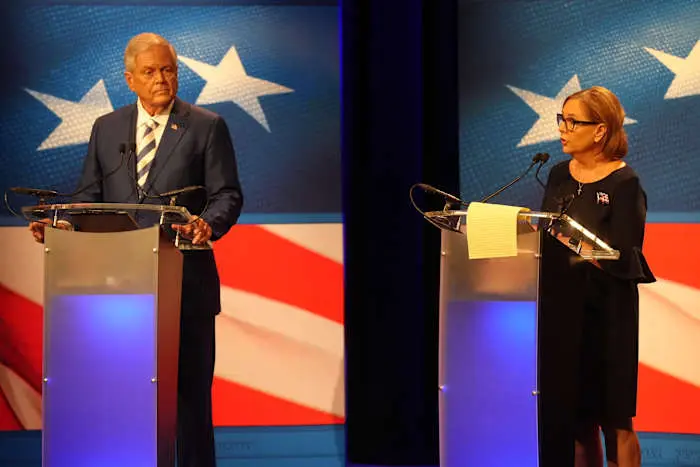
The clash reached a fever pitch during their sole face-to-face debate in Newberry, South Carolina, on August 18. During the hour-long debate moderated by regional journalists, a foreign policy question regarding Taiwan and national security exposed a significant vulnerability in Graham’s platform. When pressed on whether the U.S. has a vital national security interest in the South China Sea, Graham struggled before candidly admitting, "National security is not my thing" and "I’m not that informed on national security."
Norman seized upon the moment, sharply contrasting his extensive legislative background against what he framed as a glaring lack of qualifications on his opponent’s part. Nevertheless, Graham’s campaign pivoted quickly, returning the focus to domestic kitchen-table issues, economic affordability, and her alignment with the Trump administration’s legislative priorities.
Supporting Context & Metrics
The financial and demographic metrics surrounding this special election underscore its unprecedented nature in modern South Carolina political history.
- Financial Infusion: On the eve of the election, MAGA Inc.—the premier super PAC aligned with President Trump—poured nearly $830,000 into Darline Graham’s campaign chest. This capital was immediately deployed for targeted voter outreach, automated phone banks, and high-volume text message blasts across the Palmetto State.
- Self-Funding: Ralph Norman countered institutional super PAC spending by digging deep into his own pockets. As a wealthy former real estate developer, Norman injected over $1 million of his personal fortune into the final week of the campaign to sustain television ad buys and grassroots mobilization.
- Historical Margins: In the 2020 general election, the late Lindsey Graham defeated his Democratic challenger by a comfortable 10-percentage-point margin, though it ranked as one of the most expensive Senate contests in American history.
- The Democratic Nominee: Dr. Annie Andrews, a Charleston-based pediatrician, secured the Democratic nomination uncontested back in June. Having initially structured her entire campaign around unseating Lindsey Graham, Andrews has been forced to rapidly recalibrate her strategy to take on whichever conservative emerges victorious from today’s primary.
Official Statements and Campaign Rhetoric
The ideological battle lines drawn by both campaigns reflect broader tensions within the contemporary Republican Party: the pull of executive alignment versus independent legislative pedigree.
Darline Graham and the Trump Coalition
Darline Graham’s campaign has centered tightly on her commitment to advancing President Trump’s second-term agenda. Rallying supporters alongside the President at the Myrtle Beach Convention Center, Graham emphasized her dedication to preserving tax cuts, securing the border, and enacting conservative judicial appointments.
"I want it to happen. Good luck, Darline," President Donald Trump told a cheering crowd of several thousand attendees at the Myrtle Beach rally, cementing his direct investment in her political ascent.
Voters responding to the Trump endorsement have echoed the sentiment. Robert Tropiano, a local voter who cast his ballot early near the rally site, noted:
"Trump wants her, he’s doing a great job, and I believe we should give him what he wants."
Ralph Norman and Legislative Pragmatism
Conversely, Representative Ralph Norman has campaigned heavily on his deep familiarity with the inner workings of Washington. Having served in the South Carolina General Assembly and multiple terms in the U.S. House of Representatives—coupled with an intense run for governor earlier in the cycle—Norman has positioned himself as the battle-tested conservative ready on day one.
In an exclusive interview with The Associated Press, Norman criticized the orchestration behind his opponent’s candidacy:
"The Washington elite and special interests are dictating the terms and giving her the political answers… voters deserve someone who has lived and breathed conservative legislation, not someone learning on the job."
Norman’s platform has garnered high-profile endorsements from fiscal and social conservative leaders, including Senators Rick Scott of Florida and Mike Lee of Utah, former Senator Jim DeMint, and Turning Point Action.
Future Outlook and General Election Implications
As polls close across South Carolina, the outcome of this Republican runoff will reverberate far beyond the borders of the Palmetto State.
- Senate Power Dynamics: If Darline Graham wins, President Trump secures another reliable, tightly aligned vote in the upper chamber, reinforcing his influence over the Senate Republican caucus. If Ralph Norman prevails, the Senate gains an outspoken, uncompromising fiscal hawk known for challenging leadership orthodoxy.
- The General Election Landscape: No Democrat has captured a U.S. Senate seat in South Carolina in decades. However, Dr. Annie Andrews and the state Democratic apparatus are closely monitoring the bitter divisions sown during this compressed primary. Should the Republican base experience lingering fatigue or fractures following today’s intense runoff, Democrats hope to capitalize on voter alienation.
- The Trump Kingmaker Test: Nationally, political analysts are watching to see if a late-stage presidential endorsement, bolstered by significant super PAC funding, can single-handedly manufacture a viable candidate out of a political newcomer.
Regardless of tonight’s results, South Carolina has once again cemented its status as an indispensable crucible for the future direction of the American conservative movement.

0 Comments